

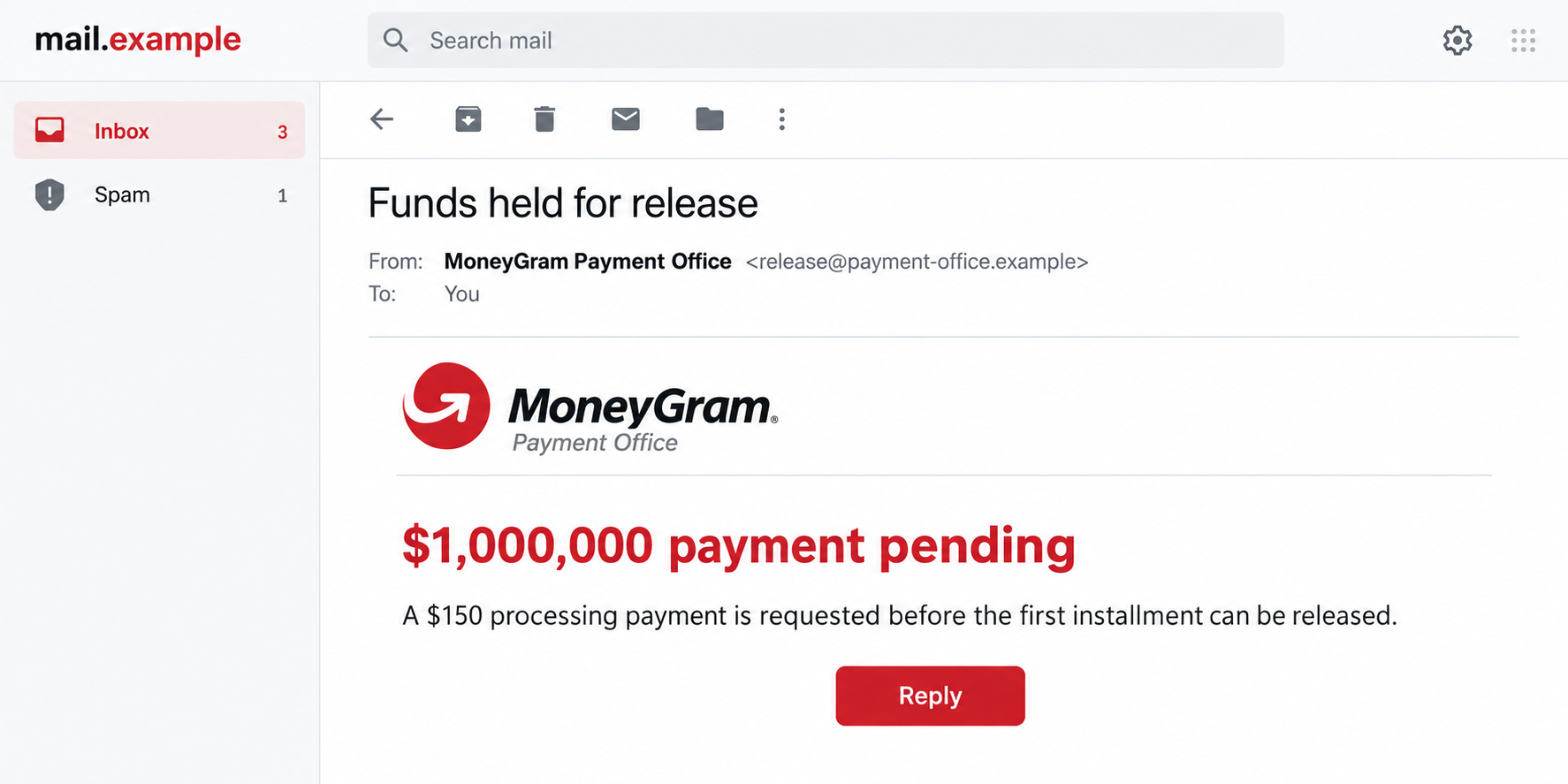
An email says a MoneyGram office found a payment waiting for you. There is a manager, an explanation for the delay, and a plan to release it.
It sounds like unfinished paperwork rather than an unexpected offer. Before replying, look at the condition attached to receiving that money.
Overview
A supposed remittance office invents a waiting payment
The MoneyGram payment email scam impersonates a money-transfer office and claims a large payment is already held for the recipient. An upfront charge supposedly unlocks it.
One version promises $1 million while requesting $150 before payments begin. The sender’s authority and the held funds are claims, not independently confirmed transfer records.
MoneyGram is a legitimate transfer service. That does not make a stranger using its name a real employee, authorized agent, or source of a windfall.
The trick changes the question from whether the payment exists to how quickly you can complete its release. That is exactly where the fee demand becomes effective.
The small fee is made to feel easier than losing the payout
A comparatively small charge can seem manageable next to an enormous promised balance. The message may add daily installments, personal assistance, or a deadline.
Those details explain the proposed transaction without verifying it. A convincing payment schedule is still only a schedule written by the sender.
Common warning signs in this approach include:
- An unexpected payment with no known sender or verified reason.
- A supposed manager requesting a separate release payment.
- A promise to help fund part of the charge personally.
- Pressure to act before funds are forfeited or transferred elsewhere.
- Requests to email personal information to an unverified office.
- New fees whenever the next promised installment should arrive.
The real service warns against paying to receive money
MoneyGram’s fraud guidance warns against sending money to receive money and explains how to report suspicious transfers.
This warning concerns the stranger’s advance-fee demand. It does not mean every legitimate transfer worldwide has identical pricing, receiving methods, or identification requirements.
Verify any genuine expected transfer through MoneyGram independently. Do not pay the claimed manager, follow their tracking link, or send identification merely to test the story.
What Makes This More Than a Strange Payment Notice?
The email lacks the relationship that would explain a real payment. You have not identified a trusted sender who actually arranged a transfer for you.
Instead, the contact supplies a large balance and asks you to accept its administrative story. The fee is presented as the final obstacle to money already yours.
That reverses the order of sensible verification. Establish the payer, payment purpose, and actual transfer first, not after paying someone who claims to control it.
An official-looking job title does not fill the gap. Neither does a signature naming a director, remittance department, foreign office, or recently appointed manager.
A free-mail address is another warning in a supposed corporate-payment request. But changing the address to something more professional would not make the advance-fee story trustworthy.
The central problem is the unverified windfall tied to an outgoing payment. A better logo or more polished grammar cannot change that condition.
How the MoneyGram Payment Email Scam Works
Step 1: A manager claims to discover a dormant fund
The sender presents a reason the payment was overlooked. In the $1 million version, a supposed new manager finds it while reviewing an office’s files.
The administrative explanation makes the contact feel like a correction of an old mistake. It can soften the obvious question of why a stranger is offering money.
Do not treat an internal-file claim as a transfer confirmation. The sender has not shown that the actual service recognizes your entitlement or holds those funds.
Ask yourself who should have sent the payment and why. If the answer comes only from this email, the claimed payer has not been independently established.
Step 2: Installments make the large balance sound practical
The same version describes $3,000 payments and a possible $9,000 daily total. Smaller installments make the extraordinary sum sound like a manageable processing arrangement.
A recipient may begin thinking about the first payment rather than questioning the total. That first installment becomes the emotional reward for finishing the requested task.
A schedule is not proof that a transfer has been funded. The actual receiving method and status must come from the service, not the claimant’s explanation.
Do not plan spending around a balance shown in an email, attachment, or later dashboard. Confirm that funds truly exist and are legitimately available to you.
Step 3: An upfront charge is paired with a helpful offer
The proposed $150 charge is framed as necessary before release. The sender may also claim they can contribute personally, reducing the apparent burden on the recipient.
That helpfulness creates another pressure point. You may feel you should cooperate because someone supposedly already took a risk or spent money for you.
But a promise of partial assistance does not validate the debt or payout. The person asking for your payment still controls the unverified story.
The demand can be described as processing, activation, clearance, tax, or another fee. The label should not distract from paying a stranger for an unexpected windfall.
Step 4: Personal details and payment instructions are requested
The sender asks for receiver information and directs the outgoing payment. Details may include contact information or documents, depending on the version.
Those disclosures can support follow-up approaches even before money moves. A more personalized message later may simply reuse information you supplied during this conversation.
MoneyGram’s unsolicited-email guidance says not to provide personal or financial information in response to such requests.
Do not email a document because the manager promises to register the transfer afterward. Legitimate identification requirements should be handled through independently verified service channels.
Step 5: The payout stays ahead of the next obstacle
After a payment, another administrative problem may appear. A new certificate, processing step, or payment correction becomes the explanation for why the installment has not arrived.
That is a possible continuation of advance-fee fraud, not a verified history for every recipient. The important response is stopping additional payments when the promised funds remain unconfirmed.
A deadline can make the next charge feel urgent. A threat that the balance will go elsewhere does not prove the office controls any real balance.
Later recovery offers may promise to retrieve the earlier payment for another fee. Do not let the desire to recover money restart the same unverified relationship.
What a Genuine MoneyGram Transfer Looks Like
There is a real sender and a service record
A legitimate transfer begins with someone actually sending funds through the service. If you expect money from a known person, confirm the arrangement with them independently.
Do not use contact information inserted by the suspicious email for that check. The person confirming the story should not be another contact chosen by its author.
MoneyGram’s U.S. receiving guide describes cash pickup using valid photo identification and an eight-digit reference number from the sender.
Other receiving routes and country requirements can differ. Use the instructions for your actual location and transfer rather than applying one example worldwide.
A reference number does not establish a prize or debt
A number typed into an email can be fabricated, incomplete, or unrelated. Even a genuine service reference would not explain why a stranger owes you a windfall.
Use a tracking route you reach through the real MoneyGram site. Do not trust a status screenshot or a tracking page supplied by the supposed payment office.
Keep transfer information private. Sharing reference details widely can expose information connected with a real transaction, even when you only intend to warn other people.
Receiving identification is different from an emailed release payment
A verified agent may need identification for a legitimate cash pickup. That does not make every request for an ID copy fraudulent.
The relevant distinction is who receives it and through what verified process. An unexpected manager asking for documents and a separate advance payment is a different situation.
If you are uncertain about an actual expected transfer, contact the service independently. You should not need to fund the email’s story before asking whether it exists.
Check the Outgoing Payment, Not the Promised Balance
Identify where your money actually went
If you paid, find the receipt or account record for that payment. Note the real recipient, destination, reference, amount, currency, and time.
The email may use MoneyGram branding even when it directs payment through another method. Contact the provider that handled your outgoing money, not just the named brand.
If MoneyGram handled it, tell the genuine service that the transfer was induced by a false payment-release claim. Ask about its current status immediately.
A pending payment may offer different options from a collected one
MoneyGram’s fraud guidance provides an urgent cancellation route for suspected fraudulent transfers that have not been received. Do not wait for the promised installment.
Once collected or completed, recovery may be harder. Report the facts anyway and ask what options exist rather than accepting an unsolicited helper’s guarantee.
The FTC’s money-wiring guidance explains why advance-fee offers and fast collection create substantial risk.
Another payment is not a recovery plan
A demand to correct the recipient name, buy a certificate, or pay an investigator needs its own independent verification. It should not inherit credibility from earlier promises.
Work from the payment you actually made, not the claimed $1 million balance. Your receipt and the provider’s records tell you what can be investigated.
What to Do if You Have Fallen Victim to This Scam
-
Stop the conversation and any further release payments.
Do not send another fee to preserve the alleged fund. Save the communications first, then block the suspicious contact through your mail or messaging service.
If you are worried about losing the promised balance, discuss the message with someone you trust. A deadline from the claimant is not independent transfer evidence.
-
Contact the actual outgoing-payment provider urgently.
If MoneyGram handled the transfer, its U.S. fraud page lists 1-800-933-3278 for suspected fraud before receipt. Elsewhere, use the official local contact route.
Ask whether the payment can be stopped, canceled, recalled, or otherwise reviewed. Timing and payment status matter; a refund is not guaranteed.
-
Provide the real receipt details, not the supposed prize file.
Give the transfer reference, destination, recipient, time, and amount. Explain that you were told an advance payment would unlock unexpected funds.
Keep the provider’s case number and instructions. Do not publish a complete transfer receipt or send it to another unverified recovery contact.
-
Report the use of MoneyGram’s identity.
The official MoneyGram contact form includes a Report fraud option. Preserve the original email so useful sender and message details remain available.
Reporting the email does not replace urgent action on a pending transfer. Make sure the provider handling the money also receives your payment-specific report.
-
Assess the personal information you disclosed.
List any identity documents, account credentials, or financial details sent. Contact the relevant bank or document issuer for advice appropriate to that disclosure.
If a password was given, replace it through the real account. Sending a name or contact address alone should not be described as confirmed account takeover.
-
Notify a bank or card issuer about related exposure.
If the scam also collected card details or banking access, explain that separately. Review actual account activity and ask about necessary restrictions or replacements.
Retain payment statements and dispute references. Do not approve a new transaction because a caller claims it is needed to refund the earlier one.
-
Make an appropriate fraud or identity report.
U.S. readers can use ReportFraud.ftc.gov; elsewhere, use the relevant local authority. Include the message, payment destination, and documented loss rather than the invented payout.
Keep sensitive attachments out of public comments. Provide identification or complete records only through a verified reporting channel when requested.
-
Expect recovery claims and reject another upfront charge.
The FTC warns about refund and recovery impostors. They may know details of your loss without having any ability to return it.
Continue through the payment provider’s existing case. A familiar story, impressive title, or promise of recovered funds does not justify paying a new stranger.
Frequently Asked Questions
Is MoneyGram itself the scam?
No. This guide concerns impersonating payment emails and advance-fee demands. MoneyGram is a legitimate service whose name can be misused by unrelated people.
Why would a manager offer to pay part of the fee?
The offer makes cooperation feel easier and more personal. It does not verify the held funds, employee identity, or recipient’s entitlement to a payout.
Does a transfer reference prove the money is waiting?
Not by itself. Verify an actual expected transfer through the real service and known sender. A reference does not establish an unexpected windfall or justify a separate fee.
Is every identification request for cash pickup fraudulent?
No. Legitimate receiving procedures can require identification. Use verified agents and official instructions, not a document request from an unexpected payment-office email.
Can a payment still be canceled after sending it?
Sometimes, depending on status and method. Contact the actual provider immediately, especially before collection. Do not assume cancellation or reimbursement is available after completion.
Should I install security software just because this email arrived?
Receiving this advance-fee message does not establish a device infection. Focus on any money or information supplied; investigate software only if a separate exposure occurred.
The Bottom Line
Do not pay a stranger to release an unexpected MoneyGram payment. The $150 request makes your real money the condition for a fund the email has not verified.
If you already sent funds, contact the actual payment provider immediately with the receipt details. Stop additional fees and use verified reporting channels, not unsolicited recovery helpers.








