

A friend sends what looks like an easy supermarket freebie. There is a voucher, a familiar green logo, and a link they thought you might appreciate.
An ASDA giveaway scam can feel more like a favor than an advertisement. Before joining in, look at what happens between the friendly message and the promised gift.
Overview
The promotion uses a real supermarket’s name without its authority
The warning concerns fake offers impersonating Asda, not the supermarket’s genuine vouchers or rewards. Criminals borrow a recognizable retailer to make an unfamiliar link seem worth opening.
Asda’s own prize-message warning describes unrelated voucher giveaways, prize draws, and messages seeking personal or financial information.
That provides a clear reason to verify the promotion independently. A message claiming to give you a gift is not itself evidence that Asda issued it.
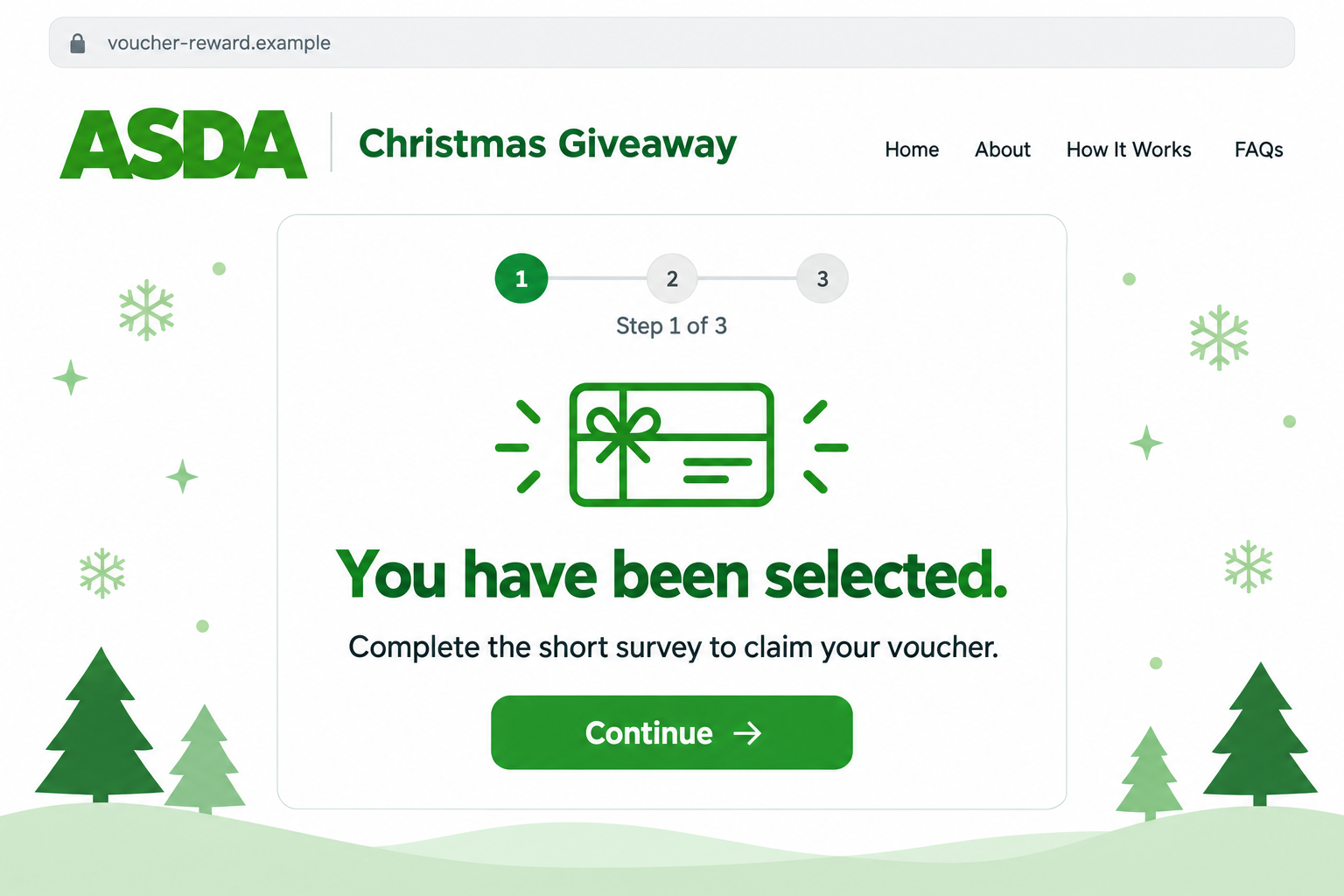
The Christmas-themed illustration is fictional. It demonstrates the style of the lure, not an authenticated seasonal campaign, a current prize amount, or a live claim page.
The gift can be a pretext for collecting information
A questionnaire may begin with ordinary shopping questions, then request contact details or information that has little to do with receiving a voucher.
Other versions can add sharing requests, additional offers, or a supposed payment step. Do not assume every fake promotion uses the same sequence.
Who is collecting your details: the retailer, or someone borrowing its name? A polished page can make that question easy to overlook.
If the form asks for banking details or account secrets, stop before submitting. A claimed reward does not explain why an unverified page needs those details.
Check the offer before checking your eligibility
The page may encourage you to focus on whether you qualify. First establish whether there is a genuine promotion to qualify for.
Look for these details through the retailer’s own channels:
- The actual promotion name and who is running it.
- Terms explaining eligibility, closing dates, and how the reward is provided.
- A destination connected to the real retailer, not a lookalike address.
- A clear distinction between entering, buying something, and agreeing to marketing.
- A way to ask the real retailer about an uncertain message.
If you cannot find the offer independently, do not complete the mystery form while waiting for proof. You can leave the page without losing a verified entitlement.
A Real Voucher and a Fake Giveaway Are Different Things
Genuine rewards exist, so the brand name alone proves little
Asda has real promotions and eVouchers. Their existence makes the impersonation believable, but does not validate every message using the same name.
A genuine voucher has applicable conditions. It may belong to a particular account, purchase, campaign, or period rather than being available to everyone receiving a forwarded link.
Check the offer where it is actually issued or managed. Do not enter your genuine shopping-account password into a page just because it resembles the retailer’s colors.
The actual web address matters more than the wording on the button
Asda’s warning points shoppers toward official websites such as asda.com and george.com. It also highlights deceptive characters that can make another address look familiar.
Read the domain carefully. A retailer’s name inside a longer address can be decoration rather than proof that the retailer controls the page.
A shortened link hides some of that information until it is opened. Shortening is not automatically fraudulent, but it should not be treated as a trust signal.
You do not need to expand a suspicious link by visiting it. Open the known retailer website or app separately and look for the promotion there.
A friend’s good intentions do not authenticate the promotion
Your friend may have shared the message because the page requested it, not because they received a voucher. Ask what they actually completed and received.
A screenshot saying Congratulations is different from a genuine reward accepted through the retailer’s own process. A success screen can be part of the same unverified page.
If someone you trust forwarded it, explain the concern without blaming them. The scam benefits when people pass along a promise before testing its source.
How the ASDA Giveaway Scam Works
Step 1: A simple gift arrives through a familiar channel
The message may reach you through a chat, social post, text, or email. A supermarket voucher fits an everyday need, so the promise feels immediately useful.
A seasonal theme can make the timing feel natural. The invitation to join may sound friendly rather than urgent or threatening.
That softer approach still deserves scrutiny. The sender’s enthusiasm does not tell you who owns the page collecting your information.
Before continuing, ask whether you know the original source or only the latest person who forwarded it. Those are not the same thing.
Step 2: Branding and a short questionnaire lower resistance
The landing page may use green styling, a retailer name, a voucher graphic, or a simple survey. Familiar presentation helps the request feel ordinary.
Early questions can be easy to answer, such as whether you shop at the store. Completing them creates momentum before the more consequential request appears.
A progress indicator encourages you to finish. It shows where you are in the page’s script, not whether a real reward is waiting.
Pause when the requested information changes. An innocuous first question does not make later account or payment fields safe.
If the promotion cannot be found through the real retailer, do not use the questionnaire itself as evidence. It is the object you are trying to verify.
Step 3: Sharing can make the message look independently endorsed
Some giveaway pages ask participants to send the offer to friends or groups before proceeding. That can turn each hopeful participant into another distributor.
A recipient sees the friend’s name, not the unknown operator behind the link. Several forwards can then look like widespread confirmation of the offer.
But repeated circulation is not evidence that anyone received a legitimate voucher. The same unverified promise may be moving through overlapping groups.
Do not share first and verify afterward. If you already forwarded it, send a correction without including the link again.
Sharing is a possible part of this pattern, not a requirement in every version. A fake promotion can also collect details directly without asking for referrals.
Step 4: Claiming the gift introduces a more valuable request
The supposed claim process may ask for your name, phone number, address, or email. Some versions can introduce payment information or another offer.
Read what you are being asked to authorize. A delivery charge, purchase, marketing signup, and ongoing subscription are different arrangements, even when shown beside the same voucher.
Do not assume that a small charge is harmless, or that every fake giveaway necessarily creates recurring billing. The actual fields and terms determine the exposure.
A request for a banking password, card PIN, or unrelated sign-in code is a reason to stop. The reward story does not justify surrendering those secrets.
If a charge already appears, keep the transaction details. They are more useful for your bank than a claim that the page promised everyone a prize.
Step 5: The gift may stay out of reach while contact continues
You may see another questionnaire, a new condition, or a message saying the reward is almost ready. Completing one screen does not establish a valid voucher.
Follow-up calls or emails can use the information already supplied. An apparently informed contact may simply be continuing the original approach.
Do not pay an extra claim, release, or refund fee to finish the process. Verify any new approach outside the giveaway conversation.
The point to act is when the promotion loses a verifiable connection to the retailer, not after you have satisfied every condition on the page.
What the Promised Voucher Does Not Tell You
Selection is not proof of a real entry or award
A page can display You Have Been Selected to every visitor. That statement does not show how a draw was conducted or who is responsible for fulfillment.
Look for an independently verifiable promotion, rather than trying to infer legitimacy from a favorable result. A surprise win should not bypass basic source checks.
You also do not need to submit identification to prove the warning wrong. Keep sensitive documents away from an unverified claim process.
Permission should be clear before you provide information
Consider who receives your details and for what purpose. A supermarket-style page may not be operated by the supermarket whose name appears most prominently.
Do not treat a checked box or a long policy as evidence that a gift exists. If the operator and purpose are unclear, leave.
If you joined an actual paid offer, keep its terms and cancellation details. Address that transaction directly rather than assuming blocking the original text cancels it.
What to Do if You Have Fallen Victim to This Scam
-
Stop the claim process and further sharing. Do not complete another survey or make an additional payment to prove you qualify. Save the message and page address.
Record which details you supplied and whether you approved a purchase, entered a password, downloaded anything, or allowed browser notifications. Different exposures need different actions.
If you only received the message, reporting and removing it may be sufficient. You do not need to buy protection simply because someone sent you a voucher claim.
-
Warn anyone you sent it to. Use the same group or a known direct contact route to explain that the giveaway was not verified.
Ask people not to open it or pass it on. Avoid quoting the active link, since your correction should not create another opportunity to click.
Be straightforward about what you know. You can warn that the offer is suspicious without claiming every recipient has already lost money or had an account taken over.
-
Contact your bank if financial information was entered. Use the bank’s genuine app or a number from your card. Describe both the details disclosed and any payment.
Ask about blocking further misuse, replacing a card where appropriate, and investigating a charge. Give the actual transaction amount and merchant description from your own records.
Keep the reference and follow the bank’s instructions promptly. Neither the page’s small payment label nor a fraud report guarantees reimbursement.
-
Protect any password or code you shared. Open the affected service independently and change an exposed password. Replace it on other accounts if it was reused.
If a verification code was supplied, identify the service and action in the genuine code message. Protect that account rather than accepting the giveaway’s explanation.
Review unfamiliar sessions and recovery details using the provider’s controls. A new password is important, but it should not replace checking how access was obtained.
-
Review an actual signup or charge on its own terms. If you agreed to a separate paid offer, locate the receipt, operator, cancellation method, and stated billing conditions.
Request cancellation through a verified channel and retain confirmation. Tell the bank about disputed or misleading charges instead of assuming deleting the message stops future billing.
Do not enter more card details into the original claim page to cancel. A cancellation request should not become another unverified payment instruction.
-
Remove risky permissions or software when applicable. Revoke notification access for an unfamiliar site through browser settings, not by following an unsubscribe button inside its alert.
If you installed something from the giveaway, use trusted assistance and consider a Malwarebytes scan. A scan addresses software, not a leaked card number or an unwanted contract.
AdGuard can reduce malicious advertising and redirects. It cannot validate a supermarket promotion, cancel an offer, or recover money already transferred.
-
Report the message through the appropriate UK route. The NCSC explains how to report a suspicious text to 7726.
Its email reporting guidance covers suspicious messages and distinguishes reporting phishing from reporting a crime. Check the official instructions rather than using the sender’s contact details.
For fraud in England, Wales, or Northern Ireland, use Report Fraud. In Scotland, the official route is Police Scotland on 101.
-
Verify future offers without returning to the lure. Use your existing retailer app or type the known website yourself. Look for the promotion and its conditions there.
Be alert to later messages referencing the voucher, a refund, or information you submitted. Familiar details do not make a new contact genuine.
If someone offers to recover a charge for another advance fee, decline. Continue with your bank and genuine reporting references instead.
Frequently Asked Questions
Does Asda really issue vouchers?
Yes. Genuine eVouchers and rewards exist. That does not authenticate an unrelated giveaway link or a forwarded promise of a free gift.
Is a giveaway safe because a friend sent it?
No. They may have forwarded it before checking the source or receiving anything. Ask what they actually verified, then check independently.
Does completing the survey prove I won?
No. A success screen is part of the page’s presentation. Confirm the promotion through the real retailer before providing sensitive information.
Are shortened links always fraudulent?
No. They can be used legitimately, but they hide destination details. An unfamiliar short link should not replace checking the genuine promotion.
What if I supplied a phone number but no payment information?
Watch for tailored follow-up messages and calls. A phone number alone does not prove a bank account was accessed, but avoid supplying more details.
Can reporting the text automatically refund a charge?
No. Reporting helps address the message. Contact the payment provider separately about an actual charge, its circumstances, and available remedy.
The Bottom Line
Don’t follow an unknown voucher link to claim an ASDA giveaway. The retailer warns that impostor prize messages can collect your private and financial information.
If you already responded, stop sharing, protect the information exposed, and contact your bank about payment risk. Check any genuine reward through the retailer itself.

Join the discussion
0 commentsShare your experience or ask a question about this article.
Discussion
Start the conversation
Have a question or something useful to share? Add the first comment.