

A tiny device promises quieter nights without the mask, tubing, and frustration of your usual sleep treatment. For an exhausted household, that sounds worth a look.
SleepEase Pro’s pitch reaches people who want more than less noise. Before trusting it with a breathing condition, separate an appealing promise from the care you need.
Overview
The indexed promotion makes substantial sleep-apnea claims
The SleepEase Pro page at sleepeasepro.us has been indexed with claims of eliminating snoring and sleep apnea through micro-stimulation applied around the throat.
That indexed version promises permanent results, including help for severe apnea, and displays clinical and FDA-related assurances. Such claims require evidence for the exact device.
They are not established simply because electrical stimulation exists as a medical technology. Placement, intended users, treatment schedule, and authorization all matter.
The live storefront currently shows a different page
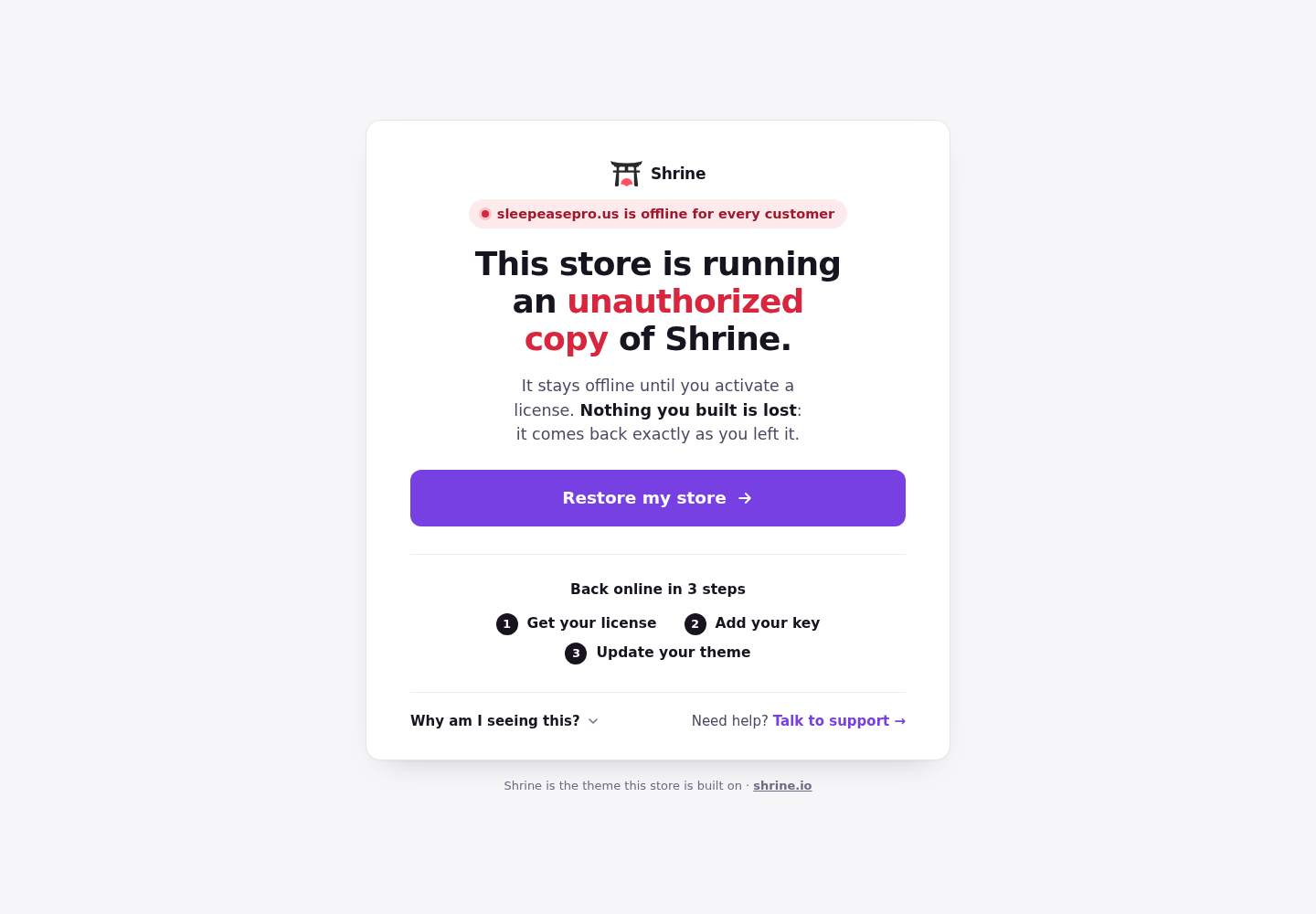
The actual browser visit displayed a Shrine notice saying the store was offline because of an unauthorized theme copy. The product could not be evaluated as an active checkout.
That notice is a statement on the page, not an independent adjudication of a licensing dispute. It also does not prove that orders were stolen or never shipped.
- An indexed sales pitch is not proof that the store can currently take or fulfill an order.
- A sleep-apnea diagnosis cannot be replaced by a snoring testimonial.
- Evidence for another stimulation device does not transfer to this one.
- A refund promise does not make an unverified treatment medically safe.
Do not use this offer to replace prescribed treatment
Do not buy SleepEase Pro as a proven cure for sleep apnea or substitute it for prescribed CPAP on the strength of this promotion.
This review concerns that exact promotional route, not every similarly named mouthpiece or sleep product. It does not establish hidden subscriptions, manufacturing origin, or a proven criminal scheme.
If you already ordered, preserve your receipt and the version of the guarantee you saw. Address the purchase separately from decisions about your breathing treatment.
Snoring Less Is Not the Same as Treating Sleep Apnea
A quieter room can feel like proof that a device works. Your partner may sleep better, and you may understandably want that improvement to settle the question.
But the noise you hear is not a complete measurement of breathing during sleep. A claim about apnea needs more than a change in sound.
The National Heart, Lung, and Blood Institute’s treatment guidance describes care based on assessment, including positive airway pressure and other selected options.
Different people need different approaches. A sales page that treats every case as the same weak-muscle problem leaves out the assessment that makes treatment appropriate.
If your current mask is uncomfortable, that is a genuine problem worth addressing. It is not evidence that an unfamiliar patch is a suitable replacement.
Tell your sleep clinician about leaks, discomfort, dryness, or difficulty tolerating therapy. Those details can guide adjustments or discussion of appropriate alternatives.
Do not make a treatment change because a testimonial says someone else stopped using a machine. You do not know that person’s diagnosis or follow-up results.
How the SleepEase Pro Promotional Route Is Presented
Step 1: Frustration with existing treatment becomes the opening
The indexed sales text contrasts the product with masks, machines, and uncomfortable alternatives. It connects sleep problems with exhaustion and strain on a relationship.
Those concerns are recognizable, which makes the proposed solution feel personal. The reader may already be looking for permission to stop something they dislike.
Advertising can legitimately describe convenience. It crosses into a much more consequential promise when convenience becomes evidence that a device treats a serious breathing disorder.
Keep those questions apart. Would it be easier to wear? Has it been shown to treat your diagnosed condition? One answer cannot stand in for the other.
Even a comfortable product can be unsuitable if it delays effective care. The smaller or simpler appearance of a device does not determine its medical value.
Step 2: A real technology lends credibility to a different product
Muscle stimulation sounds plausible because medical devices use electrical stimulation in carefully defined ways. That broad plausibility can make a specific product’s claims seem settled.
The meaningful comparison must identify the exact equipment. An oral device used while awake is not automatically equivalent to a throat device promoted for nighttime use.
The same applies to the patient group. Research involving mild obstructive apnea cannot simply be stretched into a claim of permanent relief for severe cases.
Ask for the model name, intended use, applicable regulatory record, and finished-device trial. A general explanation of muscles is not a substitute for those details.
If a seller points to another product’s document, compare the instructions and limitations. Similar terminology does not make two devices interchangeable.
Step 3: Testimonials and timelines turn possibility into expectation
The indexed presentation offers early relief and a later endpoint of no longer needing a device. That creates a strong reason to keep waiting for transformation.
Personal stories can explain why someone liked a purchase. They cannot establish whether breathing events improved, whether other treatment continued, or how representative the result was.
A percentage also needs a denominator and method. A customer survey about perceived improvement is not the same as a sleep study measuring respiratory events.
Ask whether a reported result was measured before and after treatment, how the measurement was performed, and who reviewed it.
Without those answers, the percentage may sound precise while answering a different question. Precision in presentation should not be mistaken for precision in clinical evidence.
Step 4: A long guarantee appears to reduce the decision’s risk
The indexed product text offers a 100-night, no-questions refund and says returning the device is unnecessary. A separately indexed refund policy describes additional conditions.
That policy states a minimum of 30 consecutive nights, original packaging, prior authorization, and a returned device. It also uses a different support-domain address.
These versions leave practical questions about which promise governs an order. The current offline notice prevents checking how a live purchase would present them.
Do not interpret a lengthy guarantee as permission to use an unverified treatment until a deadline approaches. A health decision needs a clinical basis immediately.
For an existing order, use the purchase record and saved promise. Ask for clarification promptly rather than waiting for the storefront to become available again.
What Genuine Device Evidence Looks Like
The named device and its authorized use should match
The FDA’s eXciteOSA assessment provides a useful example of specific rather than generic evidence.
It describes a removable tongue-stimulation device intended for adults with snoring or mild obstructive sleep apnea, with use while awake.
The document includes limitations and follow-up requirements. It does not authorize every stimulation product, and it is not a regulatory record for SleepEase Pro.
This comparison is not a recommendation to purchase the other device. It shows why an approval claim must match the actual model and proposed use.
A study needs the outcome you are relying on
If the proposed benefit is fewer breathing interruptions, the evidence should measure that outcome. A report of improved relationships or energy cannot replace the measurement.
Useful details include baseline severity, the number of participants, the comparison treatment, adverse effects, and whether improvement persisted after treatment stopped.
A permanent-cure claim needs evidence covering the claimed permanence. A short observation period cannot answer what happens after years without treatment.
Ask your clinician to interpret any study rather than accepting the sales summary. The exclusions can matter as much as the headline result.
Symptoms and consumer trackers have a limited role
It is useful to tell a clinician that you feel less sleepy or that a partner hears fewer pauses. Those observations can guide follow-up.
They should not independently certify that apnea has resolved. Nor should a reassuring reading from a consumer wearable override a prescribed evaluation plan.
If you are dangerously sleepy, avoid driving and obtain prompt medical advice. Do not wait for an online seller to explain whether the device is working.
The Seller, Contact Details, and Device Identity
The exact model matters more than a familiar product name
Sleep-related products often have similar names. This article addresses the indexed claims and live availability of sleepeasepro.us, not an unrelated dental appliance with overlapping wording.
For a delivered product, record the manufacturer, model, instructions, and any regulatory identifier. Compare those details with the offer you accepted.
A generic device without matching documentation cannot borrow the evidence of another product simply because both are described as anti-snoring technology.
The current storefront does not establish a return destination
The offline page is not a usable explanation of who handles returns or where an existing customer should ship a device.
Do not guess a warehouse address from a parcel label. Dispatch origin may be different from an authorized returns facility.
There is no verified finding here that an address belongs to a fake company or that goods came from China. Those claims would require further records.
Published support addresses are not proof of a response
The indexed product and refund texts use support addresses across different domains, including sleepeasepro.co and sleepeasepro.us. Preserve the address associated with your actual purchase.
A different domain is a reason to verify the relationship before sharing information. It does not prove that the recipient is an impostor.
No customer-support message or phone call was made for this review. An email lookup cannot establish whether a particular refund request will be answered.
Safety instructions must belong to the supplied device
An electrical product needs intelligible instructions, warnings, and a traceable responsible party. A reassuring marketing badge does not replace those materials.
Do not apply an unfamiliar stimulation device using instructions intended for another model. Ask a qualified professional to assess its suitability and labeling.
Keep the packaging and serial or batch information if you report an adverse event. Do not discard the evidence merely because you stop using the product.
What to Do If You Ordered SleepEase Pro
-
Keep prescribed treatment in place. Contact your sleep-care provider before replacing CPAP or another established therapy with an online device.
If the current treatment is hard to tolerate, explain the specific difficulty. A plan that you can follow safely matters more than a seller’s promised shortcut.
-
Collect the purchase documents. Save the order confirmation, charge, product description, guarantee, and any instructions already delivered.
Record whether the product arrived and whether the packaging identifies the same device advertised. Keep the current storefront notice as context, not proof of fraud.
-
Request an order-specific answer in writing. Use verified contact details from your receipt and ask about cancellation, delivery status, or a refund.
Identify the contradictory return conditions if they affected your purchase. Ask which deadline applies and whether the device must be returned.
-
Do not let the offline site consume your deadline. Check your payment provider’s dispute window now if goods are missing or the seller cannot resolve a documented issue.
Describe what happened accurately. A closed storefront does not automatically turn an authorized purchase into unauthorized card use.
-
Obtain return instructions before shipping. Ask for authorization, the full destination, and confirmation of the expected refund amount.
Keep a tracked-delivery receipt if a return is agreed. Do not send a device to an address collected from unrelated search results.
-
Report device problems through appropriate channels. Stop using equipment that causes a concerning reaction and seek medical advice.
Provide the model, manufacturer information, symptoms, and timing when reporting a possible adverse event. Do not keep experimenting to reproduce the problem.
-
Review any further billing separately. Match later charges to your consent and order documents rather than assuming all consumable patches are automatically subscribed.
If a repeat charge is unexplained, ask the seller and payment provider to identify its authorization and stop unwanted future billing.
Frequently Asked Questions
Is SleepEase Pro a verified cure for severe sleep apnea?
The reviewed promotion does not establish that claim for this exact device. Do not use it to replace a clinician’s treatment plan.
Why does the screenshot show an offline store?
That is what the live browser visit displayed. The product and refund claims discussed here come from separately accessible indexed text, not a functioning checkout.
Does the Shrine notice prove that customers were scammed?
No. It reports a storefront licensing issue. It does not establish fulfillment history, unauthorized billing, or the outcome of an individual order.
Can another device’s FDA documentation validate SleepEase Pro?
No. Regulatory evidence is specific to the named equipment and intended use. A shared technology label does not transfer authorization.
Is the advertised refund completely unconditional?
The indexed versions disagree about return requirements. Keep the terms you accepted and request written clarification rather than relying on a general guarantee slogan.
What should I do if CPAP is uncomfortable?
Speak with your sleep-care team about the problem and appropriate adjustments or alternatives. Do not stop prescribed therapy because a sales page promises permanent freedom.
The Bottom Line
Do not buy SleepEase Pro as a proven apnea cure or CPAP replacement through this offer. Its indexed medical promises are not established for the exact device.
If you already paid, pursue the order or refund through verified purchase records and your payment provider. Keep medical treatment decisions with your sleep clinician.

Join the discussion
0 commentsShare your experience or ask a question about this article.
Discussion
Start the conversation
Have a question or something useful to share? Add the first comment.