

Someone is threatening to share an intimate image. You search for help, and a company offers to take over before the situation gets worse.
When every minute feels urgent, an offer of expert protection can be deeply reassuring. The terms behind that offer deserve attention before any payment leaves your account.
Overview
What the FTC alleges about Digital Forensics Corporation
The FTC has sued Digital Forensics Corporation LLC, owner Dmitry Belkin, and affiliated businesses over the marketing and delivery of sextortion assistance services.
According to the complaint, consumers paid at least $60 million after being promised help identifying blackmailers, stopping threats, and reporting crimes.
The FTC says those promises often went unfulfilled. It alleges fabricated investigative material, high-pressure selling, additional paid phases, and manipulation of customer reviews.
A temporary court intervention is not a final judgment
The FTC’s announcement says a federal court granted its request to temporarily halt the activities. The underlying allegations remain for the court to decide.
This is not a finding that every paid forensic professional is dishonest. It concerns named businesses, specific representations, and conduct described in a pending enforcement case.
- The alleged initial packages cost between $1,499 and $20,000.
- Further monitoring was sold as a second phase, according to the complaint.
- The FTC disputes promised investigative work, crime reporting, and review authenticity.
- Free reporting and image-protection resources exist outside commercial sales funnels.
You do not need to buy emergency reassurance
Do not pay a high-pressure provider because it claims a frightening outcome is inevitable without its intervention. Start with official reporting and appropriate free support.
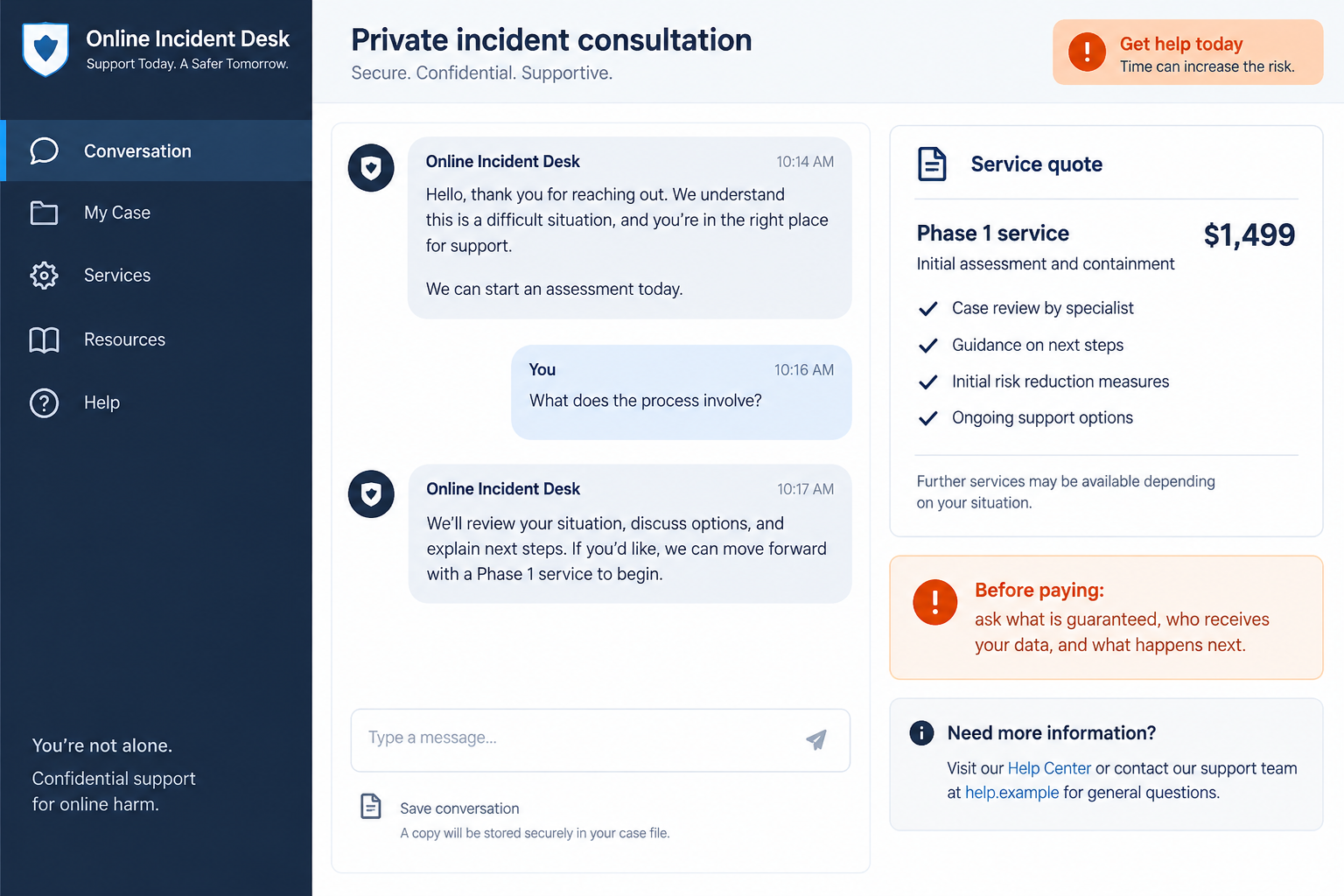
The image above illustrates a fictional consultation, not a conversation with Digital Forensics Corporation. Its purpose is to make the payment decision easier to recognize.
If you already paid, preserve the promises and receipts. You can address the service dispute while separately protecting your accounts and reporting the original extortion.
Why Sextortion Victims Can Be Targeted Twice
The first threat often creates a feeling that there is only one chance to prevent humiliation. Searching privately can seem safer than telling somebody you know.
That isolation makes a confident sales pitch especially powerful. A frightened person may hear certainty in a promise that would deserve skepticism in calmer circumstances.
Money can feel easier to spend when you believe it buys protection instead of silence. A rescue offer can therefore feel safer than another demand.
But a protective label does not establish what a service can deliver. A company cannot guarantee control over every account, copy, recipient, or criminal involved.
A useful helper should explain practical limits without turning those limits into a reason to buy another expensive package immediately.
There is no shame in wanting someone else to take over. The problem is a sales process that exploits that need instead of providing clear, verifiable assistance.
How the Alleged Sextortion Assistance Sales Process Worked
Step 1: Advertising met people already searching for urgent help
The complaint describes advertising on search, video-sharing, and social platforms. Its intended audience was people already dealing with threats involving intimate material.
A search placement can make a business easy to find without making it an official emergency resource. Visibility and government authority are entirely different things.
A visitor looking for a way to remove an image may not be looking for a long-term consulting contract. The sales process needs to make that distinction unmistakable.
Before discussing private details, establish whether you are speaking with law enforcement, a nonprofit resource, a platform support team, or a commercial salesperson.
Being first in a search result does not settle that question. Neither does a professional-looking intake form or a reassuring claim of confidentiality.
Step 2: Personal fears allegedly became pressure to purchase
The FTC alleges that telemarketers tailored warnings to consumers’ circumstances, including marriage, military service, and family relationships, to make the situation feel more dangerous.
That matters because asking about your circumstances can serve two very different purposes. A genuine assessment identifies appropriate support; a pressure sale identifies leverage.
If a conversation repeatedly returns to everything you might lose unless you pay now, pause it. You are allowed to seek another source of help.
A responsible explanation should distinguish a possibility from a prediction. Nobody should convert a stranger’s threat into a certainty simply to justify a service charge.
Do not disclose additional intimate material to prove you deserve help. Initial reporting can begin with the threats, usernames, contact information, and a clear description.
Step 3: An expensive first phase promised concrete intervention
According to the FTC, Phase 1 was sold as including communication with the extortionist, tracing, a detailed report, and referral to law enforcement.
The alleged price range, $1,499 to $20,000, makes the promised deliverables important. These were not merely optional tips on tightening social-media settings.
When a service promises investigation, ask what evidence will demonstrate that the work happened. A polished report alone cannot answer whether its information is genuine.
Also ask who is contacting authorities and what confirmation you receive. Paying a private provider is not the same as personally filing a report with police.
Keep the original description rather than relying on a later summary. Specific promises can disappear into a broad contract description after payment.
Step 4: The FTC says reports could disguise missing work
The complaint alleges that the businesses fabricated chat transcripts and reused geographic coordinates while presenting them as investigative findings.
It also alleges that blocking a blackmailer was sometimes substituted for the broader intervention sold to consumers, and that promised law-enforcement contact did not occur.
These are allegations about the service’s performance, not proof about the location of every blackmailer. A place printed in a report does not authenticate its investigation.
If you received a report, keep its original file and the accompanying explanation. Record which claims were made before you paid and which appeared afterward.
Do not challenge the alleged extortionist yourself using information from a paid report. Confrontation can create more communication without verifying whether the information is accurate.
Step 5: Further phases and reviews allegedly prolonged the relationship
The FTC says consumers were pressured into additional Phase 2 services involving ongoing monitoring and reporting. It alleges that these promises also went unfulfilled.
It further describes fake positive reviews and suppression of negative feedback. Those allegations are relevant because prospective customers may have relied on visible satisfaction signals.
A request for another payment should be assessed against what the first payment actually bought. Do not accept continuing fear as an adequate explanation.
If a refund conversation becomes a request to remove criticism or post praise, preserve that request. Do not surrender an accurate record of your experience.
You can stop negotiating with a provider and seek independent reporting support. A sales relationship does not give it exclusive ownership of your next steps.
The Businesses, Websites, and Records Behind the Offer
The complaint names actual legal entities
The defendant list includes Digital Forensics Corporation LLC, Belkin, and several affiliated companies. The FTC filed the case in the Northern District of Ohio.
These are named operating businesses in a civil enforcement action, not unidentified people proven to be using a fictitious company registration.
If you bought services, compare the contract, invoice, card descriptor, and correspondence. The relevant provider may appear under an affiliate rather than the headline brand.
Several public-facing names are relevant to the same case
The FTC identifies websites including DigitalForensics.com, BlackmailHelpline.com, CyberBlackmail911.com, and SecurityBreach911.com in its consumer warning about the alleged conduct.
Those names help customers recognize a possible connection. They are not an invitation to visit each website or submit another intake request.
An office address is also not a performance guarantee. The key dispute is whether the promised services were honestly described and actually provided.
Support contact is different from independent assistance
Use the contact details on your own contract for a written cancellation or refund request. Keep that exchange separate from your report to authorities.
Do not assume a salesperson has made an official crime report for you. Ask for the agency, submission date, and reference before treating that task as completed.
No phone call or private message to these businesses was made for this article. Their responsiveness to a new customer request has not been tested.
The service needs an auditable trail, not a packaging label
This case concerns assistance services, not a manufactured product. Meaningful records include deliverables, dates, authorized account access, reporting confirmations, and the scope of any monitoring.
Keep copies outside an account controlled by the provider. If a customer portal becomes inaccessible, your contract and correspondence should still be available to you.
A refund or cancellation dispute is easier to explain when each charge is matched to a specific promise and a specific missing or disputed deliverable.
Free Help Has Limits, but It Should Not Create Another Payment Trap
The FBI’s sextortion guidance warns against fee-based offers of assistance and directs victims toward reporting and trusted support.
It also advises against continuing to engage with the extortionist. Preserve essential threat information, report the account, and block further contact rather than bargaining.
Blocking does not erase material already sent. It stops giving the person another immediate route to frighten you, which is a useful and realistic objective.
For imagery taken when you were under 18, NCMEC’s Take It Down can generate a digital fingerprint locally for participating platforms.
Use only material already on your device. Do not download, request, send, or redistribute an intimate image to create a submission.
For eligible adult imagery, StopNCII similarly uses local hashing. The image stays on your device; participating platforms receive the fingerprint.
Neither service promises removal from the entire internet. That honest limitation is a reason to understand its scope, not a reason to buy a supposedly unlimited guarantee.
If you are helping a child, stay calm and involve a trusted adult or appropriate authority. Do not make punishment or blame the price of getting help.
What to Do If You Paid for Sextortion Assistance
-
Separate the two problems. The original blackmail and the paid-service dispute need different records. List the threatening account separately from the business that charged you.
You can report the extortion even if the service contract is still being disputed. No company’s permission is needed to contact law enforcement.
-
Keep your purchase evidence. Save the agreement, invoices, payment receipts, sales messages, reports, refund language, and requests for additional phases.
Write a short timeline of promised actions and what you actually received. Avoid editing original files or relying only on screenshots of selected sentences.
-
Send a specific written request. Identify the charge, the service you dispute, and whether you want cancellation, a refund, or an explanation of deliverables.
Ask for written confirmation of any future billing cancellation. Do not purchase an additional phase merely to qualify for a discussion about the first one.
-
Speak with the payment provider promptly. Describe the issue accurately, such as services not delivered as represented. Ask about the applicable dispute deadline and required documentation.
A civil lawsuit does not automatically refund your individual payment. Continue following your provider’s process rather than waiting for an assumed payout.
-
Remove account access you no longer authorize. Review sessions, connected applications, recovery contacts, and any credentials shared with the provider.
Use each platform’s official security settings. If access was granted to manage communications, preserve relevant records before revoking it where practical.
-
Report through verified channels. Tell law enforcement about the extortion and report the commercial experience through the FTC’s official reporting service.
Include business names, dates, amounts, and the promises at issue. Avoid sending intimate images unless an authorized reporting process specifically provides safe instructions.
-
Bring another trusted person into the situation. Ask them to help organize messages, sit with you during reporting, or check a new offer before you pay.
Someone promising to recover the service fee for another advance payment can create a third loss. Keep unexpected recovery approaches outside the process.
Frequently Asked Questions
Has Digital Forensics Corporation been finally found liable?
The cited FTC announcement describes a lawsuit and temporary court intervention. Those are not the same as a final judgment on every allegation.
Does the FTC case mean every forensic investigator is fraudulent?
No. The allegations concern specified defendants and practices. Legitimate professional work should have a clear scope, accountable deliverables, and honest limits.
Should I pay somebody who guarantees my images will never spread?
No. Do not buy an absolute guarantee over other people’s copies and accounts. Use official reporting and appropriate image-protection resources without paying for certainty.
Can Take It Down remove every copy from the internet?
No. Its hashing system helps participating public or unencrypted platforms detect matching material. Its scope is limited, and it does not require uploading the image.
Will the FTC automatically send me a refund?
Do not assume that. Preserve your records, pursue available payment-dispute routes, and check official case updates rather than relying on unsolicited refund messages.
What if I am too embarrassed to report the threat?
Tell a trusted person and begin with the threatening messages. You deserve support, and the responsibility for extortion lies with the person making the threats.
The Bottom Line
Do not pay high-pressure sextortion rescue offers for guaranteed silence or unverified intervention. The FTC’s Digital Forensics Corporation case makes those sales promises especially important to challenge.
If you already bought assistance, preserve the contract, question missing deliverables, and contact your payment provider. Address the blackmail separately through official reporting and free, appropriate support.

Join the discussion
0 commentsShare your experience or ask a question about this article.
Discussion
Start the conversation
Have a question or something useful to share? Add the first comment.