

A message about money still waiting for you can be hard to ignore, especially after a long and frustrating claims process.
The Celsius balance email scam uses that expectation. Before treating a remaining-balance notice as good news, look at who is speaking and where the message takes you.
Overview
A payout story arrives with an unrelated sender address
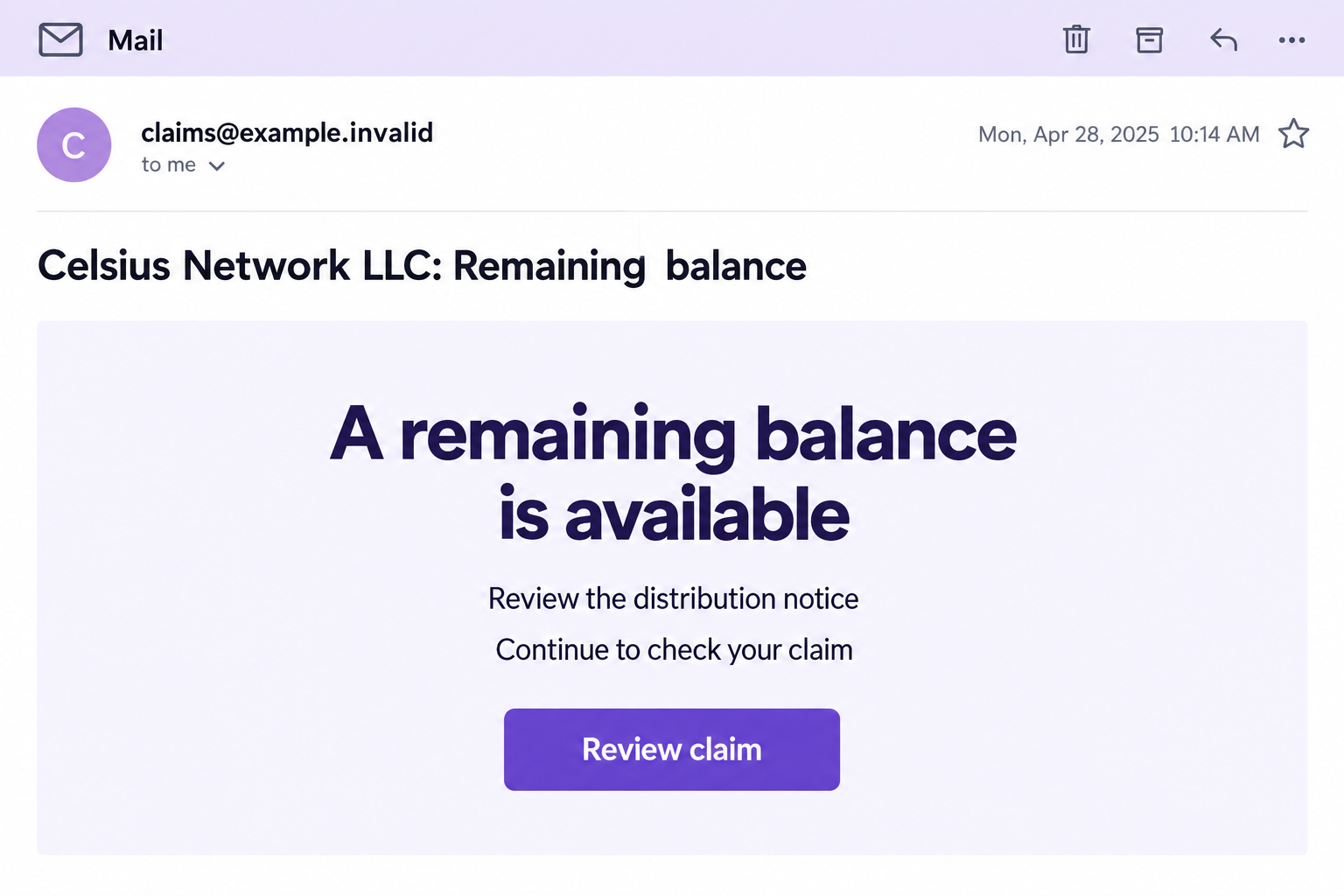
The reported messages use the Celsius Network name and refer to cryptocurrency or a remaining balance. The displayed address discussed in the report is info@buah.de.
That address also appears on the legal-information page of buah GmbH, a legitimate business selling fruit products. It is not evidence of a Celsius distribution relationship.
The real business should not be blamed for a displayed address
A suspicious message showing an address does not establish that the address owner sent or approved it. Original headers and sending-system access were not examined here.
We cannot determine from the reported display whether it involved spoofing, a compromised system, or another delivery arrangement. The illustration uses fictional details, not the original message.
Verify the distribution rather than the promise
Before following a claim notice, check four separate things:
- Whether you actually have a Celsius claim to investigate.
- Whether the contact matches current official distribution guidance.
- Whether the requested action matches your independently checked claim status.
- Whether it asks for wallet secrets, an unexpected signature, or a payment to unlock funds.
A real claim does not authenticate an unsolicited message. Equally, a fraudulent email does not prove that your legitimate claim has disappeared.
Why This Payout Story Can Catch People Off Guard
A long wait makes an update feel welcome
People dealing with unresolved claims may expect occasional administrative emails. Another message about a distribution can fit a situation that already feels complicated.
That makes relief part of the pressure. Instead of threatening immediate loss, a sender may suggest that a problem is finally about to be resolved.
You may want to finish before the opportunity disappears. Take that feeling as a reason to pause, then check the notice through your established claims route.
You should not need to abandon independent checking to protect a genuine entitlement. Contact the verified administrator if a notice seems inconsistent with your records.
Knowing the company name does not prove knowledge of your claim
An email can name Celsius without knowing your balance, identity, distribution partner, or eligibility. Broad language lets many recipients imagine that the message fits them.
Even personal details are not sufficient authentication. A name or case reference can appear in earlier correspondence, exposed records, or other material available to a sender.
Look for a request that matches what you independently see in the correct administrative process. Do not substitute personalization for that check.
If you never had a Celsius account or claim, there is no reason to create a wallet or pay a verification charge to investigate the promise.
Finding a real shop does not verify a payout
Searching the displayed address may lead to a real business with normal products and contact information. That finding can be reassuring for the wrong reason.
It establishes that the business exists, not that it administers cryptocurrency claims. Its reputation cannot authenticate unrelated financial instructions appearing in an email.
Do not contact the store to request a crypto withdrawal, accuse its staff publicly, or send them your claim documents. Use the appropriate distribution-support process.
How the Celsius Balance Email Scam Works
Step 1: A remaining-balance notice gives you a reason to engage
The message starts with a plausible administrative subject: funds, a balance, or a distribution associated with Celsius. The promised result is access to money.
A creditor may see an awaited update. A noncustomer may wonder whether an old account or unexpected entitlement has been found.
Both reactions give the sender attention before their authority has been established. Start instead with your own records and the verified distribution information.
You can keep an email for evidence without using its links. There is no need to follow the offered route merely to determine whether you are a creditor.
Step 2: Financial language encourages trust in the process
A company name, formal signature, or distribution label can make the message sound like routine case administration rather than a sales pitch.
The risk is accepting the whole process because a few terms are familiar. A correct company name does not validate the sender or destination.
Read the full address and destination carefully. A recognizable word inside a longer hostname is not enough to show that the hostname belongs to the administrator.
If your email application hides the details, leave the message alone and navigate independently. Verification should not require using a button supplied by the questionable sender.
Step 3: A review or claim action moves you elsewhere
A fraudulent payout notice can direct recipients to a lookalike sign-in page, a document form, or a wallet-related prompt.
The downstream destination for the reported sender-address example was not authenticated here. Do not treat these possible branches as a tested sequence for that exact email.
What matters is whether a request is supported by a process you reached independently. A polished page that repeats the email’s promise is not a second source.
Stop if the journey changes unexpectedly, especially if collecting a distribution suddenly requires giving another website control over assets you already own.
Step 4: A verification request can cross into account or wallet access
Identity checks can be legitimate in financial administration. That does not justify sending documents through any form that uses a recognizable company name.
Likewise, a wallet-connection screen is not a harmless administrative form. Read what a request authorizes rather than relying on a reassuring claim-review label.
Current Celsius distribution security guidance says recipients are not asked to connect a crypto wallet to a third-party site for payment.
A seed phrase or private key is a firm boundary. Those secrets can confer control over existing assets; they are not ordinary information needed to locate a claim.
Step 5: Further demands can keep the recipient committed
Once somebody has begun, another instruction may be framed as the last obstacle: a validation payment, a new document, or a second approval.
Do not assume that earlier participation makes the next demand safer. Each additional disclosure or transaction can create a separate loss.
If the promised balance remains unavailable, return to independently verified support. Do not keep paying or signing while the sender explains why one more action is necessary.
Record the actual requests and transaction details. That evidence is more useful than a continuing conversation in which the sender keeps changing the explanation.
How to Verify a Genuine Celsius Distribution Request
Use the current administrator’s information, not an old whitelist
Distribution arrangements and contact routes can change. A years-old message or security article may not describe the current process.
Consult the current approved-domain guidance and official contact instructions through an independently reached route.
There can be legitimate distribution partners with different domains. Do not declare every address outside one familiar domain fraudulent without checking the current approved list.
At the same time, a displayed address matching that list is not permission to disclose everything requested. Verify the actual action and destination too.
Check your assigned distribution route
The guide for eligible claim distributions explains that instructions differ according to the assigned payment or cryptocurrency-distribution partner.
Do not assume that another creditor’s screenshot applies to you. Compare your own case information with the route described for your circumstances.
The guide also describes legitimate identity re-verification in the claims process. The warning is against unverified collection, not against every genuine request for identity information.
If something does not match, submit a support question through the official process. Do not send duplicate documents to an address copied from a suspicious notice.
Keep claim codes and wallet permissions separate
A code used in an authorized distribution process is not a wallet recovery phrase. A document upload is not permission for a website to spend tokens.
Different prompts authorize different things. Pause when a step introduces a new type of access that the distribution instructions do not explain.
No support conversation should require your private recovery words. Keep those offline and private rather than pasting them into a claim-checking website.
Keep a Claim-Checking Record That Does Not Depend on the Email
Start with information you already held
Keep your established claim reference, prior administrator correspondence, and previously verified contact route together. An unexpected notice should be checked against those records, not replace them.
Record which distribution partner applies to your case and which questions remain unresolved. That helps you spot a notice describing a process unrelated to your circumstances.
You do not need to collect every online rumor about distributions. A short list of verified records is easier to use than a folder of conflicting screenshots.
Describe the discrepancy without sending unnecessary secrets
When asking support about a suspicious notice, explain the sender, claimed action, destination hostname, and whether anything differs from your established process.
A screenshot can help, but inspect it first. Claim codes, identity numbers, balances, and contact details may be visible in areas unrelated to the question.
Use a verified support channel for necessary case details. Public discussion should not become a second disclosure incident while you are investigating the first.
Do not send a wallet recovery phrase as evidence of ownership. The fact that support needs information about a claim does not make every secret relevant.
Verify changes to payment instructions with extra care
A message changing where money will go deserves more scrutiny than a general administrative update. Confirm the change through the established process before approving it.
If the notice names a new partner, check whether current official guidance names that partner and explains its role. Do not rely on branding alone.
Save the verified answer and support reference for future use. The next unexpected message can then be checked against a documented decision rather than fading memory.
This keeps the focus where it belongs: preserving access to a genuine claim without letting a convincing payout story dictate a new financial relationship.
What to Do if You Have Fallen Victim to This Scam
-
Stop the email-led process and preserve the evidence. Keep the original message, destination addresses, and a timeline of what you entered or approved.
Do not forward recovery phrases or active codes with your report. Store transaction hashes and screenshots separately from secrets that still protect an account.
-
Secure any exposed email or service login. Change the affected password from a trusted device and review recovery details, forwarding settings, and active sessions.
If a code was disclosed, identify the service and action it referred to. Tell that service through verified support rather than accepting the sender’s explanation.
-
Review wallet activity according to what you approved. A connection, a token allowance, a signed transaction, and a revealed recovery phrase are different exposures.
Use your wallet provider’s official instructions. MetaMask explains that disconnecting a site does not revoke existing token approvals.
Check applicable approvals through a trusted route. Do not sign another unfamiliar request advertised as a recovery or protection step.
-
Treat a disclosed recovery phrase as compromised. Changing a local wallet password does not undo somebody else’s knowledge of the phrase.
Consult the provider’s compromised-wallet guidance promptly. Seek trusted assistance for remaining assets; do not send extra funds into a wallet suspected of automated theft.
-
Report payments and identity exposure to the relevant institutions. Contact the exchange, bank, or card issuer involved, supplying transaction references through its genuine support channel.
If documents were shared, explain which documents and with whom. US identity-theft victims can obtain a tailored response plan at IdentityTheft.gov.
-
Check the device if the interaction included software. Unexpected downloads, extensions, or remote-control sessions justify additional inspection and removal of unwanted access.
Malwarebytes can assist with malicious-software checks. AdGuard may reduce some risky advertising and tracking, but neither reverses blockchain transactions or retracts disclosed documents.
-
Return to the legitimate claims process and avoid recovery solicitations. Tell verified distribution support about any changed contact details or suspicious activity affecting your real claim.
Beware of people promising recovered crypto for an upfront fee. The FTC describes these repeat-victim recovery schemes; report relevant evidence without paying another stranger.
Frequently Asked Questions
Does info@buah.de prove the fruit company sent the scam?
No. A displayed sender is not a forensic finding. The address belongs in the legitimate business’s published contact information, but that does not establish responsibility for the message.
Could I genuinely have a Celsius distribution to collect?
Possibly, if you are an eligible creditor. Check through the official claims process. The existence of a real distribution does not authenticate an unsolicited balance email.
Does Celsius ever require identity verification?
Its current distribution guidance describes legitimate verification procedures. Only provide documents through the independently verified process appropriate to your claim, not an email’s unconfirmed form.
Should I connect a wallet to receive the promised balance?
Not through an unsolicited third-party claim page. Current Celsius security guidance explicitly warns against wallet-connection requests for distributions and requests for private keys or recovery phrases.
Is disconnecting a wallet enough after an interaction?
Not necessarily. An existing token approval or exposed recovery phrase requires a different response. Review the actual exposure with your wallet provider’s official security instructions.
Can an investigator guarantee that my crypto will be recovered?
No. Treat guaranteed recovery paired with advance payment as a serious warning. Report promptly to relevant institutions, but do not confuse a report with a promised reversal.
The Bottom Line
Do not use the Celsius balance email scam as your route to a payout. Verify the actual distribution through official instructions, not an unrelated sender’s promise.
If you already disclosed information or approved wallet activity, secure the affected accounts and contact the appropriate provider immediately. Keep your legitimate claim separate from the fraudulent approach.

Join the discussion
0 commentsShare your experience or ask a question about this article.
Discussion
Start the conversation
Have a question or something useful to share? Add the first comment.