

A honey recipe sounds reassuringly ordinary. Add a recognizable brain-health doctor and a television-style announcement, and a memory advertisement becomes much harder to scroll past.
If a presentation involving Dr. Daniel Amen brought you here, keep the page open only long enough to save its address. The details deserve a closer look.
Overview
The promise is a memory breakthrough, not simply a food suggestion
The Dr. Daniel Amen honey recipe campaign presents an everyday ingredient as the doorway to reversing serious memory problems, including Alzheimer’s disease and dementia.
The documented presentation combines a supposed medical explanation with television-news styling and references to recognizable public figures. The viewer is led toward a commercial formula.
No verified endorsement connects Dr. Amen to the advertised honey cure. A genuine doctor discussing nutrition elsewhere would not authenticate this separate sales presentation.
The authority claim needs evidence outside the sales video
The reported campaign invokes acetylcholine, a toxin explanation, and an exceptionally precise reversal figure. Those details sound scientific without establishing a valid clinical result.
A broadcaster’s appearance, a doctor’s name, and a medical term perform different jobs. None proves that the finished product safely treats the condition described.
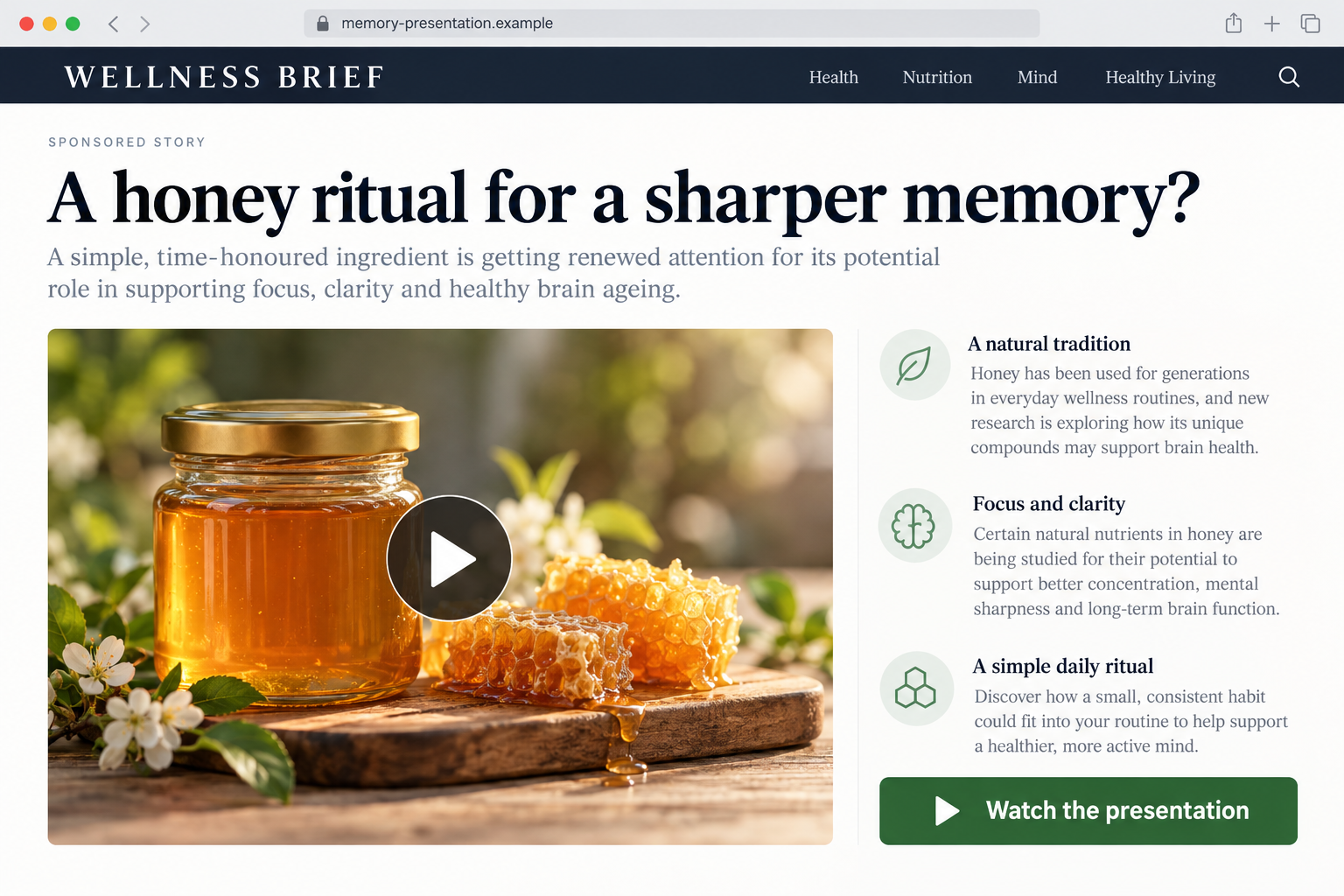
The image above illustrates the advertorial format, not an authenticated broadcast. Its fictional address and generic layout should not be mistaken for evidence of a particular advertisement.
- The recipe is presented as access to a much larger medical discovery.
- The doctor’s supposed involvement is not independently established by the promotion.
- News-style presentation can disguise a sales destination.
- A supplement offer is not equivalent to the free household method promised.
- Claims about automatic billing require the actual order terms.
A changing supplement does not repair the unsupported story
The useful warning is the advertised honey cure and borrowed authority. A different bottle name cannot make the underlying endorsement or medical result genuine.
Do not purchase through a presentation claiming this recipe reverses dementia. The evidence needed for that extraordinary outcome is missing.
This is not an assessment of every service, book, interview, or supplement associated with Dr. Amen. The article concerns the separate promotion using his identity.
Why the Honey Recipe Is an Effective Hook
Honey makes the discovery sound familiar before anything has been proved. You can picture it in a kitchen, not in an expensive or frightening medical procedure.
That familiarity lowers the perceived risk of watching. Someone who would reject a mysterious drug advertisement may happily stay for a recipe.
The emotional appeal is even stronger when memory loss has already changed family life. An ordinary ritual seems to offer something the family can control.
The story then adds a doctor. His recognizable name supplies the expertise the household ingredient cannot supply by itself.
A television-style introduction adds apparent public verification. The viewer may assume journalists already checked the discovery before placing it in front of an audience.
Those impressions arrive quickly and reinforce one another. The missing evidence is easy to overlook because each presentation element seems to validate the next.
But familiar food, recognizable expertise, and professional production remain separate from clinical proof. Combining them does not fill the gap between an appealing story and effective treatment.
The recipe itself should also have a clear identity. If the presentation will not provide ingredients, amounts, and safety information, you cannot evaluate what it is proposing.
How the Dr. Daniel Amen Honey Recipe Scam Works
Step 1: The advertisement finds a worry that already exists
The opening addresses forgetfulness, fear of losing independence, or the distress of watching a relative struggle. It does not need to create those concerns.
Instead, it offers a reassuring interpretation: an overlooked cause has finally been discovered, and something simple might restore what has been lost.
That framing can make attention feel urgent. Closing the video seems less like ignoring an advertisement and more like refusing a chance to help.
Recognize that pressure without blaming yourself for it. The hope is understandable; the commercial claim still needs independent evidence.
Step 2: The doctor’s identity makes the presentation feel personal
The campaign uses Dr. Amen’s name to create the impression that a known medical figure stands behind the discovery.
A photograph or apparent speaking clip can strengthen that impression. Yet neither establishes that he made the statement in the context the seller now presents.
Some misleading campaigns combine unrelated footage with altered narration, fabricated captions, or synthetic voices. The exact production method can differ between versions.
The essential check is the commercial claim itself. Find the full statement through a genuine professional source, rather than treating convincing lip movement as authorization.
Do not confuse a real nutrition discussion with the advertised cure. Someone mentioning honey in a conversation has not thereby endorsed an unrelated bottle.
Step 3: The page borrows the shape of medical news
The reported presentation brings in broadcaster-style material and recognizable names to make the announcement feel larger than an ordinary sales pitch.
That apparent coverage can distract from the actual web address. The logo or interview frame suggests one organization while the browser points somewhere else.
Open the real publisher separately and search for the alleged report. Check whether the headline, speaker, date, and complete interview match.
A real photograph appearing in both places is not enough. The original may concern a completely different subject, with the cure claim added later.
Independent verification should remain possible before payment. A page that demands belief first and details later is asking you to reverse that order.
Step 4: A simple biochemical explanation replaces the missing trial
The campaign connects memory decline with a supposedly hidden problem and presents the honey formula as a way to correct it.
Acetylcholine is a genuine chemical messenger involved in nervous-system function. Naming it does not demonstrate that a household mixture reverses dementia.
Biological plausibility is only a starting point for research. A treatment claim still needs appropriate participants, reliable comparisons, meaningful outcomes, and safety monitoring.
A precise reversal figure is particularly demanding. The presentation should explain the diagnosis, measurement, study duration, and number of participants behind it.
If those details are unavailable, the figure is persuasive decoration rather than a result you can interpret or apply to a relative’s care.
Step 5: The promised kitchen method becomes a proprietary purchase
After the viewer invests time and emotion, the presentation points toward a formula available from the seller. A free discovery has become a purchasing decision.
The transition may be explained as convenience, improved absorption, special ingredients, or a preparation supposedly impossible to reproduce at home.
Whatever the explanation, the product now needs its own evidence. The emotional story cannot establish the label, ingredients, dose, manufacturer, or clinical benefit.
Keep the two questions separate: was the original endorsement genuine, and is the delivered product supported for the advertised purpose?
A yes to delivery would not answer either question. A parcel can arrive exactly as ordered while the medical story used to sell it remains false.
Step 6: Packages and guarantees make a larger commitment feel reasonable
A seller may recommend several months of supply, presenting a bigger order as the serious or economical way to follow the discovery.
Compare the complete charge with the unit price. Someone expecting one inexpensive bottle can otherwise agree to a much larger package.
Recurring shipments are a separate issue. A refill arrangement requires actual consent terms, frequency, price, and a cancellation process; it cannot be inferred from the video alone.
A money-back headline also needs operational details. Identify the seller, return deadline, bottle requirements, and authorized address before assuming the decision is reversible.
No particular live checkout or universal renewal charge was verified for every version of this campaign. Preserve the terms that accompanied your own order.
A Real Memory Evaluation Does Not Begin With a Sales Timer
Memory changes can have different causes and require proper assessment. An advertisement cannot determine the diagnosis from the symptoms it lists.
Careful evaluation can consider medication effects, sleep, mood, hearing, and other health issues alongside possible neurological disease. The appropriate next step depends on the person.
That process should not be replaced by a claim that every memory problem comes from one invisible toxin or one missing ingredient.
Research into diet and brain health is real. It does not establish that a honey ritual cures Alzheimer’s disease or that a seller’s formula reproduces a studied intervention.
The National Institute on Aging advises discussing products that promise prevention or treatment with a clinician. Supplements can also interfere with other care.
Do not stop a prescribed medicine because an advertisement attacks it. If you are worried about side effects, ask the professional who manages the treatment.
Bring the exact product information rather than a remembered sales summary. Ingredients, amounts, intended use, and purchase documents make the conversation more useful.
Seek prompt medical assessment for sudden confusion or a rapid change in functioning. A dramatic deterioration should not be managed by waiting for supplement delivery.
How to Check the Story Without Sending More Information
Start with the claim that persuaded you most. It might be the doctor’s involvement, the broadcaster’s report, a study result, or the promise of a free recipe.
Write that claim in a single sentence. Then look for a source that actually supports it, rather than another page repeating the same advertisement.
A university logo needs a matching research record. A trial claim needs an identifiable study. A celebrity endorsement needs an authentic statement tied to the product.
Do not supply your name, medical history, or payment details to unlock supposedly essential proof. Evidence offered to justify a sale should be available before that commitment.
Be careful with review pages that all lead to the same checkout. Repeated enthusiasm can come from a shared commercial incentive rather than independent investigation.
Also avoid inventing a conclusion from an unavailable page. A missing website limits what can be checked; it does not establish the contents of every earlier order.
For someone already charged, the practical record matters most. The receipt, statement descriptor, shipping label, and cancellation correspondence identify where to direct the complaint.
What to Do If You Followed the Honey Cure Advertisement
-
Pause the purchase or further orders. You do not need to finish a video, enter a final offer, or buy another bottle to verify the original claim.
If a relative is involved, offer help without humiliation. Focus first on the receipt and the person’s care, not on winning an argument.
-
Tell the treating clinician about any product taken or medication changed. Bring the packaging, ingredient panel, amount used, and timing of any symptoms.
For sudden confusion or another urgent change, seek appropriate medical help rather than relying on the seller’s reassurance.
-
Save the advertisement and its destination. Keep the supposed interview, medical claims, product description, order terms, confirmation, and full payment record together.
Store copies locally where possible. Sales pages can change, and a later version may no longer display what persuaded you.
-
Identify the actual transaction provider. Use the merchant name and verified support route in your receipt, not a guessed company associated with the doctor.
Request cancellation of unwanted future shipments and ask whether any recurring authorization exists. Require a clear written answer about the whole arrangement.
-
Ask for a refund while the deadline is still open. Obtain the approved address, required contents, and instructions for opened or unused bottles.
Retain the authorization and tracked-postage record. A verbal promise is difficult to reconstruct if the parcel is later disputed.
-
Escalate an unresolved charge to your bank or card provider. Describe the represented endorsement, medical promise, actual product, and steps taken with the seller.
Ask which documentary and timing requirements apply. Do not assume a merchant’s lengthy review process pauses your payment-dispute deadline.
-
Secure the device if the funnel led to a suspicious installation. Malwarebytes can help check unwanted software; AdGuard can reduce exposure to deceptive advertising.
These are digital-safety tools, not treatment or payment-recovery services. Watching a video alone does not establish that the device is infected.
-
Report the specific impersonation and medical claim through the platform and appropriate consumer or health authority. Include the URL and the relevant evidence.
Ignore anyone demanding a new fee to recover the purchase. A second promise of easy rescue can exploit the same worry as the first advertisement.
Frequently Asked Questions
Did Dr. Daniel Amen endorse this honey dementia cure?
No verified endorsement supports the advertised cure described here. Genuine interviews or nutrition discussions should not be treated as permission for an unrelated commercial claim.
Is honey a proven treatment for Alzheimer’s disease?
The campaign provides no reliable clinical evidence establishing that outcome. Ordinary food use and preliminary ingredient research are not proof of disease reversal.
Does a convincing video prove the speaker authorized it?
No. Check the full original recording and its context. Repurposed clips, changed captions, and altered narration can create a misleading commercial statement.
Why does the presentation end with supplement bottles?
The recipe attracts attention; the formula creates a transaction. Evaluate that product independently instead of transferring trust from the earlier story to the purchase.
Will every order lead to monthly refills?
That is not established for every version. Your accepted checkout terms, confirmation, and statement show whether a recurring arrangement was included.
Should a concerned family member cancel prescribed treatment?
No. Discuss worries and any supplement use with the treating professional. A sales presentation is not a safe basis for changing a medical plan.
The Bottom Line
Do not buy through a Dr. Daniel Amen honey-cure presentation expecting dementia reversal. The recognizable name and news styling do not supply the missing medical evidence.
If you already acted, keep care on track, collect the transaction documents, stop unwanted billing, and pursue a timely refund through the actual merchant and payment provider.

Join the discussion
0 commentsShare your experience or ask a question about this article.
Discussion
Start the conversation
Have a question or something useful to share? Add the first comment.