

An apparent Bill Gates video can stop you mid-scroll when someone you love is struggling with memory loss. A familiar face makes the promise tempting.
The presentation offers hope in a few short sentences. Before giving it your attention, or your payment details, look closely at the story being sold.
Overview
The 45-day Alzheimer’s cure pitch is deceptive advertising
Do not buy a supplement on the strength of this Bill Gates honey-and-cinnamon presentation. The supposed breakthrough is a sales story, not a verified Alzheimer’s treatment.
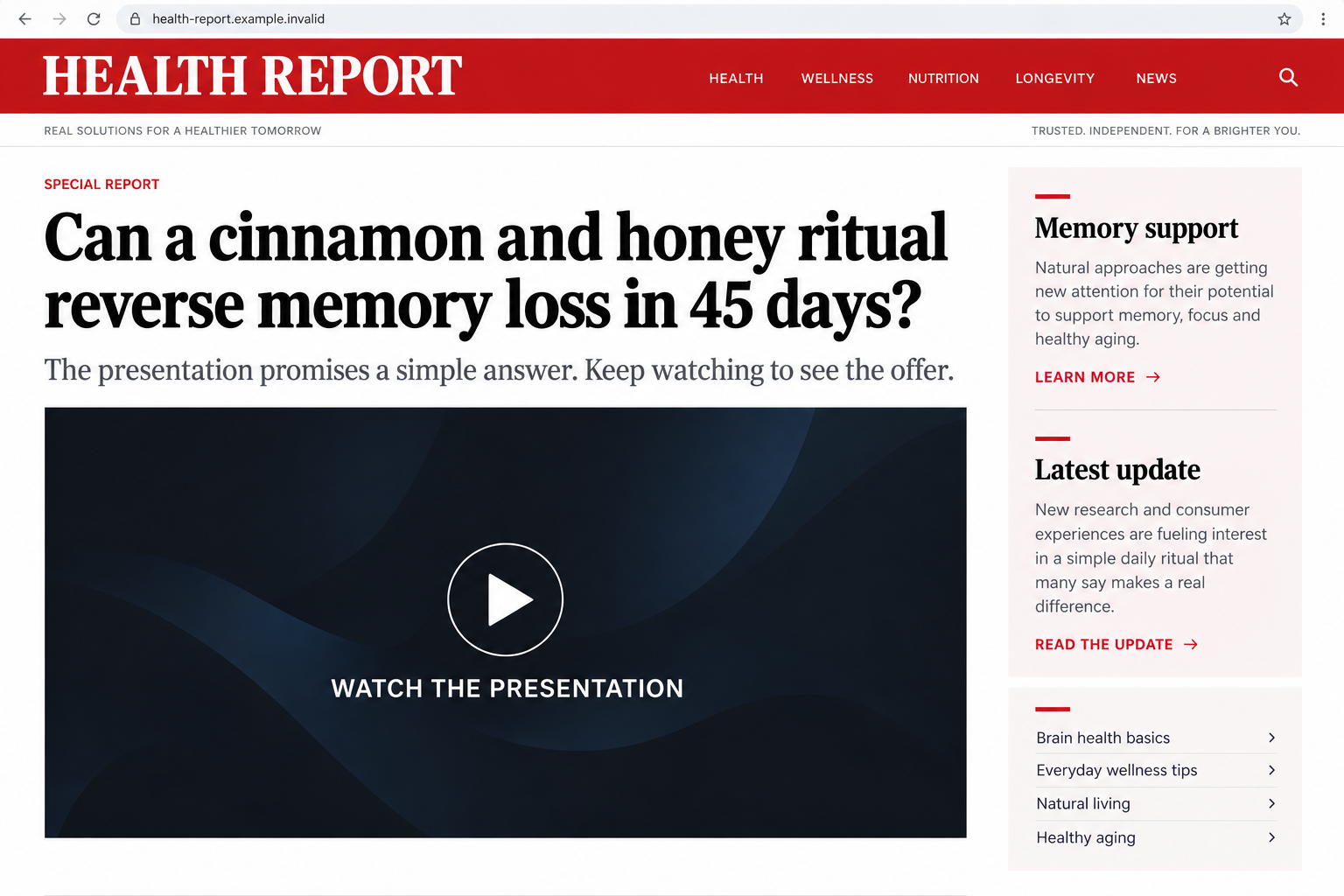
The Golden Brain campaign footage reviewed uses a news-style setting and apparent celebrity appearances to promote a dramatic memory-recovery promise.
Its headline claims Alzheimer’s can be reversed in 45 days. That claim does not come with an authenticated clinical publication establishing the advertised outcome.
Calling the promotion a scam does not mean we chemically tested every capsule carrying a similar name. The deception concerns the authority and treatment story.
CNN, CBS, Bill Gates, and the other recognizable people invoked in the pitch should not be confused with the people selling through it.
The free ritual becomes a supplement offer
A household recipe makes the information sound accessible. The reviewed presentation ultimately promotes Golden Brain pills rather than providing a medically validated kitchen treatment.
The name on the bottle is less important than the switch. A promise of free information gradually turns into a reason to spend money.
This is why searching only the latest product name can miss the wider warning. A new label does not authenticate an old celebrity-cure narrative.
- Opening hook: memory restoration through cinnamon and honey.
- Borrowed authority: apparent public-figure appearances and television-style reporting.
- Medical claim: rapid reversal of Alzheimer’s without credible evidence supplied.
- Commercial destination: a supplement pitch after the recipe tease.
- Practical decision: close the promotion and keep treatment decisions with a qualified clinician.
What this review establishes, and what it does not
We assessed recorded campaign material and current official medical information on October 8, 2026. An authenticated live merchant checkout was not recovered.
Accordingly, we do not report an actual Golden Brain renewal price, delivered quantity, refund outcome, or laboratory finding about the capsules.
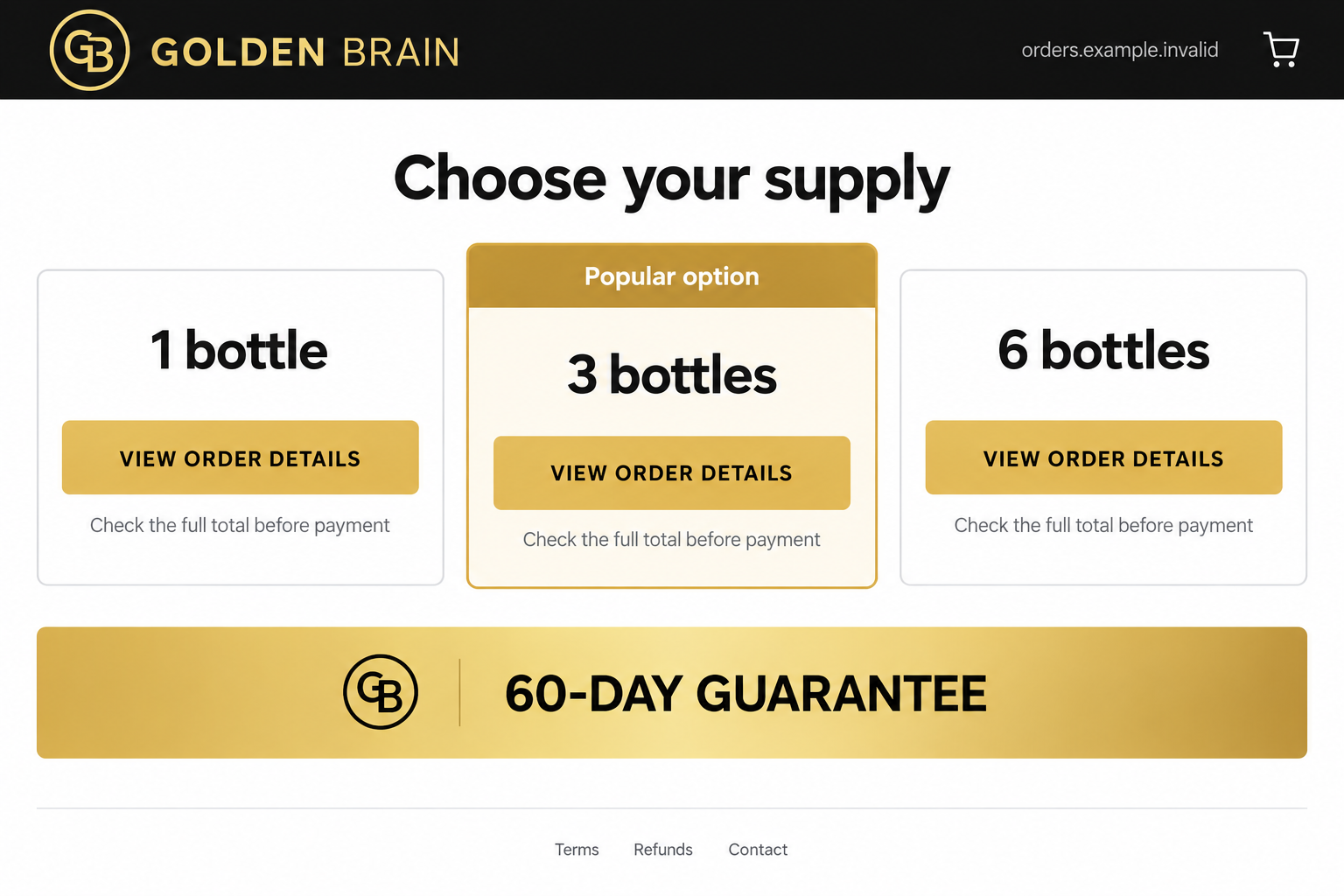
The images illustrate the news-page and supply-selection formats using fictional addresses. They are not recovered campaign screenshots or evidence of a particular checkout’s terms.
If you already paid, your receipt and card statement are the documents that identify the transaction. A video cannot settle what a merchant charged you.
Why the Medical Story Falls Apart
The emotional appeal is understandable. Memory difficulties can make an ordinary conversation feel frightening, especially when a family has already heard an Alzheimer’s diagnosis.
That fear deserves honest information. It should not be used to suggest that families have missed an easy cure hiding among their groceries.
The FDA warns about false Alzheimer’s cure promises, including products presented as supplements. Unproven treatments can waste money and delay appropriate care.
A claim of reversal is much stronger than a claim of general nutritional support. It needs credible evidence of an actual disease outcome.
The National Institute on Aging discusses diet and Alzheimer’s evidence. Research into eating patterns does not establish that one pantry combination reverses dementia.
Some approved treatments can help symptoms or slow progression in appropriate patients. That is not the same as restoring everyone’s memory on a fixed timetable.
The pitch also borrows Yoshinori Ohsumi’s scientific reputation. His 2016 Nobel Prize recognized autophagy discoveries, not a commercial honey cure.
A real scientific concept can be inserted into an invented sales explanation. Mentioning cellular recycling does not validate the supplement or the promised clinical result.
Never stop prescribed treatment because an advertisement says medicines are useless or deliberately harmful. Discuss concerns with the treating clinician, not a sales narrator.
How the Bill Gates 45-Day Alzheimer’s Cure Scam Works
Step 1: A familiar ingredient lowers your guard
The invitation starts with something ordinary: honey, cinnamon, and a promise that you can do something helpful at home.
There is no expensive machine to understand and no unfamiliar procedure to evaluate. The apparent simplicity makes the story feel approachable.
That first impression matters. A person may watch because they want to help a parent, not because they are shopping for supplements.
The promotion benefits when those two activities blur together. Curiosity about a recipe becomes attention that can later be directed toward an order.
Before following the promise, ask whether the ad actually identifies evidence or simply describes an attractive outcome. A recognizable ingredient supplies familiarity, not proof.
Food can be part of a healthy diet without becoming a disease-reversal treatment. The difference should be established before a sales page changes your expectations.
Step 2: News styling makes an advertisement feel like reporting
A television-style setting suggests that professional journalists have already checked the story. An apparent interview can make the pitch feel independently investigated.
But the surrounding format does not tell you who published the page, who produced the footage, or whether a broadcast actually occurred.
A network’s name in a video is not permission from that network. Likewise, a copied visual style is not an editorial relationship.
Go to the broadcaster independently and search for the supposed segment. Do not use the advertorial’s links as your only route to verification.
Search results should lead to the original outlet, episode, and context. A collection of pages repeating the same claim is not a substitute.
If the promotion cannot connect its apparent report to an authentic publication, there is no reason to treat the sales page as trusted news.
Step 3: Apparent celebrity appearances replace medical evidence
The reviewed footage presents recognizable figures as part of the treatment story. Their apparent participation is meant to supply trust before the product is examined.
Modern altered footage can look convincing in a small social-media window. A familiar voice is no longer sufficient evidence that someone made a statement.
Check the person’s own channels or a verified original interview. Look for the complete context, not a clipped promotional upload.
Even a genuine celebrity endorsement would not establish that a supplement reverses Alzheimer’s. Fame and clinical effectiveness are separate questions.
The research claim needs a named study, identifiable investigators, a publication, relevant participants, and a result that matches the advertisement.
Do not let several famous names create the impression of several independent confirmations. Repeated appearances inside one sales presentation remain one unverified source.
Step 4: A hidden-cause story discourages outside questions
The campaign’s explanation includes a supposed brain-damaging parasite and claims that a simple intervention can solve what conventional care allegedly ignores.
A story like that offers both a villain and a reassuring solution. It can make complicated illness feel suddenly understandable.
However, an explanation does not become true because it is easy to picture. It must be supported by diagnostic and clinical evidence.
Be especially cautious when disagreement is treated as proof of a cover-up. That framing allows the seller to dismiss every outside check.
A legitimate treatment discussion explains uncertainty and limitations. It does not require you to believe that all contrary information comes from people hiding the answer.
Your clinician should be able to discuss proposed treatments without a countdown or a purchase button. Use that opportunity before changing care.
Step 5: Waiting for the recipe creates commitment to the offer
A long presentation can repeatedly suggest that the useful information is coming next. Each additional minute makes leaving feel like wasting the time already spent.
Eventually, a bottle is offered as the practical way to obtain the benefit. The original idea of an ordinary recipe has become a proprietary purchase.
That change should trigger a fresh evaluation. Watching a video for a long time does not establish that its final recommendation deserves payment.
Ask what the actual product contains, what it costs altogether, and what evidence supports that exact formulation. Do not borrow answers from another supplement.
The illustration below shows a supply-selection format, not a verified Golden Brain package list. No particular bottle count or price is established by it.
Step 6: The transaction introduces separate financial questions
If an offer reaches checkout, stop and read the item description, quantity, full total, optional upgrades, refund conditions, and any repeat-payment wording.
Subscriptions occur in some supplement funnels, but this review did not authenticate a Golden Brain renewal agreement. Do not assume one from the product category.
Equally, do not accept an unexplained later charge. Your own authorization determines whether a recurring payment was agreed to.
Refund assurances need written conditions that apply to your order. A reassuring phrase inside an earlier video does not identify a return destination or deadline.
A checkout retailer’s reputation also does not authenticate the medical promotion. Customer-service reviews can concern support interactions rather than the supplement’s effectiveness.
Keep those issues separate: deceptive advertising, the item ordered, the seller receiving payment, and the billing arrangement you actually accepted.
Video, News-Page, and Billing Checks
Verify the original publication, not the copied appearance
Type the news outlet’s address yourself. Find the story through its own search tools and compare the date, headline, speakers, and subject.
A page can copy a header while hosting an unrelated video. A shortened link or unfamiliar destination deserves examination before you enter information.
We are not publishing a live campaign address here. Advertising destinations can rotate, and no original checkout was authenticated during this investigation.
Require research that can actually be inspected
A reference to a university should lead to a specific publication, not merely a prestigious name. Check whether the study involved the advertised finished product.
Laboratory work, animal research, general nutrition findings, and clinical dementia outcomes are different types of evidence. The video should not treat them as interchangeable.
If the only documentation available comes from the promotion itself, you still have a claim rather than independent confirmation.
Identify the transaction before requesting help
The brand in an advertisement may differ from the merchant on a statement. Your confirmation email should explain the product, seller, contact route, and charges.
Save that information before a landing page disappears. A payment provider can investigate a concrete transaction more effectively than an unidentified video.
Do not send a return to an address belonging to a different supplement with similar branding. Obtain instructions tied to your own order.
Helping a Relative Without Adding More Pressure
If someone close to you believed the presentation, avoid starting with blame. The ad targets a painful situation and offers an emotionally attractive answer.
Ask what they hoped the product would do. Then compare that expectation with the actual evidence and the receipt, one question at a time.
Offer to contact the payment provider together or organize the purchase records. Practical help often works better than an argument about an entire industry.
If they are worried about medication, arrange a conversation with the clinician. Do not turn a dispute about advertising into an abrupt treatment change.
Keep the focus on the immediate decision: no additional purchases, no unsupported treatment changes, and a documented request about any payment already made.
What to Do if You Have Fallen Victim to This Scam
You can begin protecting yourself without identifying everyone behind the promotion. Work through the steps that match what actually happened.
-
Stop further purchases and sales conversations. Decline additional bottles, telephone upgrades, or a different product presented as necessary to complete the promised result.
Do not pay a second party claiming it can recover your purchase for an upfront fee. That introduces another transaction rather than resolving the first.
-
Preserve the advertisement and order records. Save the video link, screenshots, receipt, package description, merchant name, and the dates of each contact.
Capture any medical promises that influenced your decision. Keep the actual product label and shipping packaging if a delivery arrives.
-
Request a specific written remedy. Ask the merchant about cancellation, the applicable refund conditions, the return authorization, and the amount being reimbursed.
If your order includes recurring billing, separately request cancellation of future charges and shipments. Save confirmation of both actions.
-
Contact your payment provider promptly. Explain the deceptive treatment promotion and the documented problem with your transaction. Supply the records rather than guessing at hidden charges.
Ask about applicable dispute deadlines. Report charges you did not authorize separately from dissatisfaction with a product you did order.
-
Protect medical decisions. Do not rely on the supplement as Alzheimer’s treatment. Discuss the product’s actual label and any medication changes with a healthcare professional.
Keep the container if an adverse reaction occurs. Serious symptoms need prompt medical attention, not another message to an advertising support address.
-
Address device exposure only if it occurred. If the pitch persuaded you to install software or an extension, remove the unfamiliar item and scan with Malwarebytes.
AdGuard can reduce exposure to intrusive advertising. Neither tool authenticates a cure claim, cancels a subscription, or reverses a payment.
-
Report the promotion through the relevant channels. Use the social platform’s scam-reporting option and consider an FDA report for the unsupported treatment advertising.
For financial fraud, use your payment provider and appropriate reporting authorities. Keep a copy of what you submitted and avoid public exposure of private account details.
Frequently Asked Questions
Did Bill Gates announce a 45-day honey cure for Alzheimer’s?
The reviewed promotional material does not establish an authentic announcement. Treat the celebrity-cure presentation as deceptive advertising, not medical guidance.
Can cinnamon and honey reverse dementia?
No credible evidence supplied with this promotion establishes that outcome. Ordinary foods should not replace assessment or treatment for memory problems.
Is Golden Brain an approved Alzheimer’s medication?
No approval or product-specific clinical evidence was established in this investigation. A supplement pitch should not be confused with an approved treatment.
Does a news logo prove the video was broadcast?
No. Verify the segment through the broadcaster’s own archive. A copied presentation and an apparent interviewer do not establish a real report.
Will every Golden Brain purchase include automatic refills?
This review did not verify a recurring-payment checkout. Inspect your exact receipt and authorization; challenge any later billing you did not agree to.
What should I do first if a relative already ordered?
Help them save the receipt and contact the payment provider promptly. Keep the conversation calm and arrange clinical advice before any treatment changes.
The Bottom Line
The Bill Gates 45-day Alzheimer’s cure story is not a reason to buy Golden Brain or any replacement label. Close the promotion and reject its medical promise.
If you paid, concentrate on your actual transaction and dispute deadlines. Keep health decisions with qualified professionals, not a celebrity-style supplement presentation.








