

A new wave of deceptive health marketing is spreading rapidly across social media platforms, promising desperate families a miracle cure for Alzheimer’s disease. The so-called “Golden Honey Tonic” claims to reverse memory loss, restore cognition, and heal the brain — all through a secret “honey recipe” supposedly discovered by Harvard doctors. But behind these too-good-to-be-true promises lies a dangerous and manipulative online scam.
This elaborate fraud, often associated with a supplement brand called MemoGold or similar names, uses fake CNN articles, deepfake videos, fabricated doctor endorsements, and counterfeit scientific claims to trick vulnerable consumers into buying unregulated pills online. In this article, we expose how the Golden Honey Tonic scam works, why it’s spreading so fast, and how you can protect yourself and your loved ones from becoming the next victim.
Scam Overview: The Anatomy of the Golden Honey Tonic Hoax
The Golden Honey Tonic Scam is one of the latest examples of how cybercriminals exploit health fears and hope to make fast money. It mimics legitimate journalism and medical research while pushing a fake product that supposedly cures Alzheimer’s disease. Let’s break down the deceptive ecosystem that powers this operation.
1. The Illusion of Credibility
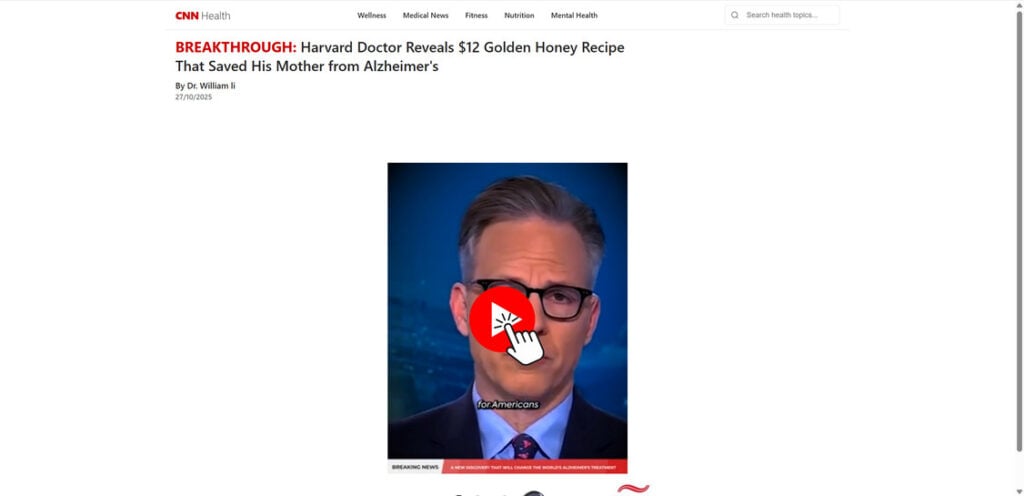
At the heart of this scam is the use of fake news websites designed to look exactly like respected outlets such as CNN, Fox News, or ABC Health. One common domain, memoryhealth.fun, features a cloned version of CNN’s homepage layout — complete with a red banner, familiar fonts, and a fabricated author byline such as “Dr. William Li” or “Harvard Medical Team Reveals Breakthrough Alzheimer’s Cure.”
The fake article begins with a gripping headline:
“BREAKTHROUGH: Harvard Doctor Reveals $12 Golden Honey Recipe That Saved His Mother from Alzheimer’s.”
This emotional hook is deliberately chosen to attract seniors, caregivers, and anyone dealing with dementia in their family. The story then transitions into pseudoscientific explanations and false testimonials, gradually steering the reader toward a “solution” — a bottle of MemoGold or another rebranded supplement marketed as the “Golden Honey Tonic.”
2. False Celebrity and Doctor Endorsements
The scammers often fabricate endorsements from real doctors and public figures. For example, they’ve used the name of Dr. William Li, a well-known physician and researcher, without his permission. They also fake logos and mentions from Harvard University, the Mayo Clinic, and Johns Hopkins Medicine — institutions that have never endorsed such products.
Deepfake technology plays a major role in this deception. In some video ads circulating on Facebook and Instagram, AI-generated footage shows actors made to look and sound like trusted figures — including newscasters or doctors — discussing the supposed “Golden Honey breakthrough.” The videos are polished enough to fool even skeptical viewers.
3. The Product: MemoGold or “Golden Honey Tonic”
The supplement sold under the Golden Honey Tonic scam typically appears in gold-and-white bottles labeled MemoGold, NeuroHoney, Golden Memory Boost, or other similar names. Each variation promises cognitive restoration, “reversed memory loss,” or “brain detoxification.” The product description claims it’s based on “ancient Mediterranean honey enzymes” or “bioactive compounds studied at Harvard.”
In reality, these pills contain generic herbal ingredients, often unlisted or mislabeled. No independent lab has verified their safety or effectiveness. There is no scientific basis linking honey-based supplements to Alzheimer’s treatment or cognitive recovery.
4. False Claims of FDA Approval and Scientific Backing
To reinforce trust, scammers include false “FDA Approved” or “GMP Certified” badges on the website — neither of which are legitimate. The U.S. Food and Drug Administration (FDA) does not approve dietary supplements in this way, nor does it endorse private brands. The site also lists nonexistent clinical studies and uses stolen images of medical professionals.
The use of pseudo-scientific jargon — terms like “neuronal repair,” “synaptic activation,” and “neuroprotective enzymes” — creates an illusion of authenticity. But these are empty buzzwords meant to confuse readers and push emotional decision-making.
5. The Emotional Hook
The scam narrative often focuses on family bonds and personal stories. It describes a “doctor whose mother suffered from Alzheimer’s” and how he “discovered a secret honey formula” that reversed her memory loss. These fabricated accounts are carefully written to evoke empathy, trust, and urgency.
By the time the reader reaches the end of the page, they’re primed to buy — emotionally convinced that this $47 bottle could save someone they love.
How The Scam Works
Step 1: Deceptive Advertising on Facebook and Instagram
The operation begins with sponsored ads on social media, often under fake profiles like “Caleb Stone,” “Healthy Mind News,” or “NeuroHealth Daily.” The ad usually features a video of an elderly woman claiming she regained her memory using the “Golden Honey Tonic.” The caption promises a home remedy that “Harvard doctors don’t want you to know about.”
When users click the link, they’re redirected to a counterfeit CNN-style article on a domain that ends with “.fun,” “.info,” or “.health-news.online.” These domain names are cheap and untraceable, allowing scammers to switch them frequently.
Step 2: The Fake News Page
The fake article presents the “discovery” as a major news story. It uses stolen imagery, fabricated quotes, and deepfake videos of supposed experts. The structure mimics authentic news articles: introduction, expert quote, case study, and solution. But every section exists solely to push the user toward buying the supplement.
Scrolling through the page reveals:
- Fake CNN, Fox, and Harvard logos
- A fabricated publication date (to make the story seem current)
- Stock photos of seniors labeled as “patients”
- Dozens of fake testimonials
The “comment section” under the article is also fabricated, using bots to post repetitive positive messages such as “This cured my mom’s Alzheimer’s!” or “I just ordered three bottles!”
Step 3: The Product Pitch
At the end of the fake article, a bright red button says “Order MemoGold Now” or “Try Golden Honey Tonic Before It’s Banned.” Clicking it redirects to memogold.mycartpanda.com — a third-party e-commerce page powered by Cartpanda, a platform repeatedly linked to online scams.
The product page features:
- A countdown timer suggesting limited stock
- Tiered pricing (1, 3, or 6 bottles)
- A fake 180-day money-back guarantee
- Trust badges and “secure checkout” icons
The goal is to create panic and urgency, making the visitor buy before verifying authenticity.
Step 4: Payment and Data Harvesting
Once payment details are entered, several risks unfold:
- The card is charged more than the stated amount.
- Customers often never receive the product.
- The buyer’s email, phone number, and address are sold to other scam networks.
Even if a bottle arrives, it’s usually an unmarked or generic supplement with no manufacturer information. Attempts to request refunds typically go unanswered.
Step 5: Rebranding and Repeat Offenses
After public complaints surface, scammers abandon the domain and rebrand the product under a new name — for instance, NeuroGold, Golden Mind Boost, HoneyBrain Formula, or MemoPure. The same scam reappears under different branding within weeks.
This cyclical system ensures that the criminals stay one step ahead of detection while continuing to target new victims.
What to Do If You Have Fallen Victim
If you’ve already purchased MemoGold, Golden Honey Tonic, or any supplement promoted through similar fake news ads, act quickly. Here are the steps to take:
- Contact Your Bank or Credit Card Provider Immediately
Report the transaction as fraudulent and request a chargeback. Many victims successfully reverse charges if they act within 30–60 days. - Cancel Further Charges
Some scammers sign victims up for “subscription” plans, charging monthly fees without consent. Ask your bank to block any recurring payments. - Report the Scam to Authorities
- Federal Trade Commission (FTC): ReportFraud.ftc.gov
- Better Business Bureau (BBB): File a complaint under “online purchase fraud.”
- Internet Crime Complaint Center (IC3): ic3.gov
- Report Fake Ads on Social Media
On Facebook or Instagram, click the three dots on the ad → “Report Ad” → “Misleading or Scam.” Include screenshots and links. - Avoid Contacting “Customer Support” Emails
Many victims are tricked into revealing more personal data when they email supposed refund teams. These are often the same scammers fishing for information. - Monitor for Identity Theft
If you entered full personal details, use a credit monitoring service and change your passwords. Scammers often sell data to third-party fraud rings. - Warn Others
Share verified warnings on social media or in relevant Alzheimer’s support groups. Awareness helps prevent further exploitation of vulnerable families.
The Bottom Line
The Golden Honey Tonic scam represents one of the most insidious trends in digital health fraud — exploiting medical fear, false hope, and misinformation to sell fake products. There is no scientific evidence that any “Golden Honey” formula can reverse or treat Alzheimer’s. The fake CNN articles, deepfake doctor videos, and fabricated testimonials are nothing more than tools of deception.
If you see ads for miracle “honey cures” or Alzheimer’s reversals tied to names like MemoGold, NeuroHoney, or Golden Mind Boost, avoid them entirely. Legitimate medical breakthroughs are published in peer-reviewed journals — not advertised through Facebook videos or shady websites.
Trust only licensed healthcare providers and reputable medical organizations when exploring treatments. And remember: if a health product sounds too miraculous to be true, it almost certainly is.
Frequently Asked Questions
What is the Golden Honey Tonic Scam?
The Golden Honey Tonic scam is a fraudulent online marketing operation promoting a fake “miracle cure” for Alzheimer’s disease. It uses deceptive ads and counterfeit news articles that impersonate major media outlets like CNN, CBS, and Fox News to convince people to buy an unproven supplement known under names such as MemoGold, NeuroHoney, or Golden Mind Boost. These scams claim a “Harvard doctor” discovered a natural honey-based formula that can restore memory and reverse Alzheimer’s, but there is no scientific or medical evidence supporting these claims. The real purpose of the scam is to collect payments and personal data from unsuspecting consumers.
Does the Golden Honey Tonic really cure Alzheimer’s disease?
No. There is no scientific proof that any “Golden Honey Tonic” or similar supplement can cure or reverse Alzheimer’s disease. Alzheimer’s is a complex neurodegenerative condition with no known cure at this time. The U.S. Food and Drug Administration (FDA) has not approved any over-the-counter product that claims to treat or reverse Alzheimer’s symptoms. The claims made by MemoGold and other products in this scam are false, unsubstantiated, and designed to exploit vulnerable individuals searching for hope or relief.
Who is behind the Golden Honey Tonic scam?
The scammers behind this operation remain anonymous, using fake company names, shell websites, and untraceable third-party payment platforms such as Cartpanda or ClickBank. They create multiple websites that look like legitimate health news portals — often using domains like memoryhealth.fun or healthreport.today — and fill them with fabricated stories, AI-generated videos, and fake doctor endorsements. Once exposed, they quickly shut down those sites and relaunch under new names to continue targeting new victims.
How do scammers promote the Golden Honey Tonic?
The scam primarily spreads through paid advertisements on Facebook, Instagram, and YouTube. These ads use emotionally charged videos showing elderly people claiming miraculous recovery after using a “Golden Honey recipe.” When viewers click the ad, they’re redirected to a fake CNN-style article that looks like an official news story. This article uses stolen logos, deepfake videos, and fabricated testimonials to build credibility. It eventually leads readers to an online store selling the MemoGold supplement or a similar rebranded product, using aggressive urgency tactics like countdown timers and “limited stock” warnings to pressure quick purchases.
Is the CNN article about the Golden Honey Tonic real?
No, it’s completely fake. The “CNN Health” article used in this scam is hosted on an unrelated domain like memoryhealth.fun, not the official cnn.com website. Scammers copy CNN’s layout, fonts, and logo to make it appear authentic. They also invent fake headlines such as “Harvard Doctor Reveals $12 Golden Honey Recipe That Saved His Mother from Alzheimer’s.” CNN has never published such an article, and no credible journalist or doctor endorses this product. The fake CNN site is designed purely to trick readers into believing the story is legitimate.
Is MemoGold or the Golden Honey Tonic FDA approved?
No, neither MemoGold nor any version of the Golden Honey Tonic is FDA-approved. The FDA does not certify dietary supplements or herbal remedies as treatments for diseases like Alzheimer’s. Any site displaying “FDA Approved” or “GMP Certified” badges in relation to this product is engaging in false advertising. Such claims are red flags that the product is not legitimate. Always verify product certifications through the official FDA website before purchasing any health supplement.
What are the risks of buying MemoGold or Golden Honey Tonic?
Consumers face several risks, including financial loss, identity theft, and health dangers. Many victims report being overcharged, receiving counterfeit products, or never receiving anything at all. Others find that their credit cards were billed for unauthorized recurring charges. Additionally, because the product’s ingredients are not verified or tested, there’s a potential risk of contamination or adverse health effects. Sharing personal details like phone numbers, emails, and addresses can also expose victims to further scams or phishing attacks.
How can I tell if a health product is part of a scam?
There are several warning signs to look for:
- The product claims to “cure” or “reverse” serious diseases like Alzheimer’s or diabetes.
- The website mimics a major media outlet (CNN, Fox News, BBC) but uses an unfamiliar domain such as .fun, .info, or .store.
- There’s no verifiable company address or customer service contact.
- The checkout page uses third-party processors with poor reputations.
- The site pressures you to buy immediately using countdown timers or “limited stock” messages.
- There are fake doctor endorsements, celebrity testimonials, or “Harvard-approved” claims without sources.
If you notice any of these signs, it’s best to avoid the site and report it.
What should I do if I already bought the Golden Honey Tonic or MemoGold?
If you’ve already made a purchase, take immediate action:
- Contact your bank or credit card provider to dispute the charge and request a chargeback.
- Ask your bank to block any future recurring payments to the same vendor.
- Report the scam to the Federal Trade Commission (FTC) via ReportFraud.ftc.gov.
- File a complaint with the Better Business Bureau (BBB) under “Online Purchase Fraud.”
- Submit a report to the Internet Crime Complaint Center (IC3) at ic3.gov.
- Change your passwords and monitor your accounts for unusual activity.
- Do not communicate further with the seller — many of their “support” addresses are used to collect more personal data.
Taking these steps quickly can reduce the chances of ongoing financial harm or data misuse.
Why do scammers use Alzheimer’s and memory loss in their marketing?
Alzheimer’s disease is one of the most emotionally charged topics in health marketing. It affects millions of people worldwide, and families are desperate for solutions. Scammers exploit this vulnerability by offering “natural cures” that sound safe, simple, and affordable. By using emotional stories — such as a doctor curing his mother’s Alzheimer’s with honey — they create false hope and urgency. This emotional manipulation makes victims more likely to buy without verifying the legitimacy of the claims.
Are there legitimate supplements or treatments for Alzheimer’s disease?
Currently, there is no supplement or tonic proven to reverse or cure Alzheimer’s disease. Some FDA-approved prescription medications, such as donepezil or aducanumab, may temporarily manage symptoms or slow progression, but they do not provide a cure. Legitimate brain health supplements can support overall wellness but should never be viewed as substitutes for professional medical care. Always consult a licensed neurologist or healthcare provider before trying any supplement marketed for memory or brain health.
Can the Golden Honey Tonic Scam appear under other names?
Yes. This scam frequently reappears under different brand names and domains. Known variations include MemoGold, NeuroHoney, Golden Memory Tonic, NeuroPure Honey Formula, and HoneyBrain Boost. The same scammers often reuse scripts, images, and videos while changing only the brand name. If you encounter similar ads using “Golden Honey,” “Harvard Doctor,” or “Reverses Alzheimer’s Naturally,” it’s likely part of the same fraudulent network.
How can I report fake ads for the Golden Honey Tonic?
You can report fake health ads on the platforms where you saw them:
- On Facebook or Instagram, click the three dots (…) on the ad and select “Report Ad” → “Misleading or Scam.”
- On YouTube, click the flag icon below the video and select “Report” → “Misleading Content.”
You can also forward screenshots and links to the FTC and your local consumer protection agency. Reporting helps authorities track and remove these operations faster.
What happens to my data if I shared it on these scam websites?
When you enter personal information on these fake sites, scammers may sell your data to third-party marketers or use it for phishing attacks. You may begin receiving spam emails, fraudulent phone calls, or text messages promoting other “miracle cures.” To protect yourself, use a spam filter, change your passwords, and consider enabling two-factor authentication on all your accounts. Never click on links from unknown emails claiming to offer refunds or additional products.
How can I stay safe from future supplement scams?
To avoid falling for similar scams:
- Always verify the website’s domain — trusted sources use .com, .org, or .gov.
- Research the company name and product on the FDA website or Better Business Bureau.
- Check whether the supplement’s claims are supported by real clinical studies.
- Be wary of products advertised as “miracle cures” or “hidden secrets big pharma doesn’t want you to know.”
- Avoid supplements marketed through social media ads that impersonate news outlets.
- If in doubt, consult your doctor before buying any health-related product online.








