

Cleantra Lymphatic Drainage Drops are being promoted as a liquid supplement that claims to support lymph flow, reduce puffiness, flush trapped fluid, ease bloating, and help the body feel lighter.
But before ordering, buyers should look closely at the claims, the subscription option, the refund policy, and the fact that similar lymphatic drainage drops are widely available through generic private-label supplement suppliers. This appears to follow a familiar social media supplement pattern: exaggerated detox claims, “root cause” wellness language, high-pressure discounts, subscription refills, multi-bottle bundles, and refunds that may be difficult once the product is opened.
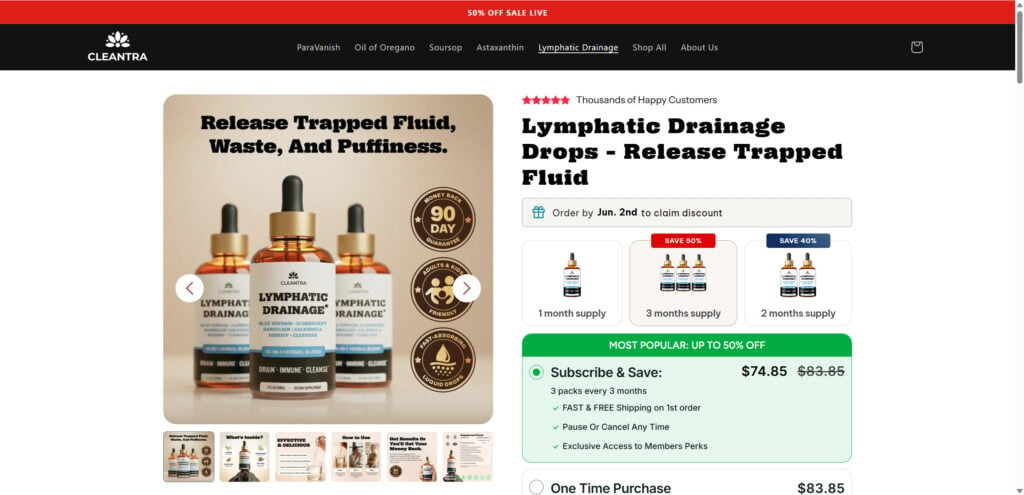
Cleantra Lymphatic Drainage Drops Overview
Cleantra sells Lymphatic Drainage Drops through Cleantra.com as a botanical liquid supplement for “trapped fluid,” puffiness, bloating, swelling, lymphatic congestion, and drainage support.
The product page claims the drops can help:
- Support lymphatic pathways
- Move trapped fluid
- Reduce puffiness
- Reduce bloating
- Support fluid balance
- Help with inflammatory buildup
- Support drainage without harsh diuretics
- Help the body feel lighter
- Support detoxification and lymph cleansing
- Work gradually with daily use
The promoted ingredients include cleavers extract, dandelion leaf, burdock root, red clover, and ginger root. These are common herbs in detox, drainage, and lymphatic support supplements.
The page uses strong trust and urgency signals, including “50% OFF SALE LIVE,” “thousands of happy customers,” “scientifically backed,” “doctor-recommended,” “family friendly,” and a 90-day money-back guarantee.
At first glance, the product looks like a normal herbal wellness supplement. The problem is that the marketing goes beyond simple support. It uses language like “release trapped fluid,” “flush trapped fluid, waste, and inflammatory buildup,” and “reactivate your body’s drainage pathways.”
That kind of wording can make buyers believe the product is doing something more powerful than a typical herbal tincture can prove.
Why Cleantra Raises Red Flags
1. The “lymphatic drainage” claims are broad
Cleantra’s page connects the product to puffiness, bloating, swelling, heaviness, inflammation, water retention, tissue congestion, waste buildup, sluggish lymph flow, and energy.
That is a wide range of claims for one supplement.
Bloating and swelling can have many causes. These include diet, hormones, salt intake, medication side effects, kidney disease, heart problems, liver disease, venous insufficiency, lymphedema, inflammation, allergies, digestive disorders, pregnancy, thyroid issues, and other medical conditions.
A liquid supplement cannot diagnose why someone is swollen or bloated. If the cause is medical, relying on an online supplement may delay proper care.
2. “Flush trapped fluid and waste” is strong marketing language
The FAQ says the drops flush trapped fluid, waste, and inflammatory buildup out of tissues. That sounds powerful and medical.
But the body already has systems for fluid balance and waste removal, including the kidneys, liver, lymphatic system, circulation, and digestive system. If those systems are not working properly, the cause needs medical evaluation.
A supplement may support general wellness, but buyers should be cautious when a product implies it can clear waste buildup or fix congestion inside the body.
3. The page uses “detox” and “root cause” style messaging
Cleantra’s page implies that modern life, processed food, environmental toxins, hormonal shifts, and sluggish lymph flow can cause fluid and waste to build up.
This is common wellness marketing. It creates a simple explanation for vague symptoms and then presents the product as the missing solution.
The problem is that these claims are hard for consumers to verify. Feeling puffy or bloated does not automatically mean the lymphatic system is “overloaded,” and a supplement ad cannot prove that someone’s symptoms are caused by lymphatic congestion.
4. The product is sold through subscription pricing
One of the clearest buyer risks is the subscription model.
The product page includes a “Subscribe & Save” option for 3 packs every 3 months. It advertises free shipping on the first order, the ability to pause or cancel, and member perks. It also includes a one-time purchase option, but the subscription pricing is presented as the better deal.
That creates a real risk of unwanted refills.
Many buyers are drawn in by the discounted price, then later discover another shipment or charge because they selected a subscription. Even when a subscription is disclosed, customers may not notice the renewal terms in a busy checkout flow.
5. Future subscription shipments may not keep the first-order discount
Cleantra’s terms say promotional subscription discounts may apply only to the first order, and future subscription shipments may be billed at the regular price without the promotional discount.
That is important.
A buyer may think they are locking in the discounted rate, but later renewals may cost more. This is one of the most common complaints with supplement subscription funnels: the first bottle looks cheap, but the next charge surprises the customer.
6. Subscription cancellations must happen before the billing date
Cleantra’s terms say subscriptions renew automatically until canceled and that customers must cancel three days before the next billing date to avoid the next scheduled order.
The refund policy also says subscription renewals and repeat orders must be canceled before the payment method is charged. Once the payment is processed and the order is in progress at the warehouse, it is not eligible for a refund.
That means “pause or cancel anytime” does not necessarily mean you can cancel after the charge and get your money back.
7. The 90-day money-back guarantee has important restrictions
The product page says buyers can try the drops risk-free for 90 days and get a refund if they do not love the results.
But the refund policy says the item must be unused and packaged in its original box. It also says returns cannot be accepted if the packaging has been opened.
That is a major issue for a supplement.
How can a buyer know whether the drops work without opening and using them? If the bottle must remain unopened, then the guarantee may be less useful than the sales page makes it sound.
This is one of the biggest practical risks: the product is sold as something to try for results, but the return policy may only protect unopened products.
8. Similar lymphatic drops are widely sold elsewhere
Cleantra’s formula is not in a unique product category. Similar lymphatic drainage drops are widely available on Amazon and other marketplaces. Many use similar claims around dandelion, burdock root, cleavers, red clover, echinacea, elderberry, ginger, detox, fluid balance, and lymph support.
Alibaba and other supplier platforms also list private-label lymphatic drainage drops and OEM herbal liquid supplements from Chinese suppliers.
This does not prove the exact Cleantra bottle is made in China. But it does show that the general product category is easy to source, private label, and sell under different brand names.
The risk is that buyers may pay premium prices for a generic supplement category marketed as if it were a special breakthrough.
9. “Doctor-recommended” is not enough
The product page repeatedly displays “doctor-recommended” and “scientifically backed” messaging.
Those phrases sound reassuring, but buyers should ask:
- Which doctor recommends it?
- Is that doctor independent?
- Was the finished product clinically tested?
- Are the exact doses disclosed?
- Are the studies on the ingredients or the actual Cleantra formula?
- Is third-party lab testing available?
- Are contaminants, heavy metals, and ingredient levels verified?
Without clear answers, “doctor-recommended” is mainly a marketing phrase.
10. Supplements are not FDA-approved like medicines
Cleantra’s own disclaimer says the statements have not been evaluated by the FDA and that the product is not intended to diagnose, treat, cure, or prevent any disease.
That disclaimer matters.
The product is being marketed with strong claims around swelling, puffiness, bloating, drainage, waste, toxins, inflammation, and fluid balance. But it is still a dietary supplement, not an approved medical treatment.
Buyers should not use it as a substitute for medical advice, especially if they have persistent swelling, leg edema, unexplained weight gain, shortness of breath, kidney problems, heart disease, liver disease, pregnancy-related swelling, or diagnosed lymphedema.
How the Cleantra Sales Funnel Appears to Work
Step 1: The ad targets puffiness and bloating frustration
The marketing likely targets people who feel swollen, puffy, bloated, heavy, or inflamed.
These symptoms are common and emotionally frustrating. People may feel uncomfortable in clothes, notice facial puffiness, feel ankle swelling, or believe their body is “holding water.”
The ad then gives a simple explanation: your lymphatic system is sluggish or overloaded.
Step 2: The product is presented as a drainage solution
Cleantra is positioned as a way to restart or support the body’s natural drainage pathways.
This sounds more advanced than a normal herbal supplement. The product is not just described as a tincture. It is framed as a solution for trapped fluid and waste buildup.
That makes the offer feel more urgent and medical.
Step 3: Herbal ingredients create a natural image
The formula uses familiar botanicals such as dandelion, burdock, cleavers, red clover, and ginger.
These ingredients make the product feel safe, traditional, and gentle. But “natural” does not automatically mean risk-free. Herbs can cause side effects, allergic reactions, stomach upset, medication interactions, and problems for people with certain medical conditions.
Step 4: The buyer is pushed toward a multi-month supply
Cleantra offers 1-month, 2-month, and 3-month supply options. The 3-month supply is marked as most popular and shows the strongest discount.
This is a classic supplement funnel tactic. Buyers are encouraged to buy more before they know whether the product works for them.
If the drops disappoint or cause side effects, the buyer is now holding multiple bottles.
Step 5: The subscription is positioned as the best deal
The Subscribe & Save option offers a lower price, first-order free shipping, and member perks.
That can make the subscription look like the obvious choice. But it also creates recurring billing risk. The buyer may forget to cancel, miss the deadline, or be charged for another 3-pack every 90 days.
Step 6: Refunds may become difficult after the product is opened
If the buyer opens and uses the product, the refund policy may no longer apply because opened packaging is not accepted.
This creates a mismatch between the “try it risk-free” message and the actual return conditions.
Main Red Flags
- Strong claims about trapped fluid, waste, puffiness, bloating, inflammation, and lymphatic congestion.
- “Flush trapped fluid and waste” language may create unrealistic expectations.
- Uses detox and root-cause style messaging.
- Product page promotes “scientifically backed” and “doctor-recommended” badges.
- Multi-month bundles push buyers toward more bottles.
- Subscribe & Save option ships 3 packs every 3 months.
- Future subscription shipments may not keep the first-order discount.
- Customers must cancel before billing and at least three days before the next billing date.
- Subscription renewals may not be refundable once processed.
- 90-day guarantee sounds broad, but the return policy says products must be unused and unopened.
- Similar lymphatic drainage drops are widely sold on Amazon and through private-label suppliers.
- Chinese OEM/private-label supplement suppliers sell similar lymphatic liquid drops.
- Dietary supplements are not FDA-approved for safety and effectiveness before sale.
- Swelling and fluid retention can be signs of real medical problems.
Is Cleantra Lymphatic Drainage Drops a Scam?
Cleantra may ship a real liquid supplement. This may not be a simple “pay and receive nothing” scam.
The bigger issue is whether the product is being oversold and whether the subscription/refund structure creates buyer risk.
A fair conclusion is this: Cleantra Lymphatic Drainage Drops appear to be a high-risk supplement offer because of the broad lymphatic, detox, puffiness, swelling, and fluid-drainage claims, the subscription model, the multi-bottle discount structure, and the return policy requiring unopened packaging.
The drops may contain real herbs. Some buyers may feel they benefit from them. But buyers should not treat this as a proven medical solution for swelling, edema, lymphedema, inflammation, bloating, or toxin buildup.
Why the Health Claims Should Be Treated Carefully
The lymphatic system is real and important. It helps move lymph fluid, supports immune function, and helps maintain fluid balance.
But that does not mean every supplement marketed as “lymphatic drainage” can meaningfully flush fluid or waste from your tissues.
Terms like “lymphatic congestion,” “trapped waste,” “detox,” and “drainage pathways” are often used in wellness marketing because they sound scientific while remaining vague enough to apply to many symptoms.
If you have persistent puffiness, swelling, leg edema, bloating, or unexplained inflammation, the cause may need medical evaluation. Taking drops without knowing the cause may not solve the problem and could delay care.
Safety Concerns Buyers Should Consider
Cleantra contains herbal ingredients. Herbal supplements can affect people differently.
Be especially careful if you:
- are pregnant or breastfeeding
- have kidney disease
- have liver disease
- have heart disease
- take diuretics
- take blood thinners
- take blood pressure medication
- have autoimmune disease
- have allergies to plants or herbs
- have diagnosed lymphedema
- have unexplained swelling in your legs, face, hands, or abdomen
- experience shortness of breath, chest pain, or sudden swelling
Do not use a lymphatic supplement as a substitute for medical care. Sudden or severe swelling can be serious.
What To Do Before Buying
1. Avoid the subscription unless you truly want refills
If you only want to try the product, choose a one-time purchase. Do not select Subscribe & Save unless you understand the refill schedule, renewal price, cancellation deadline, and refund rules.
2. Avoid the 3-month supply at first
Do not buy multiple bottles before testing one. If the product does not work or causes side effects, the return policy may not help once bottles are opened.
3. Compare similar products
Search for:
- lymphatic drainage drops
- lymphatic cleanse drops
- cleavers dandelion burdock drops
- lymphatic support liquid drops
- private label lymphatic drainage drops
- OEM lymphatic liquid drops
If similar formulas are cheaper elsewhere, that is a sign to slow down.
4. Read the refund policy carefully
The sales page says 90 days, but the refund policy says the product must be unused and unopened. That makes a major difference.
5. Screenshot the checkout page
Before paying, save screenshots showing:
- one-time purchase or subscription
- quantity
- number of bottles
- renewal schedule
- first-order discount
- future pricing
- shipping cost
- final total
- refund policy
This helps if you need to dispute the charge.
6. Use a payment method with buyer protection
Use a credit card or PayPal when possible. Avoid debit cards if you are unsure about the seller.
What To Do If You Already Ordered
1. Check whether you selected Subscribe & Save
Look at your order confirmation for words like:
- subscription
- subscribe and save
- every 90 days
- 3 packs every 3 months
- auto-renew
- recurring
- refill
- membership
- renewal
2. Cancel immediately if you do not want refills
Do not wait. Cleantra’s terms say customers must cancel before the next billing date and three days before the renewal to avoid the next scheduled order.
Save screenshots and confirmation emails.
3. Check your account and payment method
Look for an active subscription inside your Cleantra account. Also check your credit card, PayPal, Shop Pay, or Apple Pay account for recurring billing permissions.
4. Do not open all bottles
If you bought multiple bottles and may want a refund, do not open them all. The refund policy says opened packaging cannot be accepted.
5. Contact support in writing
Email support and ask for written confirmation of:
- subscription cancellation
- no future charges
- no future shipments
- refund eligibility
- return instructions
- whether opened bottles qualify
- whether return shipping is required
6. Monitor your card
Watch your statement for at least 90 days. If another shipment is charged after cancellation, contact your card issuer quickly.
7. Dispute if necessary
Contact your bank, credit card company, or PayPal if:
- you were enrolled in a subscription without clear consent
- you were charged for a renewal after canceling
- you were charged for more bottles than ordered
- the product never arrives
- the seller refuses the advertised guarantee
- the refund terms contradict the sales page
- the product is not as advertised
Use clear wording such as:
- “unauthorized recurring charge”
- “item not as described”
- “misleading refund guarantee”
- “subscription not clearly disclosed”
- “merchant refuses refund”
- “unauthorized quantity charged”
FAQ
What are Cleantra Lymphatic Drainage Drops?
Cleantra Lymphatic Drainage Drops are a liquid herbal supplement marketed for lymphatic support, puffiness, bloating, fluid balance, and drainage.
Is Cleantra Lymphatic Drainage Drops a scam?
Cleantra may ship a real product, but the offer has several red flags: broad health claims, subscription refills, multi-bottle bundle pressure, generic supplement category signals, and a return policy that may exclude opened products.
Does Cleantra really flush trapped fluid and waste?
Be cautious. That is strong marketing language. The body manages fluid and waste through complex systems, and persistent swelling or fluid retention should be evaluated medically.
Is Cleantra FDA approved?
No dietary supplement should be assumed FDA-approved for safety and effectiveness before sale. Cleantra’s own disclaimer says the product is not intended to diagnose, treat, cure, or prevent disease.
Does Cleantra have a subscription?
Yes. The product page offers a Subscribe & Save option for 3 packs every 3 months, with automatic renewals unless canceled.
Can Cleantra cause unwanted refills?
Yes, that is a risk if a buyer selects Subscribe & Save or does not cancel before the renewal deadline.
Are subscription renewals refundable?
The refund policy says subscription renewals and repeat orders must be canceled before the payment method is charged. Once processed and in progress at the warehouse, the order is not eligible for a refund.
Can I return Cleantra after opening it?
The refund policy says returns must be unused and in original packaging and that opened packaging cannot be accepted for hygiene and safety reasons.
Is Cleantra made in China?
The Cleantra product page does not clearly prove the exact manufacturing origin from the visible page. However, similar lymphatic drainage drops are widely available through Chinese OEM/private-label supplement suppliers, which raises a generic sourcing risk.
Should I buy Cleantra?
Be cautious. Avoid subscriptions and multi-bottle bundles at first, check the refund terms, and speak with a healthcare professional if you have persistent swelling, edema, or unexplained bloating.
The Bottom Line
Cleantra Lymphatic Drainage Drops are marketed as a natural way to release trapped fluid, reduce puffiness, support lymphatic flow, and help the body feel lighter.
The product may contain real herbal ingredients, but the offer carries several warning signs: broad detox-style claims, “flush waste” language, subscription refills, multi-month bundle pressure, generic private-label supplement signals, and a refund policy that may only protect unopened products.
Buyers should not treat Cleantra as a proven medical solution for swelling, edema, inflammation, bloating, or lymphatic problems. If you still want to try it, avoid the subscription, buy only one bottle first, screenshot the checkout, and monitor your payment method for future charges.









You never said it doesn’t work. I and most people buying health products don’t want a Chinese knock off with fillers and other harmful ingredients.
You are right that manufacturing origin, ingredient quality, and contamination risk matter. To be clear, though, we did not find reliable clinical evidence that Cleantra works as advertised. The concern is not simply that a product may be made in China—reputable products can be manufactured in many countries—but that this seller does not provide credible independent testing, transparent sourcing, or convincing evidence for its health claims. With any supplement, look for a complete ingredient list, verifiable third-party testing, and a clearly identified manufacturer before buying.