

A sophisticated online scam has been circulating under various names — from Memo Genesis to Golden Honey Tonic, NeuroHoney, and Brain Reconnect Formula — but one thing always stays the same: the narrative.
Each version falsely claims that Dr. Sanjay Gupta, CNN’s chief medical correspondent, has “revealed” a secret natural cure for Alzheimer’s disease. The same fake story often features Anderson Cooper, Bruce Willis, and Rumer Willis, presented as witnesses or supporters of the “discovery.”
But here’s the truth: none of these people have any connection whatsoever to these products or claims. Every video, quote, and endorsement you see is fake, generated using AI deepfakes, stolen photos, and fabricated news articles. This scam is not just another case of online misinformation — it’s a full-scale fraud operation preying on fear, hope, and trust.
This article breaks down how the Dr. Sanjay Gupta Alzheimer’s Cure Scam works, how it evolves under different names, and what you can do to avoid becoming its next victim.
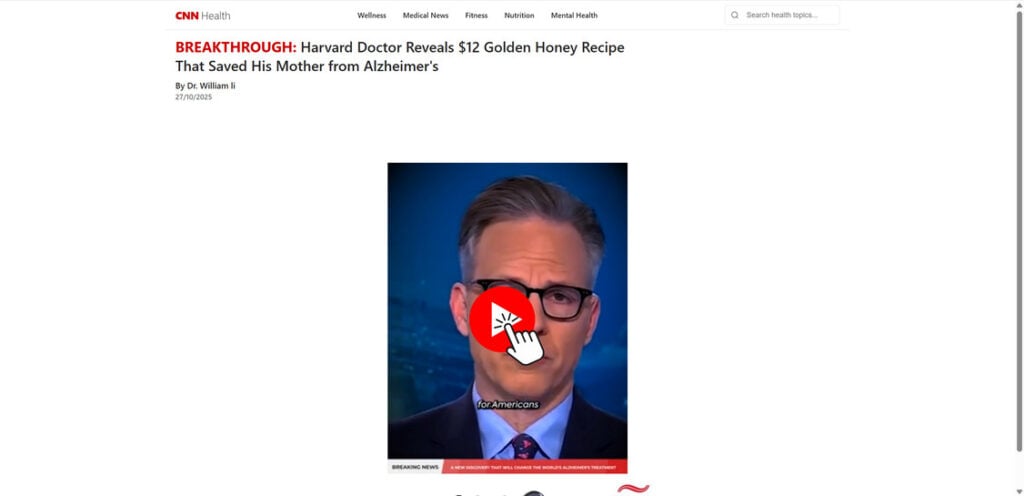
Scam Overview: The Recycled “CNN Alzheimer’s Cure” Narrative
The scammers behind this operation have created an entire ecosystem of deception designed to look legitimate and trustworthy. At the heart of it is a fake CNN news article that claims a “Harvard or CNN doctor” has discovered a natural way to reverse Alzheimer’s.
1. The Fake CNN Setup
The scam typically begins on Facebook, Instagram, or Taboola, where users see an ad labeled “Sponsored.” The post might feature an image of Dr. Sanjay Gupta, Anderson Cooper in a CNN studio, or a distressed elderly person with a headline like:
“BREAKING: CNN Doctor Reveals $12 Natural Cure That Reverses Alzheimer’s — Big Pharma Furious!”
Clicking the ad takes you to a fake CNN-style website — often hosted on domains like magazinecohealth.com, memoryhealth.fun, or todaynewsreport.com — that imitate the real CNN Health section.
These fake pages use CNN’s exact color scheme, layout, and fonts, including the familiar red header and navigation bar (“Wellness,” “Medical News,” “Nutrition”). The goal is to make the viewer believe they are reading an authentic article written by Dr. Gupta or another credible source.
2. The Fabricated Story
The fraudulent article usually opens with a headline like:
“BREAKTHROUGH: Harvard Doctor Reveals $12 Golden Honey Recipe That Saved His Mother from Alzheimer’s.”
The text begins with an emotional anecdote about a doctor discovering a “simple home trick” that reversed his mother’s memory loss. It then shifts into a pseudo-investigative tone, suggesting that pharmaceutical companies are hiding this “natural cure” to protect their profits.
Names like Dr. Sanjay Gupta, Anderson Cooper, and even Bruce Willis and Rumer Willis are woven into the story to amplify credibility. The scam often claims Bruce Willis — who was diagnosed with frontotemporal dementia — “used the same method” to improve his condition, or that Rumer Willis is “advocating natural Alzheimer’s treatments.”
None of this is true. These are fabricated claims built using AI-generated voices, deepfake videos, and stolen news footage.
3. The Fake “Expert” and Pseudoscience
The article often introduces a fictional neuroscientist, such as “Dr. Michael Carter” or “Dr. Jonathan Reeves,” who supposedly worked with Dr. Gupta on this discovery. The text mentions “groundbreaking Harvard research,” “neural rewiring,” or “ancient Indian honey roots,” all completely invented.
There are no references to real studies, no journal citations, and no verifiable institutions backing any of the information. The pseudoscience serves only one purpose — to keep readers hooked until they reach the product pitch.
4. The Product They’re Selling
Every version of the scam promotes a supplement under a rotating set of brand names, including:
- Memo Genesis
- Golden Honey Tonic
- NeuroHoney
- Brain Reconnect Formula
- MemoGold
Each of these is presented as the “natural cure” discovered by Dr. Gupta or his “Harvard research team.” The supplement bottles typically feature generic gold-and-white labels with slogans like “Supports Brain Health” or “Improves Memory Naturally.”
Prices are deliberately manipulated to seem like limited-time offers — $47 per bottle for “6 bottles” or $67 for “3 bottles” — accompanied by fake “FDA Approved” and “GMP Certified” badges. These badges are meaningless; the FDA does not certify or endorse dietary supplements.
5. The Emotional Hook
The article’s language is crafted to manipulate emotions. It tells a heartfelt story about an elderly parent regaining memory and recognizing family members again. Readers are told this method is “simple,” “home-based,” and “ignored by pharmaceutical companies.”
This appeal to emotion overrides rational skepticism, leading many to click “Buy Now” without verifying the legitimacy of the site or the claims.
How the Scam Works
Step 1: The Social Media Trap
The scam begins with AI-generated video ads and clickbait headlines. The ads are distributed on Facebook, Instagram, YouTube, and Taboola through fake profiles such as “HealthDailyReports,” “Caleb Stone,” or “Medical News Today Now.”
Each video often features deepfaked visuals of Dr. Sanjay Gupta or Anderson Cooper “reporting” on a new discovery about Alzheimer’s. Subtitles like “CNN BREAKING NEWS” flash across the screen, while the narration promotes a “$12 home trick that Big Pharma wants to hide.”
Step 2: The Fake CNN or Health Site
Once the user clicks the link, they’re taken to a counterfeit CNN-style page hosted on a fake domain. The article layout perfectly mimics CNN’s interface, featuring:
- A CNN logo and red navigation bar.
- A byline like “By Dr. Sanjay Gupta, CNN Chief Medical Correspondent.”
- A date to make it appear current (e.g., “27 October 2025”).
- Embedded fake videos.
At first glance, it looks entirely legitimate. Even the comment section below the article includes fabricated user reviews with photos and names like “Mary T. – Florida” and “George S. – Texas,” all praising the “miracle tonic.”
Step 3: The Fake Presentation Video
Scrolling down the page, readers are invited to “Watch the Full CNN Interview.” Clicking play launches a video with a deepfake voice impersonating Dr. Gupta, describing how “ancient Indian honey and turmeric compounds rebuild neural pathways.”
The voice and visuals are generated using AI tools that replicate Gupta’s speech style, tone, and facial movements. The video promises to reveal a “home recipe,” but it never does — instead, it segues into promoting Memo Genesis or another supplement.
Step 4: The Sales Page and Checkout Trap
Clicking “Order Now” redirects users to a checkout site — often hosted on CartPanda or ClickFunnels — where they are pressured to buy immediately.
The page includes:
- Fake countdown timers.
- Claims of limited stock (“Only 14 bottles left!”).
- A “100% Money-Back Guarantee” (which is never honored).
- Fake 5-star reviews with photos stolen from real people’s social media profiles.
Once a user submits their payment, several things may happen:
- They are charged more than the listed amount.
- They are signed up for a recurring monthly charge.
- Their personal and financial data are sold to third-party networks.
Step 5: Rebranding and Repetition
When the scam site is exposed or reported, the perpetrators simply rename the product, register a new domain, and re-upload the same content under a different supplement brand.
The narrative remains identical — only the name changes. Dr. Sanjay Gupta’s likeness, Anderson Cooper’s “interview,” and the “Golden Honey recipe” story are reused across every version.
Why Scammers Use Dr. Sanjay Gupta and CNN
Scammers exploit Dr. Gupta’s reputation because he is one of the most trusted medical voices in the media. As CNN’s chief medical correspondent, he represents credibility and authority in health journalism.
By attaching his name — and those of Anderson Cooper and Bruce Willis — scammers tap into a ready-made sense of trust and familiarity. Many people assume, “If CNN is reporting this, it must be real.”
The use of Bruce Willis and his daughter Rumer Willis further manipulates emotions, leveraging the actor’s public diagnosis to create a false sense of legitimacy and compassion.
In reality, CNN has never published or aired any segment about an Alzheimer’s cure involving honey, roots, or Memo Genesis. Dr. Gupta has repeatedly warned against misinformation and miracle cures.
What To Do If You Fell for the Scam
If you’ve purchased Memo Genesis or similar products from a site claiming Dr. Sanjay Gupta’s endorsement, here’s what you should do immediately:
- Contact Your Bank or Credit Card Provider
Report the charge as fraudulent and request a chargeback. - Cancel Future Charges
Ask your bank to block recurring payments linked to the merchant. - Report the Scam to Authorities
- FTC: ReportFraud.ftc.gov
- IC3: ic3.gov
- BBB: File under “Online Purchase Scam.”
- Do Not Respond to Emails from the Seller
Many “support” emails are phishing attempts. - Warn Others
Post warnings on social media and Alzheimer’s support groups to help prevent others from falling victim.
The Bottom Line
The Dr. Sanjay Gupta Alzheimer’s Cure Scam is not one isolated case — it’s an evolving network of fake health product sellers who continuously rebrand to stay ahead of detection.
They recycle the same narrative — a CNN doctor, a hidden home remedy, a natural cure, and a product that “Big Pharma doesn’t want you to know about.” Whether the product is called Memo Genesis, Golden Honey Tonic, or NeuroHoney, the story is the same — and it’s all a lie.
There is no home cure for Alzheimer’s, no hidden recipe, and no scientific evidence supporting these claims. Always verify the source before trusting any medical news, especially if it involves celebrity endorsements or miracle solutions.
Dr. Sanjay Gupta, Anderson Cooper, Bruce Willis, and Rumer Willis have no connection to these scams whatsoever.
Stay skeptical, research before you buy, and share verified information to help shut down this growing wave of health-related deception.
Frequently Asked Questions
What is the Dr. Sanjay Gupta Alzheimer’s Cure Scam?
The Dr. Sanjay Gupta Alzheimer’s Cure Scam is an elaborate online fraud that falsely claims CNN’s Dr. Sanjay Gupta has endorsed or discovered a natural cure for Alzheimer’s disease. The scam circulates under different product names — such as Memo Genesis, Golden Honey Tonic, NeuroHoney, and Brain Reconnect Formula — but always reuses the same storyline. It typically starts with a fake CNN-style article or video featuring deepfake footage of Dr. Gupta, Anderson Cooper, Bruce Willis, or Rumer Willis. These fabricated materials promote a so-called “natural home recipe” that can reverse Alzheimer’s or restore memory. In reality, there is no such cure, and these claims are entirely false. The goal is to trick people into purchasing unregulated, overpriced supplements or to steal their financial information.
Is Dr. Sanjay Gupta really promoting an Alzheimer’s cure or supplement?
No. Dr. Sanjay Gupta has never endorsed, promoted, or been involved with any supplement claiming to treat or cure Alzheimer’s disease. Scammers misuse his name, likeness, and professional reputation to add legitimacy to their schemes. They often use deepfake videos or stolen TV footage to make it appear as if Dr. Gupta is discussing a “miracle discovery.” CNN has not published or aired any story about a natural Alzheimer’s cure involving Dr. Gupta. If you see an advertisement or article claiming otherwise, it is fake.
Why do scammers keep using Dr. Sanjay Gupta, Anderson Cooper, and Bruce Willis in these fake ads?
Scammers deliberately use well-known and trusted public figures to make their fake news stories look authentic. Dr. Sanjay Gupta and Anderson Cooper are respected journalists associated with CNN, and Bruce Willis is a beloved actor who has publicly battled a dementia-related condition. By linking these familiar faces to their scams, fraudsters hope to manipulate emotions and build credibility. Rumer Willis is also mentioned to strengthen the false narrative about her father’s supposed “recovery.” None of these individuals are involved in any Alzheimer’s supplement promotion. Their names and images are used without consent.
How does the Dr. Sanjay Gupta Alzheimer’s Scam work?
The scam follows a predictable pattern:
- The victim sees a clickbait ad on Facebook, Instagram, Taboola, or YouTube. The ad shows an image of Dr. Gupta or Anderson Cooper with a headline such as “BREAKING: CNN Doctor Reveals Alzheimer’s Cure.”
- Clicking the ad leads to a fake CNN-style website hosted on a fraudulent domain like magazinecohealth.com or memoryhealth.fun.
- The article claims the FDA banned Alzheimer’s medications and that a “Harvard or CNN doctor” discovered a secret home recipe that reverses memory loss.
- The story introduces a fake expert, such as “Dr. Michael Carter,” who allegedly worked with Dr. Gupta to develop a product called Memo Genesis.
- The page eventually directs readers to a checkout site selling unverified supplements, often with fake “FDA Approved” and “Money-Back Guarantee” badges.
- Once the victim makes a purchase, they are either overcharged, signed up for recurring payments, or never receive a product at all.
Is Memo Genesis a real medical treatment?
No, Memo Genesis is not a legitimate or medically approved treatment for Alzheimer’s disease, dementia, or memory loss. It is a fraudulent product created as part of this ongoing scam network. There is no scientific research, FDA approval, or clinical evidence supporting Memo Genesis or any similar supplements like NeuroHoney or Brain Reconnect Formula. These products are typically manufactured by anonymous entities that disappear once exposed.
Why do scammers claim the FDA banned Alzheimer’s medications?
Scammers use this false claim to create panic and urgency, making people more likely to act impulsively. The message “The FDA just banned Alzheimer’s medications” is entirely false. In reality, the FDA continues to evaluate, approve, and regulate Alzheimer’s treatments such as Lecanemab and Donanemab. The claim is designed to mislead consumers into believing that pharmaceutical options no longer exist, leaving them desperate to try the scammers’ fake “natural solution.”
What happens if I buy Memo Genesis or a similar product?
Victims of this scam often experience one or more of the following:
- Unauthorized credit card charges or hidden subscription fees.
- Receiving fake or low-quality supplements with no ingredient transparency.
- No product delivery at all after payment.
- Exposure of personal and financial data to identity theft networks.
Even if a product arrives, it may be unsafe, contaminated, or completely ineffective. Consumers should never take unverified supplements claiming to cure serious medical conditions.
What are the red flags of this Alzheimer’s scam?
Common warning signs include:
- Fake news articles using CNN or Harvard logos.
- Claims that Dr. Sanjay Gupta or Anderson Cooper discovered a natural Alzheimer’s cure.
- Emotional stories about a doctor saving a family member from dementia.
- Urgency tactics like “limited stock” or countdown timers.
- Fake customer testimonials with stock images.
- “FDA Approved” and “Doctor Recommended” badges that can’t be verified.
If a product makes extraordinary health claims without scientific proof, it’s almost certainly a scam.
How can I verify whether a health product is legitimate?
Before purchasing any supplement or health-related product online, take the following steps:
- Check the domain name — legitimate health outlets use .com, .org, or .gov, not .fun or .info.
- Research the company’s name on the Better Business Bureau (BBB) and the FDA’s warning database.
- Look for scientific citations from credible journals or medical institutions.
- Search the product name followed by the word “scam” to see existing reports.
- Avoid any ad that uses celebrity endorsements for medical cures.
- Consult your doctor before starting any supplement that claims to treat or prevent diseases.
What should I do if I fell for the Dr. Sanjay Gupta Alzheimer’s Cure Scam?
If you’ve already made a purchase, act immediately:
- Contact your credit card provider or bank to dispute the charge and request a chargeback.
- Cancel any ongoing subscription or automatic payments.
- Report the scam to the Federal Trade Commission (FTC) at ReportFraud.ftc.gov.
- File a complaint with the Internet Crime Complaint Center (IC3.gov).
- Monitor your bank account for suspicious transactions.
- Do not reply to scam emails or click on any links from the seller.
- Warn others about the scam by posting accurate information on social media or forums.
Why does this scam keep resurfacing under different names?
Scammers constantly rebrand their products to stay ahead of detection. When one version — like Memo Genesis or Golden Honey Tonic — gets exposed, they simply register a new domain, change the product name, and reuse the same videos, scripts, and fake CNN layouts. Because social media advertising algorithms allow rapid re-targeting, these fraudsters can relaunch the scam in hours. This pattern of rebranding is common in online health fraud networks.
Is it safe to click on “CNN Health” ads about memory loss or Alzheimer’s cures?
No. Legitimate CNN Health stories are only published on cnn.com. If an ad or article is hosted on any other domain, it’s fake. Scammers use cloned versions of CNN’s site to trick users. Hover over links before clicking — if the URL doesn’t contain cnn.com, do not engage. Clicking such ads can expose you to phishing attacks or malware.
Does Alzheimer’s have a cure?
Currently, there is no cure for Alzheimer’s disease. Approved treatments can help manage symptoms and slow progression, but no supplement or “home recipe” can reverse the disease. Researchers continue to study promising therapies, but any claim of a guaranteed natural cure is false. The best protection against Alzheimer’s remains a healthy lifestyle, medical guidance, and early diagnosis from licensed professionals.
How can I report fake Alzheimer’s cure ads online?
You can help stop the spread of scams by reporting deceptive ads to:
- Facebook and Instagram: Click the three dots on the ad, choose “Report Ad,” then “Misleading or Scam.”
- YouTube: Click the flag icon and report the video as “Misleading Content.”
- FTC: Visit ReportFraud.ftc.gov to file a formal complaint.
Providing screenshots or URLs helps authorities track and remove fraudulent campaigns faster.









They have morphed the miracle product into “NeuroTyde”, hustled with great aplomb by a Dr. Attia. The CNN bit then moves to a 60 Minutes report, complete with the “FDA Certificate of Efficacy” which likely doesn’t exist. The hustle at the back end is “we don’t have many bottles left from this production run, so don’t wait for the next one”. Six bottles are nearly $300, while three are just over $200. The people responsible for this scam should be prosecuted to the full extent of the law, and hopefully imprisoned for a long time. They are the worst sort of predators, preying on people who live in fear amid the ravages of a cruel disease. I suspect they have no hearts.
Hi Steve, thank you for the detailed warning. Fake news-style segments, fake FDA-style certificates, celebrity or doctor name-dropping, and “only a few bottles left” urgency are all classic scam-ad tactics. Your comment will help readers recognize the same playbook under the NeuroTyde name.
Hi Steve, thank you for the detailed warning.
Fake CNN/60 Minutes segments, fake doctor endorsements, made-up “FDA certificate” language, and urgent “limited bottles left” pressure are all classic scam-ad tactics. Your comment helps document how the same scheme is being rebranded as NeuroTyde.
There was one. very convincing long video on Instagram with Gupta and an eldery chinese physician who in exquisite detail explains how the brrain works with necessary biological components and how and why when this is now missing material causing Alzheimers and how to return the missing material to the brain. Gupta is shown validating the research and thousands of people who have regained their memories. With film of how neurons become contaminated from plastics, etc. and what has over the years is missing caused by plastics and the environment: in the 20 or so minutes it is a very convincing snake oil presentation. There is a similar video of 60 minutes with Nora whatshername introducing the next scammer with similar films of the brain and how it’s not plak but contamination from all the electronics that surround us, not to mention a female neurologist (very convincing) who lost her father to Alzheimers, not to mention Bill Gates who lost HIS father to the tragedy, pitching a cure. Since I’m 95 and fairly intelligent, educated and independent, it is easy to believe these AI generated commercials, in spite of the fact that a young relative of mine works with Gupta but his brother won’t ask him because it is so obvious to him that’s its all fake. I could easily be duped because these people know what happens to the human body and the wish for
“A Cure”, of course is tempting; I mean “how much have I got to lose?” They always bring down the price in half to make it tempting.
Therefore a website like this is hugely helpful. It just needs to pop up as these fake ads pop up to warn people who do not check it out because they don’t know how to find you. Thank you for the information. It should be sent unsolicitated as a public service.
60
Hi Judith, thank you for such a thoughtful comment.
You described exactly why these ads are so dangerous: they are long, polished, emotionally persuasive, and packed with fake authority, fake science, and familiar public figures. For many people, especially older adults who are looking for hope or a real solution, they can be incredibly convincing.
Your comment explains the problem very well, and I’m glad the article was useful.