

Have you seen the video where Anderson Cooper and Dr. Sanjay Gupta supposedly reveal a “honey recipe” that can reverse Alzheimer’s disease? It looks like a CNN news segment, features well-known figures, and claims Bruce Willis used it to restore his memory. Sounds groundbreaking—but it’s a complete fake.
In reality, this video is part of a dangerous, AI-driven scam designed to sell fake supplements to vulnerable people. This article exposes the scam, breaks down how it works, and offers clear steps for those who may have been misled.
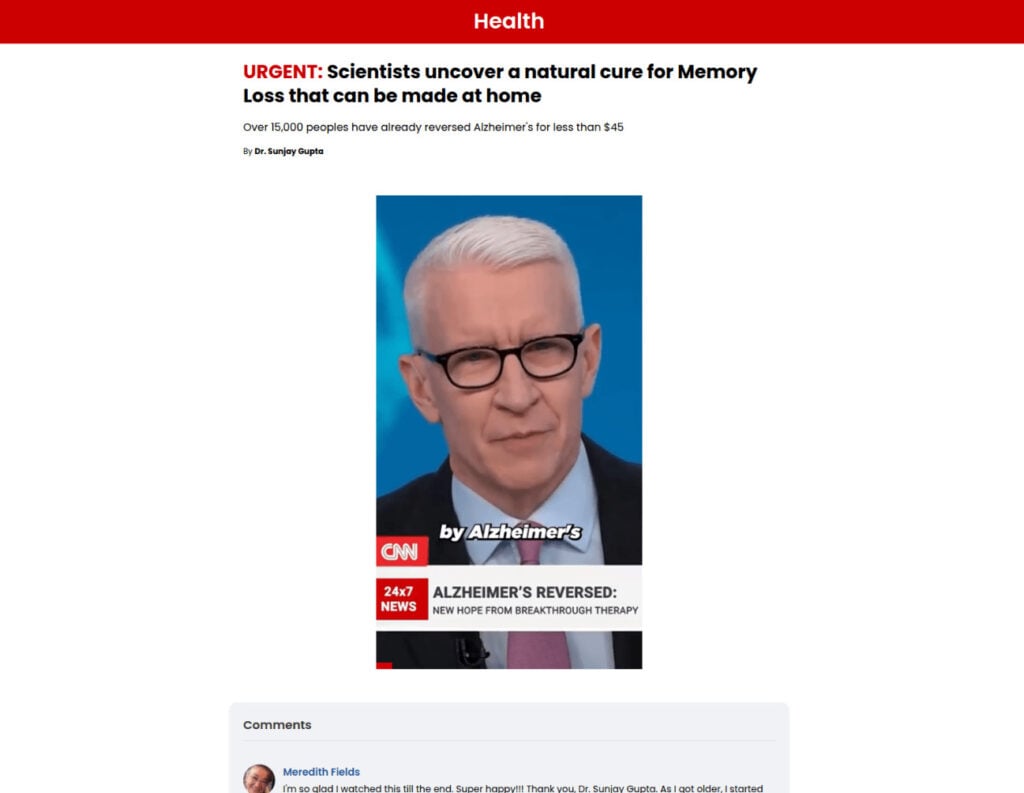
Scam Overview: False Hope Wrapped in Fake News
The Honey Recipe Alzheimer’s Scam has gone viral on Facebook, YouTube, and other platforms. It presents itself as a breakthrough medical report but is built entirely on deception.
Fake CNN Branding and Deepfake Technology
The scam uses CNN logos, lower-thirds, and familiar voices to create a sense of legitimacy. AI deepfake technology replicates Anderson Cooper and Dr. Sanjay Gupta with uncanny realism. The voices, facial movements, and background settings are digitally altered to mimic real CNN broadcasts.
Misuse of Public Figures and Tragedy
Scammers falsely claim Bruce Willis has reversed Alzheimer’s symptoms using this honey-based remedy. Bruce Willis has been public about his diagnosis, but neither he nor his family have endorsed any product. The use of his name without consent is both unethical and exploitative.
Unsupported Health Claims
The product in question is usually a supplement or powder marketed as a natural cure for Alzheimer’s, dementia, or memory loss. These claims are completely unproven. No peer-reviewed medical journal or reputable health organization supports the idea that a honey recipe can reverse cognitive decline.
Targeting Vulnerable Populations
This scam specifically targets older adults and families of those suffering from memory-related illnesses. The ads use fear, urgency, and emotional manipulation to sell false hope under the guise of a miracle cure.
Fake Authority and Science
To further convince viewers, the videos often include:
- Stock footage of scientists in labs
- Graphics of brain scans
- Buzzwords like “neuro-regeneration,” “natural detox,” and “reversal pathways”
- Fake FDA approvals or “Harvard-backed” claims
All of these are fabricated to sell a product that doesn’t work.
Deceptive Sales Tactics
Once the viewer is hooked, they’re redirected to a high-pressure sales page with:
- Countdown timers
- Fake scarcity alerts (“Only 12 bottles left”)
- Claims of limited availability
- Special pricing for today only
These are classic psychological tricks meant to force impulsive decisions.
How the Scam Works
Step 1: Hook the Viewer
The scam starts with a social media video made to look like breaking news. You see Anderson Cooper discussing a “new Alzheimer’s breakthrough” and hear Dr. Gupta explaining a natural remedy.
Step 2: Deepfake Deception
The video uses AI-generated faces and voices that imitate Gupta and Cooper. On the surface, it looks convincing. But if you pay close attention, you’ll notice off-sync lips, unnatural tone shifts, and looped gestures.
Step 3: Emotional Manipulation
The video shares stories of people “reversing dementia” within days of trying the honey remedy. The stories are completely fabricated, but they’re powerful enough to trigger emotional reactions from desperate viewers.
Step 4: Redirect to a Product Page
After building trust, the viewer is encouraged to click a link to learn more. This redirects to a website that continues the deception—sometimes showing fake reviews, more fake news segments, or even a fake scientific study.
Step 5: High-Pressure Checkout
The final step is the purchase page. Here, users are met with aggressive tactics:
- “Only 8 bottles left!”
- “60% off for the next 10 minutes!”
- “Doctor approved!”
There’s no transparency about who is selling the product. Refund policies are vague or hidden. Once you pay, customer service is non-existent.
Step 6: No Product or Useless Pills
In some cases, victims receive nothing. In others, they’re shipped a generic supplement with no proven benefit. Either way, the product does not do what the video promises.
Step 7: Ongoing Exploitation
Once a victim buys, their contact info is often sold to other scammers. They may be retargeted with more fake products, “refund” scams, or subscription traps.
What to Do If You’ve Fallen Victim to This Scam
- Stop Communication: Do not reply to emails or texts from the seller.
- Report the Scam:
- FTC: reportfraud.ftc.gov
- Better Business Bureau: bbb.org
- Your local consumer protection office
- Contact Your Bank:
- Request a chargeback
- Cancel the card used for the purchase
- Watch for additional unauthorized charges
- Flag the Ad: Report the video on Facebook, YouTube, or wherever you saw it.
- Monitor Your Identity:
- Use credit monitoring tools
- Check for new accounts or suspicious activity
- Spread the Word: Warn family and friends, especially seniors, who may be vulnerable.
- Avoid Similar Traps:
- Be skeptical of miracle cures
- Cross-check claims with official medical websites like Mayo Clinic or NIH
FAQ: Dr. Sanjay Gupta and Anderson Cooper Honey Recipe Scam
What is the Dr. Sanjay Gupta honey recipe scam?
This scam falsely claims that Dr. Sanjay Gupta and Anderson Cooper have endorsed a “honey recipe” that can reverse Alzheimer’s disease. The scam uses AI-generated deepfake videos and fake news reports, often branded with CNN logos, to mislead viewers into purchasing unproven supplements. These products are often overpriced, unregulated, and not supported by any credible science.
Did Dr. Sanjay Gupta really endorse a honey-based Alzheimer’s treatment?
No, Dr. Sanjay Gupta has not endorsed any honey recipe for Alzheimer’s treatment. Videos circulating online are deepfakes, using AI-generated versions of his face and voice. He has publicly confirmed that he is not associated with any such product and warns viewers to be cautious of false endorsements.
Is the CNN video featuring Anderson Cooper real?
No, the video that appears to show Anderson Cooper reporting on the honey cure is fake. It uses snippets of real CNN footage combined with AI-generated overlays to create a convincing but completely fabricated news segment. CNN has not reported on any such cure, and neither Anderson Cooper nor the network is involved.
What claims does the honey recipe scam make?
The scam falsely claims that:
- A secret honey recipe can reverse or cure Alzheimer’s disease
- Bruce Willis used the product to regain brain function
- The product is endorsed by CNN, Dr. Gupta, and other authorities
- Only a limited number of bottles are available
- The offer is only valid for a short time
None of these claims are supported by any medical evidence or verified sources.
Why do people fall for this scam?
The scam preys on fear, hope, and trust. It targets older adults and families of those suffering from Alzheimer’s or dementia, offering a seemingly simple and natural solution. By using trusted figures like Dr. Sanjay Gupta and Anderson Cooper, and mimicking the visual style of legitimate news, the scam gains false credibility. High-pressure sales tactics such as countdown timers also force people into quick, emotional decisions.
What is the product being sold?
The scam often promotes a vague honey-based supplement marketed as a brain booster or memory restorer. The product name changes frequently to avoid detection. It is sold through third-party websites with no verifiable contact information, refund policy, or scientific backing. In many cases, people report never receiving the product after payment.
Is there any scientific proof that honey can reverse Alzheimer’s?
No. While honey contains antioxidants and may offer some general health benefits, there is no scientific evidence that any honey-based mixture can reverse or cure Alzheimer’s disease. Reputable institutions like the Mayo Clinic, Alzheimer’s Association, and NIH have never endorsed such claims.
How can I tell if a video is a deepfake?
Deepfakes often include subtle visual or audio glitches. You may notice that the lips don’t sync with the audio, facial expressions look unnatural, or the voice has a robotic tone. If you’re suspicious, check official sources—such as CNN’s or Dr. Gupta’s verified social media pages—to confirm whether the video is legitimate.
What should I do if I bought the product?
If you’ve already made a purchase:
- Contact your bank or credit card provider to initiate a chargeback
- Report the website to the Federal Trade Commission at reportfraud.ftc.gov
- Alert the Better Business Bureau and your local consumer protection office
- Monitor your bank statements and credit report for suspicious activity
- Avoid clicking on follow-up emails or calls offering refunds—they may be a second layer of the scam
How can I avoid falling for scams like this in the future?
To protect yourself:
- Be cautious of miracle cures, especially for serious medical conditions
- Never trust medical claims without verifying them through trusted health sources like Mayo Clinic or WebMD
- Always verify celebrity or doctor endorsements through official channels
- Watch out for urgency tactics like countdown timers or “limited stock” claims
- Talk to your doctor before trying any new supplement, especially those targeting conditions like Alzheimer’s
Is this scam being investigated or taken down?
Platforms like Facebook, YouTube, and Google have policies against deceptive health ads. However, scammers often change names and re-upload content to stay ahead of moderation tools. Reporting these ads when you see them helps prevent others from falling victim.
The Bottom Line
The Dr. Sanjay Gupta and Anderson Cooper honey recipe video is a carefully crafted scam designed to sell fake supplements by exploiting the fear of Alzheimer’s. It uses AI deepfakes, fake news branding, and false testimonials to manipulate vulnerable people into buying a product that doesn’t work.
No honey-based supplement, or any supplement for that matter, has ever been proven to reverse Alzheimer’s disease. Always verify health claims with trusted medical sources and speak to a qualified doctor before considering any new treatment.

Join the discussion
0 commentsShare your experience or ask a question about this article.
Discussion
Start the conversation
Have a question or something useful to share? Add the first comment.