


A caller says there’s a problem with your credit card. They know enough about your accounts to make hanging up feel risky.
The Accelerated Debt scam shows how convincing that conversation could become. Before following another transfer or signing an emailed contract, understand where it was leading.
Overview
A fraud warning became an offer to deal with debt
Accelerated Debt Settlement and related businesses sold debt relief through phone calls and advertising, including websites inviting people to call about reducing their balances.
In the impersonation route, people first heard from someone claiming to represent their bank, a government agency, or a credit reporting company.
The supposed emergency made a sales conversation feel like the next necessary step in protecting an account.
The names you may recognize
- Accelerated Debt Settlement and Accelerated Debt Solutions.
- ADS Resolve and Financial Solutions Group.
- Unified Capital Services, also trading as Unified Debt.
These names belong to the specific operation in the FTC case. Similar wording on an unrelated business is not enough to identify the same seller.
What happened to the operation
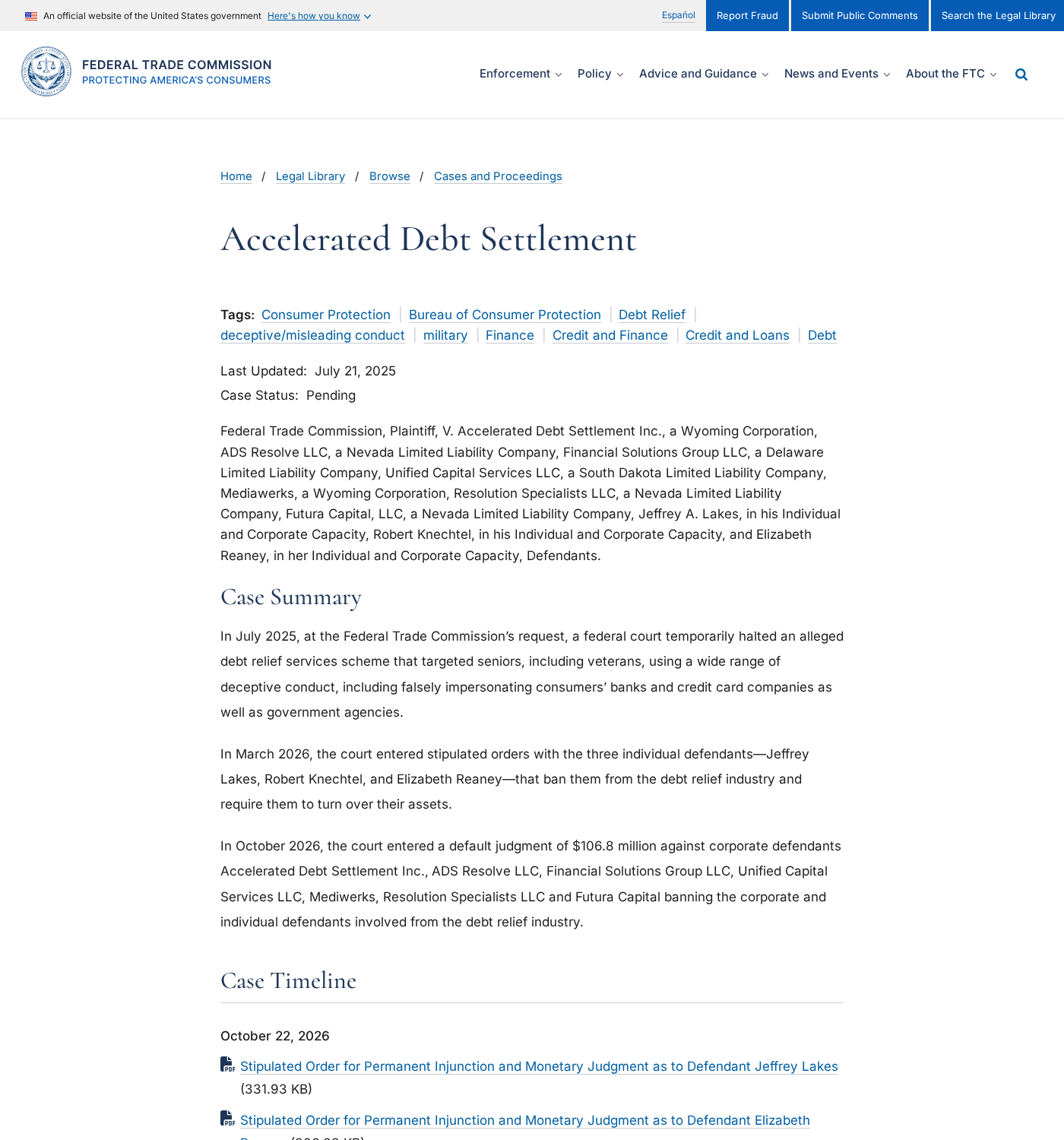
The FTC announced a permanent corporate shutdown in October 2026, following individual settlements earlier that year and a temporary halt in July 2025.
The newer event is the court outcome. The underlying scheme was already operating before the original lawsuit.
If you recognize the pitch, the urgent questions are what you paid, what information you shared, and what happened to your real credit accounts.
How the Accelerated Debt Scam Works
Step 1: Make the call sound like account protection
According to the FTC complaint, callers posed as credit card issuers and reported fraudulent activity. Some caller ID displays appeared to show the bank.
A warning about an existing card is much harder to ignore than an ordinary sales call. You may already be thinking about blocking a fraudulent purchase.
That gives the caller an opening: keep you talking long enough to explain what supposedly needs to happen next.
Treat the display as a label, not an identity check. End the call and contact the issuer through the number printed on your card.
Step 2: Pass you to a second trusted identity
The next representative purported to be from the Social Security Administration, Consumer Financial Protection Bureau, or a credit reporting agency, typically Experian.
The court found that the operation falsely represented these affiliations. The banks, agencies and credit reporting companies were being impersonated.
The transfer matters because it can feel like independent confirmation: another office appears to agree that something is wrong.
But a person introduced by the first caller has not independently verified anything for you. Start a separate conversation through a contact you obtain yourself.
Step 3: Turn account details into reassurance
The court found that unlawfully obtained credit reports helped the defendants convince consumers that they represented trusted institutions.
A familiar balance or account detail can make the caller sound unusually well informed. It can also make an otherwise strange explanation seem personal.
Knowing something about an account does not give the caller permission to manage it. Information and authority are different things.
Ask your actual issuer what is happening. Do not confirm missing account details just because the caller has supplied some correct ones.
Step 4: Introduce the debt seller, or bring you in through an ad
The complaint describes a later handoff where representatives finally identified themselves by the debt business name. They offered to negotiate lower credit card balances.
Other consumers arrived through advertising rather than a fake bank warning. Websites listed callback numbers and advertised consolidation and substantial savings.
A callback you initiate can feel safer. Yet choosing to dial a number from an advertisement does not validate the claims made after someone answers.
Keep the advertised promise and the company actually taking the fee together. A trusted name used earlier in the conversation cannot endorse a later contract.
Step 5: Get the contract signed and collect the fee
Consumers received electronic contracts while still on the phone. The complaint describes pressure to sign after lengthy conversations about supposedly compromised cards.
The court found that the defendants collected prohibited advance fees. They also falsely said the fee would become part of the debt being reduced or eliminated.
That sales story removes an obvious objection: the customer is being asked to add a charge while seeking relief from existing charges.
A seller taking a fee is not the same as a creditor accepting a settlement. Ask who receives the payment and what debt it actually pays.
Do not approve an electronic signature merely to finish an exhausting call. Read the complete contract away from the caller, with someone you trust if helpful.
Step 6: Stop paying creditors and wait for the promised result
The FTC described instructions to stop card payments. Consumers could then face higher balances and worse credit while the promised debt reduction failed to arrive.
The court found false promises of restored credit scores after the program, along with inadequate disclosure of credit harm.
Your creditor still maintains its own account. A debt company saying it is handling matters does not tell you what that creditor has actually agreed to.
Check the issuer’s records directly. A welcome email, a contract or a confident update from the seller cannot replace confirmation of an accepted arrangement.
Who Was Behind Accelerated Debt and ADS Resolve?
Several seller names appeared in the same case
The FTC case names seven corporate defendants, including ADS Resolve, Unified Capital Services, Resolution Specialists and Futura Capital.
It also names Financial Solutions Group and Mediawerks. Some FTC documents spell the latter name Mediwerks.
Match the actual contract and statement descriptor to the case. A search result for a similar company name can send you toward the wrong organization.
A shared operation, rather than seven unrelated complaints
The corporate default judgment found a common enterprise with overlapping ownership, officers, business functions and locations, along with commingled funds.
That finding connects these named defendants. It does not justify attaching the case to every business using words such as financial solutions or capital.
For your records, keep the exact legal name, trade name and document date. They can matter when explaining a charge to your issuer.
The individuals had a different procedural outcome
Jeffrey Lakes, Robert Knechtel and Elizabeth Reaney entered stipulated orders in March 2026, according to the FTC. Those orders imposed bans and asset transfers.
The October ruling concerned defaulting corporate defendants. Civil default findings and individual settlements are different outcomes; neither should be described as a criminal conviction.
The distinction helps you understand the documents without losing the practical point: the operation faced binding restrictions on the activities used to sell these services.
The judgment is not a refund already in your account
The court entered $108,586,567.60, while the FTC announcement says $106.8 million.
The court order establishes a payment obligation. It does not show that this much cash has been recovered.
The FTC says collected funds could support consumer redress. That does not mean every customer automatically receives a full refund.
Why This Was More Than a Debt Settlement Dispute
The findings include impersonation and deceptive claims. This was not simply a customer hoping for a better discount than a legitimate negotiator achieved.
The original FTC case described thousands of affected consumers, primarily older people, including veterans. It alleged collections exceeding $100 million.
One veteran described in the FTC announcement ended up $13,000 deeper in debt, with a sharply reduced credit score and a threatened job security clearance.
Another had to use savings and retirement funds to repay increased debt after an advance fee of nearly $10,000, according to the agency.
These examples show why getting a real account back under control matters as much as challenging the seller’s fee.
Debt Relief, Counseling and Consolidation Are Different
The CFPB distinguishes credit counseling, settlement and consolidation. The labels describe different arrangements, with different costs and risks.
A credit counselor may help create a budget or payment plan. A consolidation loan replaces several debts with another loan. Settlement seeks a creditor’s agreement.
A government agency’s name in a sales pitch changes none of those obligations. You still need to understand which service is being offered and by whom.
For covered debt settlement services, the CFPB explains that fees cannot precede a settled or renegotiated debt, your agreement, and a payment to the creditor.
Money reserved for settling debt also needs to be distinguished from a fee the seller has already taken. Ask for statements showing where each payment went.
The FTC’s debt relief warning advises against unexpected offers asking for personal information and advance payments for promised debt elimination.
Real help can begin with a nonprofit credit counselor, a credit union or a military financial counselor. Ask about fees before agreeing to services.
What to Do if You Have Fallen Victim to This Scam
-
Hang up and contact your card issuer. Stop following transfer instructions. Contact your actual bank or card issuer through its app, statement or card.
Explain that someone used a bank or agency identity to sell debt relief. State whether you shared account numbers, signed anything, or approved a charge.
Keep your explanation factual. If you authorized a payment because of deception, say that; identify separately any transactions you did not authorize.
-
Ask the payment provider about the fee. The FTC recommends promptly reporting a scam payment and asking whether it can be reversed.
For a card charge involving undelivered services, ask the issuer about its dispute process. Send the contract, promised service and transaction details.
The CFPB describes a 60-day billing-error notice window after the charge appears on your statement. Follow the issuer’s instructions promptly rather than waiting for a refund promise.
Older charges are still worth reporting. Eligibility depends on the facts, payment method and applicable process; a judgment does not guarantee a successful chargeback.
-
Check every affected creditor account. Confirm balances, missed payments, contact details and whether any settlement was actually accepted. Request copies of relevant agreements.
The CFPB recommends contacting your issuer immediately when payments are unaffordable, explaining what you can pay and the assistance you need.
Discuss a realistic hardship arrangement. Tell the issuer if you stopped paying because a debt seller instructed you to do so.
If court papers have arrived, get qualified legal help promptly. Do not rely on a seller’s earlier promise that it will handle everything.
-
Preserve the trail before canceling or deleting anything. Save the ad, emails, electronic contract, fee breakdown, statements, call dates and names used.
Keep a short timeline: first contact, claimed institution, company named on the contract, payment, promised result and what your creditor actually received.
Ask in writing to cancel unwanted services and revoke any disputed payment authorization. Keep a copy; separately ask your bank how to prevent further withdrawals.
Do not post full card numbers, bank details or unredacted contracts in public comments. Share sensitive records only through the verified channel handling your complaint.
-
Protect credit and identity information. Check your reports for unfamiliar accounts and incorrect contact information. Investigate changes with the relevant creditor or credit bureau.
A free credit freeze can make new-account identity theft harder. Contact Equifax, Experian and TransUnion separately to freeze each report.
A fraud alert is another option. Contact one nationwide bureau to arrange the initial alert; it must notify the other two.
If your information was misused, use IdentityTheft.gov for a recovery plan. A freeze does not resolve existing debts or reverse a payment.
-
Report the specific offer and watch for a second approach. Submit the details at ReportFraud.ftc.gov. Include the seller names and payment route.
For case developments, start at the FTC’s Accelerated Debt case page, then follow its original notices and documents.
Do not pay a stranger who promises access to judgment funds. A caller’s knowledge of this case or your loss does not prove authority to recover it.
Frequently Asked Questions
Was Accelerated Debt Settlement a confirmed scam?
The default judgment found deceptive debt relief and impersonation, accepting the allegations as true after the corporate defendants failed to defend.
Was the call really from Experian, the SSA or the CFPB?
Those callers were impersonators. Contact the organization directly through its verified website if you need to check a fresh call.
Does signing the debt contract mean my cards were paid off?
No. Confirm directly with each creditor whether it received money or agreed to a settlement. An agreement with a debt seller is a separate document.
Can I get my advance fee back?
Ask your payment provider promptly about a dispute or reversal. The court judgment does not automatically repay your fee, and recovery is not guaranteed.
Should I stop paying my credit cards while this is investigated?
Contact your issuer about the actual account and any disputed charge. Arrange help for payments you cannot afford instead of following the caller’s blanket instructions.
Is all debt counseling a scam?
No. Credit counseling can help with budgets and repayment plans. A legitimate service needs clear terms; it cannot borrow a government identity to sell you confidence.
The Bottom Line
Do not enroll or pay through the Accelerated Debt scam’s impersonation pitch. A fake bank warning and a trusted-sounding transfer cannot authorize debt relief.
If you already responded, contact your payment provider and real creditors. Check the fee, account access and missed payments as separate problems needing specific answers.
Use verified official channels for the case and any recovery process. Keep your records, and do not let another unsolicited caller sell you a way out.

Join the discussion
0 commentsShare your experience or ask a question about this article.
Discussion
Start the conversation
Have a question or something useful to share? Add the first comment.