

The ad promises a way out of an IRS bill you cannot comfortably pay. A representative says a settlement could make the balance much smaller.
Then comes the enrollment fee. Before paying for that hopeful answer, find out what the offer in compromise pitch has actually checked.
Overview
A real IRS program becomes the sales hook
An offer in compromise, or OIC, can let an eligible taxpayer settle a tax debt for less than the full balance.
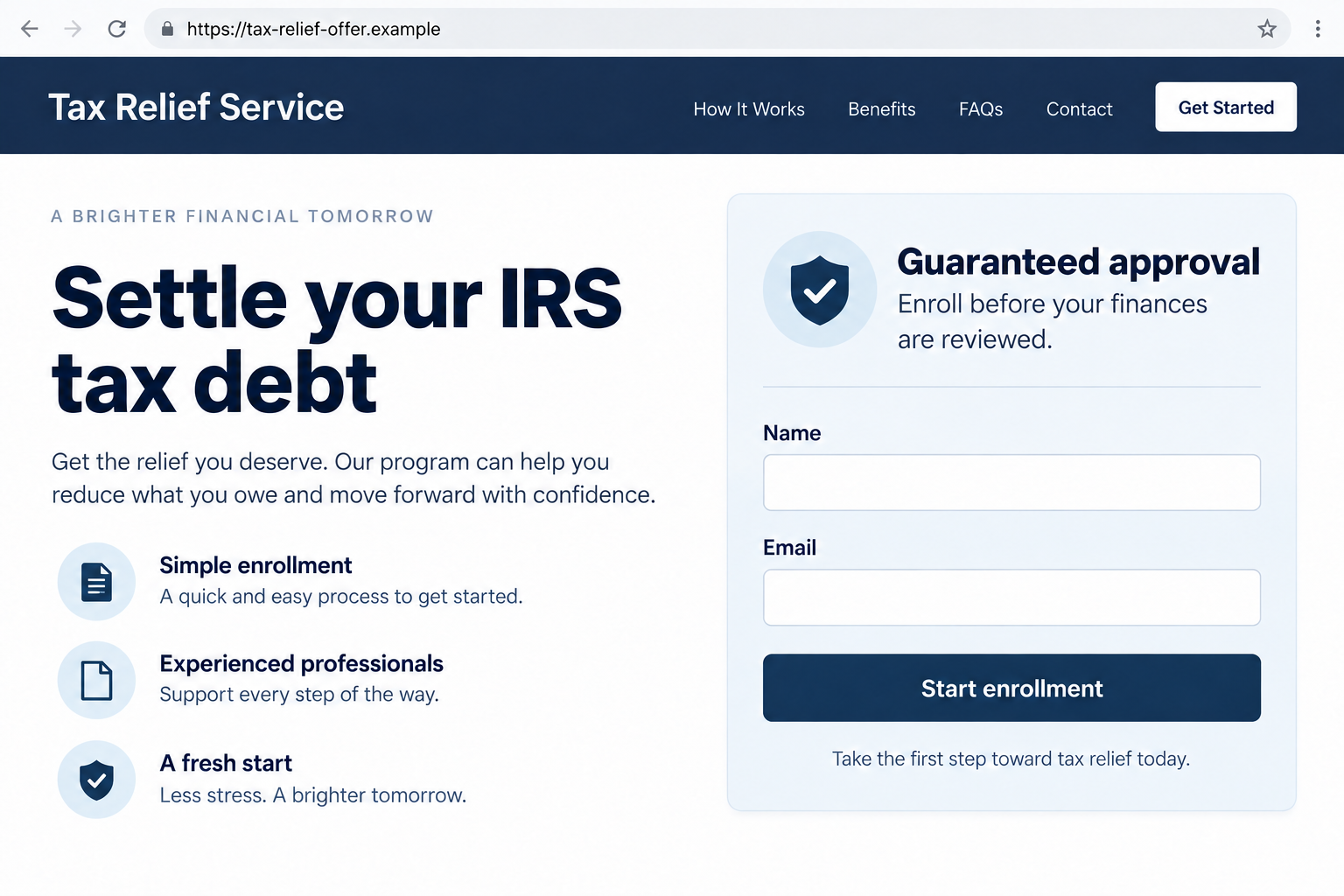
The offer in compromise scam sells that possibility as an easy or guaranteed outcome. Promoters collect substantial fees before establishing whether the customer can qualify.
The IRS calls these misleading operations OIC mills. Its warning about exaggerated tax-relief promises describes high fees charged to people who do not qualify.
The program itself is legitimate. So are many tax professionals. The problem is a sales promise that outruns the customer’s financial circumstances and the IRS decision.
Guaranteed approval is not an eligibility assessment
Owing tax does not automatically mean the IRS will accept a reduced settlement. Income, allowable expenses, assets, and ability to pay affect the review.
A salesperson who knows only your estimated balance or telephone number has not gathered enough information to promise that outcome.
Pay attention when the offer includes:
- Guaranteed acceptance before anyone examines financial records.
- A fee to unlock a supposed special IRS settlement program.
- Pressure to enroll before comparing ordinary payment options.
- An unclear distinction between agency payments and company charges.
- Promises that enrollment alone stops collection or resolves every tax year.
The useful first check does not require a promoter
Start with the IRS OIC information and its free eligibility resources. A preliminary result helps frame the question; it is not an acceptance letter.
If professional help is needed, choose someone independently and request a written assessment, scope, and fee breakdown before paying.
The lead image illustrates a misleading offer on a fictional website. It is not a captured advertisement from a named tax-relief company.
What a Genuine Offer Must Account For
Your ability to pay matters more than the advertised discount
The IRS generally will not accept a reduced offer when the debt can be paid in full through a payment plan or available asset equity.
That makes a large promised reduction meaningless without a review of your circumstances. A testimonial from another taxpayer does not answer that question for you.
The assessment also needs the actual tax periods and balances involved. An approximate total supplied during a sales call is not a complete account review.
Basic filing requirements come before a settlement promise
The official guidance includes required filed returns, estimated payments, no open bankruptcy, and relevant federal tax deposits for employers.
Those are starting requirements, not a complete personal eligibility opinion. A responsible adviser explains which records are missing instead of treating missing information as irrelevant.
If you disagree that the debt is owed, rather than being unable to pay it, ask for advice about the appropriate dispute or application route.
Company fees and IRS payments are separate
The standard Form 656 application includes a $205 application fee and an initial offer payment. Qualifying individuals can receive a low-income exception.
That does not make an unrelated commercial enrollment charge an IRS fee. The invoice needs to say who receives each amount and what it pays for.
Different offer grounds can involve different forms and requirements. Use the applicable instructions instead of assuming every advertised settlement follows one identical process.
An agency-fee waiver does not automatically waive a private firm’s service charge. Ask the professional to separate those costs before you agree to an installment schedule.
Also ask whether an assessment fee is credited toward later work. A seemingly small first payment can be only the beginning of the proposed contract.
How the Offer in Compromise Scam Works
Step 1: A reduced tax bill is presented as almost within reach
The promotion starts with a problem the reader already wants solved. It promises less stress, a smaller balance, or a quick settlement.
Using the name of a real IRS program makes the pitch sound grounded. The important missing piece is whether that program fits this taxpayer.
A genuine option can be described deceptively. You do not need a completely invented government program for the sales promise to mislead.
Step 2: A sales conversation substitutes for financial review
The representative asks a few broad questions and treats the answers as enough to suggest approval. Enrollment may be encouraged before supporting documents are examined.
That reverses the sensible order. Records should explain the likely route and its limitations before a customer commits to a substantial service.
Ask what information supports the proposed outcome. A debt threshold or confident estimate cannot replace an assessment of income, expenses, assets, and filing compliance.
If the answer returns immediately to the payment deadline, the salesperson has not resolved the eligibility question.
Step 3: An upfront payment creates the feeling of progress
The company requests an enrollment, investigation, preparation, or retainer charge. Some genuine advisers also charge for work, so the label alone is not the verdict.
The concern is what was promised before payment and what the agreement actually provides. A guaranteed settlement can shrink into a promise merely to review paperwork.
Read whether the charge covers an assessment, an application, representation, or only a referral. Those are different services with different practical value.
A receipt from the company shows payment to the company. It does not establish that the IRS received an offer.
Step 4: The paperwork reveals limits hidden by the pitch
A written contract may disclaim the result that sounded assured over the telephone. Refund exclusions may begin when work starts, not when a settlement is achieved.
Compare those terms with the original sales claim before authorizing more charges. Ask the provider to explain the difference in writing.
A legitimate adviser can identify uncertainty plainly. A misleading promoter may instead treat every objection as another reason to continue paying.
Do not assume a signed authorization covers every future action. Understand what the representative can do, which tax matters it covers, and how to end it.
Step 5: Filing, extra fees or ineligibility become the next problem
The customer may discover they cannot qualify, need additional filings, or have purchased less work than expected. More service charges can follow.
The next invoice needs an explanation of its own. Ask which extra work it buys and why that work was not included in the original assessment.
Ask for evidence of the actual work performed. A draft form, a submitted offer, and an IRS acknowledgment are not interchangeable milestones.
Keep real agency deadlines separate from the provider’s timetable. Waiting for a salesperson’s update should not replace independent attention to an IRS notice.
Step 6: The customer pays for an outcome the promoter never controlled
The central problem becomes clear: the promoter collected a real fee for a favorable agency decision it could not guarantee.
An unfavorable result alone does not prove misconduct. The relevant questions are whether eligibility was assessed honestly and whether the purchased service was delivered as represented.
If promises and performance conflict, preserve both. A written record is more useful than another assurance that everything will work out after one last payment.
Who Is Taking Your Tax-Relief Payment?
The trading name is not the person representing you
Identify the company named on the agreement and the individual handling the tax matter. A call-center brand can differ from the professional doing the work.
Use IRS guidance on choosing a tax professional to check qualifications. A preparer identification number does not establish every possible representation right.
An address does not demonstrate government affiliation
A postal address, official-looking letterhead, or nearby office does not make a private firm part of the IRS.
A mailbox can be a legitimate business contact. What matters is whether the firm accurately identifies itself and gives you a reliable route to the responsible professional.
Cancellation needs a written process, not another sales call
Find the cancellation clause, any refund conditions, and the address for sending a request. Save the version of the agreement you actually accepted.
Ask which completed work the firm claims justifies retaining a fee. Do not assume either an automatic full refund or that every charge is beyond challenge.
Follow the money and the actual submission
Separate provider fees from IRS application or offer payments. Keep receipts showing the payee, purpose, tax period, and relevant confirmation.
The official OIC payment FAQs explain agency payment methods. Company enrollment is not a substitute for the correct agency process.
Check the Alternative Before Buying the Promise
Use the official starting point
The IRS provides a pre-qualifier and an Individual Online Account route for eligible individual applications. Forms remain available for other situations.
Business Tax Account payment access should not be confused with submitting every business offer online. Follow the instructions for your account type and application.
Keep financial information within the genuine service or a verified professional relationship. A commercial quiz copying IRS colors is not the official eligibility tool.
Ask which other option fits the problem
A payment arrangement or another form of relief may be more appropriate than an OIC. The best answer is not necessarily the most dramatic advertised reduction.
For help with an IRS dispute, official assistance resources include Low Income Taxpayer Clinics for eligible people.
Tax-return preparation and representation in a dispute are different tasks. Ask which service is needed rather than paying for a broad package by default.
What to Do if You Have Fallen Victim to This Scam
-
Pause additional company payments while reviewing the agreement.
Request the signed contract, itemized charges, eligibility assessment, work completed, and refund policy. Keep the request and response together.
This concerns the provider’s charges. Do not stop legitimate IRS obligations or disregard agency notices because you are disputing a commercial service.
-
Verify what the IRS actually received.
Use your independently accessed account or an official IRS contact route. Ask about the offer status and relevant notices.
If the firm says it submitted an application, request the submission details. Do not treat a salesperson’s progress update as an agency acknowledgment.
-
Get an independent assessment before changing the tax strategy.
A verified enrolled agent, CPA, attorney, or appropriate clinic can help assess the actual records and deadlines.
Explain both the tax issue and the sales promises. A second opinion should not require accepting another guaranteed-settlement pitch.
-
Send a clear written cancellation or refund request when appropriate.
Identify the agreement, disputed promises, payment dates, and remedy requested. Follow the contract’s contact instructions and retain delivery evidence.
Ask for a written explanation of any retained fee. Your rights depend on the agreement and applicable law, so seek qualified advice if needed.
-
Speak with the payment provider about disputed charges.
Provide invoices, the advertised service, and correspondence showing how delivery or qualification differed. Ask which dispute process and deadline apply.
A commercial-service dispute differs from an unauthorized card transaction. Describe it accurately instead of assuming a particular refund rule applies.
-
Review representative access and sensitive information.
If you granted tax-information access or representation authority, ask an independent professional how to review or revoke it correctly.
If credentials were shared outside the genuine IRS service, secure the affected account through its real recovery process. Keep copies of any authorization changes.
-
Report deceptive sales and documented professional misconduct.
Use the FTC reporting service for fraudulent or misleading consumer approaches. IRS complaint routes depend on the professional’s conduct and role.
Separate an unsuccessful legitimate application from a false promise or undelivered service. Give dates, documents, payments, and the exact representation that influenced you.
-
Keep the unresolved tax bill on a separate action list.
Record genuine agency deadlines and any existing payment arrangement. A dispute with the promoter does not automatically resolve the balance.
Reject unsolicited offers to recover your fee through another advance payment. Continue with the independent adviser or official case channel you selected.
Frequently Asked Questions
Is an offer in compromise itself a scam?
No. It is a legitimate IRS process for eligible taxpayers. The scam is misleading enrollment based on unrealistic qualification or guaranteed approval.
Does the free pre-qualifier guarantee acceptance?
No. It is a preliminary check, not the IRS decision on a complete offer. A promoter cannot turn that initial result into guaranteed acceptance.
Is every upfront professional fee fraudulent?
No. Legitimate professionals charge for work. Check the assessment, written scope, payee, and promises instead of judging the service solely by when payment occurs.
Can a provider stop IRS collection just by enrolling me?
Commercial enrollment alone does not establish an IRS submission or change your account’s status. Verify the real application and notices before relying on any collection-related assurance.
What is the difference between an IRS fee and a company fee?
An agency fee belongs to the official application process. A private service charge pays the provider. Your paperwork should identify each separately, including any applicable agency-fee exception.
What should I do first if I already paid?
Obtain the agreement and work record, check the actual IRS status, and arrange an independent assessment. Address refund or payment disputes without neglecting genuine tax deadlines.
The Bottom Line
Do not pay a promoter for guaranteed IRS approval. A real financial review comes before a responsible settlement proposal, not after an unsupported sales promise.
Use official eligibility information or an independently verified professional. If you already paid, check the actual filing, request the service record, and pursue the appropriate dispute route.








