

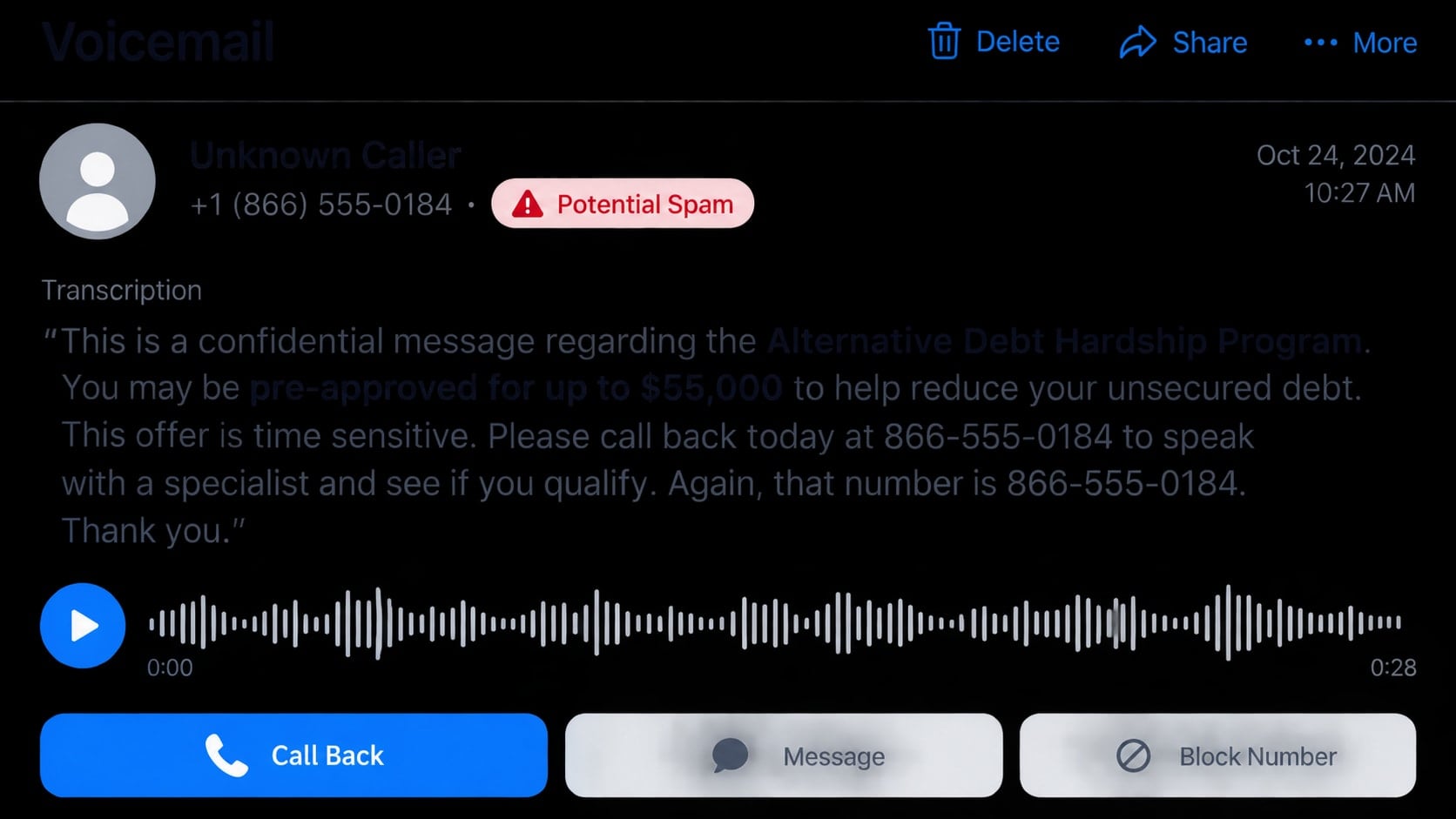
The voicemail sounds almost considerate. A calm representative says you may qualify for a special hardship program, and as much as $55,000 could be available to solve the debt that has been keeping you awake.
There is just enough detail to make the offer feel personal, yet something important is missing. Before you return the call, it helps to understand what the phrase “Alternative Debt Hardship Program” is really being used to sell.
Overview
It is a marketing phrase, not a specific government benefit
The Alternative Debt Hardship Program scam usually begins with an unexpected call, voicemail, text, or mailer. The message says the recipient has been pre-approved for debt relief, a consolidation loan, or an economic hardship program worth up to $55,000.
The name is deliberately broad. It sounds official without identifying a real agency, law, lender, or account. That vagueness lets different callers reuse the same script while changing the promised amount, callback number, and supposed deadline.
The first promise often hides a different transaction
Some callers are collecting sales leads for debt-settlement companies. Others are advance-fee scammers, identity thieves, or operators trying to obtain access to a victim’s bank account. The initial message rarely explains which business will actually provide the service.
A person who calls back may hear that the offer is a loan, then discover it is really debt settlement. Another victim may be told that an enrollment fee, insurance deposit, or tax payment is required before any help can begin.
The pressure is designed to outrun careful verification
The message may say a file is about to close, rates will change tonight, or only a few program spaces remain. These artificial deadlines encourage a decision before the recipient checks the company, reads a contract, or compares safer options.
Legitimate help does not become trustworthy because a caller knows your name or approximate debt. Those details may come from marketing lists, public records, credit-related lead forms, or information exposed in an unrelated breach.
- An unsolicited message says you are pre-approved without reviewing your finances.
- The caller uses an official-sounding program name but avoids naming a responsible agency.
- A large amount such as $55,000 is emphasized before costs and eligibility are explained.
- You are asked to pay an enrollment, processing, insurance, or release fee in advance.
- The representative guarantees that creditors, lawsuits, or collection calls will disappear.
- You are told to stop paying creditors before receiving and understanding a written plan.
What the Alternative Debt Hardship Program Claim Really Means
“Hardship program” can describe many legitimate arrangements. A credit-card issuer might temporarily reduce a payment after reviewing a customer’s circumstances. A nonprofit counselor might propose a debt management plan. A lender might offer a carefully underwritten consolidation product.
The unsolicited Alternative Debt Hardship Program pitch is different. It treats a generic label as if it were the name of a single national benefit. The caller often cannot identify the creditor offering relief or explain why the recipient qualified.
Debt settlement is also different from a new loan. A settlement company may ask a customer to save money in a dedicated account while it attempts to negotiate with creditors. Creditors are not required to accept an offer, and missed payments can bring fees, collection activity, lawsuits, and credit damage.
A consolidation loan, by contrast, pays eligible debts with borrowed money that must be repaid under new terms. A lower monthly payment does not automatically mean a lower total cost. A longer term, origination fee, or higher rate can make the loan more expensive.
That distinction matters because deceptive callers often move between these descriptions. They begin with “relief,” call it “consolidation” when asked for details, and finally present a settlement contract that does not resemble the original promise.
How the Alternative Debt Hardship Program Scam Works
Step 1: A broad message finds someone at the right moment
Thousands of prerecorded calls and texts can be sent cheaply. The message does not need to know whether every recipient has debt. It only needs to reach a few people who recently missed a payment, searched for a loan, or feel anxious about rising balances.
The wording is usually sympathetic rather than aggressive. Phrases such as “we understand,” “new hardship options,” and “you deserve a fresh start” lower the recipient’s guard while the pre-approved amount creates curiosity.
Step 2: A callback agent gathers financial and identity details
The agent asks about card balances, income, employer, housing payment, Social Security number, date of birth, and bank. Some questions resemble real underwriting, which makes the interview feel normal even when the business has not been identified.
This information can be used to sell the lead, open accounts, target the victim with more convincing scams, or attempt unauthorized withdrawals. A caller who refuses to provide a verifiable company name and physical address should not receive sensitive details.
Step 3: The original offer changes after the victim is invested
Once the agent knows the size of the debt, the “up to $55,000” promise may disappear. The victim is instead told to enroll in a program, sign a power of attorney, or deposit money into a special account every month.
The representative may describe ordinary negotiation as guaranteed forgiveness. Important risks are rushed, buried in electronic paperwork, or contradicted by verbal promises that will be difficult to prove later.
Step 4: An upfront payment is framed as necessary
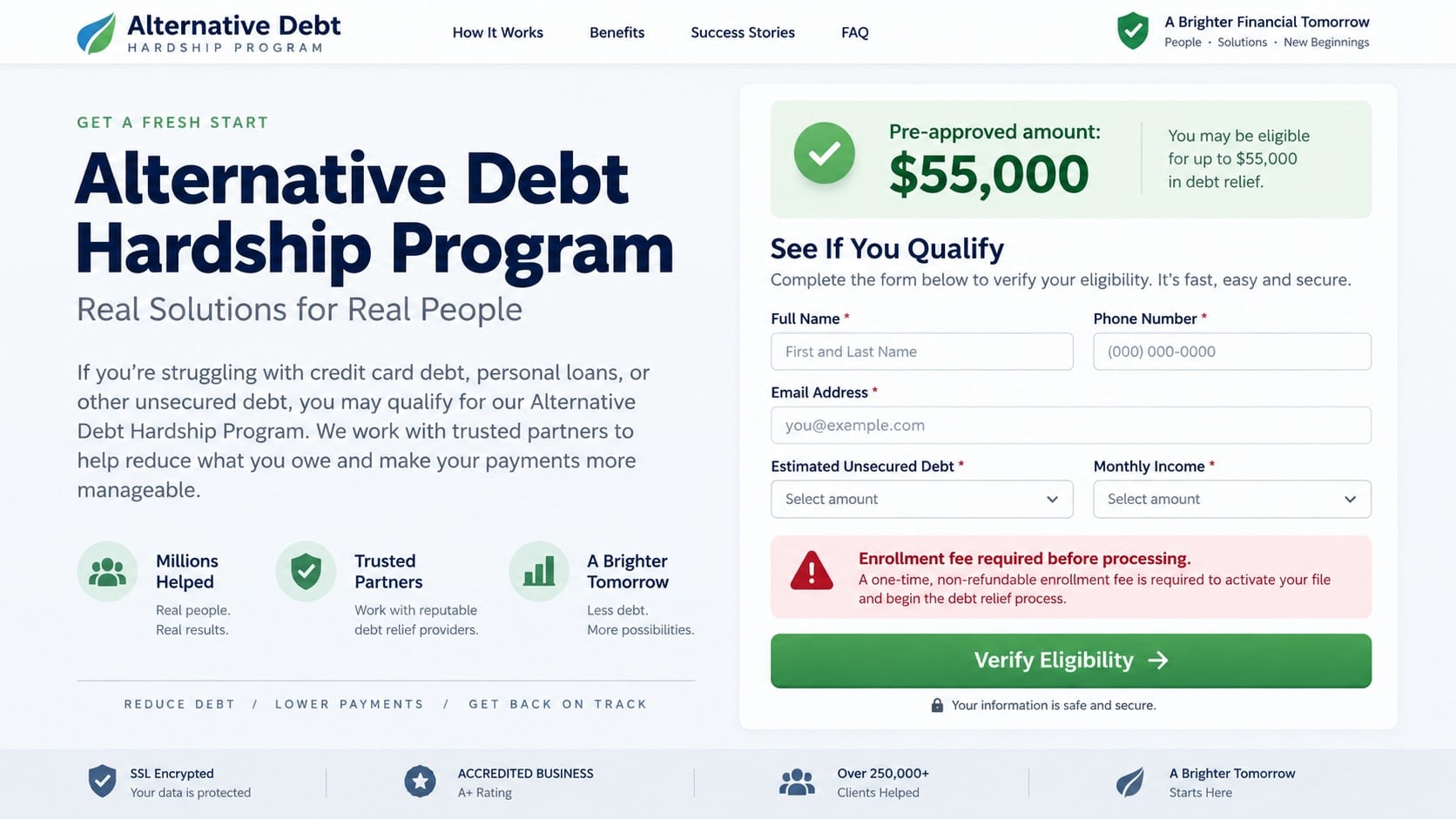
In a direct advance-fee version, the caller says a processing charge, insurance premium, refundable deposit, or first payment must be collected before funds can be released. Payment may be requested by card, bank transfer, gift card, or cryptocurrency.
The fee is not a shortcut to relief. If a stranger promises a loan or settlement only after receiving money, sending the fee removes the victim’s leverage and gives the operator a reason to invent another charge.
Step 5: The victim may be told to stop communicating with creditors
A deceptive operator may insist that every creditor call should be ignored and that regular payments must stop immediately. This creates dependence on the supposed program and prevents the victim from hearing that no settlement has been reached.
Late fees, interest, collection activity, and legal deadlines can continue during that silence. Even a legitimate settlement strategy carries consequences, so no one should stop paying based solely on an unexpected telephone pitch.
Step 6: More fees or a hard sell follow when relief does not appear
After the first payment, the victim may hear that a creditor rejected the file, a tax certificate is needed, or a larger reserve must be funded. The supposed specialist keeps changing the obstacle while promising that success is one payment away.
Other operations simply sell the person’s contact details to several marketers. The result is a wave of calls from companies using new names but repeating the same pre-approval story.
Identity, Contact, and Payment Checks
Confirm who is making the offer
Ask for the company’s full legal name, physical address, website, licensing information, and the name of the person responsible for the proposal. Do not accept a program label or callback number as proof of identity.
Search the legal name independently and compare it with state business records and any licensing database that applies where you live. A polished website created last week does not replace a verifiable operating history.
Contact creditors through trusted channels
If the caller claims a bank or card issuer authorized the program, contact that creditor using the number on a statement or the back of the card. Ask whether a hardship option exists and whether the outside company is involved.
Many creditors have internal assistance teams. Speaking directly with them can reveal that the “exclusive” program is fictional or that the same accommodation is available without an unknown middleman.
Read the payment terms before providing account access
Request a complete written explanation of fees, services, refund rules, estimated timing, creditor participation, and risks. Do not let an agent summarize a long contract while rushing you through electronic initials.
Be especially cautious if payment must be made before a promised loan arrives or before a debt is settled. Gift cards, cryptocurrency, and transfers to an individual’s account are incompatible with a normal consumer relief process.
Compare the promise with realistic outcomes
No honest provider can guarantee that every creditor will settle or that a particular credit result will follow. The company should explain what happens if a creditor refuses, how missed payments affect the account, and when fees are earned.
Take the proposal to an independent nonprofit credit counselor, attorney, or trusted financial professional. A legitimate offer can survive a second opinion; a scam depends on keeping the decision inside one pressured phone call.
Warning Signs That the Offer Is Not Safe
The most revealing clue is not a typo. It is a mismatch between the size of the promise and the amount of information the caller actually has. Real underwriting and hardship reviews require more than a name and phone number.
- The message says approval is complete, but you never applied.
- The company cannot say whether it offers counseling, settlement, or a loan.
- The representative discourages you from calling creditors directly.
- A guaranteed reduction is quoted before any creditor agrees.
- Fees must be paid through an irreversible or unusual method.
- The callback number changes between the voicemail, website, and contract.
- You are asked to sign immediately while the agent stays on the line.
- The agent claims a government affiliation that cannot be verified.
A legitimate company should be able to explain its product in ordinary language. If every direct question produces another sales phrase, stop the conversation and verify the business elsewhere.
What to Do if You Have Fallen Victim to This Scam
- Stop further contact and payments. Do not send another fee to release a refund or complete the program. Save the voicemail, texts, emails, call logs, contracts, receipts, and website addresses before blocking the sender.
- Call your bank or card issuer immediately. Use a trusted number and explain exactly how the payment was authorized. Ask whether a transfer can be recalled, a card replaced, or an unauthorized debit blocked. Speed matters, but recovery is never guaranteed.
- Protect the account used for recurring withdrawals. Review automatic debits and ask the bank about a stop-payment order when appropriate. Closing an account can affect legitimate bills, so make the decision with the bank rather than following instructions from the caller.
- Change exposed passwords. Start with email and financial accounts. Use a unique password for each service, enable multi-factor authentication, and sign out unfamiliar sessions. Never approve a code or sign-in notification initiated by the scammer.
- Secure the device. If you downloaded a file or remote-support program, disconnect it from the internet and run a full scan with Malwarebytes. Remove unknown remote tools, browser extensions, and applications before using the device for banking again.
- Block the follow-up infrastructure. AdGuard can help block known malicious and deceptive domains, but it cannot undo information already submitted. Keep the browser and operating system updated and do not revisit links preserved as evidence.
- Address identity exposure. If you shared a Social Security number, date of birth, license image, or bank details, place appropriate fraud alerts or credit freezes and watch reports for accounts you did not open.
- Report the operation. Submit the call, payment method, website, and company name to the FTC at ReportFraud.ftc.gov. A state attorney general or financial regulator may also accept complaints about deceptive debt-relief marketing.
- Contact creditors directly. Explain that a third party may have told you to stop paying. Ask about the true account status, deadlines, hardship options, and any collections or legal notices that require attention.
Safer Ways to Look for Debt Help
Begin with a complete list of balances, rates, minimum payments, and past-due amounts. That picture makes it easier to compare a creditor hardship plan, nonprofit counseling, consolidation loan, and legal advice without being pulled toward the first emotional promise.
Contact creditors yourself and ask what assistance is currently available. If you consider counseling, verify the organization independently and understand whether it is nonprofit, how counselors are paid, and which fees apply.
For any loan, compare the annual rate, origination charge, term, monthly payment, and total repayment. A payment that looks smaller because it lasts longer may not improve the overall cost.
For settlement, insist on a realistic explanation of creditor participation, tax implications, collection risk, credit impact, and cancellation rights. Do not rely on a guarantee that every balance will be cut by a fixed amount.
Most importantly, give yourself time. Financial stress makes quick relief attractive, but a pause to verify names, terms, and contacts is often the step that prevents a difficult situation from becoming a fraud loss.
Frequently Asked Questions
Is the Alternative Debt Hardship Program a real government program?
The phrase does not identify a single federal benefit or agency. It is commonly used in marketing and scam messages. A caller must still identify the actual company, product, eligibility rules, costs, and legal terms behind the offer.
Why does the voicemail say I am pre-approved for $55,000?
The amount is an attention-grabbing maximum, not proof that a lender reviewed an application. It may be a sales hook that changes after you call or a lure used to collect identity and bank information.
Can a legitimate debt company contact me unexpectedly?
A marketing call is not automatically fraud, but unsolicited contact deserves caution. Verify the business independently, request complete written terms, and do not provide sensitive information merely because the caller knows your name.
Should I pay an enrollment fee to unlock the relief?
Do not pay a stranger to release a promised loan or government benefit. Debt-relief fee rules depend on the service and jurisdiction, but a demand for money before any promised result is a major warning sign.
Should I stop paying creditors while a company negotiates?
Not based on a cold call. Missed payments can create fees, credit damage, collections, and lawsuits. Understand the written strategy and risks, and speak directly with creditors or an independent professional first.
How can I make the calls stop?
Block the numbers, use carrier spam controls, and do not press buttons that confirm your line is active. Keep records and report persistent deceptive calls. Remember that scammers can rotate numbers or spoof local caller IDs.
The Bottom Line
The Alternative Debt Hardship Program scam turns real financial stress into a vague promise of fast relief. The official-sounding name and $55,000 figure are not evidence of approval, government backing, or a safe provider.
Do not let a voicemail decide how you handle debt. Identify the company, contact creditors independently, compare written terms, and walk away from upfront fees, guarantees, secrecy, or pressure to act before you can verify the offer.

Join the discussion
0 commentsShare your experience or ask a question about this article.
Discussion
Start the conversation
Have a question or something useful to share? Add the first comment.