


A caller says your credit card balance can finally shrink or disappear. The offer sounds like help, especially when keeping up with payments has become difficult.
The OneTen telemarketing case shows how that promise can send money somewhere entirely different from the company you actually owe.
Overview
Debt relief was the explanation for sending payments
OneTen representatives made calls offering to reduce or eliminate credit card debt. They directed people to pay companies controlled by Barry Glenn Augustinsky.
Some callers claimed to represent legitimate debt-relief businesses with which OneTen had no affiliation. The familiar business identity helped sell a false explanation for the payment.
A federal jury convicted Augustinsky in July 2026 of offenses including mail fraud, conspiracy, money laundering, and obtaining information under false pretenses.
The Justice Department’s trial account establishes deliberate deception. This was more than dissatisfaction with the results of an ordinary debt-management service.
Millions of calls were supported by a payment operation
Augustinsky owned telecommunications businesses that enabled internet-based telephone calls. From 2018 through at least 2023, OneTen used his services to place millions of U.S. calls.
Victims sent hundreds of personal checks to post office boxes in Virginia. Augustinsky collected the checks, deposited them, and retained a share of the proceeds.
- The call promised a reduction or elimination of credit card debt.
- The claimed connection to established relief companies was false.
- Payments went to businesses controlled by Augustinsky rather than proving a creditor settlement.
- Caller identification was spoofed, adding another misleading appearance of legitimacy.
Credit reports created an additional privacy exposure
Augustinsky also falsely claimed to need credit reports for construction-loan funding. His overseas co-conspirator ultimately obtained more than 300 reports without authorization.
That finding does not mean every person receiving a call had a report accessed. The number of calls, checks, and unauthorized reports describe different parts of the operation.
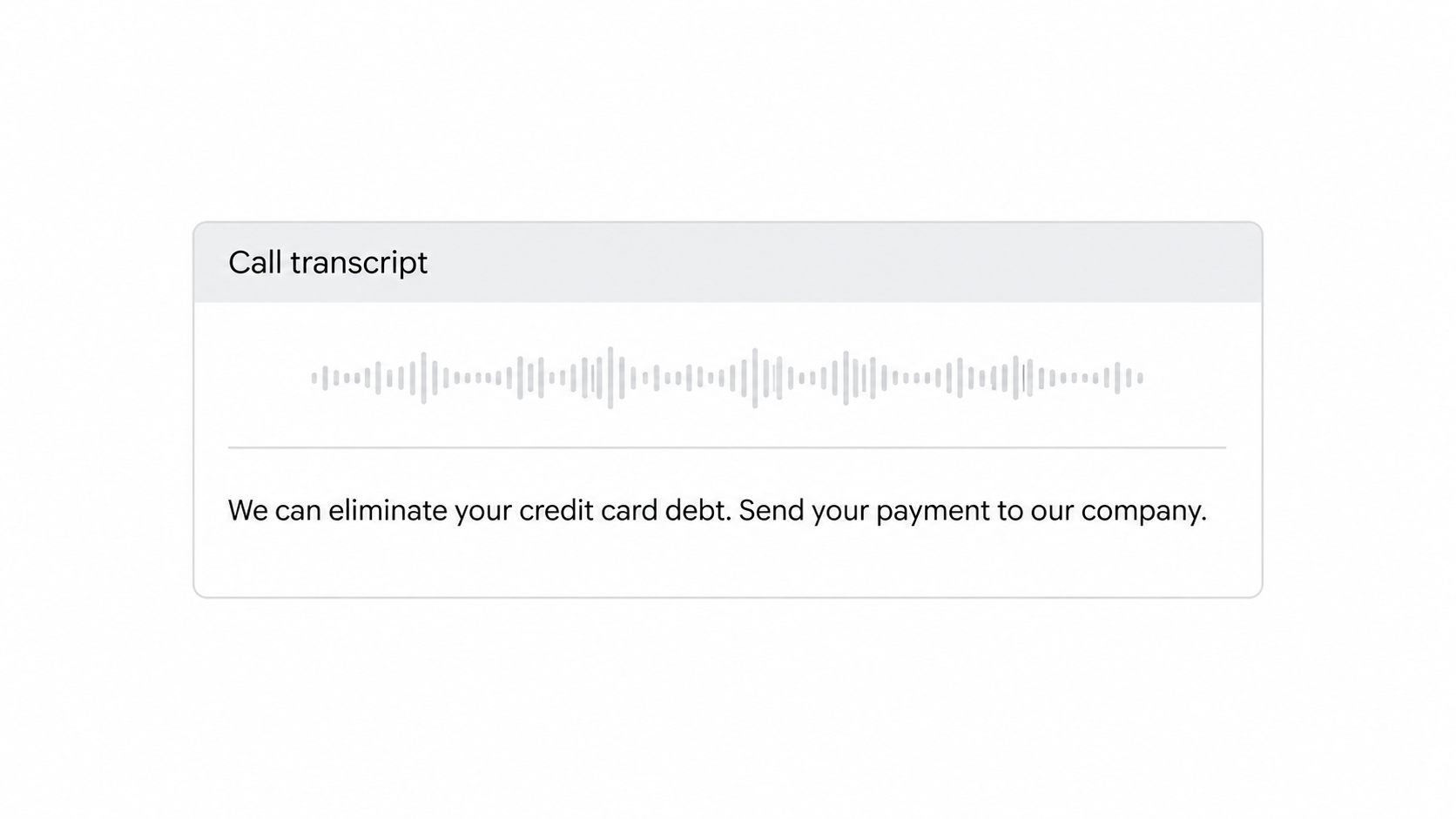
The lead image reconstructs the debt-elimination pitch in a transcript-style display. It is not an original recording or a verbatim transcript from a victim.
Why the Promise Sounds Like a Way Out
A debt-relief caller begins with a problem the recipient may already recognize. Interest and repeated payments can make a shortcut sound especially welcome.
The conversation can therefore feel relevant before the caller has established any authority. Knowing that you have debt is not the same as having permission to negotiate it.
The promise also changes what a payment appears to accomplish. You may believe you are spending money to reduce a larger balance, rather than purchasing an uncertain service.
That difference deserves a clear answer before anything leaves your account. Who receives the money, what work has been completed, and what has your creditor actually agreed?
If those answers come only from the caller, the supposed settlement remains an unverified claim. A payment receipt cannot substitute for confirmation from the creditor.
The FTC’s debt-relief warning explains why upfront demands and promises to settle all debts deserve an immediate stop, rather than another payment.
Real assistance should begin with a meaningful review of your circumstances. A confident promise delivered before that review should not be mistaken for an achievable repayment arrangement.
You can discuss options with your credit card company directly. You do not need an unsolicited caller’s permission to reach the institution holding the actual balance.
How the OneTen Debt Elimination Scam Works
Step 1: The call offers to solve an existing financial problem
OneTen callers told recipients that credit card debt could be reduced or eliminated if they sent payments to the designated companies.
The offer positioned the caller as someone with a solution, rather than someone asking for a new expense. That framing made the payment seem purposeful.
The meaningful check was whether any creditor had agreed to change the debt. The caller’s description alone could not establish that agreement.
Before paying someone who claims to negotiate for you, identify the exact account and obtain the proposed terms in a form you can review independently.
Step 2: A borrowed business identity makes the offer familiar
Callers also represented themselves as agents of legitimate debt-relief companies. According to the trial account, OneTen had no affiliation with those businesses.
This created two identities to examine: the company supposedly making the offer and the company actually receiving the payment.
If those names differ, ask the genuine business through its independently published contact information whether it authorized the caller or the proposed payment.
Do not use a transfer to another person on the same call as confirmation. That keeps the verification inside a conversation the original caller controls.
Step 3: Internet calling and spoofed identification support the contact
Augustinsky’s telecommunications services enabled OneTen’s large volume of calls. He knew the representatives were making false representations and spoofing caller identification.
A displayed number can make a call feel local or associated with a recognizable institution. It does not establish who is speaking or what they can do.
You cannot verify a debt settlement by examining caller ID alone. Reach the actual creditor through an existing statement, its app, or another established contact route.
The jury’s finding concerns Augustinsky’s knowing participation. Providing telephone service in general is not itself evidence that an unrelated provider operates a scam.
Step 4: Checks reach companies controlled by the facilitator
Victims mailed personal checks to post office boxes in Portsmouth and Poquoson. Augustinsky collected and deposited those payments.
He kept 30% from each check, collected an additional amount for the calling services, and sometimes wired funds to OneTen in Pakistan.
That documented split explains why the receiving business mattered. The payment was generating proceeds for participants in the operation, rather than establishing that a creditor reduced a balance.
The DOJ account does not supply one complete consumer-loss total. Do not calculate one by treating call volume or the number of checks as known payment amounts.
Step 5: False explanations also unlock sensitive financial records
In a separate part of the conduct, Augustinsky gave a credit-report company a false construction-loan explanation to obtain access for his co-conspirator.
More than 300 reports were obtained without authorization. This shows that the operation involved sensitive information as well as the money sent by callers’ targets.
For an affected person, that creates a different response from disputing a payment. Ask which information was exposed instead of assuming stopping a check addresses every problem.
Do not send further identity documents to an unexpected caller offering to investigate. Begin with the genuine financial institution or an independently verified reporting service.
The Business on the Call and the Business Receiving Your Money
OneTen and the genuine relief companies were different entities
The call center identified in the case was One Ten Communications in Karachi, Pakistan. Its representatives were not authorized agents of the legitimate businesses they invoked.
A recognizable brand mentioned during a call can therefore be an impersonated party. Keep the accusation attached to the false affiliation rather than blaming that business automatically.
Augustinsky’s role went beyond carrying telephone traffic
The trial account describes knowing facilitation, payment collection, and unauthorized credit-report access. Those findings distinguish the conviction from simply owning a communications company.
Someone can make the call while another participant controls the receiving account. Your payment records should identify the recipient independently of the introduction.
The name on the check deserves independent confirmation
Before paying for debt assistance, identify the legal recipient and compare it with the written arrangement. Ask the claimed provider to explain any difference.
Then verify that explanation outside the incoming call. A mailing address, company name, or deposited check does not establish that the recipient negotiated with your creditor.
A genuine balance changes through the creditor’s records
The reliable place to check whether your debt was reduced is the creditor’s own account record. Ask the creditor what payment or settlement it actually received.
If a supposed representative says the records will catch up later, do not treat that assurance as a completed result. Preserve it while checking with the creditor.
What Paying the Caller Does Not Resolve
Money sent to a relief company is not automatically money credited to your card. Your original account can remain unpaid even while another company has your check.
This matters when a caller tells you the debt is being handled. Confirm the account status directly rather than making decisions from an unsupported promise.
Ask the creditor whether there is any agreed payment arrangement and what steps are needed to address the balance. Keep the response with your other records.
Also distinguish the scam payment from your legitimate borrowing. Challenging the former does not automatically remove the latter from the creditor’s books.
Someone facing several balances should organize them by actual creditor and account. One generic promise to erase everything makes it harder to see what remains unresolved.
For help assessing affordable options, seek a reputable credit counselor who explains services and fees before requesting sensitive information. The FTC describes free and low-cost starting points.
What to Do if You Have Fallen Victim to This Scam
-
End contact with the unsolicited debt-relief caller and do not send another payment. Preserve any voicemail, written promise, business name, and instructions you received.
If the caller claimed an affiliation with a recognizable relief business, contact that business separately. Ask whether it authorized the contact and the named payment recipient.
Do not let a new deadline replace that check. A claim that today’s payment is your last chance does not establish that relief exists.
-
If you sent a check, call your bank using its genuine contact information. Provide the check number, date, amount, and payee, then ask whether payment can still be stopped.
If it has cleared, request the available check image and ask about fraud-reporting or dispute options. Explain that you wrote the check because of false debt-relief claims.
Ask whether the account details visible on the check require additional protection. The bank can explain appropriate measures for your account rather than a caller deciding them.
-
Contact each actual card issuer through an existing statement or your banking app. Ask what payments, settlements, or third-party arrangements appear on the account.
Record the balance and the representative’s explanation. If the supposed relief never reached the creditor, ask the issuer about options for dealing with the real obligation.
Keep this conversation separate from your claim about the scam payment. Both problems deserve attention, even though they began with the same call.
-
List the personal information you shared and any notice concerning unauthorized credit-report access. Keep identity exposure separate from the amount paid.
If someone misused your identity, visit IdentityTheft.gov, describe what occurred, and use the resulting recovery plan for the affected accounts.
Tell the financial institutions involved about specific unfamiliar activity. Receiving a sales call alone does not establish that a credit report was obtained.
-
Report the false offer through ReportFraud.ftc.gov and include the claimed company, actual payee, displayed number, and payment details you retained.
For internet-enabled fraud, use IC3 and select File A Complaint. Explain the promise and the payment trail rather than submitting only a telephone number.
Save the report references and any bank claim number together. Reporting does not replace the payment provider’s own deadline or evidence requirements.
-
Watch for further callers who know about the original loss and offer to obtain a refund. Verify any claimed government or banking role independently.
Do not pay an advance recovery charge or disclose security codes to release compensation. The original caller’s business details may be available to other people.
If you need help managing the paperwork, involve someone you trust. Organizing records together can make follow-up easier without handing control to another stranger.
Frequently Asked Questions
Was the OneTen operation a confirmed fraud?
The July 2026 trial resulted in Augustinsky’s conviction for fraud-related offenses. The DOJ describes false debt-relief promises, impersonated business affiliations, knowing facilitation, and payments collected from victims.
The verdict does not make every debt counselor or internet telephone provider fraudulent. The documented conduct is what establishes this case.
Were millions of people proven to have lost money?
The source describes millions of calls and hundreds of personal checks. It does not provide a matching count of unique victims or one complete consumer-loss figure.
Call volume measures the operation’s reach, rather than proving that every person contacted paid or had a credit report accessed.
Did paying the designated company settle the card balance?
A payment to that company did not itself establish a creditor settlement. The caller’s promise needed confirmation through the actual card issuer’s records.
If you paid, ask your issuer what it received and what balance remains. Address the disputed payment through the bank or payment provider separately.
Why were credit reports involved in this case?
Augustinsky falsely claimed he needed reports for construction-loan funding to enable access for his co-conspirator. More than 300 reports were obtained without authorization.
That was an additional information-related offense, rather than proof that every person called had their identity stolen. Base your response on your own documented exposure.
Can I ask my card company for help directly?
Yes, you can reach your creditor using its genuine app or a statement. Ask about the actual balance, any existing agreement, and available assistance.
An unsolicited company does not have to stand between you and that conversation. Do not pay merely for a promise to make the problem disappear.
Should a convincing caller ID change my decision?
No, this operation knowingly used spoofed identification. A displayed name or number cannot establish an affiliation or prove that a debt-reduction arrangement is genuine.
End the incoming conversation and make an independent contact. Verify the specific recipient and proposed result before sending money or financial documents.
The Bottom Line
Do not send money to an unsolicited caller who promises to eliminate your card debt. The OneTen case shows how those payments can fund scammers instead of reducing balances.
If you paid, contact your bank about the transaction and your actual creditor about the debt. Preserve the caller’s promises and report the named payment recipient.

Join the discussion
0 commentsShare your experience or ask a question about this article.
Community experiences
Did this happen to you?
Your experience could help someone recognize the same scam. Submit a private report for our team to review.
I experienced this tooReports are reviewed before publication. Sharing publicly is always your choice.
Discussion
Start the conversation
Have a question or something useful to share? Add the first comment.