


A warning appears while you are using your computer. It suggests that something is wrong with your device or bank account, and the situation suddenly feels urgent.
The next person you speak with may sound reassuring. What matters is where that conversation leads, especially when someone proposes collecting money from your home.
Overview
A computer warning became a story about protecting money
A confirmed fraud operation targeted older victims with false claims that their computers or bank accounts had been compromised. Members then collected cash while posing as federal officers.
The DOJ’s October 2026 sentencing announcement describes more than 50 victims across 19 states and losses exceeding $10 million.
The money was not being moved into government protection. The visitors were participants in the scheme taking cash from people who had been deceived.
Three sentences document the collection network
The case identifies Yankun Jiang, Hanlin Yang, and Lei Bao as participants. Their roles included collecting cash, supervising other couriers, and transporting proceeds between cities.
- Lei Bao received 30 months in prison and a $377,591 restitution order.
- Yankun Jiang received 84 months and a $1,267,122 restitution order.
- Hanlin Yang received 24 months and a $400,800 restitution order.
Those are individual court orders within a wider case. They are not interchangeable with the operation’s total losses or proof that all victims have been repaid.
The decision changes before the visitor arrives
A claimed federal identity does not make a cash collection legitimate. The purpose of the story is to make surrendering money feel like the safest available choice.
The useful response is to interrupt the instructions and contact your bank or law enforcement independently. Do that before preparing cash or arranging a meeting.
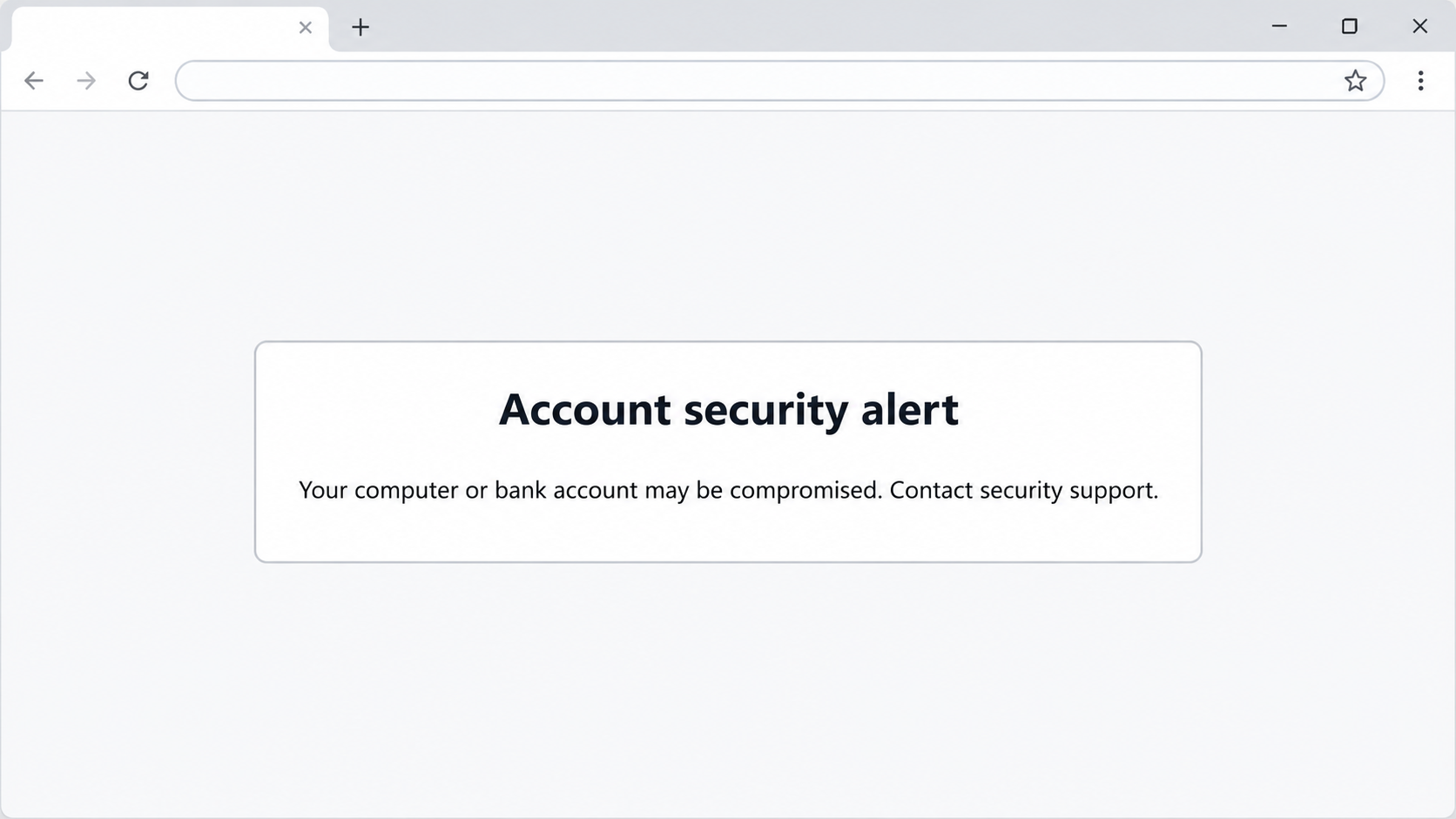
The lead alert is a reconstruction of the false compromise warning. It is not an original message from this case, a genuine bank notification, or a malware diagnosis.
Why the Warning and the Visitor Belong to the Same Story
A pop-up and a person at the door can feel like separate events. One looks like a computer problem, while the other appears to involve official assistance.
In this scheme, both supported the same deception. The warning created fear, and the supposed officer offered a way to protect assets from that invented danger.
The presence of a visitor can make the explanation feel more credible. Someone has traveled to your home, apparently knows the situation, and expects you to cooperate.
Yet that visit may simply be the next stage of the fraud. A physical handover does not make the earlier computer warning true.
This is why checking only the visitor’s appearance is insufficient. You need to verify the claimed agency and the reason anyone wants your money through an independent route.
A genuine bank can assess its own account records without receiving cash from you at home. An unsolicited browser message cannot appoint someone to collect your savings.
Keep those responsibilities separate while you seek help. The person describing the emergency should not also control every channel through which you are allowed to verify it.
How the Fake Federal Agent Cash Pickup Scam Works
Step 1: A false compromise warning interrupts ordinary computer use
The operation used computer pop-ups to tell victims that their devices or bank accounts were compromised. The claim made an ordinary browsing session feel like an urgent financial emergency.
That message was part of the fraud, rather than reliable evidence of an intrusion. A page displaying a warning does not independently know the status of your bank account.
Do not use the alert’s instructions as your verification route. Close it using your own browser or operating-system controls and contact the relevant institution separately.
If the warning includes threatening language, preserve it where safely possible. You can seek help without proving to the person behind the warning that you have complied.
Step 2: The proposed solution involves handing over assets
Members of the conspiracy claimed that victims’ assets would be protected. That explanation turned the transfer of money into a supposed defensive action.
The contradiction is easy to miss while frightened. You are being asked to give control of money to an unfamiliar person in order to prevent someone else taking it.
If a caller proposes cash collection, stop the conversation before preparing the money. Ask your real bank about the alleged compromise using a number obtained from your own records.
You do not need to continue speaking with the caller while making that check. A genuine verification process should be independent of the instructions you are questioning.
Step 3: A visitor claims to be a federal officer
Participants traveled to victims’ homes and posed as federal law enforcement officers. Their claimed identity supplied authority for collecting the cash.
The case does not establish that every visitor used the same script or props. What was documented was the false official role and the removal of victims’ money.
Do not hand over cash because someone identifies themselves as an officer. Use an independently obtained agency contact to verify the claimed visit and the purpose of the request.
If someone is already approaching your home, prioritize your immediate safety. Contact local police for guidance rather than trying to investigate or confront the visitor yourself.
Step 4: Couriers collect money from multiple victims
Lei Bao made several cash pickups, and Hanlin Yang traveled to at least six victims’ homes. These were documented roles within a broader operation, rather than a single disputed encounter.
The network could therefore repeat the same general deception in different locations. A person who collected cash did not need to originate every warning or speak to every victim.
For reporting, keep the online warning and the physical collection together. Separate participants may have handled different parts of the same loss.
Record the timing, claimed agency, communications, and any safely observed details of the collection. Do not arrange another meeting merely to obtain more evidence.
Step 5: Supervisors and transporters move the collected proceeds
Yankun Jiang collected money from other couriers, packaged cash, and coordinated onward delivery. He progressed from acting as a courier to supervising others.
Bao also transported suitcases of stolen cash from Philadelphia to Los Angeles on at least five occasions. That movement separated the collection location from the people receiving proceeds elsewhere.
This explains why a local handover can belong to a multistate fraud. The place where you lost the money is only one part of the payment trail.
Provide investigators with what you actually know rather than trying to reconstruct the entire network. They can connect reports without you following a courier or contacting other participants.
The People Named in the Case Had Different Roles
The October announcement describes three sentences imposed over several days. It does not present every person as the organizer of the entire operation.
Bao’s documented role included pickups and interstate cash transport. Yang’s role included collecting money from victims at their homes.
Jiang’s role expanded into supervising couriers and coordinating collected cash. Keeping these responsibilities distinct avoids confusing the person at the door with every other participant.
The same distinction helps when you report your own experience. A caller’s name, a visitor’s claimed name, and the person identified by investigators may be different.
Record each identity as it was presented and explain the context. Do not turn a name supplied by a scammer into a confirmed identification of an uninvolved person.
The case figures also describe different scopes. More than $10 million concerns the wider operation, while each restitution order concerns the particular defendant’s ordered obligation.
None of those figures establishes your individual entitlement or a completed refund. Keep your own loss and any actual repayment documented separately.
Stop the Browser Warning Without Following Its Instructions
Use the browser’s genuine window controls rather than buttons inside the alert. Closing the window can discard unsaved work in other tabs, so preserve unrelated work where safely possible.
On Windows, try closing the browser window normally. If it will not respond, press Ctrl+Shift+Esc to open Task Manager and locate the browser under Processes.
Select that browser and choose End task, rather than ending unfamiliar system processes. The warning should disappear when the browser process closes.
Microsoft also publishes instructions for closing an unresponsive Edge window. If you cannot identify the browser safely, stop and ask trusted technical support for help.
On a Mac, first try Command-Q to quit the browser normally. If it is unresponsive, press Option-Command-Esc, select the browser, and choose Force Quit.
Those steps follow Apple’s published force-quit procedure. Forcing an application to close can lose unsaved work, but it does not send money or validate the warning.
When reopening the browser, do not restore the suspicious page. If the same alert returns, close it again and use a trusted support route outside the displayed message.
Closing a deceptive page addresses the immediate interruption. It does not establish whether any separate account activity occurred, so verify financial concerns with the actual bank.
What to Do if You Have Fallen Victim to This Scam
-
Stop communication with the people directing the cash handover. Do not prepare another payment because someone says the earlier collection was incomplete or needs verification.
If a collection is pending, contact local police through an independently verified route. Explain the warning, the claimed federal identity, and the expected visit.
Do not arrange a confrontation or attempt to follow a courier. Preserve the information already available and follow law enforcement’s safety instructions.
-
Contact your real bank using its app, card, statement, or separately verified website. Explain the false compromise claim and any withdrawals or transactions already made.
Ask what safeguards, payment traces, or recovery options fit the actual activity. A cash handover has different recovery possibilities from a card purchase or pending bank transfer.
Tell the bank whether you authorized a withdrawal under deception. An accurate description helps its fraud team assess the transaction without confusing it with an unrelated account takeover.
-
Preserve the computer warning, caller details, messages, collection arrangements, and any documents supplied. Include dates and a chronological description of what each participant asked you to do.
Keep bank withdrawal records and any safely recorded information about the visitor. Do not publish another person’s identifying details while investigators are assessing the connection.
If evidence is unavailable, describe what you remember without filling the gaps. A clear account of the instructions is still useful.
-
Report the internet-enabled fraud through IC3 using File A Complaint. Prepare payment amounts, dates, communications, claimed agency names, and the collection location.
Keep a copy of your report information before submitting. Identify a connection to this case only when supported by your records or information from investigators.
Also retain the local police report number where one exists. Different agencies may need the same chronology and transaction evidence.
-
For help understanding the next reporting steps, older victims can use the National Elder Fraud Hotline at 1-833-372-8311.
The hotline serves people age 60 and older affected by financial fraud. It is a support and reporting resource, rather than an emergency response or guaranteed refund service.
Ask a trusted person to help organize records if the process feels overwhelming. Keep control of your documents and use verified contacts.
-
Reject unexpected requests for a fee to recover seized cash or activate restitution. The FTC describes this second fraud as a common risk for earlier victims.
Verify claimed court payments through genuine case contacts. An individual restitution amount in a news release is not an invitation to pay a collection agent.
Keep actual reimbursements separate from promised recoveries. Do not surrender more money to a person who first has to prove authority to return the original loss.
Frequently Asked Questions
Did this case involve an actual federal cash-protection program?
No, participants posed as federal officers and falsely claimed assets would be protected. The home collections were part of the confirmed criminal scheme.
Was every computer warning evidence of a hacked bank account?
No, the operation used false compromise claims. Verify any real financial concern with your bank independently rather than treating the warning itself as a diagnosis.
How large was the documented operation?
The DOJ describes more than 50 victims across 19 states and losses exceeding $10 million. Those wider figures are separate from individual defendants’ restitution orders.
Were the three people sentenced all doing the same work?
No, the announcement distinguishes cash pickups, supervision, packaging, and interstate transport. Preserve the role each person played in your experience rather than assuming one person handled every stage.
Does closing the browser mean my money is safe?
Closing the deceptive page stops that immediate interruption. Any withdrawal, handover, or unfamiliar account activity still needs separate attention from the real bank and relevant authorities.
What should I do if a courier is already expected?
Keep the cash and contact local law enforcement independently for safety guidance. Do not continue the arrangement or create another meeting to gather evidence yourself.
The Bottom Line
Do not hand cash to someone claiming a browser warning requires federal protection of your assets. The visitor can be collecting money for the same fraud that created the warning.
If you responded, stop further instructions, contact your real bank, preserve the collection details, and report the case. Seek police guidance immediately if a visitor is expected.

Join the discussion
0 commentsShare your experience or ask a question about this article.
Community experiences
Did this happen to you?
Your experience could help someone recognize the same scam. Submit a private report for our team to review.
I experienced this tooReports are reviewed before publication. Sharing publicly is always your choice.
Discussion
Start the conversation
Have a question or something useful to share? Add the first comment.