


A lender contacts your business about financing you do not remember arranging. Someone who already handles your payment services says there is nothing to worry about.
That reassurance can be tempting when the person knows your business and already has its paperwork. The Paul Paredes case shows why the lender’s message deserves your attention.
Overview
Information supplied for one business service was used for another purpose
Paul Paredes owned J&E Business Consulting LLC, a business that helped smaller retailers deal with credit card processing companies. Clients provided financial and identifying information for those services.
Paredes used customers’ identities to submit financing applications without their knowledge or authorization. The money went to accounts he controlled rather than funding an arrangement the customers had approved.
The DOJ’s sentencing account describes hundreds of fraudulent applications submitted between April 2019 and August 2023.
The criminal case confirms identity misuse and fraud
On November 5, 2026, Paredes received an 87-month prison sentence after convictions for wire fraud and aggravated identity theft.
The announcement identifies at least 63 people whose identities were used, at least 23 victim lenders, and at least 12 bank accounts involved in moving money.
It also reports an $8,754,446.64 restitution order to 57 victims. That order is an obligation to pay, not proof those victims have already received the money.
An unfamiliar financing notice needs an independent explanation
When clients received lender communications, Paredes sometimes misled them about the messages and said he would handle the matter. That reassurance helped conceal the unauthorized arrangements.
- Verify the lender through contact details obtained independently.
- Ask for the application and the agreement said to bind you.
- Identify the goods or services the financing supposedly covered.
- Find out where the approved funds were actually sent.
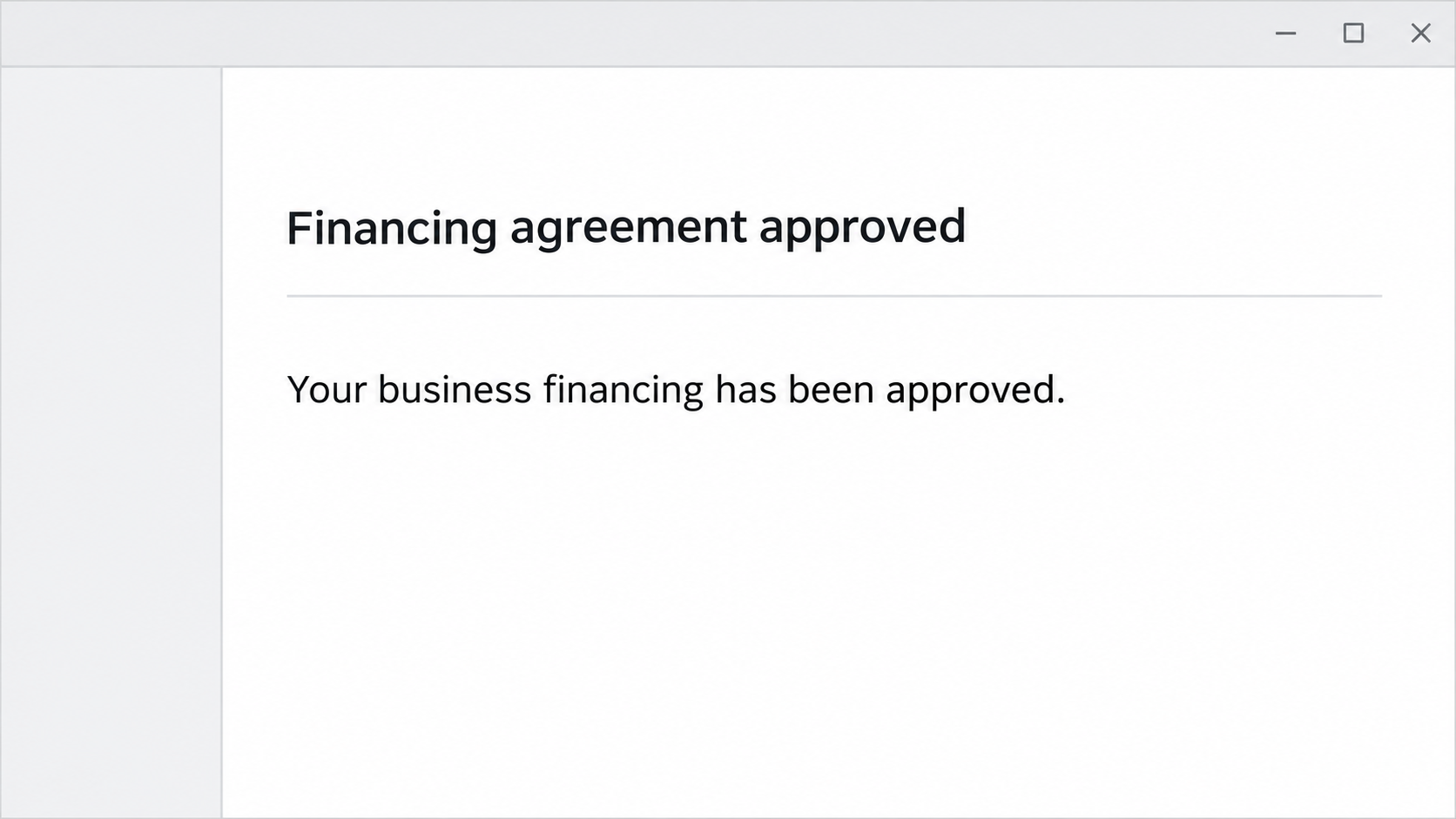
The lead image is a reconstructed approval notice. It illustrates an unexpected financing message, rather than reproducing a genuine lender email or a victim’s private records.
Why the Existing Business Relationship Was Important
A company that helps arrange payment processing may legitimately need information about a business and its owner. That can make an existing relationship feel less risky than a stranger’s request.
The problem arises when information supplied for that service is used to obtain separate financing without permission. Knowing a customer’s details is not the same as having authority to borrow.
Paredes had operated J&E since 2013. His established connection to businesses gave him access to records that could make an application appear credible to a lender.
The case therefore differs from a simple fake-bank email asking a stranger for a password. Information was misused after it had already entered a business relationship.
For owners, that changes the useful response. Checking only whether you recently clicked a suspicious link may miss an application submitted using information someone already held.
Keep a record of what each service provider is authorized to do. Processing card payments, applying for financing, and signing a personal guarantee are different responsibilities.
If a provider says a lender message is routine, ask for the underlying document. A familiar voice should not replace your own access to an agreement in your name.
How the Paredes Business Loan Identity Theft Scheme Works
Step 1: The provider receives useful customer information
Small businesses supplied J&E with owner identification and financial details while using its services. The records included information such as Social Security numbers and business bank details.
That access helped Paredes prepare financing agreements in customers’ names. The victims had not authorized the applications or the use of their identities for that purpose.
Before sharing sensitive records with any provider, establish why each item is needed and who will receive it. Retain the service agreement defining the authorized work.
The question is not whether a provider knows enough to complete a form. It is whether the specific transaction has your informed approval.
Step 2: Financing applications describe supposed goods or services
Paredes submitted applications for goods and services he allegedly provided to the customers. The financing paperwork made it appear that the named businesses were entering approved arrangements.
Lenders assessing those applications saw information that belonged to real people and businesses. The deception concerned the transaction and authorization behind the information.
If you receive an unfamiliar agreement, check more than the spelling of your name. Review the stated purchase, amount financed, date, signature, and any guarantee.
Accurate identifying details can coexist with an unauthorized contract. Do not let a correct address or Social Security number settle whether you agreed to borrow.
Step 3: Approved funds reach accounts controlled by the organizer
When lenders approved the financing, money was deposited into bank accounts Paredes controlled. He then used funds for personal expenses, salaries, operating costs, and payments to lenders.
The customer whose identity appeared on the agreement had not approved the borrowing. The lender had also been deceived about the financing transaction.
That separation matters when you report the problem. Identify both the agreement falsely placed in your name and the destination of the financing proceeds, where known.
Ask the lender for its disbursement record rather than accepting a provider’s description. The actual receiving account can help distinguish your business from the person who obtained the funds.
Step 4: Some payments help hide the unauthorized financing
Paredes made payments to victim lenders to avoid detection. Those payments allowed him to continue arranging similar fraudulent financing with multiple lenders.
A lender receiving installments may see an account behaving normally for a time. That does not establish that the person named as borrower ever authorized it.
If you discover an unfamiliar loan that appears current, investigate it anyway. The absence of a missed-payment notice does not explain who opened the account.
Preserve the account history as well as the application. Payments made by someone else may become important in explaining why the unauthorized agreement was not discovered earlier.
Step 5: Reassurance diverts clients from the lender’s warning
When victims received communications from lenders, Paredes sometimes misrepresented what those messages meant and told the clients he would handle them.
That response placed the explanation back with the person concealing the financing. It could stop the customer from asking the lender direct questions.
Use a separate channel to verify any unfamiliar financial obligation. A provider can assist with a genuine administrative issue without becoming your only source of information.
Ask for written confirmation from the lender itself. Keep any response explaining whether the agreement is recognized, disputed, corrected, or still under investigation.
J&E Business Consulting and the Lenders Kept in the Dark
The consulting role did not authorize unrelated borrowing
J&E’s described role included acting between card processors and smaller retailers. That service should not be confused with unrestricted permission to create financing agreements for clients.
Review the authority actually granted in your contract with a provider. A document authorizing one activity may not answer whether a separate loan or guarantee was approved.
If the scope is unclear, obtain independent advice before signing anything further. Keep the original agreement so later changes do not obscure the earlier arrangement.
The lender was a separate party to the deception
The DOJ identifies numerous victim lenders across the country. The public account does not establish that those institutions knowingly participated in Paredes’s fraud.
A genuine lender can contact you about an agreement created through identity misuse. Do not automatically treat every resulting notice as another impersonation attempt.
Verify the institution independently, then explain that you did not authorize the application. Ask for the documents needed to investigate the particular account.
Multiple bank accounts complicated the payment trail
The scheme involved at least 12 different bank accounts and movement of money between accounts. That activity should not be mistaken for financing proceeds received by the named customers.
Keep the original bank confirmations and transaction identifiers where available. They provide more useful detail than a summary saying only that someone borrowed in your name.
Do not transfer money to a new account merely because a provider says it will close the matter. Verify the underlying demand with the lender first.
The conviction concerns the documented operator and conduct
Paredes’s convictions establish a confirmed fraud and identity-theft case. They do not establish that every payment-processing consultant or small-business finance offer operates the same way.
The useful distinction is consent and truthful documentation. A legitimate service relationship can still require careful limits on access and independent checking of financial obligations.
Use the exact company and person named in your records when reporting. Similar business names should not be treated as evidence of a connection to this case.
Check the Application Before Arguing About the Balance
An unfamiliar loan can produce several urgent questions at once: whether the debt is yours, whether payments are due, and whether your credit is affected.
Start by obtaining the agreement and stating clearly that you did not authorize it. Do not describe the issue merely as a balance you disagree with.
Ask which identity information, signature, goods, and recipient supported approval. Keep your request factual and preserve the lender’s response, even if the investigation takes time.
Different records may require different corrections. A lender’s account, a personal credit file, and a business credit record are not necessarily updated through the same process.
A personal credit freeze can help restrict new credit checks. It does not automatically remove a loan already created or correct every business financing record.
That is why prevention and correction need separate attention. Continue the dispute over the existing agreement even after putting additional protections in place.
What to Do if You Have Fallen Victim to This Scam
-
Preserve the financing notice, service agreement, and any message saying the provider would handle the issue. Record when you first learned of the supposed loan.
Keep the original message without opening unexpected links. Find the lender’s genuine contact details separately and ask whether it recognizes the account.
If the lender cannot identify it, retain that response and investigate the message as a possible impersonation. A convincing notice alone does not authenticate a debt.
-
Tell the verified lender that you did not authorize the financing. Request the application, executed agreement, relevant signature or authorization record, and disbursement details.
Ask how to file its identity-theft or fraud dispute and what documents it requires. Obtain a reference number and a written record of your objection.
Check any response deadline on a notice while the issue is investigated. Do not assume a provider’s promise to intervene stops that deadline.
-
If your identity was misused, go directly to IdentityTheft.gov. Describe the unauthorized financing and keep the resulting report and recovery instructions.
Use your actual records to identify the lender and disputed account. A report about identity misuse is different from agreeing that the loan belongs to you.
Share requested documentation through the lender’s verified fraud process. Keep copies of what you provide and any decision correcting or rejecting the account.
-
Review your personal credit reports for accounts or inquiries you do not recognize. Use the official routes linked by the FTC’s credit-freeze guidance.
For a freeze, contact Equifax, Experian, and TransUnion separately and retain each confirmation. A free initial fraud alert can instead be placed through one bureau.
A freeze restricts new access to your personal credit file; it does not erase an existing fraudulent account. Continue separate disputes with the companies showing incorrect information.
-
Review your business bank activity and contact the bank about any unauthorized debit or unfamiliar payment instruction. Explain the connection to the disputed financing.
Ask what protections and reporting deadlines apply to the actual business account. Do not assume consumer card rules cover every commercial banking arrangement.
Limit unnecessary access held by the provider while obtaining qualified help with existing agreements. Preserve records before changing access so the evidence remains available.
-
For electronically submitted applications or online communications, report through IC3 using File A Complaint. Include the provider, lender, account identifiers, dates, and amounts.
Keep a copy of your account of events and distinguish borrowed amounts from money you personally lost. Identify the documented Paredes connection only where your records support it.
Reject anyone asking for a fee to remove the problem through an unofficial channel. Verify claimed case or recovery authority independently before sending more information.
Frequently Asked Questions
Did clients authorize Paredes to take out these loans?
The confirmed scheme involved financing applications submitted without the victims’ knowledge, consent, or authorization. Information supplied for consulting services was used for a different financial purpose.
Why might a genuine lender contact someone who never applied?
A fraudulent application can use accurate identifying information while misrepresenting consent. Verify the lender independently and request the underlying agreement before accepting the claimed obligation.
Were all the lenders part of the scam?
No, the DOJ identifies victim lenders deceived by the financing applications. The case does not establish that every institution processing an application knowingly assisted the fraud.
Does a current payment history prove the loan is legitimate?
No, Paredes made payments to lenders to conceal fraudulent agreements. Check whether you authorized the account even if someone has kept its installments current.
Will a personal credit freeze remove an existing false loan?
No, a freeze helps restrict new credit-file access. An existing unauthorized agreement still needs a separate dispute with the lender and any company reporting incorrect information.
Does the restitution order mean victims have already recovered their losses?
No, an order to pay restitution is different from completed repayments. Use verified case information and your own transaction records when asking about any recovery.
The Bottom Line
Do not let a familiar service provider explain away financing you never approved. Verify the lender independently and obtain the application, authorization, and disbursement records.
If your identity was used, dispute the agreement, document the misuse through official channels, and check related accounts. A promise that someone will handle it is not a correction.

Join the discussion
0 commentsShare your experience or ask a question about this article.
Community experiences
Did this happen to you?
Your experience could help someone recognize the same scam. Submit a private report for our team to review.
I experienced this tooReports are reviewed before publication. Sharing publicly is always your choice.
Discussion
Start the conversation
Have a question or something useful to share? Add the first comment.