


The offer starts with something reassuringly tangible: cattle, feed, meat, and a contract explaining how your money will grow. You do not have to become a rancher yourself.
That simplicity made Agridime’s pitch easy to understand. The difficult part was knowing whether the cattle behind the contracts actually matched what people were being sold.
Overview
An online cattle purchase carried an investment promise
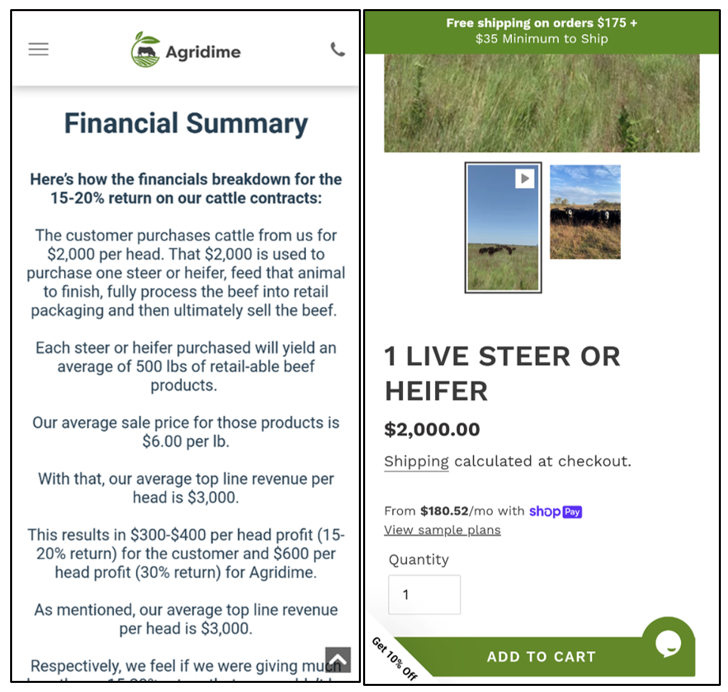
Agridime offered individual cattle for $2,000 per head. Customers were told their money would buy, raise, process, and sell the particular animals connected to their contracts.
The historical marketing material reproduced by DOJ shows a financial summary promoting a 15–20% customer return beside a cattle product listing.
Those are historical images from the criminal case, rather than a current checkout or proof that the same offer remains available today.
The criminal trial established a much larger deception
On November 10, 2026, a jury convicted Joshua Robert Link and Jason Allen Link of fraud-related offenses involving Agridime and a separate false-feed-payment scheme.
The DOJ’s trial account describes more than 2,200 victims and over $240 million collected through fraudulent representations during 2021–2023.
Agridime sold contracts for far more cattle than it controlled. Customer money also paid earlier purchasers, company obligations, salaries, and commissions rather than only the promised cattle expenses.
Real livestock operations did not make every contract genuine
The company did operate cattle and meat businesses. The fraud concerned the promises attached to customers’ money and the gap between contracts sold and actual inventory.
- A cattle photograph did not establish allocation to your contract.
- A payment to an earlier purchaser did not establish profitable cattle sales.
- An attractive return needed support from the actual business and records.
- A court repayment order did not mean every customer had already recovered funds.
The practical issue was whether the same cattle business could satisfy all the commitments being sold, not whether livestock existed somewhere within the operation.
What the Cattle Offer Asked Customers to Believe
The pitch connected an understandable purchase with a supposedly convenient financial outcome. A customer supplied the money while Agridime handled the complicated work of raising and selling livestock.
That arrangement removed the need to own land or manage animals. It also meant the customer depended heavily on information supplied by the people receiving the funds.
The financial summary made the process look orderly. It described an animal, expected meat production, sales revenue, and a profit split between the customer and Agridime.
Those figures were advertising claims, rather than an independent audit of the cattle behind every purchase. A neat calculation cannot establish that the required animals were actually acquired.
The distinction matters even when a business has genuine employees, locations, or sales. Real commercial activity can sit alongside promises that the company cannot honestly fulfill.
Before considering a similar arrangement, identify what you would own and who would verify it. A general interest in a livestock business differs from a contract tied to particular animals.
Ask how animals are identified, where the records are kept, and whether the same stock supports other obligations. The answer should be more than another promotional photograph.
You should also understand who bears ordinary business risks. A promised return does not remove costs, animal losses, market changes, or the possibility of a dishonest operator.
How the Agridime Cattle Investment Scam Works
Step 1: A specific animal makes the investment feel concrete
Agridime’s contracts represented that customer funds would purchase specific individual cattle. The company would then care for those animals, process them, and sell the resulting meat.
That explanation connected the customer’s payment to a physical product. It gave the transaction a different appearance from simply handing money to an investment promoter.
However, the contract’s wording needed actual inventory and records behind it. A promise identifying what should happen is different from evidence that it happened.
Keep the complete agreement and the version of the offer you saw. They establish what the seller represented before any later explanation about the business.
Step 2: More cattle contracts are sold than the operation can support
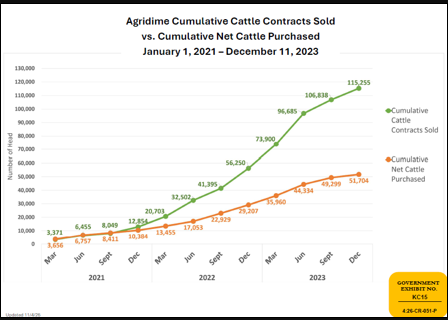
Trial evidence showed Agridime sold approximately 60,000 more heads of cattle than it controlled. The gap was central to whether customers’ promises could be fulfilled.
The inventory chart published with the DOJ announcement compares cumulative contracts sold with cumulative net cattle purchased. It shows why total commitments mattered alongside individual purchase records.
Even a reassuring account update could not resolve that wider shortfall. Customers depended on a system with more claims against cattle than the available stock could support.
For a comparable offer, ask how the company reconciles all outstanding contracts with its inventory. Checking only one photograph or one customer’s account leaves that larger question unanswered.
Step 3: New customer money helps pay earlier customers
Agridime used cattle-purchaser funds for operating expenses, loan payments, and amounts owed to earlier purchasers. Those uses differed from the specific cattle funding story sold to customers.
This helps explain why receiving a payment was not enough to validate the investment. Money could arrive from later customers rather than the promised sale of your cattle.
A regular distribution can feel like the strongest evidence that everything works. The source of that distribution still matters, especially when new contributions are needed to keep payments moving.
Ask for records connecting the return to the actual transaction described in the agreement. A payment alone answers whether money arrived, not how it was produced.
Step 4: Insiders receive salaries and commissions from customer funds
The trial also examined substantial salaries and commissions paid to people running the operation. Those payments were another use of money customers expected to support their cattle contracts.
The DOJ identifies more than $2.7 million received by Josh and Tia Link during 2022–2023, alongside more than $2.4 million received by Jed Wood.
These are particular salary and commission figures, not a complete calculation of investor losses or money available for repayment. Do not add them to the overall fundraising total.
For any proposed investment, understand compensation before paying. Hidden incentives can encourage more sales even when the underlying business cannot support the growing commitments.
Step 5: False cattle-service bills create another route for diversion
Joshua and Jason Link were also convicted over fraudulent requests for feed and yardage payments. More than $2.7 million went to a business solely controlled by Jason.
The claimed services had not been provided by that business. A separate company had already supplied and been paid for the cattle feed.
That second $2.7 million figure concerns a different payment stream from the salaries and commissions. Similar numbers in one case should not be treated as interchangeable amounts.
The episode shows why supplier invoices need their own support. A company can lose money through false expenses as well as through misleading promises to its customers.
Agridime, Its Brokers, and the Money Behind the Cattle
The public-facing company had a real livestock business
Agridime operated from Fort Worth and conducted cattle and meat-related activities in several states. The case does not support the claim that every animal or operation was imaginary.
Its genuine business activity was part of what made the offer persuasive. Customers still needed truthful allocation, inventory, and financial information for the contracts they were buying.
Treat a company’s physical presence as one fact rather than a complete guarantee. It cannot establish that customer funds are being used as promised.
Different insiders held different roles in the operation
Joshua Link was Agridime’s co-owner and executive director. Jason Link acted as a livestock broker and Meat Chain Director and owned the identified cattle business Shady Brook Ranch.
Other participants served in operations, marketing, brokerage, and financial-control roles. The DOJ describes guilty pleas by four other conspirators before the brothers’ trial.
Keep these roles distinct when reviewing your records. The person who introduced the offer, the company named in the contract, and the payment recipient may answer different questions.
Customer receipts needed to reconcile with cattle and expenses
The core promise linked the purchase price to particular cattle and their care. The trial showed that money also supported earlier commitments and insider payments.
That mismatch was not resolved by showing an attractive revenue calculation. The records needed to connect actual receipts, inventory, expenses, and distributions across the operation.
If you are documenting a loss, retain every contract separately. Multiple purchases, renewed arrangements, and payments received can otherwise become difficult to distinguish.
Civil recovery and criminal sentencing follow different paths
The CFTC’s 2025 announcement describes an order requiring Agridime to pay $102,936,904 in restitution through the court-appointed receiver’s collection and distribution process.
The SEC separately reported final judgments in its civil case. Those orders and the later criminal verdict should not be combined into one supposed payment to victims.
The CFTC explicitly cautions that repayment orders may not recover all losses. The amount a court orders is different from money a particular customer has actually received.
Why Earlier Payments Could Make the Offer Harder to Question
Someone who received an initial return may reasonably have believed the arrangement was working. That experience can also persuade friends or relatives to participate.
In a Ponzi mechanism, however, an earlier payment can depend on a later person’s contribution. The recipient sees the deposit without seeing where it originated.
That does not make an ordinary customer who received money part of the criminal operation. It explains why payment history alone cannot authenticate the promoter’s financial story.
The Agridime verdict concerned documented deception and diversion, rather than the mere fact that cattle markets carry risk. Investment risk and misrepresentation are different problems.
If you are evaluating a new livestock proposal, do not use someone else’s repayment as the only check. Understand the actual contract, records, custody, and source of returns.
What to Do if You Have Fallen Victim to This Scam
-
Stop further contributions to an arrangement you cannot independently verify. Preserve the original cattle contracts, sales messages, purchase confirmations, and statements showing expected returns.
Keep each contract’s date, quantity, price, and named entity. Record whether a later document replaced an earlier contract or simply added another commitment.
Do not discard older marketing material because the website changed. It may explain the promise that caused you to pay.
-
Create a payment history showing contributions and money actually received. Keep expected returns separate from distributions that reached your account.
Retain bank statements, transfer confirmations, checks, and the receiving account information. Include any explanation given for delayed payments or additional funding requests.
If you received more than one type of payment, label each accurately. A partial return, a refund, and a promised future distribution are different entries.
-
Contact the financial institution that handled your payment and explain the documented fraud concern. Ask whether a trace, recall, or other relevant remedy remains available.
An older investment payment may not have the same options as a recent consumer card purchase. Ask about your actual transaction rather than assuming a universal deadline.
Keep the bank’s response with your records. A criminal verdict does not automatically start a bank dispute or reverse a transfer.
-
Use official SEC and CFTC case notices to verify any claimed receivership contact or distribution instruction. Match the exact case and company before sharing documents.
The CFTC identifies the receiver in the parallel SEC action as handling collection and distribution. Its announcement does not establish a new universal claims deadline.
If you cannot authenticate an unexpected recovery message, stop and check through the regulator’s published contact route. Do not rely on the message’s own contact details.
-
For an internet-solicited transaction, report through IC3 using File A Complaint. Prepare dates, amounts, payment recipients, online identifiers, and the relevant cattle contracts.
Keep a copy of your account of events before submitting. Identify the actual Agridime connection rather than assuming every livestock offer belongs to the same case.
If investigators or the receiver request further information, use verified channels and retain what you provide. Reporting a loss and receiving compensation are separate processes.
-
Refuse advance-fee promises to unlock a cattle-contract refund. The FTC warns that recovery scammers can target people who have already lost money.
A caller may know the company, case amount, or details from public court records. That knowledge does not give the caller control over a legitimate distribution.
Verify the claimed payment independently and keep further demands with your evidence. Do not turn a recovery inquiry into another unsupported investment.
Frequently Asked Questions
Was Agridime a confirmed fraud or merely a failed cattle investment?
A jury convicted the Link brothers in November 2026 after evidence of false cattle-contract representations and other diversion. The case goes beyond an ordinary loss caused by market conditions.
Did Agridime have any real cattle?
Yes, the operation included genuine livestock and meat businesses. The fraud involved selling commitments beyond its inventory and using customer money differently from the representations made.
Did every contract promise the same return?
No, the reproduced marketing example shows 15–20%, while the SEC describes contracts with varying promised returns. Use your own agreement rather than assuming one advertised rate applied universally.
Was the $240 million already returned to customers?
No, the DOJ figure concerns money collected through fraudulent representations. Civil repayment obligations and actual distributions have different meanings and should not be treated as completed refunds.
Did the November verdict include an already imposed prison sentence?
No, the announcement described convictions and a future sentencing date. Maximum possible terms are not the same as sentences already imposed on the brothers.
Does an earlier payment prove my contract was properly funded?
No, trial evidence showed customer funds paying earlier purchasers. Preserve your payment history, but also examine whether the promised cattle transaction actually supported the return.
The Bottom Line
Do not treat a cattle photograph, contract, or early payment as proof of a sound investment. Agridime’s fraud depended on promises the actual inventory and money trail could not support.
If you paid, preserve each contract and transaction, contact your payment provider, and verify recovery instructions through official case channels. Never pay an unexpected fee to release supposed restitution.

Join the discussion
0 commentsShare your experience or ask a question about this article.
Community experiences
Did this happen to you?
Your experience could help someone recognize the same scam. Submit a private report for our team to review.
I experienced this tooReports are reviewed before publication. Sharing publicly is always your choice.
Discussion
Start the conversation
Have a question or something useful to share? Add the first comment.