


You send money to the person who says he looks after your finances. Later, he shows you a statement with your name on it and a substantial balance.
If the statement is your only view of the money, there’s one more place you need to check.
Overview
What the Antonio Petrosino investment fraud involved
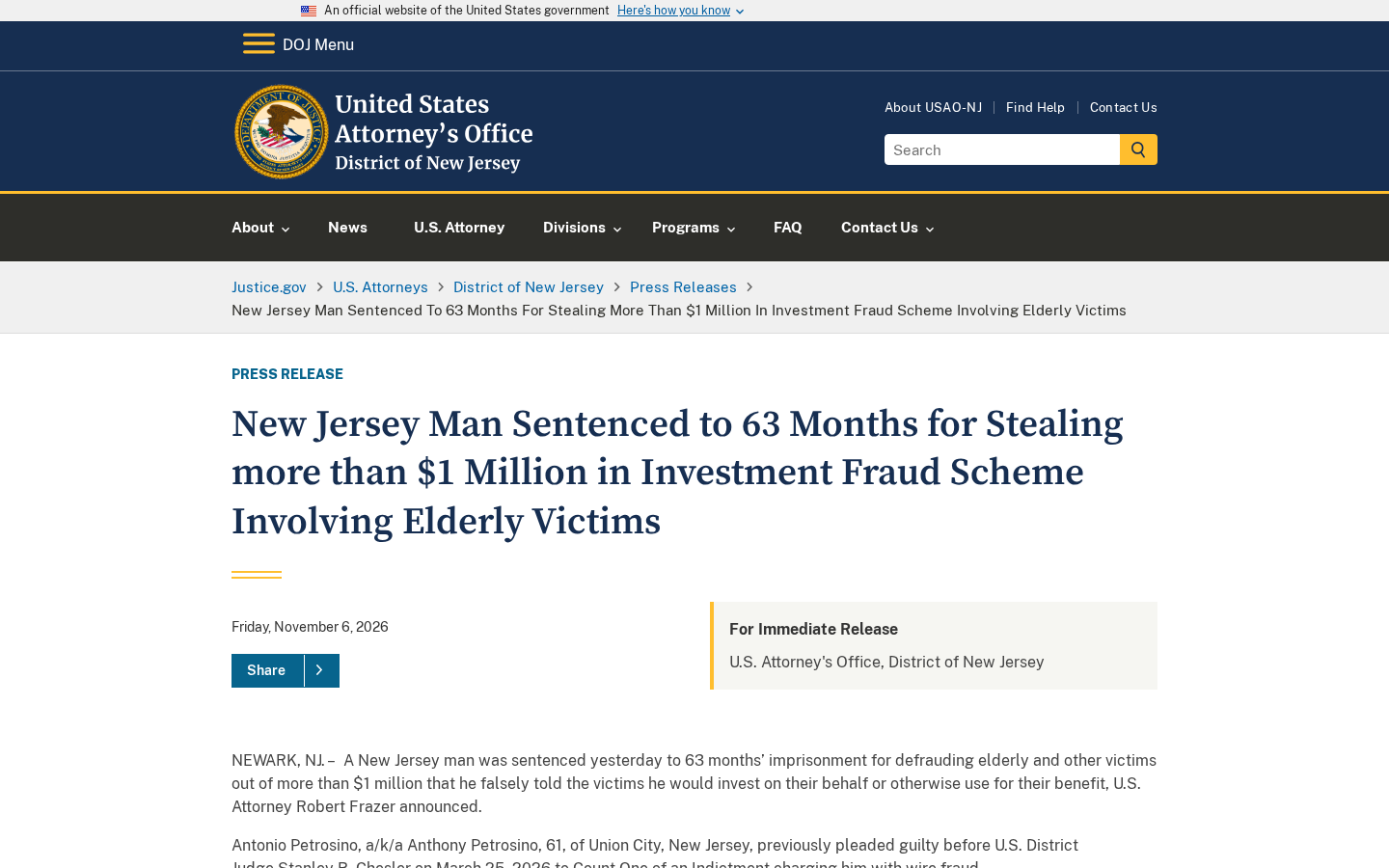
According to the New Jersey US Attorney’s Office, Antonio Petrosino, also known as Anthony Petrosino, took about $1.1 million from investors and other victims.
People gave him investment funds, mortgage payments and other money. He falsely told them he would invest it or otherwise use it for their benefit.
The official account says the conduct ran from January 2016 through November 2024. Petrosino pleaded guilty to wire fraud in March 2026 and received a 63-month prison sentence.
The Justice Department announced the outcome on November 6, 2026. The court also imposed two years of supervised release and ordered forfeiture and restitution.
Why the document in your inbox may not answer the right question
Prosecutors said Petrosino gave one older victim false statements showing hundreds of thousands supposedly held in investment accounts in her own name.
The point is not that financial statements are useless. The risk arises when the person taking the money is also the only person who can show you the reported balance.
Look for an independent institution that holds the assets and can tell the account owner what it actually received. A PDF from the intermediary cannot do that by itself.
Check three different records if you handed someone money
- Your bank can identify the transfer that left your account and the recipient information it has.
- A genuine brokerage or custodian can confirm which assets it holds for your verified account.
- A mortgage servicer can tell you whether a particular monthly payment was credited to the right loan.
Each record tells you something different about the transfer. Sending money to an assistant or adviser does not establish that a brokerage or lender received it.
How the Petrosino Investment Fraud Worked
Step 1: Victims trusted someone who presented himself as a financial professional
Petrosino held himself out as a financial services professional. Prosecutors say victims gave him money based on promises to invest it or use it for their benefit.
A familiar name alone cannot verify someone’s identity. Find the firm’s number yourself and ask whether that person works there and handles your type of account.
If someone says they can take a mortgage payment as a convenience, get confirmation from the servicer first. That is a separate claim from being able to advise on investments.
Step 2: People sent money to one person for different purposes
The announcement groups several sorts of transfers together, including brokerage funds and mortgage payments. Only the intended recipient can confirm how a given transfer was applied.
Someone may offer to combine financial errands into one payment. That creates a problem when you can’t tell which part was supposed to reach the loan or investment.
Ask the firm for separate instructions for paying fees and sending investment principal. The person giving advice does not automatically have custody of your assets.
Step 3: False statements and reassurances kept victims waiting
Prosecutors said Petrosino supplied fabricated statements to one victim and made verbal assurances to others. He also gave false reassurances to victims and relatives when they asked what had happened.
A second copy of a statement from the same sender is not an independent check. Go to the firm named on the statement using a contact you locate yourself.
Do not share a family member’s password to investigate on their behalf. Sit with them if they want help, or ask the firm about an authorized way to assist.
Step 4: The money was spent rather than used as promised
According to the case account, Petrosino used misappropriated money for expenses such as gambling, credit card bills and rent. Victims did not receive the financial services they had been promised.
The sentencing release does not say every victim had been repaid. When anyone mentions the case in a recovery pitch, check directly with the district that prosecuted it.
How to Check a Brokerage Balance and a Mortgage Payment Yourself
Find the firm before you trust the account balance
The SEC’s investment professional lookup guide tells you how to check a person or firm. Search the full name and match the employer and location.
Check the identity separately from the account. Finding a similar name doesn’t establish that the person who contacted you actually works for the firm.
Open the firm’s website on your own and find its general support number. Ask how an account owner can confirm whether the firm opened the account mentioned in a statement.
With a verified account, pull a statement from the institution directly and compare dates, balances and transactions. Use the period when a deposit was supposed to reach it.
If there is no matching account, keep the PDF as evidence. Ask the named firm how it would like to receive a copy and report the discrepancy to your bank.
Ask the mortgage servicer what posted to the loan
Start with the last statement you know came from your mortgage servicer. Use its number or portal rather than payment details supplied by the person who offered to handle it.
Ask for the amounts, dates and status of recent payments. If there is an overdue balance, find out which monthly payment isn’t recorded and ask for the latest written statement.
Compare that statement with the transfer from your account. A transfer to a different name is not a posting to the mortgage, even when the amounts happen to match.
For a genuine servicing transfer, the CFPB explains how notices work. Confirm a new payment destination through the servicers’ independently verified contact details.
If the old servicer confirms the transfer, ask for the effective date and how to identify the new account. Check those details before changing an automatic payment.
Make a family check specific enough to be useful
If you’re helping a relative, ask which organization holds their investments and how they access it. Focus on where the records come from, not whether they trust the adviser.
Offer to sit with them while they call the firm or sign in. Keep account numbers and statements private rather than forwarding them around a larger group.
If you spot a real mortgage deadline, check it before spending days on the brokerage question. One problem may be urgent even while you document the other.
What the Real Records Can Tell You
A brokerage statement should connect to financial activity
Look at the first period when the adviser said the account was funded. Confirm the receiving firm and account owner before inspecting the actual deposits and holdings.
Check whether a promised deposit appears as cash, a purchase or neither. A balance in a PDF cannot distinguish among those outcomes if the underlying transactions aren’t there.
Ask the custodian to explain what rights you have to view statements and make requests. If you cannot get into the account, use the firm’s own access recovery process.
Some legitimate investments are not immediately redeemable. Distinguish an established restriction in the governing agreement from someone refusing to tell you whether the fund received the money.
Ask what communication a legitimate account should generate and where the firm would send it. Compare the contact details in that record with those you actually control.
Use the mortgage statement to check for a specific missed month
Find the line showing the next payment due and compare it with the recent transaction history. A payment sent is not always the same as a payment the servicer applied.
Check whether a servicer says money sits unapplied, was returned or never arrived. Each explanation needs a different response, so ask for it in writing where possible.
Save a statement from before the unexplained transfer and the first one after it. That comparison can show when the due date or balance began to change.
Check whether the same family member or intermediary also handled notices. Redirect correspondence to a verified address you control so that future changes do not go unnoticed.
If you suspect the servicer made a posting error, find its designated address for written disputes. Put your name, loan identifier and payment problem in the letter.
Send copies of supporting records instead of your only originals. Keep a dated copy of the letter, the delivery record and any written acknowledgment with the disputed statement.
Helping someone without taking over their accounts
Start with permission to look at particular records, not a demand for every password. It can help to show which questions the independently issued statements will answer.
If the person is willing, list important bills and the institutions expecting the money. Pay special attention to deadlines for housing or other essential services.
When support cannot discuss the account with you, ask what written permission or formal designation applies. Do not claim to be the account holder to speed up the call.
Ask your relative how they want to receive follow-up information. A confidential written summary of confirmed balances often helps more than repeated discussions about how much they might have lost.
Keep different payments distinct when a criminal case is involved. A relative can help total verified transfers later, but the date and recipient of each one are worth preserving now.
If you discover a problem with one institution, don’t assume every statement is wrong. Compare the records one account at a time and write down which numbers you have verified.
What to Do If You Paid a Financial Intermediary and the Money Never Arrived
-
Stop money from going to the disputed destination. Check whether a standing transfer or scheduled payment used the intermediary’s details rather than the institution’s verified instructions.
Ask your bank which pending payments it can stop or recall, and which have already cleared. Then confirm the correct mortgage instructions before making a replacement payment.
-
Get the actual balance from each named institution. Ask the brokerage or servicer to check your records directly, including the date and intended amount of the payment.
Write down which institutions confirm receipt and which do not. Keep those results separate rather than treating every transaction as missing.
Do not send more money to the intermediary for an account lookup. Ask the real institution to tell you the safe way to establish your identity.
-
Preserve statements and messages without changing them. Download the original attachments, payment confirmations and complete messages from the person who received your money.
Mark a separate working copy with the dates, the intended purpose and what the real institution told you. Preserve the originals if an investigator wants to authenticate them.
-
Address any mortgage problem directly and promptly. Tell the servicer you believe a payment was diverted and ask what is needed to prevent the balance from becoming worse.
If there’s a servicing error to dispute, the CFPB’s notice guidance explains how to identify the loan and the error and find the correct address for a written request.
Don’t stop dealing with your lender while you wait for a fraud report. Ask the actual servicer about deadlines and available help if the missed payment creates a hardship.
-
Report what happened without promising recovery. In an internet-enabled case, you can file with the FBI at IC3 and include the sending and receiving records you have.
Save the report number and update the offices already helping you. If someone offers to recover the money for an upfront fee, do not hire them.
Frequently Asked Questions
Did Petrosino plead guilty or only face charges?
He pleaded guilty to wire fraud in March 2026. The New Jersey federal announcement in November reported a sentence of 63 months in prison.
Were the fraud losses all investment deposits?
The release describes investment funds, mortgage payments and other money, not a single investment account. It reports about $1.1 million stolen across the scheme.
Is a statement with my name enough evidence?
It matters where the document came from. Confirm the account and underlying activity directly with the firm that is supposed to hold the assets.
What if my bank confirms the money left my account?
That shows a payment went out. Ask the intended institution whether it received and applied that payment, and give the bank that answer if you dispute the transfer.
Can a genuine adviser take fees?
Fees can be legitimate when their purpose, destination and authorization are clear. An agreed advisory charge is different from sending an intermediary the balance intended for a lender.
Does the sentencing mean there is a public claims website?
The DOJ announcement describes forfeiture and restitution, not a public refund website. Verify case communications directly with the issuing office rather than a person selling recovery help.
The Bottom Line
Do not send investment funds or mortgage payments to an intermediary whose authority and payment instructions you cannot verify. Get the records from the institution that should hold the money.
If the money is already gone, call the bank and the intended recipient. Deal with missed mortgage payments promptly and preserve the statements that led you to trust the transfer.

Join the discussion
0 commentsShare your experience or ask a question about this article.
Community experiences
Did this happen to you?
Your experience could help someone recognize the same scam. Submit a private report for our team to review.
I experienced this tooReports are reviewed before publication. Sharing publicly is always your choice.
Discussion
Start the conversation
Have a question or something useful to share? Add the first comment.