


The project needs financing, and a lender seems willing to provide it. Before any funds arrive, there is a fee to pay and another decision to make.
The Global Capital Partners Fund case shows why that payment deserves more scrutiny than a reassuring conversation about getting the deal across the line.
Overview
Hundreds of borrowers paid for loans the operators never intended to make
Joseph Malvasio and Gregg Marcus operated an advance-fee scheme through Global Capital Partners Fund LLC, commonly shortened to GCPF.
They represented the business as a source of loans for private commercial projects. Borrowers instead paid thousands in fees for financing the operators never intended to issue.
A federal jury convicted both men of wire fraud and conspiracy in June 2026. Malvasio was also convicted of a separate additional wire-fraud count.
The DOJ’s account of the verdict describes hundreds of victims and approximately $18 million taken through the scheme.
The business names and aliases help identify the records
The proven conduct ran from at least March 2017 through at least August 2023. Malvasio also used Harbor Equity and Commercial Private Equity for the same scheme.
The criminal account identifies Malvasio’s alias as Joe Cohen and Marcus’s alias as Gregg Pierce. Those names can matter when matching old correspondence to the case.
- The promised product was financing for a private commercial project.
- The borrowers paid fees before receiving the promised loan.
- The operators did not intend to provide the represented financing.
- The verdict establishes fraud, rather than an ordinary unsuccessful application.
Historical fraud should not be confused with every lending fee
The case does not establish that every application or appraisal fee charged by a genuine lender is fraudulent. The operators’ false promises and intent were central.
These names refer to the historical 2017–2023 operation. They do not authenticate a currently advertised loan with a similar company name.
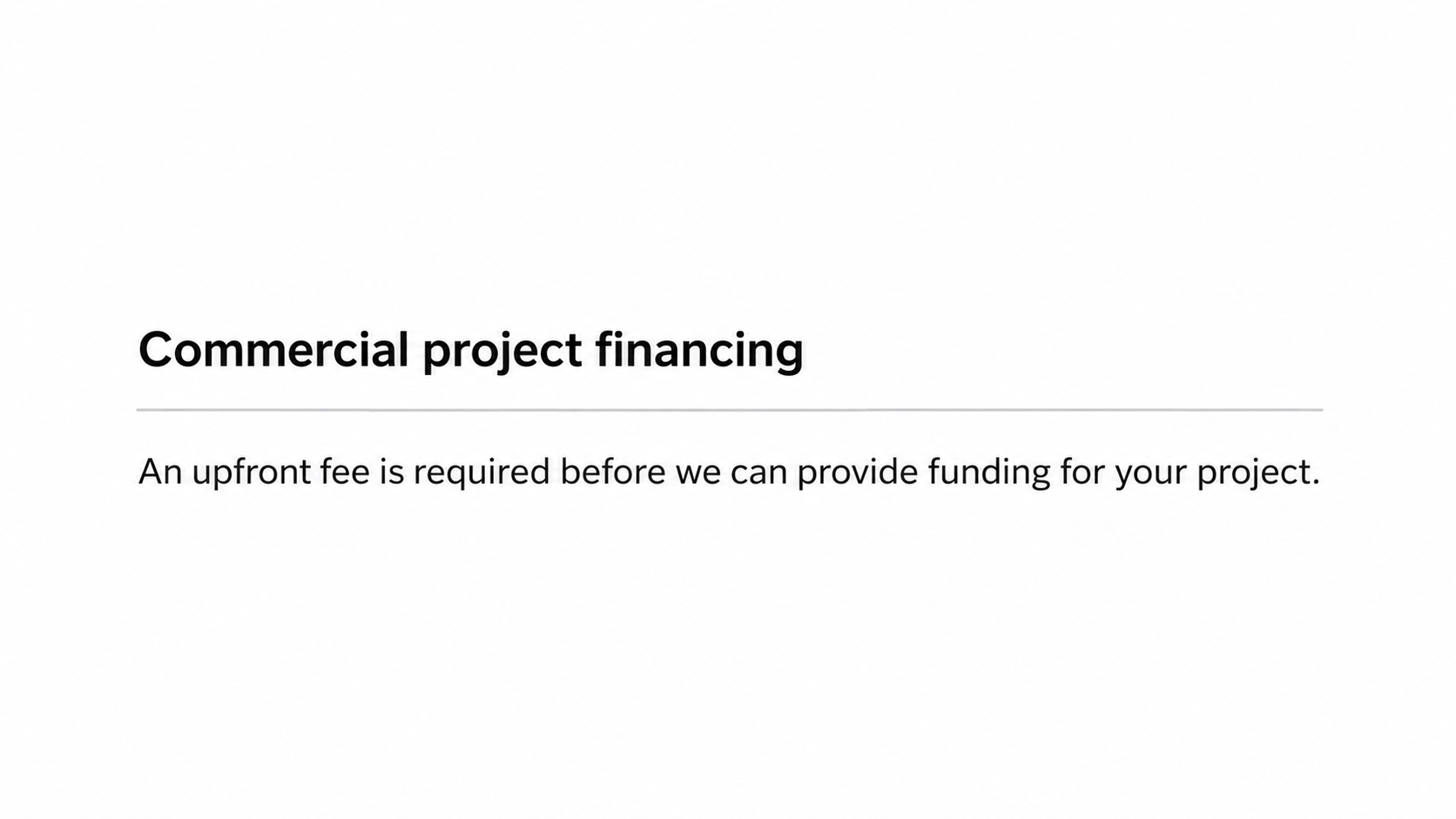
The lead email is a reconstruction illustrating an upfront financing-fee request. It is not an original GCPF email or a capture of a current lending website.
Why Commercial Borrowers Can Be Vulnerable to the Pitch
A stalled project can make financing feel urgent. The borrower may already have spent money on plans, negotiations, or an opportunity that will not wait indefinitely.
A lender appearing at that point can seem to remove the biggest obstacle. A comparatively smaller fee may feel like the final step toward something much larger.
That comparison can obscure what the fee actually buys. It may purchase a defined service, or it may simply pay someone who is promising future money.
Before paying, separate the size of the hoped-for loan from the evidence that the lender can and intends to provide it.
A large funding figure does not make a smaller charge sensible. The decision still depends on the actual agreement and the recipient’s verified role.
The GCPF verdict matters because it resolves the intent in that operation. Borrowers were not merely facing an honest underwriting decision that turned against them.
For someone considering another offer, the practical lesson is to examine the commitment before becoming invested in the promise. Payment should not replace that examination.
How the GCPF Advance-Fee Loan Scam Works
Step 1: The borrower encounters an apparent financing provider
Malvasio and Marcus presented GCPF as a legitimate source of loans for individuals seeking funding for commercial projects.
The borrower was therefore dealing with a business that appeared to provide access to capital, rather than openly purchasing an unrelated service.
Borrowers can mistake progress on an application for progress toward funding. A conversation about a project may still concern only a fee.
Ask what role the company actually performs: lender, broker, introducer, or service provider. Those roles involve different responsibilities and should not be blurred.
Step 2: A fee becomes part of reaching the promised funding
Victims paid thousands in fees while pursuing loans. The operators collected those payments without intending to deliver the financing they had represented.
A borrower can be persuaded by the difference between the fee and the much larger loan. That comparison does not establish that the loan exists.
Read the fee terms as a separate transaction. Identify the service, recipient, conditions, and refund provisions instead of treating the payment as proof of approval.
Step 3: The fee produces revenue without the promised loan
The scheme generated approximately $18 million from hundreds of victims. The financing that justified the payments was not something the operators intended to supply.
This is the point that separates the criminal case from an ordinary declined application. A genuine review can end unsuccessfully without being designed to steal the application charge.
The FTC’s advance-fee loan guidance makes a related distinction: real application fees can exist, but paying a fee does not legitimately guarantee a loan.
Do not interpret a completed fee payment as a completed lending obligation. The agreement still needs to identify what funding commitment, if any, has actually been made.
Step 4: More business names complicate the borrower’s search
Malvasio also carried out the scheme using Harbor Equity and Commercial Private Equity. The names therefore belong in a careful review of relevant historical records.
Different names can separate the sales conversation from the payment description. Matching them helps a borrower explain the whole transaction instead of presenting disconnected documents.
The aliases Joe Cohen and Gregg Pierce can similarly matter when reviewing emails or agreements. An alias should be linked to this case through actual records.
Do not accuse an unrelated person merely because a name looks similar. Identify the business, operator, period, and transaction rather than relying on a loose search result.
Step 5: The borrower is left addressing the fee and the project separately
Once the financing does not arrive, the borrower still has the original commercial problem. Seeking a refund does not itself provide replacement funding.
That situation can make another offer especially persuasive, including a request to pay more to revive the same deal or recover the first payment.
Stop and reassess any new request against the records already obtained. An earlier payment should not become the reason you accept a second unsupported promise.
Keep the project decision separate from the fraud response. This helps you avoid sending more money merely because abandoning the proposed lender feels expensive.
The Companies and People Behind the Financing Promise
GCPF was the named business in the proven scheme
The full company name identified by the DOJ is Global Capital Partners Fund LLC. The verdict concerns its operation by Malvasio and Marcus during the documented period.
When identifying your own transaction, compare the exact legal name with the agreement, invoice, payment recipient, and correspondence. Similar words alone do not establish the same entity.
Harbor Equity and Commercial Private Equity were additional names
The criminal account states that Malvasio used these entities for the same advance-fee scheme. They should not be mistaken for independently verified alternative lenders.
For an affected borrower, preserving those names can connect the payment record with the sales discussion. Keep the original document rather than replacing it with a remembered abbreviation.
An alias can explain a mismatch in correspondence
The DOJ identifies Malvasio as also using Joe Cohen and Marcus as also using Gregg Pierce. Those aliases are part of the named criminal case.
If an email or contract uses one of them, retain the full context. A matching alias is useful evidence when combined with the company and transaction details.
A funding intermediary needs a clearly defined role
A broker’s introduction, a service invoice, and a lender’s commitment are different documents. Ask which one you are receiving before sending a fee.
Identify who makes the lending decision and who has undertaken to provide funds. An intermediary’s promise cannot create another institution’s obligation merely by mentioning its name.
What a Borrower Should Establish Before Paying
Begin with the purpose of the fee. A reasonable explanation should identify a specific task rather than saying the payment is necessary because financing is almost complete.
Ask whether the fee is refundable and which conditions affect that answer. Read those terms before payment, while you can still decline the arrangement.
Next, identify the proposed lender and verify its contact information independently. Do not rely entirely on the salesperson to introduce every person who supposedly confirms the deal.
If the business claims registration or licensing, check the actual record with the relevant regulator. The FTC recommends contacting your state financial regulator or attorney general.
Registration is an identity check, not a guarantee that a particular loan will close. A genuine record cannot validate an unsupported promise about your project.
Request written terms describing the proposed amount, conditions, obligations, and the status of any approval. Do not supply your own assumptions where the document remains unclear.
For a substantial commercial transaction, have a qualified adviser examine the agreement before payment. Ask specifically whether the document promises funding or merely describes an application process.
Finally, consider what happens if the loan never arrives. An offer is harder to evaluate honestly once you are depending on it to rescue an urgent deadline.
What to Do if You Have Fallen Victim to This Scam
-
Stop additional payments connected to the same unverified financing promise. Preserve any fresh fee request or explanation without accepting it.
Write down what you were told the original fee would accomplish and what actually happened. Use the original emails and agreement to support that account.
Do not let a previous payment become the only reason to keep funding the arrangement. Each new request needs its own verified basis.
-
Contact the bank or payment provider that handled the fee and identify the recipient, amount, date, and transaction reference.
For a recent wire, ask promptly whether a recall or other intervention remains possible. For a card payment, ask which dispute process fits the misleading financing promise.
Describe accurately that you authorized payment under a false explanation. Ask about deadlines and supporting records, and retain a written reference for the report.
-
Assemble the complete application and payment trail: proposal, fee agreement, invoices, funding representations, receipts, and any refusal or delay explanations.
Keep the names used by both the salesperson and the recipient. Note where GCPF, Harbor Equity, Commercial Private Equity, or the identified aliases appear.
Separate actual transfers from loan amounts merely discussed. Investigators need to know what money you lost, rather than the value of financing you hoped to receive.
-
Report suspected financing fraud at IC3 when electronic communications or online activity were involved. Choose File A Complaint and describe the offer and payment.
Include documents or transaction identifiers requested by the reporting process, and save the confirmation information. You can also report the deceptive offer through the FTC’s fraud portal.
Do not wait for a perfectly organized file before notifying the payment provider. A report to law enforcement does not automatically initiate the bank’s recovery process.
-
For an inquiry about this federal case, the Southern District of New York lists Victim and Witness Services at 1-866-874-8900.
Identify the defendants and the transaction you believe is relevant. Ask whether any current victim instructions apply, rather than assuming a news release opens a claims window.
Check any unexpected compensation message through that independently obtained contact. Public knowledge of your lender’s name is not proof that someone controls restitution.
-
Seek qualified advice about the fee agreement, possible claims, and deadlines specific to your transaction. Keep the financing problem separate from the recovery claim.
Refuse another upfront payment from someone promising guaranteed recovery or guaranteed replacement funding. Ask for verifiable authority and written terms before considering any separate professional service.
Track actual refunds or distributions as they occur. An announced conviction or a promised payment should not be entered into your records as money already recovered.
Frequently Asked Questions
Was the GCPF case proven in court?
Yes, a federal jury convicted Malvasio and Marcus of wire fraud and conspiracy in June 2026. Malvasio was also convicted of an additional wire-fraud count.
The criminal finding concerned collecting fees for loans they never intended to make. It was not simply a poor review from an unsuccessful applicant.
How much money did the scheme involve?
The DOJ describes approximately $18 million taken from hundreds of victims during a scheme operating from at least March 2017 through August 2023.
That figure concerns fees obtained through the fraud. It should not be confused with the total face value of all loans discussed with borrowers.
Does every upfront loan fee establish a scam?
No, legitimate lenders can charge application or appraisal fees. The FTC distinguishes those charges from a promise that paying first guarantees access to a loan.
The important questions concern the specific service, the genuine lender, the written conditions, and the truthfulness of the funding representation.
Which other business names were connected to Malvasio?
The criminal account identifies Harbor Equity and Commercial Private Equity as additional entities he used for the same scheme. It also identifies his Joe Cohen alias.
Use exact names and your transaction records when assessing a connection. Do not assume a similarly named business is involved without matching evidence.
Does a fee receipt mean a lender approved my project?
No, a receipt establishes that a payment was recorded. The actual agreement must explain whether a lender has made any commitment and what conditions apply.
Ask for that distinction before paying. If the document promises only a review or introduction, do not interpret it as an unconditional funding obligation.
What should I do immediately after paying a suspected fake lender?
Contact the payment provider promptly and ask what action remains possible. Preserve the offer, payment record, fee terms, and correspondence connecting the money to the promised loan.
Stop further payments and use independently verified reporting or case contacts. Recovery is uncertain, so another promise should not substitute for practical action.
The Bottom Line
Do not pay for a guaranteed financing promise that cannot be independently verified. GCPF’s operators collected approximately $18 million while offering loans they never intended to provide.
If you paid, contact your bank immediately, preserve the complete financing and fee records, and seek the relevant reporting or case instructions before sending anything further.

Join the discussion
0 commentsShare your experience or ask a question about this article.
Community experiences
Did this happen to you?
Your experience could help someone recognize the same scam. Submit a private report for our team to review.
I experienced this tooReports are reviewed before publication. Sharing publicly is always your choice.
Discussion
Start the conversation
Have a question or something useful to share? Add the first comment.