


An unexpected legal representative says money may finally be coming back to you. There are documents to sign, a restitution claim to discuss, and fees to arrange.
The Juliet Mora case shows how a promise to put things right can introduce another financial loss, even when the paperwork looks formal.
Overview
The supposed lawyers targeted timeshare owners and earlier fraud victims
The organization contacted elderly timeshare owners and people who had already experienced fraud. Its members pretended to be attorneys offering access to restitution or other payments.
Victims signed false representation agreements and bogus nondisclosure agreements, then paid fees. Checks and wire transfers went to shell companies controlled by participants in the United States.
The DOJ’s account of Mora’s guilty plea describes more than $36 million stolen from over 400 American victims, most of them elderly.
Mora admitted participating in the money-laundering conspiracy
Juliet Mora pleaded guilty in September 2026 to conspiracy to commit money laundering. Her role included handling shell companies and helping organize the movement of victim funds.
She also used fabricated paralegal email identities to communicate with victims. The legal appearance was part of the deception, rather than independent confirmation that compensation existed.
- The contact claimed a legal role in obtaining restitution or payments.
- Formal agreements helped make the proposed relationship look legitimate.
- Upfront fees sent money away from the person supposedly awaiting compensation.
- Domestic shell companies supplied receiving accounts for the operation.
The case-wide loss was not Mora’s personal account total
Investigators traced approximately $2.75 million in stolen victim funds directly to accounts Mora controlled. That figure is distinct from the broader organization’s losses exceeding $36 million.
The guilty plea establishes her admitted participation, rather than a completed compensation program or a finding that every charged participant has been convicted.
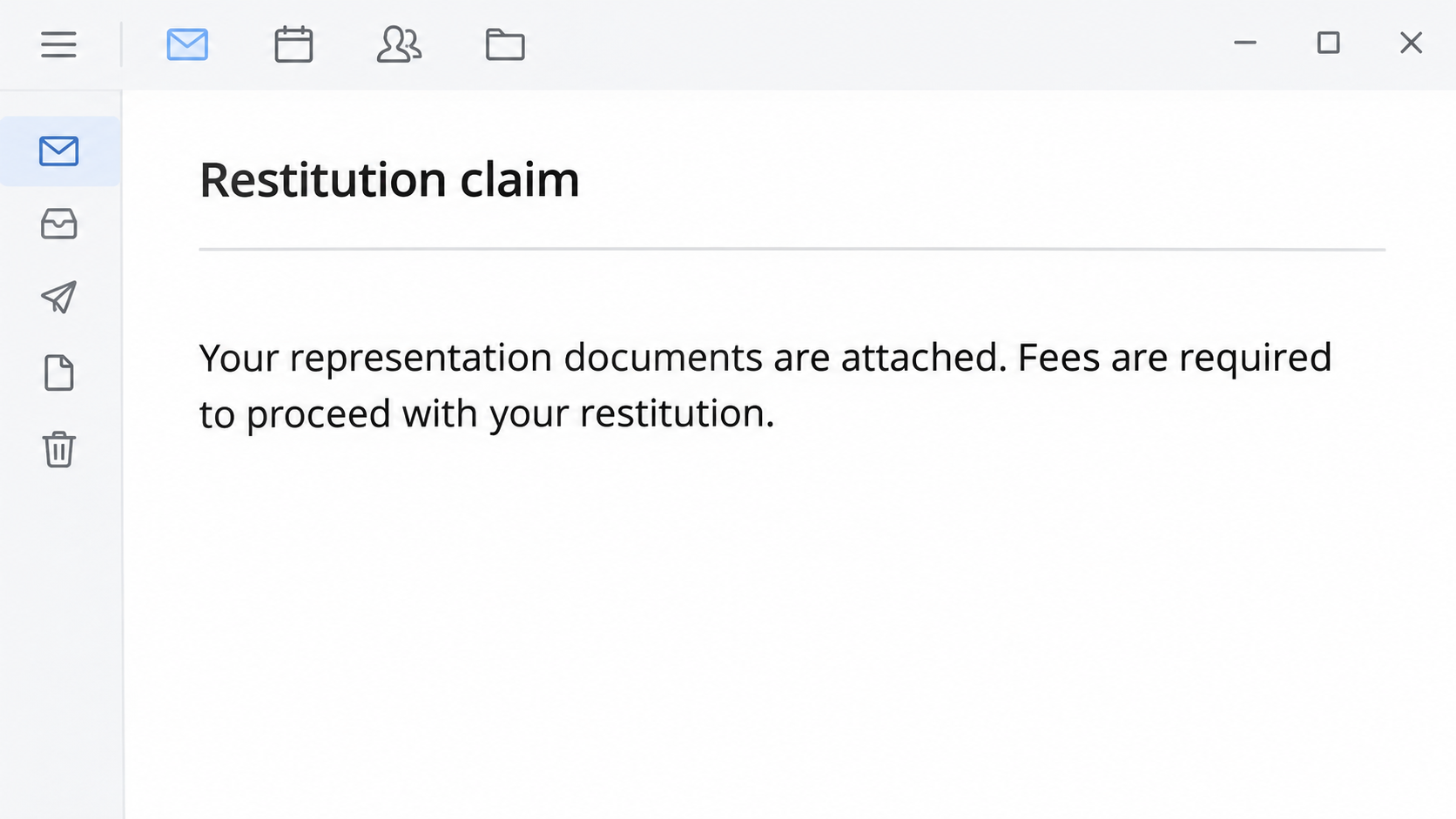
The lead email is an illustrative reconstruction of the legal-fee approach. It is not a recovered message, authentic law-firm communication, or document from a real victim.
Why an Earlier Loss Can Make This Offer Persuasive
Someone who has already lost money may have spent months looking for a useful response. A contact offering restitution appears to address that unfinished problem.
The new conversation can begin with relief instead of suspicion. Rather than promising an investment profit, the person claims to help recover something already owed.
That framing can make the fee seem temporary. You may compare it with the promised compensation and decide that another small payment is worth the chance.
The comparison is misleading if the compensation is invented. A large supposed recovery cannot justify a smaller expense when the person requesting it lacks the claimed authority.
The FTC’s recovery-scam guidance describes how previous victims can be contacted again by people claiming legal, governmental, or consumer-protection roles.
Knowing details about an earlier transaction does not prove those roles. Information about a loss can help a new caller build a convincing story around it.
This does not make every offer of legal help fraudulent. It makes independent verification especially important when the person contacting you also wants money released to their chosen recipient.
You can decline that payment while checking the claim. A genuine legal process should be identifiable outside the unexpected conversation that introduced it.
How the Fake Attorney Restitution Scam Works
Step 1: A supposed legal professional introduces the recovery
Members of the organization pretended to be attorneys contacting timeshare owners and prior fraud victims. They said the victims were entitled to restitution or payments.
The claim supplied both a reason to listen and a reason to view the caller as helpful. The person appeared to be solving the earlier financial problem.
Before treating that claim as meaningful, identify the actual proceeding or payer. Ask who owes the money and what independently verifiable record establishes the proposed payment.
A professional title cannot replace those details. Someone who knows about your timeshare or previous loss has not thereby shown authority to represent you.
Step 2: Agreements make the invented relationship look established
Victims signed fake representation agreements and bogus nondisclosure agreements. Those documents helped present the interaction as a formal legal engagement.
The danger was not the presence of paperwork alone. It was paperwork being used to support a false identity and a misleading account of compensation.
A signature line, legal vocabulary, or a confidentiality clause does not establish that a lawyer exists or that a court has awarded money.
Keep the documents and check their claims through a separate, genuine source. If their wording makes you afraid to seek help, show them to an independent lawyer.
Step 3: Payment instructions turn the recovery into another expense
Victims paid fees by check or wire transfer. The receiving accounts belonged to shell companies controlled by U.S.-based co-conspirators.
That domestic payment destination could appear more familiar than the international operation behind it. A U.S. bank account did not validate the supposed lawyer’s authority.
Compare the proposed recipient with the organization named in the agreement. Ask who controls the account and why that recipient is entitled to the payment.
Do not let a detailed invoice answer those questions on its own. An invoice records a demand, not proof that its underlying explanation is true.
Step 4: Shell companies and accounts move the funds onward
The organization used a network of U.S.-based members who created companies and bank accounts. They misrepresented the true purpose of the transactions to financial institutions.
Mora maintained shell companies, handled victim funds, and lied to banks about their origin. She also reopened accounts after closures for suspicious activity.
The practical consequence for a victim was a payment trail with several participants. The person receiving the fee could differ from the person claiming to handle the case.
Preserve the exact beneficiary details from your bank records. A remembered law-firm name is not enough to explain where the money actually went.
Step 5: Coordinated legal-looking communications keep the story moving
After moving to Nicaragua, Mora helped organize participants, directed transfers, and arranged legal documents. She also communicated with victims using fake paralegal email identities.
An additional person joining the conversation could therefore make the operation look staffed and professional without introducing a genuinely independent source.
A supposed assistant confirming the supposed attorney is not the same as checking that attorney with a separate regulator, court, or verified employer.
If several contacts provide the same payment instruction, examine where their authority comes from. Repetition inside one operation does not establish that the promised restitution exists.
Why the Paperwork and Payment Address Matter
Representation agreements normally describe a relationship between identifiable parties. In this scheme, the documents helped sell a relationship that was not what victims were told.
Read the names and obligations rather than judging the document’s appearance. Identify the person offering representation and the matter they claim to handle.
Then check the claimed proceeding through an independently located official contact. A document supplied by the caller should not be your only route to its supposed issuer.
The payment recipient deserves the same attention. A bank receipt can establish that money reached an account without establishing that the beneficiary was a lawyer or restitution administrator.
The DOJ’s description of shell companies explains why an ordinary-looking business name can appear in the transaction. It does not mean every company with a similar name is involved.
Avoid publishing bank information or signatures while seeking help online. Those records can be preserved privately and supplied through verified bank or investigative channels.
Also keep ownership of a timeshare separate from being a victim of fraud. The operation targeted both owners and earlier fraud victims; not every original purchase was necessarily fraudulent.
The new legal-fee demand needs its own evidence. A genuine timeshare account or earlier loss does not establish that the person contacting you controls any recovery.
What the Seized Money Does and Does Not Mean
The case announcement describes investigators seizing more than $2.1 million in victim funds during arrests in October 2025. Seizure is not the same as a completed refund distribution.
Likewise, money traced to Mora’s accounts identifies part of the investigation. It does not establish that those funds remain available or belong to a particular person contacting you.
A scammer can quote real enforcement news while inventing a private role in distributing money. Accurate case details do not authenticate a release-fee request.
If someone says you must pay to access seized assets, ask the actual agency handling the case whether that instruction is genuine.
Keep any proposed distribution separate from the earlier loss and the later recovery fee in your own records. These are distinct transactions, not one interchangeable balance.
The source confirms Mora’s plea to money-laundering conspiracy. It does not provide grounds to promise full reimbursement or treat every co-defendant’s charge as a conviction.
What to Do if You Have Fallen Victim to This Scam
-
Stop new fee payments and preserve the legal-looking messages. Do not sign additional documents merely because a supposed assistant says the release is almost complete.
Write down the claimed lawyer’s name, employer, jurisdiction, and the proceeding they described. Keep these claims separate from facts you confirmed independently.
If you want legal assistance, choose a professional through a route you trust. Ask that person to examine the purported agreement and the compensation story.
-
Contact your bank immediately about any check or wire connected to the recovery demand. Provide the payment date, amount, beneficiary, and transaction reference.
Ask whether an unpaid check can be stopped or a recent wire recalled. If the payment is complete, ask which fraud-reporting options and supporting records are available.
Explain that the payment followed a false attorney or restitution claim. Retain the bank’s reference and confirmation rather than relying on the original contact to arrange a refund.
-
Preserve the full email threads, attachments, agreements, invoices, and payment instructions. Keep original files where available rather than only screenshots of selected passages.
Create separate totals for the original loss and the later recovery payments. Show investigators which new communications persuaded you to send each additional fee.
Keep sensitive records private until a verified recipient supplies a secure submission method. A stranger offering to help in a public comment thread needs no such documents.
-
Verify the compensation claim outside the contacts supplied by the supposed lawyer. Locate the named court or agency independently and ask whether the described proceeding exists.
For a claimed attorney, use the relevant jurisdiction’s genuine professional regulator to check identity and status, then contact the verified office separately.
If the person or matter cannot be matched, leave the payment stopped. Seek independent advice rather than accepting a different assistant’s reassurance within the same conversation.
-
For questions about this federal case, the Eastern District of California lists its Fresno office at 559-497-4000.
Identify Juliet Mora and explain why you believe your transaction is related. Ask for the appropriate victim-assistance contact and any current instructions.
A phone inquiry is not itself a claim application. Do not assume that a public announcement establishes a new deadline, your eligibility, or an amount you will receive.
-
Report the fraudulent recovery approach through the FTC’s reporting service and, for electronic communications or transfers, the FBI’s IC3 complaint route.
Include the named recipient, account details from your records, and the false legal explanation. Save the report information alongside the bank’s claim reference.
Review what personal information you supplied. If identity misuse appears, start a tailored recovery plan through IdentityTheft.gov rather than sending more documents to the impersonator.
Checking a New Recovery Offer After You Report
Once a person has sought help, another contact may arrive claiming to know the case. That familiarity can be especially convincing after a report has been filed.
Do not assume the new caller learned the details from investigators. Ask the bank or agency you already contacted to confirm any claimed relationship.
The FTC warns that recovery scammers can use lists of earlier victims and their losses. Knowledge of an amount is not proof of authority to refund it.
Avoid supplying a security code, online banking password, or new payment to verify your entitlement. A supposed compensation process should not require surrendering control of your account.
If a contact provides a new document, preserve it and compare the issuer with the established case office. Do not replace your verified contact route with the latest email signature.
You do not have to negotiate with the original organizer to preserve your report. A clear record of the demands and payments is more useful than continuing the exchange.
Frequently Asked Questions
Was the Mora restitution operation a confirmed scam?
Mora pleaded guilty in September 2026 to money-laundering conspiracy involving the documented fraud organization. The DOJ describes false attorneys, bogus agreements, victim payments, and shell accounts.
Her admitted role establishes more than an untested consumer allegation. Other defendants’ individual outcomes should still be distinguished from her guilty plea.
Was every timeshare owner already a fraud victim?
No, the organization targeted both timeshare owners and people who had previously lost money to fraud. Owning a timeshare does not establish that its original purchase was fraudulent.
The confirmed deception here concerns the new claim of legal representation and restitution used to obtain additional payments.
Did Mora personally receive the entire $36 million?
The figure describes losses attributed to the wider organization. Investigators traced approximately $2.75 million directly to accounts controlled by Mora.
Money passing through an account is also different from a completed refund to a victim. Ask the genuine case office about any actual distribution.
Can a signed agreement prove the lawyer is genuine?
No, victims in this case signed false representation agreements and bogus nondisclosure documents. Formal wording and signatures cannot authenticate the identity behind them.
Check the professional and the claimed legal matter independently. Preserve questionable documents for your bank, investigators, or a lawyer you select yourself.
Does a U.S. receiving account make the recovery safe?
No, U.S.-based participants created shell companies and accounts to receive and move victim funds. A domestic payment destination did not validate the legal explanation.
Identify the beneficiary and its authority separately from the bank handling the transfer. A familiar bank name is not an endorsement of the recipient’s claims.
What if someone asks for a final fee to release compensation?
Keep the payment stopped and verify the demand through the genuine agency or case office. Public information about this investigation does not authenticate an unexpected caller.
If you already paid, notify your bank promptly and preserve the new demand. Do not send another fee simply because the earlier payment has not been returned.
The Bottom Line
Do not pay an unexpected legal representative to unlock supposed restitution without independent confirmation. Mora’s organization used formal documents and domestic accounts to turn recovery promises into new losses.
If you sent a fee, contact your bank, retain the agreements and beneficiary details, and use verified case contacts. Keep further payments stopped while the claim is checked.

Join the discussion
0 commentsShare your experience or ask a question about this article.
Community experiences
Did this happen to you?
Your experience could help someone recognize the same scam. Submit a private report for our team to review.
I experienced this tooReports are reviewed before publication. Sharing publicly is always your choice.
Discussion
Start the conversation
Have a question or something useful to share? Add the first comment.