

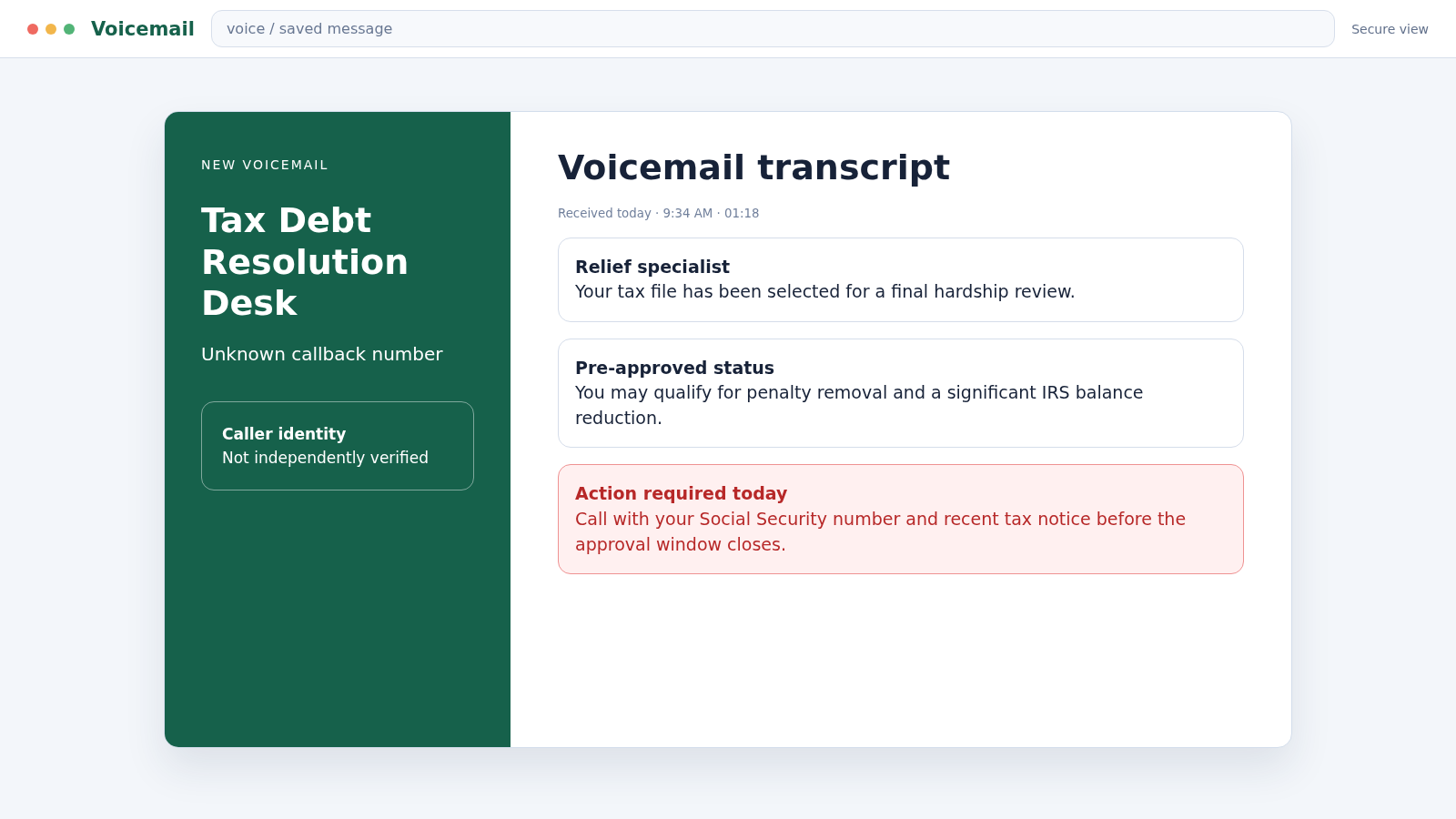
The voicemail sounds oddly specific. A calm agent says your file qualifies for a new tax settlement, but the approval window closes today.
That promise can feel like a lifeline when money is tight. Tax debt scam calls are built to turn that moment of relief into a rushed decision.
Overview
The caller pretends a private sales pitch is an official tax program
Tax debt scam calls arrive as robocalls, live calls, or voicemails claiming that a taxpayer has been selected, pre-approved, or recently made eligible for relief.
The caller may mention the IRS, a tax resolution department, a hardship initiative, or a vague compliance office.
Some calls are outright government impersonation. Others come from aggressive lead generators that collect personal details and sell the lead to tax-relief companies.
A third group charges large fees for work that is never performed.
Real tax relief exists, but eligibility is never decided by a cold caller
The IRS offers payment plans, penalty relief, temporary collection delays, and an offer in compromise for qualifying taxpayers. Those options have rules, documentation requirements, and official application routes.
A stranger cannot honestly guarantee that the IRS will erase a balance before reviewing income, expenses, assets, tax filings, and collection status.
A prerecorded claim that you are already approved is marketing at best and fraud at worst.
The first goal may be data, money, or simply a valuable sales lead
The operation may try to obtain several things during the first conversation:
- Your Social Security number, birth date, and current address
- Information about the amount you owe and your income
- IRS account credentials, tax transcripts, or identity documents
- Bank routing details or a card payment for an upfront fee
- Permission to call repeatedly or share your information with partners
- Remote access to a device under the excuse of completing forms
The danger is not limited to the fee quoted on the call. Tax and identity information can support account takeover, fraudulent returns, new credit, and more convincing follow-up scams.
What Legitimate IRS Contact and Tax Help Look Like
The IRS generally starts a collection matter with a mailed notice.
An IRS employee or authorized private collection agency may call in some circumstances, but a legitimate collector does not begin with an unexplained robocall promising instant forgiveness.
An authorized private collection agency is preceded by letters from both the IRS and the agency.
Those letters name the assigned collector and include information that helps the taxpayer authenticate later contact.
The IRS does not demand immediate payment by gift card, cryptocurrency, wire transfer, or prepaid card.
It does not threaten an instant arrest, deportation, or license cancellation because someone refuses to pay during a surprise call.
If you truly owe, you can review the balance in an independently opened IRS Online Account or use the contact information on an authentic notice.
The IRS also explains its tax debt options without requiring a commercial middleman.
Warning Signs Hidden in the Sales Script
- The call says you were selected without explaining how the caller knows your account.
- A vague deadline requires you to respond before the end of the day.
- The agent guarantees a settlement before reviewing complete finances.
- The business name changes between the voicemail, caller, and paperwork.
- You are asked for a full Social Security number before the company is verified.
- The caller will not provide a written fee agreement or cancellation terms.
- A large payment is required before any documented work begins.
- The caller tells you to stop speaking with the IRS or a trusted tax professional.
- Payment must go to a person, unrelated company, crypto wallet, or gift card.
- The agent becomes hostile when you ask to call back through a verified number.
One red flag may reflect a poorly run sales operation. Several together show that the caller is trying to control the decision instead of explaining a real service.
How the Tax Debt Scam Calls Work
Step 1: A robocall creates either fear or hope
The first message usually takes one of two tones.
It may warn that the recipient’s file is approaching enforcement, or it may announce that a new hardship program can reduce a large portion of the debt.
Both versions create urgency. Fear pushes the target to avoid punishment, while hope encourages someone under financial pressure to grab an apparent second chance.
Step 2: A generic claim is made to sound personal
The recording may refer to a case number, recent tax filing, open balance, or prior request. Often, none of those details came from the IRS.
They are placeholders designed to fit a large audience.
If the recipient calls back, the agent asks questions and reflects the answers as if the information was already in a confidential file.
This conversational trick makes the operation seem better informed than it is.
Step 3: The agent borrows government language
Terms such as compliance, resolution, hardship, fresh start, levy protection, and offer in compromise are mixed into the pitch.
Some are real tax concepts, but their presence does not prove an IRS connection.
The caller may carefully avoid saying “I work for the IRS” while still encouraging that impression.
A Washington-area caller ID, official-sounding department name, or seal on a later email reinforces the illusion.
Step 4: A quick qualification interview collects valuable data
The agent asks how much tax is owed, whether returns are filed, where the target works, and how much comes into the household.
More intrusive questions follow once the person is engaged.
A full Social Security number, date of birth, bank balance, and tax transcript can be framed as normal eligibility checks.
In a legitimate engagement, those records should only be shared after the business, professional, agreement, and secure transfer method are verified.
Step 5: The caller announces an impressive but unsupported result
After a brief hold, a “specialist” may say the taxpayer qualifies for a dramatic reduction.
The result often arrives before any meaningful analysis and may be described as confidential, limited, or already approved.
Real outcomes depend on facts the call has not established. The instant result exists to make the fee feel small compared with the promised savings.
Step 6: An upfront fee or recurring agreement appears
The victim is asked to pay for investigation, enrollment, protection, legal review, or preparation. The total price may be split into smaller debits so the first payment feels manageable.
Some agreements authorize recurring charges or broad representation while promising little specific work. An outright scam may simply take the card details and disappear.
Step 7: Delay and pressure replace measurable progress
After payment, updates become vague. The company may request the same records repeatedly, move the case between departments, or blame the IRS for delays without providing copies of submissions.
Meanwhile, interest and penalties may continue. A victim who stopped reading IRS mail or making an existing payment can end up in a worse position.
Step 8: Follow-up callers reuse the victim’s information
A person who paid or shared data may receive new offers from related names.
One caller may claim to rescue the failed case, refund the fee, or protect the identity information that the first operation exposed.
These recovery approaches are another opportunity to charge money. Prior knowledge about the debt makes the new caller sound credible, but it may simply show that the lead was sold.
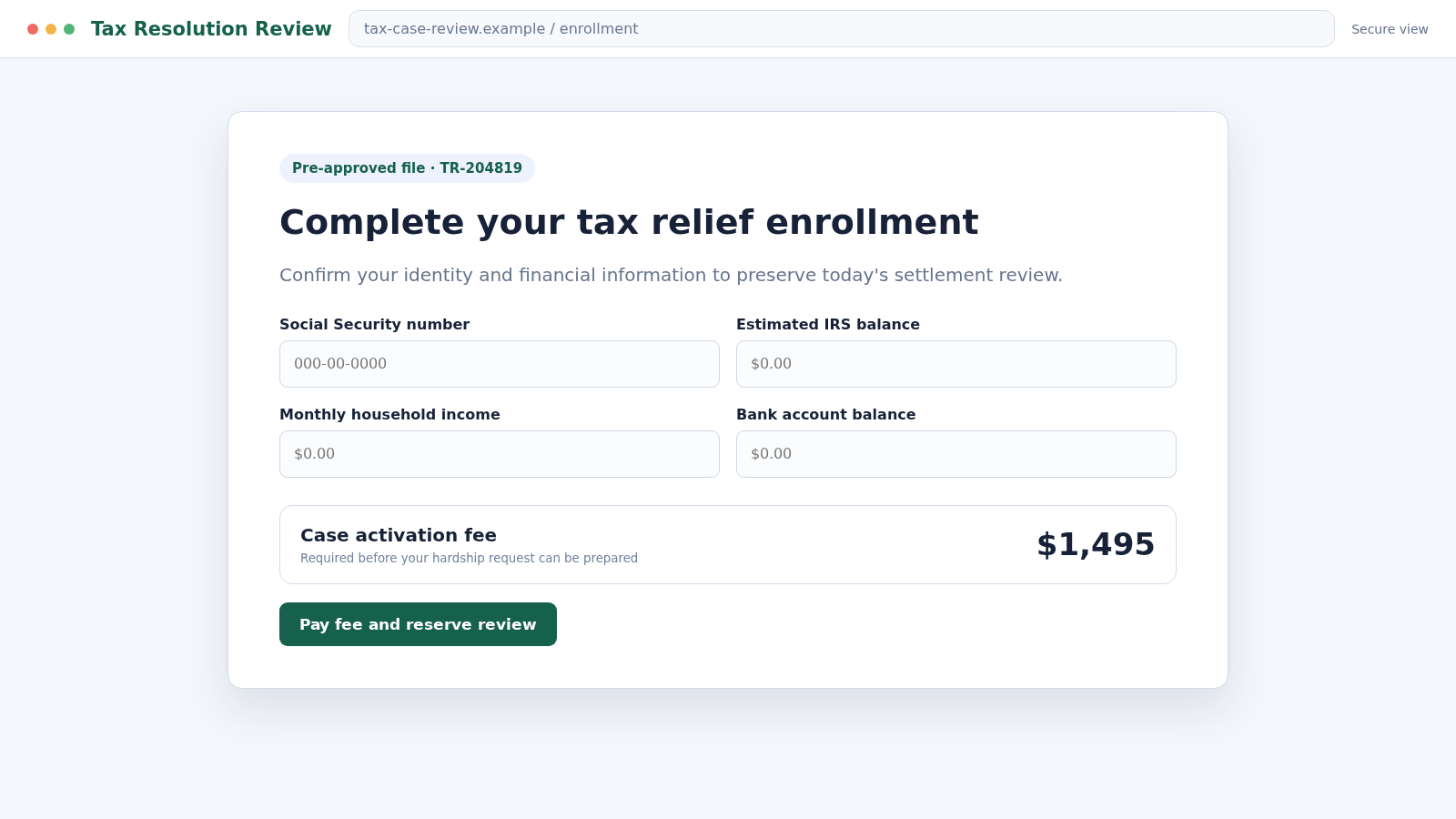
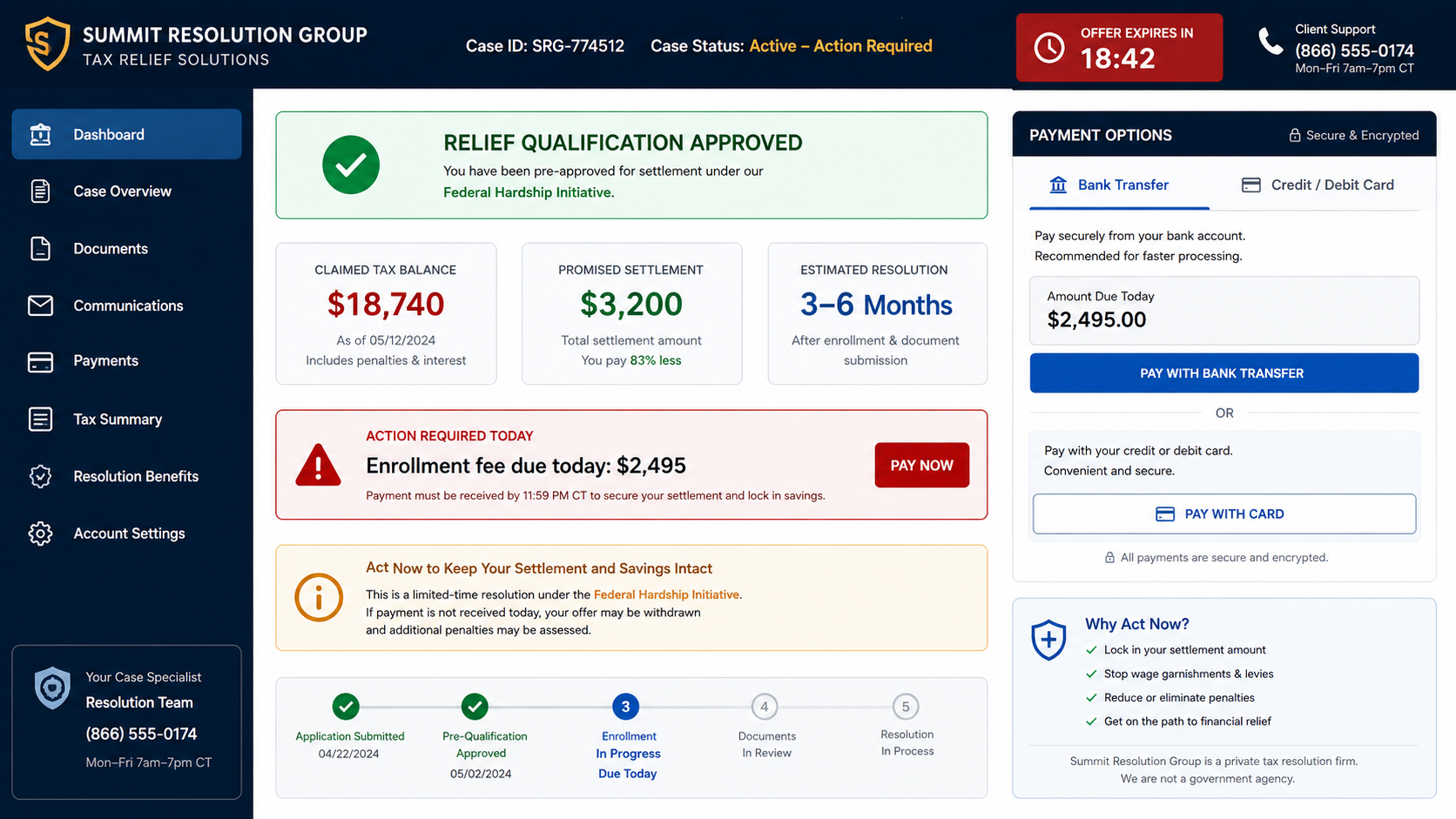
The payment page is often where the promise becomes measurable. Large guaranteed savings, urgent enrollment fees, and vague program labels deserve independent verification.
Company, Address, and Fulfillment Checks
Confirm the legal business, not just the campaign name
Write down the exact legal entity, physical address, website, and state of formation.
A phrase such as “Tax Resolution Center” may be a campaign label used by several unrelated call operations.
Search state business records and compare the result with the contract and payment descriptor.
A registration only shows that an entity was filed; it does not prove competence or honest conduct.
Verify the professional who will actually handle the case
Ask whether an attorney, certified public accountant, or enrolled agent will represent you. Get that person’s full name and license or enrollment details before sharing tax records.
The IRS maintains a directory of certain credentialed federal tax return preparers. State bar and accountancy databases can provide separate checks.
A salesperson’s claim that the firm has “licensed experts” is not enough.
Read the complete fee and cancellation agreement
The contract should state the service, price, refund conditions, recurring charges, and milestones. Look for wording that only promises to investigate options rather than obtain a result.
Do not sign while the caller waits.
Save a copy, review it away from the sales pressure, and compare the promised work with what you can request directly from the IRS.
Demand evidence of every completed action
A legitimate representative can provide copies of authorizations, transcripts requested, forms filed, correspondence received, and deadlines. Progress should be traceable to documents, not periodic assurances.
Verify important claims through your IRS account or an independently located IRS number. Do not let the service remain the only source of information about the supposed case.
How to Respond Without Ignoring a Real Tax Problem
Hanging up on a suspicious caller does not mean ignoring taxes. It separates the real issue from a stranger’s sales funnel.
Open IRS.gov yourself, review your account, and compare any notice number with the IRS notice library.
If you received a paper notice, use the number printed on that verified document.
If professional help is needed, interview more than one credentialed practitioner.
Ask for a realistic range of outcomes, a written fee structure, and an explanation of what can be done directly.
Be cautious with anyone who treats an offer in compromise as a universal discount.
The IRS evaluates ability to pay, income, expenses, and asset equity, and many taxpayers will not qualify.
What to Do if You Have Fallen Victim to This Scam
- Stop all contact and additional payments. Do not provide another document, verification code, or “final processing” fee. Block the known numbers after saving evidence.
- Call your bank or card issuer immediately. Explain that the payment resulted from a deceptive tax-relief call. Ask about stopping pending transfers, replacing exposed cards, and disputing charges.
- Secure your IRS Online Account. Change credentials through IRS.gov, review activity, and enable the strongest available multifactor authentication. Never use a link supplied by the caller.
- Protect the email account tied to tax records. Replace a reused password, sign out unknown sessions, and remove unfamiliar forwarding rules or recovery details.
- Consider an IRS Identity Protection PIN. An IP PIN can help prevent someone from filing a federal tax return using your Social Security number. Follow the IRS application process directly.
- Build an identity-theft recovery plan. If a Social Security number or identity documents were exposed, report the incident at IdentityTheft.gov and follow its personalized steps.
- Review credit files and financial accounts. Look for unfamiliar inquiries, accounts, transfers, and address changes. Place free security freezes when the exposure could support new-account fraud.
- Check the real tax balance and deadlines. Read authentic IRS notices and verify the current status independently. Resume or arrange legitimate payments rather than relying on the scammer’s claims.
- Revoke unauthorized tax representation. If you signed a power of attorney or tax information authorization, ask the IRS or a trusted professional how to withdraw it and confirm who can access your records.
- Scan any device used during the call. If you installed software, opened an attachment, or granted remote access, disconnect the session and run a full Malwarebytes scan. Remove unknown remote-control tools.
-
Block known malicious destinations.
AdGuard can help stop many phishing domains, malicious ads, and tracking requests used in follow-up campaigns. Continue to verify all tax sites independently. - Report the call through official channels. The IRS directs suspicious tax-debt-relief calls to the FTC and FCC, while IRS impersonation calls can also be reported to TIGTA. Keep the number, date, voicemail, and business name.
- Reject recovery and refund callers. A new agent who knows about the loss may have obtained your lead. Do not pay anyone who guarantees a refund or claims a new government fund will reimburse you.
Frequently Asked Questions
Are all tax relief companies scams?
No. Credentialed professionals and legitimate firms can help with tax matters.
The warning signs are unsolicited pressure, guaranteed outcomes, unclear identities, large upfront fees, and claims that cannot be verified with the IRS.
Does the IRS ever call about tax debt?
It can call in limited circumstances, usually after written contact. The IRS does not use an unexpected threatening robocall to demand immediate payment or promise instant debt forgiveness.
Can tax debt really be settled for less?
Some taxpayers qualify for an offer in compromise, but approval depends on detailed financial facts. A caller cannot guarantee acceptance after a brief conversation.
What if the caller knew how much I owed?
Accurate information does not authenticate the caller. Data can come from prior applications, breached records, public sources, or another marketing company. Verify through IRS.gov or a trusted professional.
Should I press a number to stop the robocalls?
No. Interacting may confirm that the number reaches a person. Save the evidence, hang up, block the sender, and report the campaign through the appropriate official channel.
Can a tax relief company take money before helping?
Fee rules depend on the service and sales method, but a demand for substantial payment before a clear written agreement and credential check is a serious warning.
Never pay merely to preserve a supposed same-day approval.
The Bottom Line
Tax debt scam calls disguise a sales funnel or theft attempt as urgent government relief.
The caller’s confidence, case number, and tax vocabulary do not prove access to an IRS file.
End the call and check the issue independently. Real tax options remain available through the IRS and verified professionals after the artificial deadline disappears.

Join the discussion
0 commentsShare your experience or ask a question about this article.
Discussion
Start the conversation
Have a question or something useful to share? Add the first comment.