


An AI companion that remembers you, listens whenever you need it and helps make sense of difficult feelings can sound deeply appealing.
Copymind AI therapy claims deserve a closer look before you decide what kind of support you’re getting, or how much trust to put in it.
Overview
The offer
Copymind promotes a personal AI model that learns about you through conversations and offers support at any hour.
Its appeal is easy to understand: talk without arranging an appointment, repeat less of your story, and have somewhere to put thoughts that feel hard to explain.
The ruling
On November 4, 2026, the UK’s Advertising Standards Authority (ASA) upheld three issues over Copymind ads seen in March.
The disclaimer
The current site emphasizes self-awareness and decision-making. Its footer describes an educational assistant, not a licensed mental health therapist, psychologist or psychiatrist.
That is an important limit on what a customer should expect. A wellness companion and a service providing mental health treatment are different commitments.
The National Institute of Mental Health (NIMH) recommends checking an app’s evidence, who it is for, and what to do if symptoms worsen.
- Is the support fully automated, or does it include contact with a trained professional?
- Is there evidence for the outcomes and people the app is meant to help?
- What should you do if symptoms worsen?
What Copymind AI Therapy Claims Promised
Therapy comparisons
The ads contrasted conventional therapy with an AI breakthrough.
That comparison speaks to a real frustration: wanting to feel understood after spending time and money trying to get help.
You may recognize the feeling without accepting the conclusion the advertisement invites. A moving conversation does not tell you whether a treatment works for your needs.
A testimonial describes an experience. It does not provide the comparison needed to show that one form of care produces better, safer or longer-lasting results.
Ask what improved, how it was measured, and who was included. An emotional moment is not the same answer as a sustained change in daily functioning.
Medical claims
The ASA found implied medical claims and said it had not seen the required MHRA registration and conformity evidence.
For the ad targeting serious distress, the ASA had not seen evidence of suitably qualified professional supervision.
The ruling records the evidence available to the ASA. Its findings should not be stretched into a claim about every later version of the app.
For someone looking for treatment, the practical question is who is responsible for assessment, monitoring and decisions when things get more difficult.
Being available all night does not answer that question. Nor does remembering something you typed last week.
Vulnerable audiences
The ASA found one ad discouraged essential treatment. Its suicide-related material was judged irresponsible and likely to cause unjustifiable distress and serious offense.
Antipadia did not respond. The ASA prohibited those ad versions and referred the matter to CAP Compliance.
Someone struggling should not have to separate a sales message from a suggestion about where to seek urgent care while already feeling overwhelmed.
The useful boundary is straightforward: a product pitch should never become your emergency plan. Get human help when safety is at stake.
What the Current Copymind Page Shows
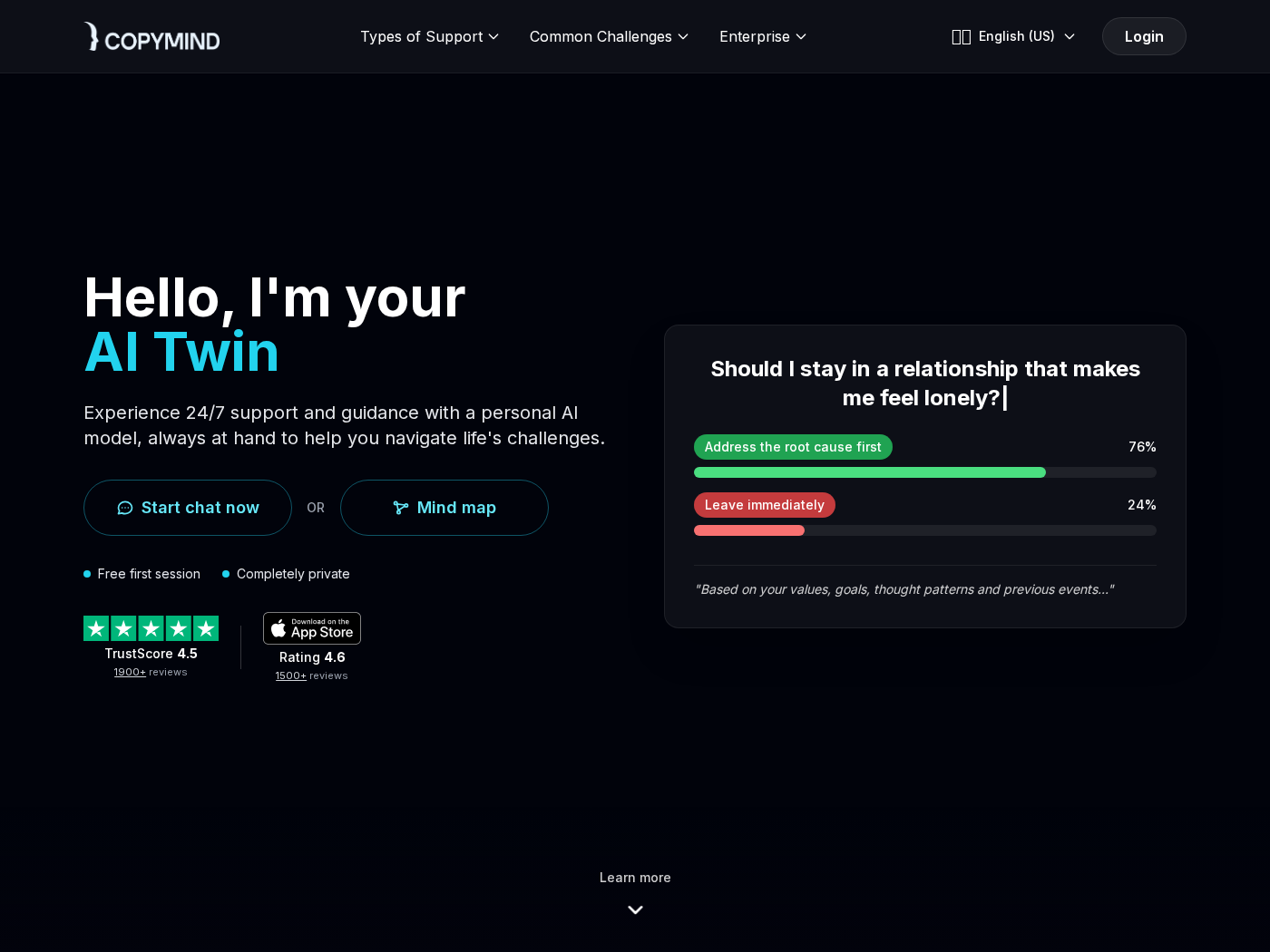
The public homepage illustrates relationship choices with percentages and invites visitors to start a conversation or create a mind map.
A percentage beside a suggested decision can look precise. It does not explain how that suggestion was validated or whether it fits the situation you actually face.
Treat an illustration as an illustration. Before making an important decision, consider what information is missing and who could help you examine it.
The site’s educational disclaimer deserves to be read alongside its promises of understanding, personal growth and constant availability.
If you want a reflection tool, judge it on that limited purpose. If you want treatment, look for the safeguards and evidence required for treatment.
Why the Therapy Promise Needs More Evidence
The MHRA’s digital mental health guidance distinguishes intended purpose from functionality: what software is meant to do, and how it does it.
It explains that a medical purpose combined with complex functionality can bring a product within software-as-a-medical-device regulation.
This is why a clinical promise needs more scrutiny than a promise to organize a journal. The claim changes what a vulnerable user may rely on.
The distinction also prevents an overreaction. The ASA ruling is not a finding that every AI companion, or every use of software for wellbeing, is unlawful.
The MHRA page concerns the UK framework. A product’s purpose and functions, rather than the word AI alone, determine the regulatory question.
An app can be part of someone’s routine without becoming the person responsible for their care. Keep that boundary explicit when deciding what to buy.
Who Runs Copymind, and What Are You Agreeing To?
The operator
Copymind names Antipadia Enterprises Limited in Cyprus. Antipadia declares registration number HE405587 and describes self-reflection technology rather than diagnosis or prescribing.
Those are company declarations. A company name and number help identify a provider, but they do not establish clinical competence or independently verify its technology.
Keep the developer, the service described in the ad and the business on a receipt connected. They answer different questions about responsibility.
Personalization is a product promise, not a professional qualification
The National Institute of Mental Health recommends asking about an app’s evidence, intended audience, privacy and response when symptoms worsen.
For Copymind, that means asking what the advertised personal understanding can actually help you do, rather than assuming it includes assessment by a clinician.
Do you want help organizing thoughts, or help with a condition affecting your life? Be clear about that before interpreting a fluent reply as care.
Read the data terms before sharing something intimate
The privacy, terms and refund links opened pages with headings and placeholder text. Their full conditions were unavailable to check.
That gap is a reason to pause before sharing sensitive material or paying. Wait for clear terms instead of guessing what a reassuring promise covers.
Look for plain answers about storage, access, deletion, export and use of your conversations. A reassuring phrase on a homepage does not answer each question.
The FTC advises checking app and device privacy settings, including permissions for information such as location, contacts or photos.
Give access only when you understand why it is needed. Changing a phone permission and deleting information already sent to a provider are separate tasks.
A refund label is not a verified purchase agreement
Do not infer the price, renewal schedule or eligibility for money back from a menu link. Read the actual offer and complete conditions before confirming payment.
Keep a copy of the displayed amount, billing interval and cancellation instructions. If those terms are unclear or unavailable, do not commit to the purchase.
The ASA’s advertising decision does not automatically cancel a customer’s contract or establish a refund for every user.
What Qualified Mental Health Care Adds
NIMH describes psychotherapy as treatment for troubling emotions, thoughts or behaviors, usually with a licensed professional, individually or in a group.
Treatment choices depend on individual needs and medical circumstances. Goals can include symptom relief, better daily functioning and quality of life.
When comparing a chatbot with therapy, consider what you would otherwise be asking a professional to do: assess the problem, explain an approach and review progress.
A service can feel supportive without taking on those responsibilities. You need to know which kind you are using.
For example, preparing questions for an appointment is a bounded task. Diagnosing a condition, judging its severity or choosing treatment involves a different level of responsibility.
Decide which task you are asking the tool to perform. Otherwise, a helpful piece of writing can quietly become the basis for a medical decision.
If therapy has felt directionless, bring that concern to the therapist. Ask about goals, the approach being used, how progress is assessed and alternatives.
NIMH also notes that digital tools can complement care and improve access. Their potential benefits do not demonstrate the effectiveness of a particular commercial app.
You do not have to dismiss every helpful moment with software. Just avoid turning that moment into a reason to abandon care you may need.
What to Do If You Used Copymind or Responded to an Ad
-
Separate reflection from treatment. Write down what you expected Copymind to provide and what led you to expect it: the ad, homepage, recommendation or purchase screen.
If you were seeking help for persistent or serious difficulties, speak with a qualified mental health professional. Discuss how the app fits with any existing care.
Do not change prescribed treatment solely because of a chatbot conversation or an advertisement. Bring concerns about your current treatment to the professional managing it.
-
Find a real route to care. If you are unsure where to begin, a primary care professional can help assess your needs and identify appropriate support.
In England, the NHS explains GP referrals and self-referral options. Some services are available without first obtaining a GP referral.
Adults in England can self-refer to NHS talking therapies for anxiety and depression; you do not need an existing diagnosis to make that referral.
The service can explain what happens after referral, including waiting times and what information will be shared with your GP. Ask before your first appointment.
Elsewhere, use your local health service or insurer’s verified directory. Check the practitioner’s qualifications, service scope, costs and availability before booking.
-
Use urgent help when you need it. If you cannot keep yourself safe or someone’s life is at risk, seek emergency care immediately.
For urgent concerns, contact your local crisis service or an appropriate healthcare professional. An app’s availability is not a substitute for expert assessment.
The NHS urgent help page explains the options in England. Choose the emergency or urgent service appropriate to where you are.
-
Limit further sensitive disclosures until you understand the terms. Review the information you have already supplied and the controls actually available in your account.
Ask the provider how to access, export or delete your information, and retain its reply. Do not assume removing an app also removes information held elsewhere.
Review device permissions and turn off access that is unnecessary for the features you choose to use. Do this through the device’s own settings.
Keep any correspondence private. You can explain a concern to a regulator or payment provider without posting an intimate conversation in a public review.
-
Deal with any unwanted payment through the right channel. Identify who billed you from your receipt or statement before choosing a cancellation or refund route.
For Apple-billed purchases, Apple explains how to request a refund and find the receipt associated with a charge. Some purchases may qualify; approval is not automatic.
Apple also distinguishes requesting a refund from canceling an unwanted subscription. Check both issues if they apply to your purchase.
For a payment made directly to a merchant, use that merchant’s published support process and keep copies. Ask your payment provider about a dispute when appropriate.
Describe what was promised and supplied accurately. An unwanted purchase and a payment you never authorized are different situations.
-
Keep the advertisement if you want to report it. Save the account name, date, link and relevant claims, along with any response you receive.
Use the original ASA ruling to distinguish the specific advertising findings from assumptions about every current use of the product.
You do not need to reproduce distressing imagery to explain your concern. A clear description and a private record of the ad can preserve the issue.
Frequently Asked Questions
Did the ASA ban Copymind completely?
The ruling prohibited the ads in the form complained of. It addressed advertising claims and presentation, rather than declaring every use of the app illegal.
Can an AI twin replace my therapist?
Do not use it as a substitute for qualified mental health care. Copymind’s own current disclaimer describes an educational assistant, not a licensed professional.
Is Copymind currently registered as a medical device?
The ASA reported missing registration and conformity evidence in its ruling. That is not an independent confirmation of its current registry status.
Do positive reviews demonstrate that it works as therapy?
Reviews can describe satisfaction or an emotional experience. Treatment claims need evidence relevant to the product, the people using it and the outcomes promised.
Are my Copymind conversations confidential?
Do not treat the homepage’s privacy assurances as an independently verified guarantee. Read the full policy and obtain clear answers before sharing sensitive information.
Am I automatically entitled to a refund because of the ruling?
Refund eligibility depends on your purchase terms and the applicable process. Keep the ad and receipt, then contact the business that billed you.
The Bottom Line
Do not treat Copymind AI therapy claims as proof of clinical effectiveness or buy the app as a replacement for qualified mental health care.
If you choose a reflection tool, keep its role limited and understand the terms before sharing personal information. An educational disclaimer should shape what you expect.
If you already relied on the therapy pitch, reconnect with appropriate care and review any payment or data concerns separately. Your wellbeing comes before the sales message.

Join the discussion
0 commentsShare your experience or ask a question about this article.
Discussion
Start the conversation
Have a question or something useful to share? Add the first comment.