

Beminda Steam Therapy Pro is being promoted as a warm steam eye mask for people dealing with dry, gritty, burning, or irritated eyes. The product is marketed as a drug-free alternative to eye drops, using moist heat and steam to support blocked oil glands around the eyelids.
But before ordering, buyers should look carefully at the claims, the product quality complaints, the subscription-related risks around its consumable “hydration” solution, and whether this is truly a premium dry-eye device or another aggressively marketed wellness gadget sold through polished online funnels.
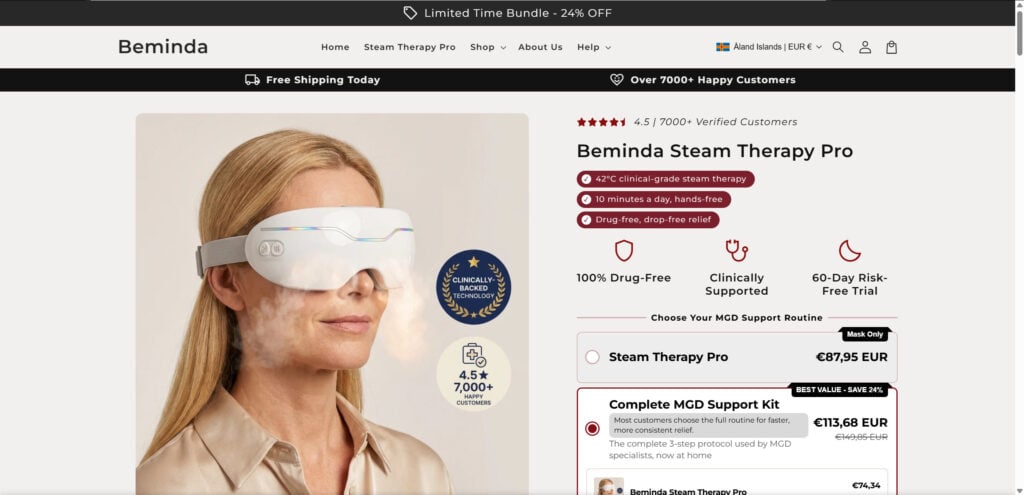
Beminda Steam Therapy Pro Overview
Beminda Steam Therapy Pro is sold through Beminda.com as a cordless, rechargeable steam eye mask. The product page claims it provides “42°C clinical-grade steam therapy,” takes 10 minutes a day, and offers “drug-free, drop-free relief.” It also says the device is “clinically supported” and comes with a 60-day risk-free trial.
The core sales pitch is that many dry-eye symptoms are caused by meibomian gland dysfunction, where oil glands in the eyelids become blocked. Beminda claims sustained warm moist steam at around 42°C can soften hardened oils, help glands flow again, rebuild the tear film, and reduce burning, gritty, and stinging sensations.
Warm compresses and eyelid heat therapy are real concepts in dry-eye care. The American Association for Pediatric Ophthalmology and Strabismus says warm compresses are commonly used for meibomian gland dysfunction, and a 2022 review of eyelid warming devices found that most devices studied improved signs and symptoms in a range of MGD severities and were generally safe.
That does not automatically mean Beminda’s specific device performs as advertised for every buyer. The product page itself states that Beminda Steam Therapy Pro is not a medical device and is not intended to treat, diagnose, or prevent disease.
That disclaimer matters. The site uses medical-style language, dry-eye symptom claims, and “clinically supported” positioning, but the device is not presented as a regulated medical treatment.
The Main Concern: Strong Claims Around a Sensitive Health Problem
Dry eyes are not a minor inconvenience for many people. Chronic dry eye can affect reading, driving, computer work, sleep, contact lens use, and daily comfort. Because of that, people are more likely to respond emotionally to products promising relief.
Beminda’s page makes several strong claims:
- “42°C clinical-grade steam therapy”
- “10 minutes a day”
- “drug-free, drop-free relief”
- “unblock the glands”
- “relief that lasts”
- “reduced drop dependence”
- “longer screen comfort”
The issue is not that warm compress therapy is fake. The issue is that a direct-to-consumer device should not be treated as a guaranteed solution for chronic dry eye, especially when the seller itself says the product is not a medical device.
Dry eye can have many causes, including meibomian gland dysfunction, aqueous tear deficiency, autoimmune disease, medication side effects, contact lens problems, allergies, screen use, eyelid inflammation, and post-surgical complications. A heated steam mask may help some people feel temporary relief, but it should not replace an eye exam or treatment plan from an eye-care professional.
How the Beminda Offer Appears to Work
1. The page targets people tired of eye drops
The product page says drops only replace moisture temporarily and cannot unclog blocked glands. This is used to position Beminda as a more complete solution than artificial tears.
This is a persuasive angle because many dry-eye sufferers use drops repeatedly without long-term relief. The product is framed as treating the “root” issue rather than just adding moisture.
That may sound logical, but buyers should be careful. Not every dry-eye case is caused by blocked oil glands, and not every person with MGD will respond the same way to home heat therapy.
2. The device uses clinical-sounding features
Beminda describes the device as using:
- PTC ceramic heating
- NTC thermistor temperature monitoring
- ultrasonic atomization
- micron-grade warm mist
- 40°C and 42°C heat levels
- 10-minute auto shut-off
- USB-C rechargeable battery
The product page says the device heats in about 10 seconds and runs a 10-minute session with adjustable mist and heat levels.
These features may sound advanced, but buyers should separate technical specifications from proof that the device will meaningfully improve their specific eye condition.
3. The product relies on a proprietary liquid
Beminda says users should put only the Beminda Eye Hydration Complex into the device and should not substitute tap water, distilled water, saline, contact lens solution, or eye drops. The page says other liquids can damage the atomizer and void the warranty.
This creates an important buyer concern. If the device depends on a proprietary consumable liquid, the real cost may go beyond the initial purchase.
The site navigation also includes a “Manage Subscriptions” link, and the refund policy says consumable products, including Beminda Eye Hydration Complex, are non-returnable and non-refundable. (Beminda)
That does not prove customers will be enrolled in unwanted refills. But it does mean buyers should inspect the checkout page carefully for any subscription, refill, bundle, or recurring shipment option.
4. The “60-day risk-free trial” sounds reassuring
Beminda’s refund policy says customers have 60 days from delivery to return the product for a full refund, and that Beminda will provide a prepaid return label if a return is needed
That is better than many dropshipping-style stores that require customers to pay overseas return shipping. However, the same policy also says consumable products such as the Eye Hydration Complex are non-returnable and non-refundable.
So the device may be returnable, but refill liquids or consumable add-ons may not be.
5. Customer reviews are mixed
Beminda’s Trustpilot page shows a claimed profile with 13 reviews and an average TrustScore of 3.3. At the time checked, Trustpilot showed 31% of reviews as 1-star.
Some customers report positive results, saying the device helped soothe dry eyes or reduced their need for drops. But negative reviews raise concerns about product defects, leaking, poor fit, delays, unlabeled bottles, Chinese instructions, and devices that do not heat or produce steam.
One reviewer said they received two unmarked pink bottles with liquid inside and no ingredient label or safety seal. Another said the device broke out of the box and mentioned Chinese instructions. Other reviews complain about leaking, discomfort, poor fit, or no steam.
That mixed pattern does not prove the company is a scam, but it does show real buyer risk.
Red Flags Buyers Should Consider
1. Medical-style claims, but not a medical device
Beminda uses dry-eye relief language, gland-related explanations, and clinical-style positioning. But the company also states the device is not a medical device and is not meant to treat, diagnose, or prevent disease.
That gap should make buyers cautious.
2. Results may vary widely
Dry eye has different causes. A steam mask may help some people, especially those with meibomian gland dysfunction, but may not help others with more complex or severe dry-eye disease.
3. Product quality complaints exist
Reviews include complaints about leaking, no heat, no steam, poor fit, defective devices, and unclear or Chinese instructions.
For a product used near the eyes, quality control matters.
4. The consumable liquid is a concern
The product page tells users to use only Beminda Eye Hydration Complex in the device. The refund policy says that consumable products, including that complex, are non-returnable and non-refundable.
Buyers should check whether the liquid is sold as a refill, subscription, bundle, or recurring purchase.
5. Similar eye masks are widely available
Marketplace suppliers sell many heated eye masks, steam eye masks, and warm compress devices at low wholesale prices. This does not prove Beminda is identical to those products, but it does show the category is crowded with generic devices and private-label opportunities.
6. “Clinically supported” does not mean this exact product is clinically proven
The site references research around steam therapy and eyelid warming, but buyers should ask whether independent clinical testing was performed on the exact Beminda device, not just on the general concept of warm compress or steam therapy.
Is Beminda Steam Therapy Pro a Scam?
Beminda Steam Therapy Pro does not appear to be a simple “pay and receive nothing” scam. It sells a real device, has a public refund policy, lists business information, and has mixed reviews from customers who appear to have received products.
However, it still looks like a high-risk wellness gadget offer.
The main concerns are the strong dry-eye claims, the non-medical-device disclaimer, mixed product quality reviews, possible refill/subscription angle around the hydration solution, and the fact that similar warm-eye devices are widely available from other sellers.
A fair conclusion is this: Beminda may help some users feel temporary dry-eye relief, but buyers should not treat it as a guaranteed medical solution or assume the marketing claims apply to every dry-eye condition.
What To Do Before Buying
1. Ask your eye doctor what type of dry eye you have
Before buying any steam mask, confirm whether your dry eye is actually caused by meibomian gland dysfunction. If your symptoms are due to aqueous tear deficiency, inflammation, allergies, medication, autoimmune disease, or another cause, heat therapy may not be enough.
2. Compare alternatives
Compare Beminda with:
- basic warm compress masks
- microwaveable eye masks
- USB heated eye masks
- established dry-eye devices
- in-office treatments such as LipiFlow, IPL, or gland expression if recommended by a doctor
Do not buy only because the sales page says drops are not enough.
3. Check for recurring charges
Because the site includes a subscription-management link and sells a required hydration liquid, inspect checkout carefully for:
- subscribe and save
- auto-refill
- monthly delivery
- recurring billing
- refill plan
- hydration complex subscription
- bundle add-ons
Screenshot the checkout page before paying.
4. Read the refund policy
Beminda says device returns are accepted within 60 days and that prepaid return labels are provided when a return is approved. But consumable products are non-returnable and non-refundable. (Beminda)
That distinction matters if you buy extra bottles or bundles.
5. Use a payment method with buyer protection
Because customer reviews mention defective devices, leaking, and unclear packaging, use a credit card or PayPal rather than debit.
What To Do If You Already Ordered
1. Inspect the package before using it
Check:
- whether the device heats properly
- whether it leaks
- whether it produces steam
- whether the instructions are in English
- whether bottles are labeled
- whether ingredients and safety seals are present
- whether you received exactly what you ordered
Do not use unlabeled liquids near your eyes.
2. Stop using it if it causes irritation
If the liquid stings, the device leaks, or your eyes feel worse, stop using it. If irritation, redness, pain, or vision changes occur, contact an eye-care professional.
3. Contact Beminda in writing
Email support with your order number and describe the issue clearly. Ask for:
- refund
- replacement
- return label
- cancellation of any refill or subscription
- confirmation that no future charges will occur
4. Check for subscription settings
Use the “Manage Subscriptions” link if needed and check your payment account for recurring charges. Save screenshots of any cancellation.
5. Dispute the charge if needed
Contact your card issuer or PayPal if:
- the device never arrives
- the device is defective
- the seller refuses the stated refund policy
- you receive unlabeled consumable liquids
- you are charged for refills you did not approve
- the product does not match what was advertised
Use clear dispute wording such as “item not as described,” “defective product,” or “unauthorized recurring charge.”
FAQ
What is Beminda Steam Therapy Pro?
Beminda Steam Therapy Pro is a rechargeable steam eye mask marketed for dry, irritated, gritty eyes. It uses warm mist and heat around the eyelids during a 10-minute session
Is Beminda Steam Therapy Pro a medical device?
Beminda’s own page says the product is not a medical device and is not intended to treat, diagnose, or prevent disease
Does warm compress therapy help dry eyes?
Warm compress therapy is commonly recommended for meibomian gland dysfunction, and research reviews suggest eyelid warming devices can improve signs and symptoms for some MGD patients. (AAPOS)
Does that mean Beminda is proven to work?
Not necessarily. Evidence for eyelid warming as a general therapy does not automatically prove every claim made for this specific device.
Are there complaints about Beminda?
Yes. Trustpilot shows mixed reviews, including complaints about leaking, defective devices, no steam, poor fit, delayed shipping, Chinese instructions, and unlabeled bottles. (Trustpilot)
Does Beminda offer refunds?
The refund policy says customers have 60 days from delivery to return the device for a full refund and that Beminda provides a prepaid return label if a return is approved. Consumable products such as the Eye Hydration Complex are non-returnable and non-refundable.
Can I use water or eye drops in the device?
Beminda says to use only its Eye Hydration Complex and warns that tap water, distilled water, saline, contact lens solution, or eye drops can damage the atomizer and void the warranty.
Is there a subscription risk?
The site includes a “Manage Subscriptions” link and sells consumable Eye Hydration Complex. Buyers should check checkout carefully for refill or subscription terms
Should I buy Beminda Steam Therapy Pro?
Be cautious. It may help some users, but the product has mixed reviews and should not replace professional eye care. Confirm your dry-eye cause first and avoid any subscription unless you clearly want recurring refills.
The Bottom Line
Beminda Steam Therapy Pro is marketed as a warm steam eye device for dry-eye comfort and meibomian gland support. The general concept of eyelid warming is real, but the product’s marketing should still be treated carefully.
The biggest concerns are the medical-style claims, the non-medical-device disclaimer, mixed customer reviews, reported product defects, and the dependence on a proprietary non-refundable hydration liquid.
Buyers should compare alternatives, check for recurring refill terms, save screenshots before ordering, and consult an eye-care professional if they have chronic or severe dry-eye symptoms.








