

A familiar face appears beside an extraordinary memory claim. For a family worried about dementia, a story involving Michael J. Fox can be difficult to ignore.
The headline seems to promise more than another supplement advertisement. Before following it, take a moment to separate the familiar name from the offer.
Overview
A recognizable advocate is used to make an unsupported cure believable
The promotion describes Michael J. Fox as connected to a formula capable of reversing dementia. A news-style presentation gives the claim an appearance of public importance.
The documented campaign used a Fox News lookalike to introduce Catalina Farms CBD Gummies. The reporting page was not an authenticated Fox News publication.
There is no verified endorsement connecting Fox to that advertised dementia cure. His public advocacy is not permission for an unrelated seller to borrow his identity.
The deception lies in the represented endorsement and medical breakthrough. It should not be confused with an allegation that Fox or his foundation runs the promotion.
Actual foundation guidance is considerably more careful
The Michael J. Fox Foundation discusses supplements as a subject for informed medical conversations, including possible interactions, uncertain ingredients, and the need for credible research.
That is very different from announcing that a gummy permanently reverses dementia. The genuine guidance does not authenticate a bottle appearing in an advertisement.
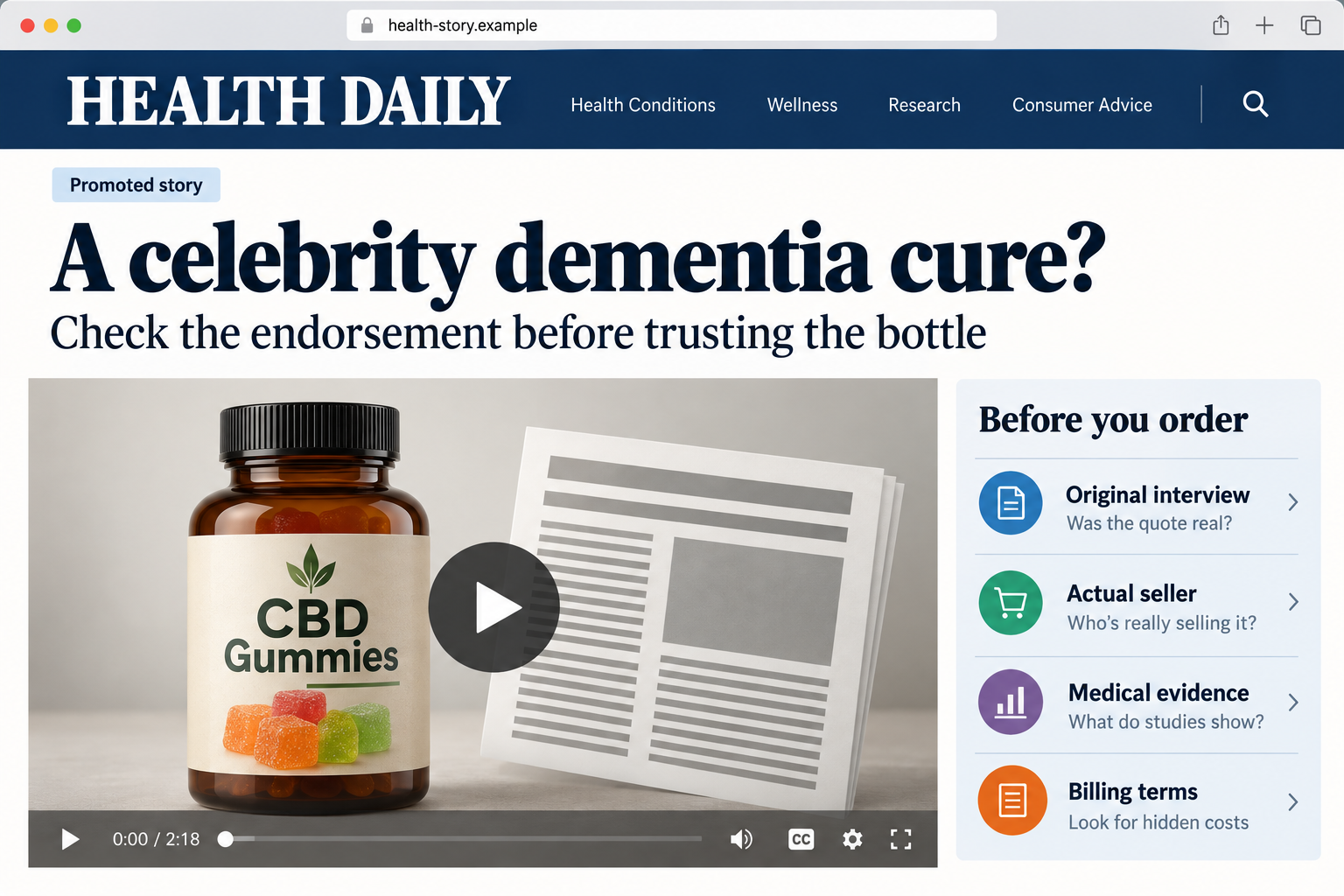
The foundation’s educational guidance is not an endorsement of Catalina Farms. The illustration above depicts a generic advertorial, not a genuine broadcast or foundation page.
- A celebrity’s health advocacy does not establish involvement in a commercial formula.
- A familiar news logo cannot authenticate a page on another domain.
- Research into cannabis is not proof of a retail gummy’s medical claims.
- A memory-cure promise needs clinical evidence, not a dramatic headline.
- The receipt identifies the seller more reliably than the celebrity in the advertisement.
The story can survive a change of bottle
Catalina Farms is a product name associated with the documented version. The warning remains useful if a similar promotion later changes the label or purchase destination.
Do not order because Michael J. Fox supposedly invented, endorsed, or recovered through the advertised cure. That connection has not been substantiated.
At the same time, do not attribute every seller’s actions to one operator without evidence. Advertising control, manufacturing, and payment handling are separate questions.
Why Michael J. Fox Is Such a Persuasive Name
People recognize Fox as an actor and an advocate associated with Parkinson’s research. That recognition gives an unfamiliar medical advertisement an immediate emotional advantage.
A viewer may assume a person who understands serious illness would only appear beside a treatment after careful checking. The advertisement benefits from that assumption.
But the person whose image appears may not have participated at all. A photograph, old interview, or rewritten caption can create a connection without authorization.
Parkinson’s disease and Alzheimer’s disease are also not interchangeable. Borrowing visibility from one condition does not establish expertise, a diagnosis, or a cure for another.
Some people with neurological conditions experience cognitive changes, but that does not turn all memory problems into the same disease or make one product appropriate for everyone.
The sensible response is not to speculate about Fox’s private health. It is to ask whether the commercial statement can be traced to a genuine source.
Authentic interviews and research announcements have context. They identify what was discussed, when it happened, and which claims the speaker actually made.
An advertisement that removes that context should not gain more authority simply because its editing is convincing.
How the Michael J. Fox Dementia Cure Scam Works
Step 1: A hopeful or alarming headline interrupts the feed
The opening combines a well-known person with a serious medical concern. A reader who normally ignores advertising may stop because the claim seems personally important.
Someone caring for a parent can be especially receptive. They are not searching for entertainment; they are searching for a way to preserve recognition, independence, and safety.
The ad does not need to persuade that person to buy immediately. Its first job is to make not clicking feel like missing potentially important news.
That is why a headline should be treated as an invitation to verify, not as evidence that the supposed breakthrough happened.
Step 2: A news-like page borrows credibility
The next page can resemble a broadcaster’s report, using a familiar masthead, interview framing, photographs, and the visual rhythm of a genuine news article.
In the documented version, a Fox News-style presentation helped sell the claimed connection. The resemblance did not make the page part of that organization.
Check the complete destination address rather than the logo. A copied header can remain unchanged even when the page belongs to an unrelated advertising domain.
Michael J. Fox’s surname and Fox News are not evidence of a relationship either. Neither name gives an unfamiliar page permission to represent a medical endorsement.
Search for the exact report through the real publisher’s own website. A matching photograph alone is not a matching interview or announcement.
Step 3: The endorsement is treated as settled
Once the page looks credible, the supposed celebrity involvement becomes the foundation for everything that follows. The reader is encouraged to argue about results, not authenticity.
That skips the first essential question: did the named person actually make this commercial recommendation?
Altered captions, repurposed footage, synthetic narration, and fabricated quotations can all create apparent endorsements. Not every version uses the same technique.
You do not need to determine which editing tool was used before declining an unsupported claim. A missing verifiable endorsement is already a substantial problem.
A genuine discussion of cannabis or brain health would not authorize a seller to attach an unrelated brand, dose, price, or guarantee.
Step 4: A broad medical breakthrough becomes a specific bottle
The story eventually directs the reader toward a product. In the recorded campaign, that product was Catalina Farms CBD Gummies.
The shift matters. The emotional appeal concerns a devastating disease, while the payment buys a particular retail formulation whose evidence must be evaluated separately.
Even genuine research into CBD would not establish that the advertised gummies reproduce a studied preparation, dose, or outcome.
The landing page and the earlier advertorial may also make different claims. Save both instead of assuming the final page will preserve what persuaded you.
Do not let a changed label end the investigation. The durable warning is the fabricated celebrity breakthrough, not the temporary bottle occupying the order page.
Step 5: Purchase pressure replaces medical verification
A discount, deadline, limited-stock message, or recommendation to buy several bottles can make checking with a clinician feel like an obstacle to savings.
That reverses the sensible order. A product intended for someone with cognitive problems deserves more careful review, not less.
Compare the full package total with the price emphasized in the advertisement. Also identify who will receive payment and what the refund actually requires.
Some supplement funnels offer automatic refills, but that cannot be assumed from this story alone. Look for authorization, delivery frequency, cancellation terms, and the receipt.
Receiving several bottles is not proof that quantities changed after payment. The selected bundle and order confirmation must be examined before making that allegation.
Step 6: The familiar face disappears when help is needed
If the purchase disappoints, the buyer deals with a merchant, support portal, payment processor, or fulfillment address, not the celebrity who supplied the emotional reassurance.
That separation often becomes visible only during a dispute. The people responsible for the transaction may barely feature in the original advertisement.
Contacting the actor, a broadcaster, or an unrelated similarly named business is unlikely to resolve an order they did not process.
Find the transaction identity in the receipt and card statement. A clear chain of documents is more useful than repeatedly replaying the original promise.
What the Medical Evidence Actually Needs to Show
A claim about reversing dementia requires considerably more than an ingredient description or a customer’s improved sleep.
The diagnosis must be clear, and the study needs meaningful outcomes. Feeling calmer for an evening is not the same as reversing a progressive neurological disease.
Researchers also need an appropriate comparison, enough participants, adequate follow-up, and a way to assess adverse effects. A sales video cannot substitute for those details.
The FDA has approved a prescription CBD medicine for particular seizure disorders. That fact does not approve CBD gummies for dementia or validate a celebrity advertisement.
The foundation’s published supplement guidance emphasizes discussing products with a doctor and pharmacist. It is not a shortcut around that conversation.
Ask whether the evidence concerns the finished product or merely a component studied in a different setting. The difference is essential when comparing benefit claims.
Bring the actual label, ingredient amounts, and intended use to the appointment. A brand name without a formulation gives the clinician too little to assess.
Do not stop prescribed treatment because an advertisement portrays conventional care as obsolete. Medication changes require advice from the professional managing the person’s condition.
Helping a Relative Without Turning the Conversation Into an Argument
If a parent has already bought the gummies, beginning with ridicule usually makes the problem harder. They may hear criticism of their judgment rather than concern.
Start with the practical issue you can solve together: finding the receipt, checking the bottles, or asking the pharmacist about ingredients.
Then compare the advertisement with an authentic source. Let the missing connection become visible without demanding that your relative defend every detail.
Keep consent and dignity central. Needing help with a purchase does not automatically mean someone should lose control of their finances or online accounts.
If memory difficulties are affecting daily life, arrange an appropriate assessment. A difficult transaction can be a reason to offer support, not to diagnose someone yourself.
A simple pause-before-purchase agreement can help with future ads. Choose a trusted person or clinician to consult when a promotion promises a major medical discovery.
Make that pause easy to use. Saving the link and talking later works better than expecting someone to perform an elaborate investigation while an advertisement is playing.
What to Do If You Responded to the Michael J. Fox Cure Ads
-
Stop using the advertisement as medical guidance. If you changed treatment after watching it, contact the prescribing professional and explain exactly what changed.
Take the product label to that conversation. Avoid making another medication adjustment based on a seller’s reassurance or an online comment.
-
Recover the original purchase trail. Save the ad, destination address, supposed news story, product page, order confirmation, and payment statement.
Record the promised outcome in your own words. This helps distinguish the medical claim that influenced you from the item named on the invoice.
-
Ask the actual merchant for cancellation and refund instructions. Use contact details verified against the receipt rather than a telephone number in an unrelated promotional page.
Request the deadline, authorized return address, bottle requirements, and confirmation about any future deliveries. Retain the reply before sending a parcel.
-
Challenge unresolved billing through the payment provider. Explain the difference between the represented cure or endorsement and what was actually sold.
Keep the facts specific. If a recurring charge appeared, provide the authorization record or your written cancellation rather than assuming all transactions were subscriptions.
-
Protect information entered during the funnel. Watch for follow-up messages referring to memory treatment, refund eligibility, or additional supposedly necessary products.
Do not disclose verification codes or permit remote access to receive a refund. A stranger who knows your order is not automatically legitimate support.
-
Check the device only when exposure justifies it. If the promotion led to a download or unwanted software, use Malwarebytes and remove unfamiliar extensions.
AdGuard can reduce exposure to misleading advertisements. Neither tool establishes a cure, authenticates a celebrity, or recovers the payment by itself.
-
Report the impersonation to the advertising platform. Include the complete destination URL and explain that the celebrity and news presentation were used to sell a medical claim.
Consumer or health regulators can also receive relevant evidence. Redact private medical and financial information from anything you post publicly.
Frequently Asked Questions
Did Michael J. Fox endorse the advertised dementia cure?
No verified endorsement supports the documented campaign. A promotional page using his name or image should not be treated as an authorized medical recommendation.
Was the reported Fox News-style article genuine?
The documented promotion used a lookalike rather than an authenticated publisher report. Verify stories through the broadcaster’s own site, not the logo displayed in an advertisement.
Does foundation research prove these gummies work?
No. Research, surveys, and educational discussions do not establish that a particular commercial formula reverses dementia or has the foundation’s endorsement.
Is Catalina Farms the only product used in such stories?
It is the name in the documented version discussed here. Similar advertising can change products, so verify the exact seller and formulation on your own receipt.
Does a delivered bottle make the medical story true?
No. Delivery establishes that something arrived. It does not authenticate the endorsement, confirm the ingredients, or prove the claimed disease outcome.
Should I contact Michael J. Fox for a refund?
Use the merchant and payment provider identified in your transaction. The actor, his foundation, and an impersonated broadcaster are not automatically parties to the sale.
The Bottom Line
Do not buy a dementia cure because an advertisement attaches Michael J. Fox to it. A recognizable advocate and a copied news design cannot establish medical evidence.
If you already responded, protect ongoing care, preserve the purchase trail, and seek cancellation or a refund from the actual seller and payment provider.

Join the discussion
0 commentsShare your experience or ask a question about this article.
Discussion
Start the conversation
Have a question or something useful to share? Add the first comment.