

Burning feet can make a long evening feel endless. A Dr. Oz pink salt neuropathy advertisement interrupts it with the promise of an easier answer.
It sounds like the answer might already be in your kitchen. Before searching for ingredients, look at the story carrying that promise.
Overview
This version targets nerve pain, not weight loss
The Dr. Oz pink salt neuropathy pitch claims that a simple mineral-based discovery can relieve burning, tingling, or numbness and restore comfortable movement.
Do not confuse it with the similarly named weight-loss recipe advertisements. The targeted condition changes, but the borrowed authority and promised kitchen shortcut remain recognizable.
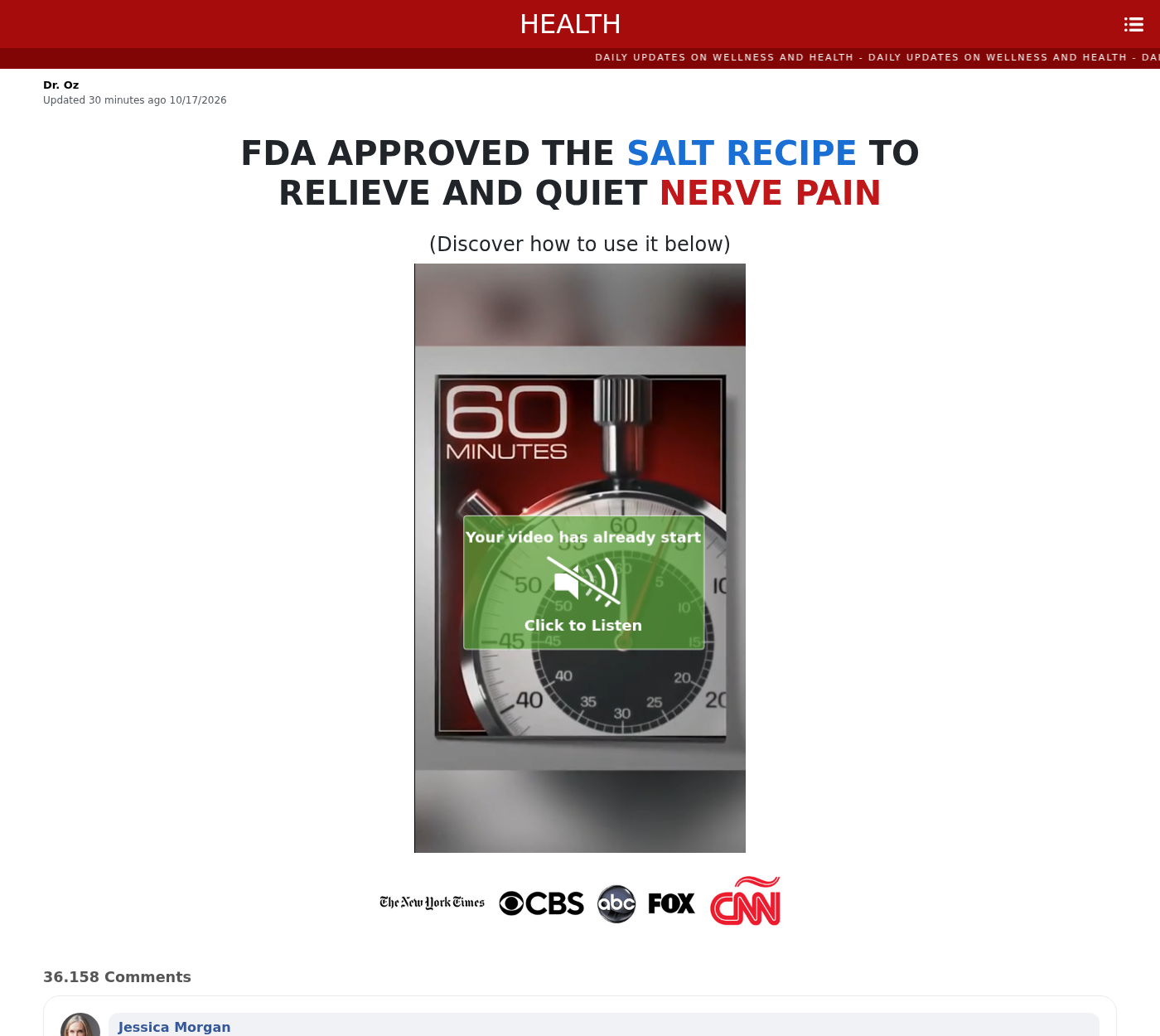
In one accessible example, a NervoFlow advertorial places a Dr. Oz byline above a claim that the FDA approved the salt recipe.
The approval claim is a concrete problem, not merely an impression
The page proceeds from that medical-sounding headline to supplement packages. A claim of official approval encourages readers to assume someone already evaluated the promised treatment.
The FDA does not approve dietary supplements before marketing as it approves drugs. A supplement advertorial cannot establish an approved nerve-pain treatment by announcing one.
Neither the displayed byline nor broadcaster logos authenticate Dr. Oz’s participation. An authorized endorsement requires evidence outside the seller’s own presentation.
- The pitch starts with a household salt recipe.
- A famous doctor’s name supplies apparent authority.
- Government and media references make the claim seem checked.
- The purchasing destination sells bottles rather than a simple kitchen instruction.
- Package totals and refund conditions require separate attention.
The story matters more than the current supplement name
Neuro Salt and NervoFlow are names associated with documented versions of this broader nerve-pain pitch. Their appearance does not establish common ownership or identical contents.
The enduring warning is the supposed Dr. Oz salt cure. Changing the bottle cannot supply the missing proof of endorsement, approval, or effective neuropathy treatment.
Do not buy through a promotion on that basis. If you already ordered, keep the original claim and transaction terms because the page may later change.
Why the Nerve-Pain Story Feels So Convincing
Persistent tingling and burning are difficult to ignore. They can interfere with walking, sleep, and ordinary activities long before anyone offers a clear explanation.
A short kitchen ritual promises relief without another appointment, another prescription, or another complicated routine. That simplicity is part of the attraction.
The advertisement also gives the symptoms a single, satisfying explanation. A hidden process supposedly irritates the nerves, and the salt trick supposedly corrects it.
Real peripheral neuropathy is not one uniform problem. Different causes can produce similar symptoms, so a convincing story is not a diagnosis.
A deficiency, diabetes, nerve compression, medication effect, or another condition may require a different response. An advertisement cannot distinguish them from a list of symptoms.
That is why the apparent shortcut can cost more than its purchase price. It may persuade someone to postpone finding a treatable cause.
None of this means the discomfort is imaginary or that improvement is impossible. It means the explanation needs to fit the person, not a reusable sales script.
Relief from a symptom and repair of nerve damage are also different outcomes. A product should not treat those phrases as interchangeable.
How the Dr. Oz Pink Salt Neuropathy Scam Works
Step 1: A familiar symptom makes the video feel relevant
The opening describes burning soles, interrupted sleep, awkward walking, or numbness. Someone living with those problems immediately recognizes the situation.
The video then offers a small discovery with a large implication. You supposedly do not need an elaborate treatment, just access to an overlooked method.
At this point, the reader is not yet comparing labels or merchants. They are considering whether the presentation understands a problem that has already consumed their attention.
Remember that accurately naming a symptom is not proof that the advertiser knows its cause or can supply effective treatment.
Step 2: Dr. Oz and medical institutions are presented as the authority
The campaign attaches a recognizable doctor’s name to the explanation. Some versions add university references, apparent interviews, or voiceovers intended to sound authoritative.
The accessible NervoFlow page directly displays the Dr. Oz byline and describes a discovery associated with him. That is a commercial claim requiring authentication.
A genuine interview elsewhere would not authorize every claim placed beside it. Check the full recording, exact subject, publication source, and product connection.
Altered clips and synthetic narration are risks in this category, but appearance alone cannot identify the technique used in every advertisement.
The practical test is simpler: can the seller produce a verifiable, contextual endorsement for the actual offer? If not, the doctor’s image is not purchase evidence.
Step 3: A health-news layout makes the offer look reported
The page can resemble a medical report rather than a shop. A byline, recent-update label, video panel, comments, and familiar broadcaster marks support that impression.
But those visual elements can be assembled by the promoter. They do not show that a newsroom investigated the treatment or that commenters are independent patients.
Look at the domain and the page’s destination. If the report leads into the seller’s packages, treat its commercial role as central rather than incidental.
A real publisher’s logo is not a license to impersonate its reporting. Search the publisher directly for the exact report before accepting that association.
Likewise, an automatically refreshed date does not mean a discovery was just announced. Fresh-looking presentation and fresh medical evidence are different things.
Step 4: A recipe promise turns into capsules
The household ingredient keeps the viewer interested while the explanation expands. Eventually the proposed solution becomes a proprietary supplement.
A seller may present the bottle as a convenient or concentrated version of the discovery. That explanation does not establish equivalence with a tested treatment.
The finished formulation needs its own label, amounts, safety information, and evidence. The original promise cannot be used to skip those checks.
In this category, several brand names can serve the same sales story. Search the durable claim as well as the temporary product name.
A new bottle is not a new clinical trial. Nor does seeing several products repeat the story make independent confirmation more likely.
Step 5: The package is framed as a commitment to recovery
A larger bundle can be presented as the sensible way to follow the protocol long enough. Declining extra bottles begins to feel like undermining your own improvement.
The inspected NervoFlow offer illustrates the distinction between bottle price and payment: six bottles are presented at $49 each, with a $294 total.
That is not a $49 trial. The consumer commits the full package amount before knowing whether the product will be useful.
It also does not prove that six bottles were added after payment. To assess an incorrect quantity, compare the selected package and final order confirmation.
Watch separately for renewals. Some funnels include continuity offers, but the mechanism must be verified from the particular checkout rather than assumed from a similar advertisement.
Step 6: Contradictory guarantees move the risk into the future
A refund promise makes an uncertain purchase feel reversible. The details matter especially when the seller also recommends a long course of use.
The NervoFlow page displays 60-day guarantee wording while another answer describes 180 days. It also mixes instructions about returning bottles and keeping them.
Those inconsistencies should be resolved before payment, not after you spend months following a suggested regimen.
Get the actual deadline, its starting point, return requirements, and authorized address in writing. A large guarantee graphic cannot answer those operational questions.
More importantly, a return policy cannot undo medical delay. Even a successful refund would not make postponing proper assessment a good decision.
Why the FDA Language Should Stop the Purchase
Approval is not a general badge of trust that follows any product sold in a clean facility. It refers to specific regulatory decisions and uses.
The FDA explains that dietary supplements do not receive premarket approval for safety and effectiveness in the way new drugs do.
A manufacturing claim, business registration, or quality logo therefore cannot establish that the agency approved a salt recipe as neuropathy treatment.
Ask for an identifiable approval record matching the exact product and intended use. A certificate image without that connection cannot carry the claim.
Do not substitute another genuine approval as proof. Approval of a medicine for one condition does not validate a different supplement advertised through the same medical vocabulary.
The burden is on the seller making the claim, not on a frightened reader to disprove every scientific-sounding sentence.
What to Check Instead of Mixing a Salt Remedy
Begin with the symptoms: where they occur, when they started, whether they are changing, and what affects them. Bring that information to a qualified professional.
Describe numbness as well as pain. Reduced sensation can matter even when it is less noticeable than burning or tingling.
A clinician can review relevant conditions, medicines, and possible tests. The right investigation depends on the history and examination, not the product the advertisement happens to sell.
Do not increase salt intake as an experiment based on this promotion. People managing blood pressure, kidney problems, or other conditions may have individualized dietary restrictions.
Likewise, do not stop pain treatment, diabetes medication, or another prescription because the video claims conventional care addresses the wrong cause.
If a current treatment is not helping, ask about reassessment and alternatives. That is a reason for a useful medical conversation, not a reason to trust a stranger’s formula.
Keep supplement labels available during that discussion. Combining products can duplicate ingredients without you realizing it, especially when several bottles advertise broadly similar benefits.
Seek prompt care for sudden weakness, rapidly worsening symptoms, or another acute neurological change. A sales page is not an appropriate triage service.
What to Do If You Followed a Dr. Oz Salt-Trick Offer
-
Stop treating the advertisement as a prescription. Continue your established care and contact the treating clinician if you changed medication or began a product because of it.
Bring the label and describe the dose actually taken. A screenshot of a benefit claim is not enough to assess an ingredient interaction.
-
Save the complete sales chain. Keep the original ad, supposed news page, approval statement, product destination, selected quantity, checkout, and receipt.
Capture contradictory guarantee wording before it changes. Preserve the page address along with each image so its source remains clear.
-
Check the charge against the accepted package. Distinguish an unexpected quantity from a bundle that was displayed but poorly understood.
Ask the merchant for the order record and any renewal authorization. Cancel unwanted future deliveries explicitly and request a confirmation covering the entire arrangement.
-
Start the refund request promptly. Ask which guarantee applies, when its clock began, whether used bottles qualify, and what must accompany a return.
Do not wait for a suggested six-month course if doing so would place you outside the written return period.
-
Escalate an unresolved payment problem through your card issuer. Explain the false approval representation or specific order mismatch and provide supporting documents.
Ask about the relevant deadlines and follow-up requirements. Keep a dated record of merchant contact rather than relying on an unrecorded telephone promise.
-
Be suspicious of refund calls requiring screen sharing or extra payments. A support impersonator can use knowledge of the purchase to sound convincing.
If you installed software through the funnel, check it with Malwarebytes. AdGuard can help reduce exposure to similar misleading ads and redirects.
-
Report the approval and endorsement claims to the advertising platform and appropriate regulators. Include the exact page, represented medical use, and product name.
A precise complaint is stronger than saying every seller or manufacturer belongs to one network. State what your evidence actually shows.
Frequently Asked Questions
Is the Dr. Oz pink salt neuropathy recipe a proven treatment?
No reliable evidence presented by the campaign establishes it as an effective neuropathy treatment. The claimed cause and remedy require proper medical evaluation.
Did the FDA approve the advertised salt recipe?
The sales page provides no approval record supporting that representation. Supplement manufacturing claims do not establish FDA approval for a nerve-pain treatment.
Is this the same as the pink salt weight-loss trick?
The targeted condition differs. This article concerns burning, tingling, numbness, and neuropathy, although similarly structured recipe advertisements also target weight loss.
Are Neuro Salt and NervoFlow necessarily the same formula?
No. Shared advertising themes do not establish identical ingredients or ownership. Inspect the precise label, seller, and terms attached to the product you encountered.
Does the six-bottle offer prove an unauthorized quantity change?
No. A displayed bundle and an unauthorized alteration are different issues. Compare the selected order, final confirmation, and actual charge before making that claim.
What is the safest next step if I already ordered?
Keep prescribed care unchanged, identify the merchant, preserve the original promises, and request written cancellation or refund instructions before the applicable deadline.
The Bottom Line
Do not buy through a Dr. Oz pink salt neuropathy offer based on a celebrity name or supposed FDA approval.
The inspected presentation offers authority without the necessary proof. If you already paid, protect ongoing treatment, document the offer, and pursue cancellation or a refund promptly.

Join the discussion
0 commentsShare your experience or ask a question about this article.
Discussion
Start the conversation
Have a question or something useful to share? Add the first comment.