

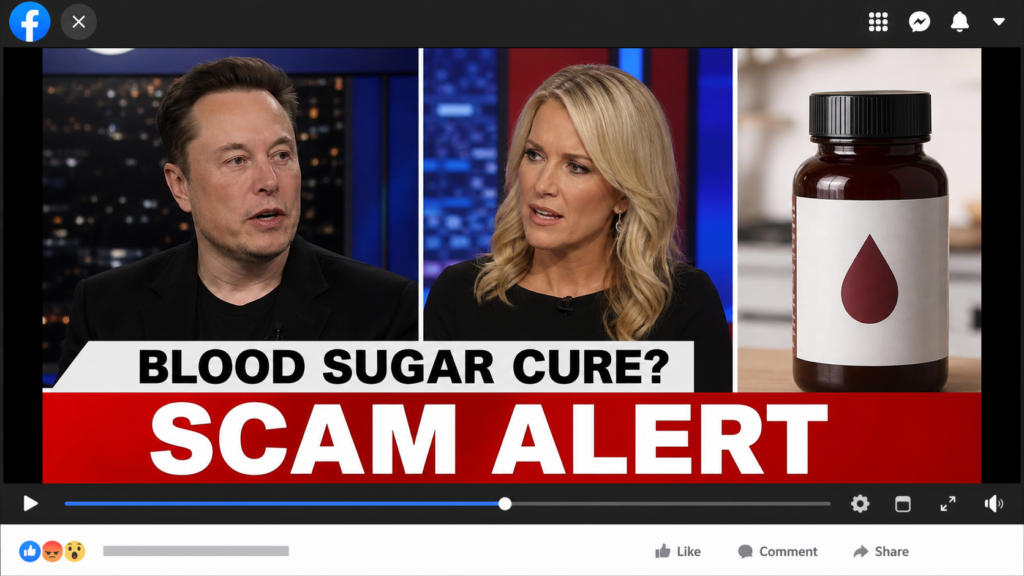
A Fox News-style video appears to show Elon Musk revealing a hidden blood sugar or nerve-pain breakthrough. The host reacts with surprise, a bottle appears, and the viewer is told that the story may soon be removed.
It looks like breaking news. It is actually a carefully built sales path, and the product name at the end is one of the least stable parts of it.
Overview
What viewers are led to believe
The advertisement suggests that Elon Musk discussed a natural answer for blood sugar, neuropathy, or related symptoms during a Fox News interview. Laura Ingraham may appear to ask questions or confirm that the discovery threatens established medical interests.
The story is designed to feel independent. Viewers are not initially told that they are watching affiliate advertising for a supplement.
The campaign can switch between different bottles
Recent versions have led to products such as GlycoGuard Blood Balance and GlucoRx Blood Balance. Older campaigns have used similar “blood sugar breakthrough” stories for many other supplement names.
That rotation is the central warning. Elon Musk and Fox News are the durable hook. The bottle can be replaced when a domain attracts complaints, loses advertising access, or the seller wants to test a new brand.
Why the presentation is deceptive
There is no credible evidence that Elon Musk or Laura Ingraham endorsed these supplements, or that Fox News aired the health segment shown in the promotion. The footage appears to be AI-generated, manipulated, or assembled from unrelated material.
- The video borrows the faces and authority of real people.
- The landing page imitates a trusted news organization.
- The medical promise exceeds what a supplement can prove through testimonials.
- The checkout may emphasize expensive multi-bottle packages.
- Support and seller information can be difficult to verify.
This article focuses on that repeating story, not on treating one product name as permanent. When tomorrow’s ad promotes a different bottle, the same checks still apply.
The Fox News Segment Is Not What It Appears to Be
A genuine television report has a verifiable broadcast record. It appears on the network’s official site, has a named program and date, and can be confirmed through the participants’ official channels.
The scam version lives on an unrelated domain. It copies colors, lower-third graphics, studio layouts, or logos, then places purchase buttons around the “report.” Menu links may lead nowhere, and every call to action sends the visitor deeper into the same funnel.
AI adds another layer. A video can now imitate a recognizable voice, synchronize new words to old footage, and create a plausible studio exchange. The result may look smooth enough on a small screen to survive a quick glance.

The correct question is no longer “Does this look like Elon Musk?” It is “Can I verify this exact statement through Elon Musk, Fox News, or another independent source?” If the answer is no, the visual resemblance proves nothing.
The same caution applies to Laura Ingraham. An AI version of a host inside a copied Fox layout is not a network endorsement, and it is not medical evidence.
How the Scam Works
Step 1: A shocking AI news clip earns attention
The first video often promises that a billionaire exposed the truth about diabetes, nerve pain, circulation, or a “blood sugar root cause.” The wording suggests a conflict with drug companies or regulators.
Scammers choose a famous technology figure because viewers associate him with innovation. They choose a news host because the setting feels familiar and authoritative.
Step 2: The ad creates urgency and secrecy
Viewers may be told that the clip was banned, leaked, or will disappear after pressure from powerful companies. That story discourages normal verification. It makes skepticism feel like proof that the suppression claim is true.
A legitimate medical finding does not need a disappearing timer or a secret social-media link. It can be examined through published research, qualified clinicians, and transparent regulatory information.
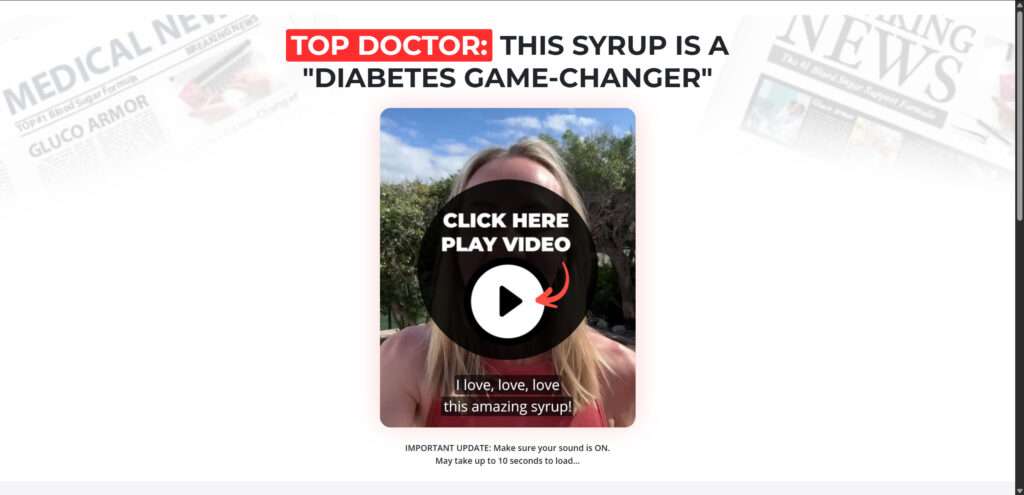
Step 3: The click opens a fake news advertorial
The next page resembles Fox News or another established publication. It may show a transcript, fake comments, a broadcast screenshot, and repeated buttons inviting the reader to “learn more.”
Check the domain before reading the headline. A copied logo does not transfer ownership of the website. Broken navigation and a page where every link leads to the same offer are common signs of an advertorial.
Step 4: A broad health story becomes a specific supplement
The presentation moves from blood sugar or nerve damage to a bottle such as GlycoGuard Blood Balance or GlucoRx. The transition may be gradual, with ingredient stories and testimonials placed between the fake interview and the offer.
The product does not gain clinical credibility simply because it appears after a famous face. The seller must still identify the formula, evidence, manufacturer, and legal merchant.
Step 5: The order page pushes a larger package
Three-bottle and six-bottle packages may be marked “most popular” or “best value.” Per-bottle pricing can make the largest order look cheaper even though the card is charged a much larger total.
Read the final total before authorizing payment. Confirm whether shipping, taxes, continuity plans, or post-purchase upsells alter the amount shown in the advertisement.
Step 6: The receipt may introduce a different merchant name
A customer can order a recognizable brand and later see a processor, fulfillment company, or unrelated descriptor on the statement. That makes it harder to connect the charge with the ad when asking for help.
Save the confirmation email immediately. It should identify the merchant, order number, amount, quantity, support channel, and any recurring terms.
Step 7: Refund friction buys the seller time
Customers may face disconnected numbers, delayed replies, partial-refund offers, return-shipping costs, or requirements to send back every bottle. One current GlycoGuard page listed 844-206-5258; a late-August 2026 check reported that the number failed to connect.
A failed call alone does not prove everything about the seller, but it is a serious problem when combined with fake endorsements and unclear responsibility for the order.
Blood Sugar and Neuropathy Claims Need Real Medical Evidence
Blood glucose problems and neuropathy are not interchangeable diagnoses. Peripheral neuropathy can be associated with diabetes, vitamin deficiencies, medication effects, autoimmune disorders, injuries, infections, and other causes.
That is why a single “blood balance” supplement cannot responsibly be marketed as the answer for every viewer who has tingling, burning, numbness, or an abnormal glucose reading. Diagnosis matters.
The FDA does not approve dietary supplements to treat or prevent disease before they reach the market. A product represented as treating diabetes or reversing neuropathy would need evidence and regulatory status that ordinary supplement language does not provide.
Even a plausible ingredient does not validate the finished formula. The relevant questions are dose, purity, interactions, product-specific studies, and whether the claim matches the evidence.
How to Spot the Fake News Page Before Reaching Checkout
Start with the web address, not the logo. A legitimate Fox News article uses an official Fox-controlled domain. A long, unfamiliar address reached through a tracking link is not converted into journalism by a copied masthead.
Try the menu. On many advertorials, sections such as Politics, Health, or Business do not open real archives. They either do nothing or redirect to the supplement order. That is because the page was built as a single sales route, not as part of a newsroom.
Look at the date and comments. The article may always appear newly published, while comments use vague first names and conveniently enthusiastic results. Some pages refresh the date automatically so the “breaking” report never grows old.
Check the purchase buttons. Independent reporting can link to background material, but a page where every image, button, and highlighted phrase opens the same checkout has a commercial purpose that should be disclosed clearly.
Search a distinctive sentence from the video in quotation marks. Scam networks frequently clone the same script across multiple domains and replace only the product name. Finding several nearly identical pages is strong evidence that the news story is a template.
Finally, leave the funnel and search the alleged participants separately. If Fox News, Elon Musk, and Laura Ingraham have no record of the segment, do not let the embedded video overrule that absence.
These checks take only a few minutes and do not require special software. They are far more reliable than replaying the clip and trying to decide whether every blink or syllable looks natural.
Company, Address, and Fulfillment Checks
The seller behind the checkout must be named
Do not stop at the GlycoGuard or GlucoRx logo. Identify the legal entity accepting payment and compare it with the terms, privacy policy, receipt, card statement, and package label.
If the documents use several unexplained names, the customer may struggle to determine who owes the refund. A transparent seller should make the relationship between brand, merchant, and processor easy to understand.
An address can be real and still tell you very little
Search the listed company and return addresses. They may belong to a fulfillment warehouse, registered agent, virtual mailbox, residential property, or unrelated tenant.
A fulfillment center can legitimately handle packages for many brands. It does not prove that the supplement is manufactured there, that the seller has a medical staff, or that the warehouse controls billing.
Dead support details are a hard stop
Call before purchasing. Ask the agent to identify the exact product, legal seller, recurring-delivery status, return location, and refund rules. Send the same questions by email so there is a written record.
If a phone number does not connect or messages go unanswered, do not rely on a prominent “money-back guarantee.” A guarantee is only as useful as the process available to claim it.
Unknown manufacturing is not cured by a glossy bottle
Look for a complete Supplement Facts panel, serving size, ingredient amounts, warnings, lot details, and a named manufacturer or distributor. Ask whether independent testing is available for the finished batch.
Do not assume the product is made in China without evidence. The real concern is lack of traceability. If the seller will not clearly say who made it, where it was made, and who handles adverse-event reports, the buyer cannot properly evaluate the risk.
What to Do if You Have Fallen Victim to This Scam
- Save the deceptive material. Capture the AI video, fake Fox News page, product page, quantity, price, guarantee, checkout, receipt, support information, and card descriptor.
- Contact the merchant in writing. Request cancellation, a refund, and confirmation that no future shipment is authorized. Include the order number but never email a full card number.
- Call the card issuer. Explain the fake endorsement, any amount or quantity difference, failed support attempt, or recurring charge. Ask about blocking future transactions and opening a dispute.
- Do not mail products to an unverified address. Obtain written return instructions and use tracked shipping. Photograph the package contents before sending them.
- Speak with a healthcare professional. Do not replace diabetes or neuropathy care with the supplement. If you took it, bring the bottle and label to a doctor or pharmacist, especially if symptoms changed.
- Check the device and browser. Run Malwarebytes if the funnel produced suspicious downloads, redirects, alerts, or extensions. Remove site-notification permissions you do not recognize.
- Use safer browsing protection. AdGuard can block many malicious ad calls, trackers, and pop-ups associated with these funnels. It cannot authenticate a celebrity video, so continue checking the source.
- Report the impersonation. Report the ad to the social platform, deceptive marketing to the FTC, and questionable disease claims or adverse reactions to the FDA.
Frequently Asked Questions
Did Elon Musk endorse a blood sugar supplement on Fox News?
No credible evidence supports that claim. The circulating video appears to use an AI or manipulated depiction of Elon Musk inside a fake news presentation.
Did Laura Ingraham recommend GlycoGuard or GlucoRx?
No credible evidence shows that she endorsed either product. Her appearance in a copied Fox News layout should not be treated as genuine participation.
Are GlycoGuard and GlucoRx the same product?
They are marketed as different brands. They are linked here because similar fake-news and blood-sugar narratives can be reused to sell different supplements.
Can a supplement reverse diabetes or neuropathy?
Do not accept that claim from an online advertisement. Diabetes and neuropathy require proper diagnosis, and supplements are not FDA-approved disease treatments.
What if I received more bottles than expected?
Do not open unnecessary bottles. Save the checkout and receipt, contact the merchant in writing, and ask the card issuer about dispute options if the quantity or total was not authorized.
Why do scammers imitate Fox News?
A familiar network lowers skepticism. The visual design makes an affiliate sales page feel like independent reporting, even though the domain and purchase links reveal its real purpose.
The Bottom Line
The fake Fox News blood sugar cure story is built to survive product changes. AI versions of Elon Musk and Laura Ingraham supply attention, copied news graphics supply trust, and a rotating supplement captures the order.
Do not judge the offer by the studio set or famous face. Verify the domain, medical evidence, seller, checkout, and support. If those basics fail, the “breaking news” is only a sales script wearing a newsroom costume.








