

The man in the video appears to be sharing something he was never supposed to reveal. His voice is calm, the story sounds personal, and the promised secret seems to explain both extraordinary success and why ordinary people have been kept outside the room.
There is one problem. The Elon Musk Secret Wealth App Scam is assembled from AI manipulation, invented reporting, and vague self-improvement claims. The celebrity is the hook, not the creator, owner, or verified user of the $37 product waiting at the end.
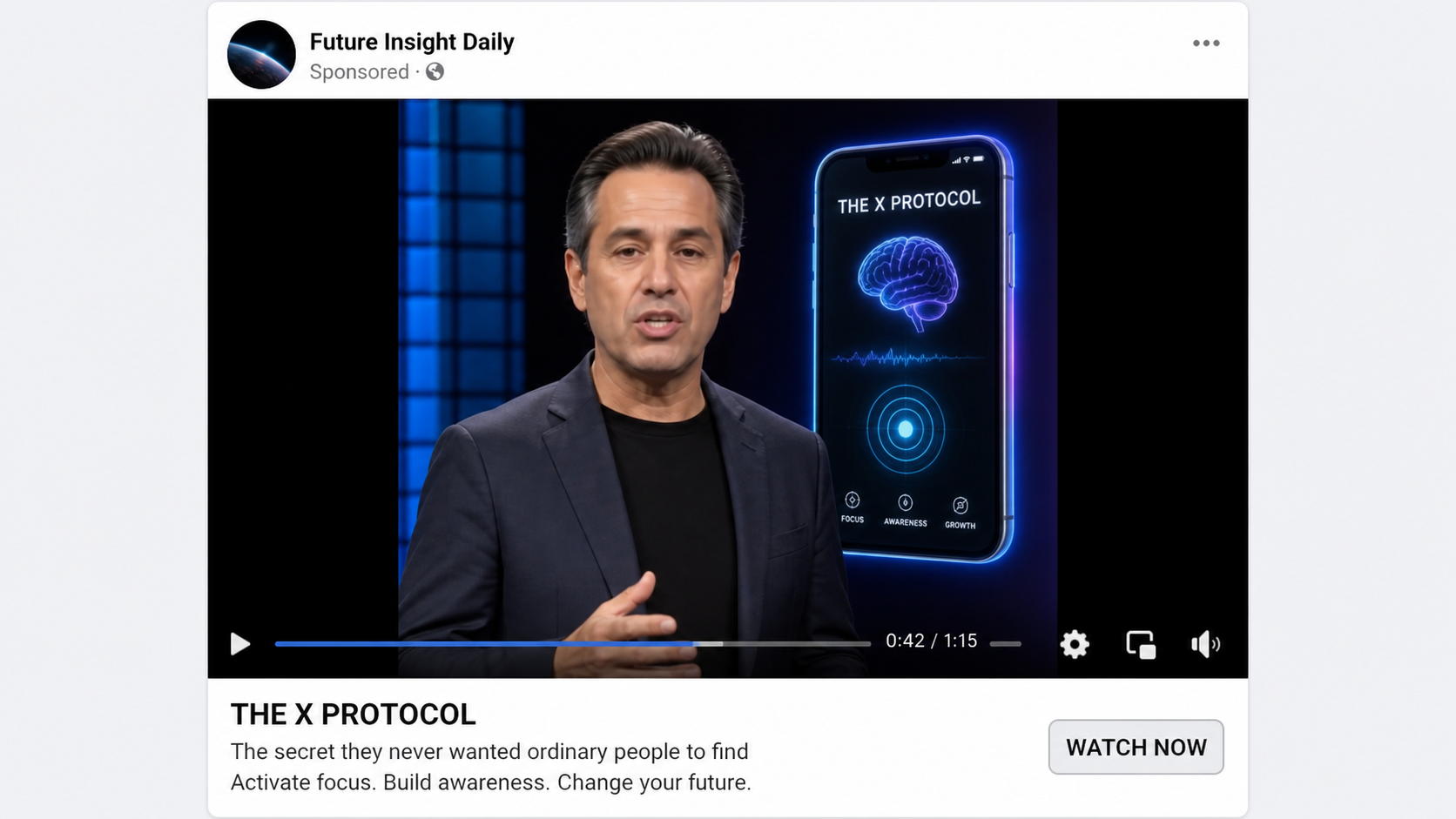
The first image shows the style of ad used in this campaign. A fictional technology executive appears in a paused sponsored video beside an app graphic labeled The X Protocol. The presentation is designed to feel like a candid revelation rather than an advertisement.
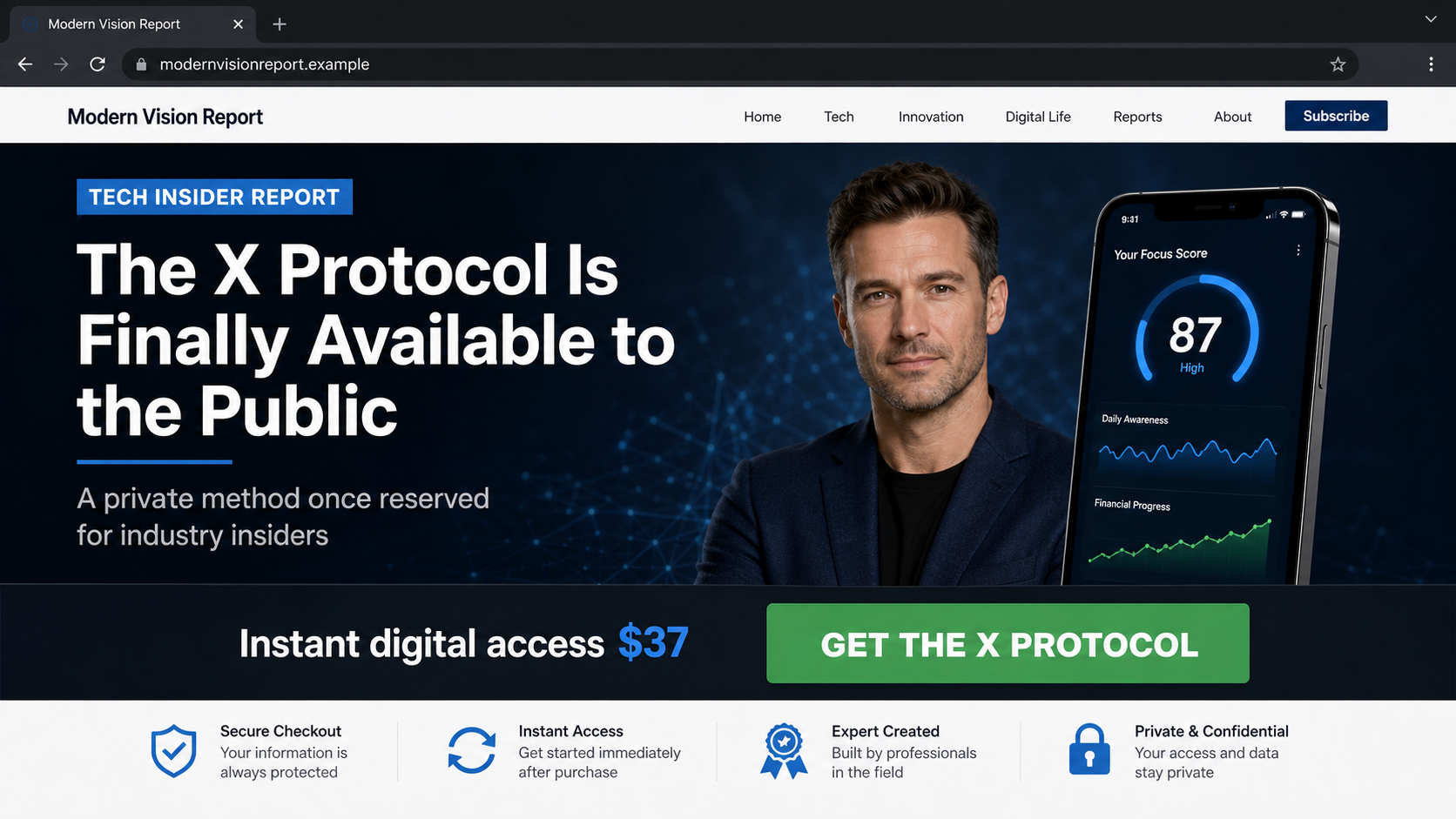
The second image shows the next stage, a fake technology report that turns the emotional video into a purchasable system. Industry language, a focus score, security-style badges, and an instant-access button create authority without identifying who built or tested the product.
Both images use fictional people, domains, and publication names. They recreate the documented funnel without reproducing Elon Musk’s likeness, a real social network logo, or a scammer-controlled checkout that may collect live payment details.
Overview
Elon Musk did not verify or endorse The X Protocol
The campaign uses manipulated video and audio to make it appear that Elon Musk is describing a secret mental protocol behind his wealth and influence. No credible announcement, official account, company filing, or established interview connects him to the offer.
The pitch changes between versions, but the core message remains the same. A famous entrepreneur supposedly reveals an overlooked method that activates focus, awareness, confidence, or a dormant part of the mind and then leads to financial transformation.
The product is vague because the celebrity story does the selling
The X Protocol has been framed as an app, digital program, private method, or guided system. The sales material spends more time explaining why elites kept it secret than explaining its curriculum, developer, evidence, privacy controls, or measurable outcomes.
A $37 price makes the offer feel accessible after an extravagant story. The buyer is not purchasing access to Elon Musk, a verified investing platform, or a proven cognitive treatment. They are paying an unidentified seller for a digital product whose value cannot be evaluated from the ad.
A recurring subscription was not proven in the captured funnel
The visible offer was $37 for virtual access. We did not confirm that this exact version automatically enrolled every buyer in a recurring plan or charged a larger hidden amount. It would be inaccurate to describe an unverified subscription as a fact.
That does not make the checkout trustworthy. Upsells, continuity programs, data harvesting, and changing billing terms are common in low-transparency digital funnels. A buyer should inspect the final order summary and save it before submitting payment.
- The celebrity video shows signs of AI-generated voice or lip manipulation.
- No verified Elon Musk endorsement or official product relationship was found.
- The story invokes elites, governments, and suppressed knowledge.
- Fake technology reporting and emotional imagery provide borrowed authority.
- The product is described more vaguely than a normal commercial app.
- The reported entry price is $37 for digital access.
- No stable legal company, headquarters, or accountable support team is prominent.
- Automatic recurring billing was not confirmed for the exact captured offer.
Why the Secret Wealth Story Is So Effective
Celebrity impersonation collapses the buyer’s research into one familiar face. Elon Musk is associated with technology, wealth, risk, and unconventional ideas, so a strange mental-performance claim can feel more plausible when it appears to come from him.
The story avoids a straightforward promise such as buy an investment course. Instead, it links awareness, focus, inner balance, and decision-making to financial success. These elastic concepts are difficult to disprove because any outcome can be blamed on how faithfully the user followed the method.
Secrecy supplies an explanation for the missing evidence. The audience is told that powerful people know the protocol but keep it from the public. When independent proof cannot be found, the absence itself is presented as proof of suppression.
The campaign has also used fabricated newspaper layouts and emotional imagery, including a fake deathbed-style scene. These devices create the feeling that a hidden history has finally surfaced, even though the page is an advertisement written to produce a checkout.
AI video lowers the cost of producing many variations. Operators can change the script, voice, price, product name, and landing domain while preserving the same persuasive structure. A takedown of one clip does not end the campaign.
The most reliable test is external verification. A world-famous executive launching a consumer app would leave evidence across official accounts, app stores, corporate records, reputable interviews, security documentation, and independent reporting. A lone social ad followed by an obscure checkout is the opposite pattern.
What Our X Protocol Investigation Found
The campaign presented a video that appeared to show Elon Musk explaining a hidden method. Visual and audio inconsistencies indicated synthetic or manipulated content rather than a verified interview published through an official channel.
The script claimed that the method was known to elites or government insiders and had been concealed from ordinary people. It tied the supposed protocol to Musk’s success at a young age without offering a source that could be checked independently.
The story moved between cognitive and financial language. It promised focus, awareness, inner balance, clearer decisions, and a changed future, then encouraged the viewer to interpret those benefits as a route to wealth.
Fake editorial framing made the offer look investigated rather than advertised. News-like headlines, a presenter, charts, and a technology interface created the appearance of third-party validation while leading directly to a sales page.
The visible product price was $37. The offer appeared to be virtual, which means there was no expensive hardware, brokerage service, or verified investment account behind the celebrity narrative.
The funnel did not provide a clear legal operator, physical headquarters, verified developer identity, privacy practices, independent reviews, or a stable public support organization that matched the size of the claims.
The version we examined was no longer reliably available, which is common with disposable direct-response campaigns. Pages can be removed after complaints and relaunched under new domains, new product labels, and a slightly different script.
No evidence showed that Elon Musk wrote, narrated, financed, endorsed, or used The X Protocol. The connection existed only inside campaign-controlled media, which is not independent evidence.
How the Elon Musk Secret Wealth App Scam Works
Step 1: A deepfake celebrity video stops the scroll
The sponsored clip appears to show Elon Musk speaking directly to the viewer. Synthetic voice, face animation, and edited footage make a newly written script look like a genuine confession or interview.
Watch the mouth edges, blinking, facial texture, pacing, and emotional tone. Imperfections can be subtle, and increasingly realistic AI means a visually convincing clip still requires verification from the speaker’s official channels.
Step 2: The script introduces a forbidden secret
The viewer is told that wealthy insiders know a protocol that activates mental capacity or improves awareness. Secrecy transforms an ordinary self-help pitch into information that feels rare and urgent.
The story rarely defines what is being activated or how success will be measured. Mystery is useful because precise claims could be tested, while vague transformation can mean something different to every buyer.
Step 3: A fake news page launders the claim
Clicking the ad opens an advertorial that resembles a technology publication, television segment, or investigative report. The layout makes the visitor feel they are reading confirmation from a trusted third party.
Look closely at the domain, navigation, author history, publication archive, and links. Fake reports often have decorative menus that do not work and every button leads to the same order page.
Step 4: Emotional proof replaces verifiable evidence
The page may add stories about Musk’s early success, a suppressed discovery, dramatic personal testimony, or a final revelation from someone near death. These scenes are difficult to source because they are created for the advertisement.
Charts and app graphics can be fabricated as easily as testimonials. A screenshot of a rising balance or focus score is not a clinical study, audited result, or proof that a real app performs as described.
Step 5: The mysterious system becomes a $37 purchase
After a long presentation, the impossible story resolves into an inexpensive digital offer. The contrast is deliberate. Compared with the wealth and life change described, $37 feels too small to lose and too tempting not to try.
Before paying, the buyer should know the developer, exact contents, device requirements, refund policy, data practices, customer support, and total billing schedule. The funnel does not earn trust merely by lowering the price.
Step 6: The checkout can add new offers and collect valuable data
Even when the first payment is one-time, the order may lead to upgrades, coaching, additional programs, marketing consent, or an optional continuity plan. Read every selected box and the final total.
The seller also receives contact and payment information that can be used for retargeting. A person who bought once has demonstrated interest in celebrity secrets and may receive more aggressive offers later.
Step 7: The campaign rotates when scrutiny arrives
Once a domain, video, or product name attracts warnings, the operator can replace it. A different famous entrepreneur, doctor, app name, or secret method can carry the same script to a new audience.
That is why searching only for The X Protocol is not enough. Learn the pattern: unauthorized celebrity, suppressed secret, fake report, vague transformation, low entry price, and an opaque seller.
Company, Address, and Fulfillment Checks
The seller hides behind the celebrity
The ad tells viewers far more about Elon Musk than about the company accepting $37. No verified legal entity, executive team, developer profile, or accountable merchant is prominent in the story.
A celebrity image is not a substitute for a contract. The checkout should name the legal seller and that name should match the terms, receipt, support emails, and card statement before any payment is authorized.
There is no credible headquarters to verify
The temporary campaign pages did not establish a physical business address that could be tied to the developer. A privacy-service address, mailbox, or domain registration contact would not prove where the operation is managed.
For a digital product, an address still matters. It tells consumers which laws govern the sale, where formal notices can be sent, and whether the business exists beyond a replaceable landing page.
Support must work before the card is charged
No stable phone and support organization was verified for the exact offer. A web form on the sales page can disappear with the domain, leaving buyers unable to request a refund or delete personal data.
Before ordering any digital program, ask a specific pre-sale question. If no human answers with the legal company name, refund process, and product details, assume after-sale support will be worse.
A digital product has a supply chain too
There may be no bottle or warehouse, but someone must develop the app, host user data, process payments, deliver access, maintain security, and issue refunds. The campaign identifies none of these roles clearly.
Unknown software can create privacy and security risks. Do not install an APK, browser extension, remote-access tool, or configuration profile from an ad. Use recognized app stores and verify the named developer independently.
Is The X Protocol Fake or Real?
The name may refer to a deliverable digital file, video series, or app interface, so a buyer could receive something after paying. That narrow fact would not validate the AI celebrity endorsement, suppressed-secret narrative, or implied route to wealth.
A legitimate self-improvement program should be judged by transparent authorship, specific content, realistic objectives, privacy practices, refund terms, and independent evidence. The X Protocol campaign relies on the opposite: secrecy, famous authority, urgency, and ambiguous outcomes.
No investment should be made because a deepfake figure appears to recommend it. If a later version asks for brokerage deposits, cryptocurrency transfers, wallet connections, identity documents, or remote computer access, stop immediately and contact the relevant financial institution.
We did not verify recurring billing in the exact $37 offer. That limitation matters. A careful investigation separates the deception that is documented from risks that are only possible. Buyers should still inspect statements because a changing funnel can use different checkout terms.
The strongest conclusion is that the celebrity association is fabricated and the product lacks the transparency required for the promise. The appropriate response is not to see whether $37 is affordable. It is to refuse a seller that needs an invented celebrity confession to make the sale.
Future versions may remove The X Protocol name entirely. The same campaign can sell a focus frequency, wealth code, neural app, manifestation routine, or private AI system. The story is the durable product, while the label is disposable.
Warning Signs to Watch For
- A sponsored video appears to show Elon Musk revealing a secret product.
- The voice or lip movement looks synthetic or slightly out of sync.
- The story claims elites or governments suppressed the method.
- A fake news page provides all the supposed verification.
- The benefits move vaguely between focus, awareness, and wealth.
- No official Elon Musk or company channel confirms the offer.
- The product contents and developer remain poorly defined.
- A $37 price follows an extravagant transformation story.
- The legal seller, address, phone, and privacy controls are unclear.
- The domain can vanish while the ad reappears under a new name.
A convincing face is no longer proof of a real endorsement. When a secret wealth product exists only inside an AI video, a fake report, and an opaque checkout, the safest assumption is that the story was engineered to sell, not to inform.
What to Do if You Have Fallen Victim to This Scam
- Stop any further payment. Do not buy upgrades, deposit money, send cryptocurrency, or pay a second fee to unlock earnings. Contact the card issuer if the seller attempts additional charges or if the original transaction was obtained through deceptive impersonation.
- Request cancellation and a refund in writing. Use the receipt rather than the ad to identify the merchant. State the purchase date, amount, product, and false celebrity representation. Save the request, delivery status, and every response.
- Check whether recurring billing was activated. The captured $37 offer did not prove a subscription, but review the checkout confirmation and several statements. Cancel any continuity plan you knowingly selected and dispute billing you did not authorize.
- Secure accounts and payment details. Change any password reused on the site, enable multifactor authentication, and remove unfamiliar apps or browser extensions. If you uploaded identity documents, ask the credit bureaus about a fraud alert or freeze.
- Preserve the synthetic-media evidence. Save the video, page URL, advertorial, checkout, receipt, card descriptor, and messages. Screen-record the ad if it is still available because rotating campaigns can disappear quickly.
- Report the impersonation. Report the ad to the platform as celebrity impersonation and financial deception. Submit the seller, domain, amount, and evidence to the FTC. Report investment requests to the SEC, CFTC, or local regulator as appropriate.
- Run Malwarebytes after any unauthorized installation. If the funnel installed software, opened downloads, or asked for browser permissions, run a complete Malwarebytes scan. Remove unknown extensions and review startup programs, notification permissions, and saved sessions.
- Use AdGuard to block repeat campaigns. AdGuard can reduce malicious advertising, tracking redirects, pop-ups, and cloned advertorials. It is not a substitute for verifying an endorsement, but it can stop many repeat versions before they load.
Frequently Asked Questions
Did Elon Musk create or endorse The X Protocol?
No credible evidence shows that Elon Musk created, narrated, financed, used, or endorsed the product. The relationship is asserted only by campaign-controlled AI media.
Is the Elon Musk video a deepfake?
The reported clip shows signs of synthetic audio or video manipulation and was not published through a verified official source. Treat any celebrity sales video as unverified until independently confirmed.
What is The X Protocol supposed to do?
The pitch describes a vague digital method for focus, awareness, inner balance, decision-making, and future success. It does not provide the transparent specifications expected from a normal app or evidence-based program.
How much does The X Protocol cost?
The captured offer displayed a $37 entry price for digital access. Different versions may use other prices, upgrades, or checkout terms, so the final order summary matters.
Is The X Protocol a subscription trap?
Automatic recurring billing was not confirmed for the exact version examined. Buyers should nevertheless check for selected continuity plans, upsells, and later charges because the funnel can change.
What if I installed an app from the advertisement?
Disconnect it from sensitive accounts, remove unusual permissions, scan the device, change reused passwords, and watch financial accounts. If it requested remote access or wallet credentials, seek immediate specialist help.
The Bottom Line
The Elon Musk Secret Wealth App Scam is built around an endorsement that was never verified. AI video supplies the face and voice, fake reporting supplies authority, and vague mental-performance language bridges the gap to a $37 digital offer.
Whether a file or app is delivered is not the decisive question. A seller that disguises advertising as a celebrity revelation and hides its own identity has already failed the most basic trust test.
Do not chase the next product name. Watch for the reusable story: famous insider, suppressed secret, fake news page, low entry price, and an operator who remains harder to identify than the celebrity in the ad.








