

An artist receives the kind of email that could change a career. A famous name has supposedly noticed the work, a prestigious exhibition is being assembled, and several pieces may sell for cryptocurrency.
The buyer sounds generous, the royalties sound permanent, and the marketplace looks polished. The only obstacle is a minting bill that the artist must pay before any sale can exist.
Overview
The offer used a famous artist’s identity
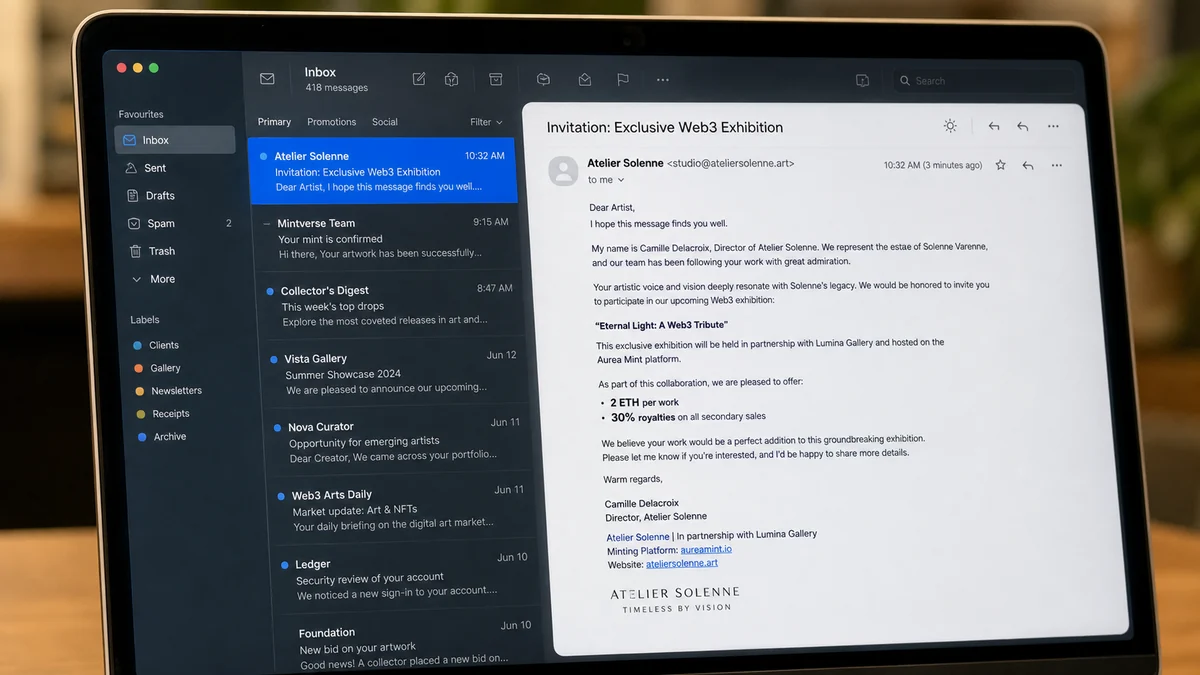
A detailed artist report described an unsolicited email from someone allegedly impersonating Takashi Murakami. The sender praised the recipient’s art and proposed a high-end Web3 exhibition involving HOSSANAART Gallery and an NFT marketplace called Trivamint.
The reported offer was 2 ETH for each work plus 30% royalties on future sales. Those numbers make the proposal feel like patronage from an established artist rather than a cold approach from an unknown buyer.
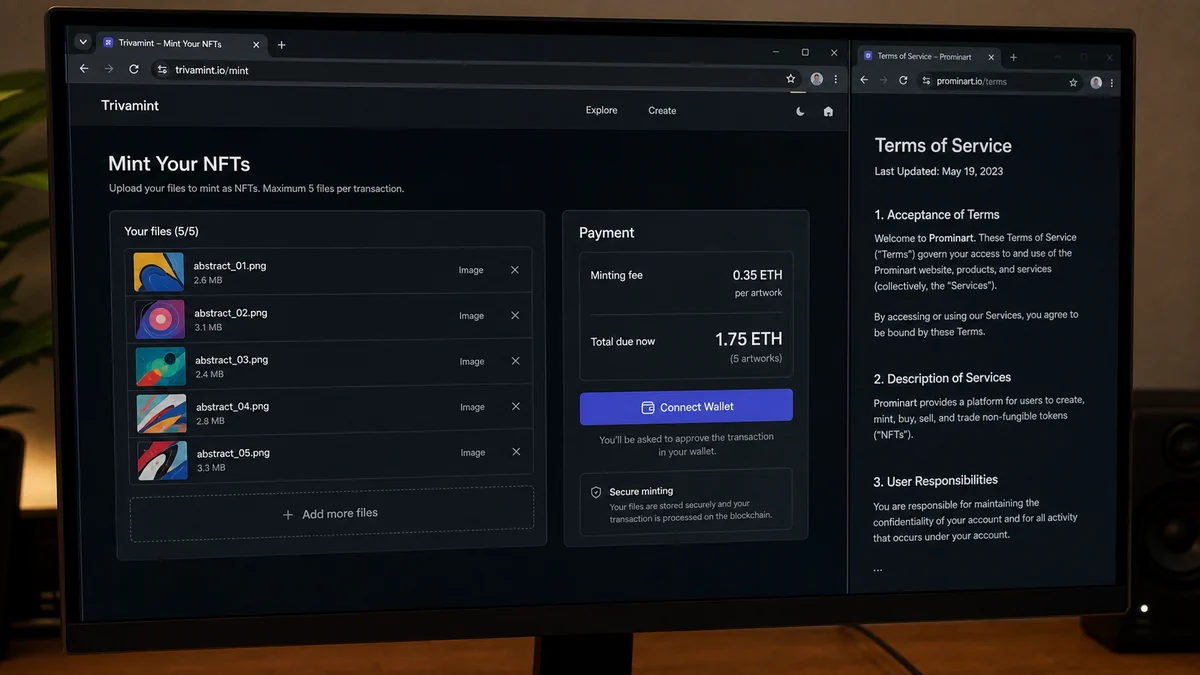
The recipient was then told to mint the artworks on Trivamint at 0.35 ETH per piece. For five works, the upfront demand would be 1.75 ETH, which the reporter valued at roughly $7,000 at the time.
The fee, not the artwork, is the transaction
The supposed collector does not need to buy anything. The promise of a future 2 ETH payment exists to make a smaller upfront charge feel reasonable.
Once the artist sends crypto or approves a wallet transaction, the marketplace can show a listing, bid, sale, royalty, or account balance that has no independently verifiable value. A dashboard number is not a blockchain payment under the artist’s control.
The reported scam became threatening after the recipient rejected it. Takedown threats and pressure are not how a serious gallery resolves a declined exhibition invitation. They are tools for pushing the target back toward the payment.
Trivamint’s own pages contain major identity conflicts
The live Trivamint homepage claims 99K+ artworks, 35K+ artists, and 128K NFTs created. Large counters can imply a mature marketplace, but they are site claims, not independently audited statistics.
The live terms page says “Welcome to Prominart,” repeatedly identifies Prominart as the operator, and displays “Last Updated: May 19, 2023.” It does not clearly explain why a site branded Trivamint is governed by another marketplace’s name.
Third-party domain records report that trivamint.com was created on November 29, 2025. A terms date in 2023 therefore predates the reported domain creation by more than two years. That does not mathematically prove theft or fraud, but it is a serious template and identity warning.
Before paying an NFT minting fee, check:
- Did the famous artist contact you through a verified official channel?
- Can the gallery confirm the exhibition independently?
- Why must the creator pay before the buyer purchases?
- Is the marketplace operator clearly named in its legal pages?
- Do the brand, domain age, copyright date, and terms date agree?
- Can the promised buyer prove control of the purchasing wallet?
- Does the wallet prompt match the exact minting action described?
- Can proceeds be verified on-chain rather than only inside a dashboard?
Why Artists Are Perfect Targets for This Story
Artists regularly receive unsolicited messages about commissions, exhibitions, licensing, collaborations, and purchases. A cold email is not automatically abnormal in that profession.
Public portfolios give scammers everything needed to personalize praise. Titles, media, themes, recent posts, exhibition history, and contact addresses can be copied into a message that appears carefully researched.
A famous name creates authority. The recipient may fear losing a rare opportunity by asking too many questions or delaying the response.
Cryptocurrency creates unfamiliarity. Gas, minting, wallets, royalties, smart contracts, and marketplace fees are real concepts, so a fabricated process can hide inside legitimate technical language.
The offer also flatters the target’s professional identity. It does not say “send us money.” It says the artist’s work has already been selected and that the fee is merely a technical step toward a prestigious sale.
The ratio is designed to feel favorable. Paying 0.35 ETH to receive 2 ETH per work sounds like an obvious investment when the promised buyer is assumed to be real.
That promised payment is the illusion. A genuine collector can purchase through an established marketplace, commission work under a signed agreement, or cover agreed production costs. The artist should not need to fund a stranger’s preferred marketplace to prove the buyer’s interest.
How the Fake Famous Artist NFT Scam Works
Step 1: The attacker studies an artist’s portfolio
The scammer finds a website, Instagram page, Behance profile, marketplace account, or gallery listing. Specific references to style and recent work make the first message feel personal.
Contact details are often public because artists need clients to reach them. That accessibility also makes targeted approaches easy.
Step 2: A famous identity supplies instant credibility
The sender claims to be a celebrated artist, estate representative, curator, gallery director, or studio assistant. A copied biography and signature can support the impersonation.
The email address may use a free mailbox or a lookalike domain. Display names can hide the actual sender unless the recipient expands the header.
Step 3: An exclusive exhibition creates urgency
The message describes a curated Web3 event, limited artist roster, private collector group, or upcoming launch. The recipient is told that several works have already been chosen.
The opportunity appears time-sensitive, which discourages independent contact with the real artist or gallery.
Step 4: A generous crypto price anchors the decision
The scammer offers several ETH per artwork and ongoing royalties. The headline payout makes the future minting charge look small by comparison.
No verifiable purchase transaction exists yet. The buyer’s promise remains an email claim.
Step 5: The artist is routed to a controlled marketplace
The sender insists that the work must be minted on one unfamiliar platform. Established marketplaces or the artist’s current storefront are rejected.
The site may contain polished listings, seller rankings, large activity counters, wallet buttons, and terms copied from another service.
Step 6: The minting fee multiplies by artwork
Instead of one small network fee, the platform demands a fixed charge per piece. Five works turn a 0.35 ETH requirement into 1.75 ETH.
The site may ask the artist to deposit crypto into an internal balance or approve a wallet transaction whose real function is difficult to understand.
Step 7: More fees appear behind the fake sale
After payment, the dashboard can show that the NFTs sold. Withdrawal may then require tax, verification, commission, liquidity, activation, or gas payments.
Every charge protects the earlier loss. The promised 2 ETH per work remains just out of reach.
Step 8: Refusal triggers pressure or threats
The impersonator may accuse the artist of breaching an agreement, threaten copyright action, demand removal of warnings, or claim that a valuable slot will be lost.
A legitimate famous artist or gallery can be verified and will use professional contracts. Threats from an unverified email do not transform an invented offer into a real obligation.
What Trivamint’s Live Site Shows
The Trivamint homepage presents itself as a digital-art marketplace. It displays collections, seller rankings, a four-step minting process, and large counters for artworks, artists, and created NFTs.
Those interface elements can be created without the corresponding marketplace activity. A visitor should look for verifiable contract addresses, on-chain collections, transaction links, operator identity, marketplace volume, and independent artist histories.
The site’s FAQ says users can mint, buy, and sell NFTs and that the service charges a small fee. It refers visitors to a pricing page for fee details, but a general statement does not validate an unexpected 0.35 ETH-per-work demand.
The most important inconsistency appears in the terms. The introduction identifies the service as Prominart, not Trivamint. The ownership and intellectual-property sections continue using that other name.
The footer displays a 2017 copyright, while third-party registration data places the trivamint.com domain creation in late 2025. The terms are dated May 2023. Three different time signals do not form a coherent operating history.
The site’s navigation also links a wallet connection to another domain. Connecting a wallet to an unfamiliar domain can expose the user to signature requests or token approvals outside the page they thought they were using.
Do not test a suspicious marketplace with a valuable wallet. Even rejecting a payment later does not make it wise to expose wallet addresses, holdings, or signing habits.
If technical analysis is necessary, use a fresh empty wallet created solely for research and do not seed it with funds. Most consumers should simply avoid the platform and preserve screenshots.
How to Verify a Famous Artist or Gallery Invitation
Start with the real artist’s official website and verified social profiles. Look for a publicly listed studio contact. Do not use the phone number, link, or alternate email contained in the suspicious message.
Send a short verification note that includes the sender address, claimed exhibition, gallery, marketplace, and requested fee. Do not forward active wallet links or attachments unless the studio asks for them safely.
Verify the gallery separately. Search corporate or nonprofit records, a physical address, prior exhibitions, artist rosters, and established press coverage. Contact the gallery through a channel found independently.
Ask for a written exhibition agreement. It should identify the parties, works, rights, commission, costs, payment schedule, venue, cancellation terms, and dispute process.
A contract is not automatically safe. Compare the legal names and addresses with public records and have a knowledgeable person review high-value commitments.
Ask why one specific marketplace is mandatory. A genuine buyer should be able to explain the chain, contract, custody, fees, and settlement process without requiring an irreversible deposit first.
Request the buyer’s public wallet address and proposed transaction method. Review its history using a reputable block explorer. A newly created or empty wallet cannot support claims of major collecting activity.
Search exact email sentences in quotation marks. Template-based scam messages often reuse praise, price, royalty, and exhibition language across many artists.
Take time. A legitimate career opportunity does not become illegitimate because an artist verifies who is offering it. Urgency protects the impersonator, not the creator.
Ask the proposed buyer to purchase one existing low-risk listing through a marketplace the artist already uses. Refusal does not prove fraud, but a buyer who insists on a new fee-taking platform while rejecting every established option is revealing where the real interest lies.
Separate copyright permission from token ownership. Minting an NFT does not automatically transfer reproduction, commercial, exhibition, or derivative rights. A genuine gallery should discuss those rights in writing instead of reducing the relationship to a wallet deposit.
Price the opportunity in ordinary currency as well as ETH. Crypto amounts can feel abstract, especially when the promised payment is much larger than the fee. Writing down the current cost of five minting charges makes the immediate risk harder to hide behind a future royalty story.
Have another person review the message before replying. An artist association, gallery contact, lawyer, or experienced collector may recognize copied language and marketplace inconsistencies that excitement makes difficult to see.
Search image assets and artist names displayed by the marketplace. Reverse-image search can reveal collections copied from unrelated creators or stock libraries. Copied art does not establish who operates the site, but it undermines claims of a curated community and verifiable seller history.
Archive the relevant pages before they change. Save the homepage claims, terms, fee screen, wallet destination, and contact details as PDFs or screenshots with visible addresses and dates. A later rebrand may remove the exact mismatch that helped identify the risk.
Company, Address, and Fulfillment Checks
The operating company is not clearly consistent
Trivamint’s live terms name Prominart as the owner and operator. That mismatch prevents a user from easily identifying which legal entity would hold funds or answer a dispute.
Do not infer a relationship between the two names without documentary evidence. A copied template is at least as plausible as a disclosed corporate connection.
The dates do not support the claimed history
The site shows a 2017 copyright and 2023 terms, while third-party domain records report a 2025 domain creation. Ask for evidence explaining the earlier operating history.
Old-looking footer dates and large counters can be typed into a template. On-chain and corporate records are harder to fabricate consistently.
No email invitation should define the official address
Verify the artist, gallery, and marketplace through independently found records. A contact page controlled by the same questionable site is not independent confirmation.
If there is no clear legal address, company registration, or accountable operator, an irreversible crypto payment has no practical recovery path.
Real fulfillment must exist outside the dashboard
A valid mint should be traceable to a known chain, contract, token ID, and transaction. A real sale should send funds to an address the artist controls.
Internal balances, bids, and royalties that cannot be verified on-chain can be arbitrary numbers displayed by the site owner.
Warning Signs in an NFT Exhibition Offer
- A famous artist contacts you from a free or unfamiliar email address.
- The praise is flattering but could fit many portfolios.
- The buyer offers several ETH per work before discussing rights or contracts.
- A prestigious gallery cannot confirm the event independently.
- One unfamiliar marketplace is mandatory.
- The artist must pay a fixed minting charge per work.
- The operator name in the terms does not match the brand.
- Domain, terms, and copyright dates conflict.
- Marketplace activity cannot be verified on-chain.
- The wallet connection opens another domain.
- Withdrawal requires further tax, activation, or verification fees.
- Rejecting the offer produces threats or takedown pressure.
The FBI’s NFT impersonation warning explains that criminals hijack or imitate known NFT figures, create urgency, and direct users to spoofed sites that can drain wallets.
MalwareTips has documented fake NFT purchase email pattern involving counterfeit sale notices and payment pressure. A famous-name email adds prestige to the same irreversible-payment risk.
What to Do if You Have Fallen Victim to This Scam
- Stop sending crypto. Do not pay tax, gas, verification, liquidity, recovery, or withdrawal fees to release a promised NFT sale.
- Disconnect the wallet. Remove the suspicious site from connected applications and review token approvals using a reputable chain explorer or wallet security tool.
- Move remaining assets if compromise is likely. Use a clean device and a newly secured wallet. Get expert help before moving valuable collections.
- Preserve the complete approach. Save email headers, messages, domains, wallet addresses, transaction hashes, contract addresses, screenshots, artwork requests, and threats.
- Contact the impersonated artist and gallery. Use official channels found independently. A concise report may help them warn other creators.
- Notify the exchange or wallet provider. If funds passed through a regulated exchange, report the destination immediately and provide transaction hashes.
- Report the domain and accounts. Submit abuse reports to the email provider, hosting provider, registrar, social platform, and marketplace used to recruit victims.
- Report the financial crime. File at IC3.gov and ReportFraud.ftc.gov where applicable.
- Protect the artwork. Keep original files and creation records. Monitor for unauthorized listings and use each marketplace’s takedown process when copied art appears.
- Reject recovery agents demanding upfront crypto. Blockchain recovery promises are a common second scam aimed at people who already lost funds.
- Scan affected devices. Run a full Malwarebytes scan if wallet software, browser extensions, archives, or remote-access tools were installed.
- Block known malicious routes. AdGuard can reduce exposure to recognized phishing domains and malicious advertisements. It cannot make a wallet signature safe or recover cryptocurrency.
Frequently Asked Questions
Did the real famous artist send this offer?
The report describes an alleged impersonation. Do not assume the real artist was involved. Verify through the artist’s official website or established studio contact.
Is a 0.35 ETH minting fee normal?
Network costs vary, but a fixed per-artwork demand chosen by an unfamiliar marketplace is not proof of a legitimate mint. Verify the exact transaction and contract before signing anything.
Does a polished NFT marketplace prove it is real?
No. Listings, counters, bids, and seller rankings can be template content. Check the operator, domain history, contracts, tokens, and transactions independently.
Why do the Trivamint terms say Prominart?
The live terms page uses that different name repeatedly. Without a documented relationship, the mismatch is a serious legal-identity and template warning.
Can a crypto transfer be reversed?
Blockchain transfers are generally irreversible. Report quickly to any exchange involved and law enforcement, but do not pay anyone who guarantees recovery.
What if the dashboard says my NFT sold?
Verify the token and payment on the relevant blockchain. A site-controlled balance or sale notice is not evidence that spendable funds reached your wallet.
The Bottom Line
The Fake Famous Artist Email scam turns recognition into a bill. A prestigious name and a promised 2 ETH sale make a 0.35 ETH minting demand seem like a professional expense.
Real opportunities survive independent verification. If the artist, gallery, operator, contract, and payment cannot be confirmed outside the email and Trivamint dashboard, do not connect a wallet or send crypto.








