

A message offers help with money, and the names behind it seem familiar: Richard and Debbie Nuttall, the couple whose lottery win made headlines.
For someone struggling with bills, an offer from their supposed team can feel wonderfully personal. That is why the person behind the message matters so much.
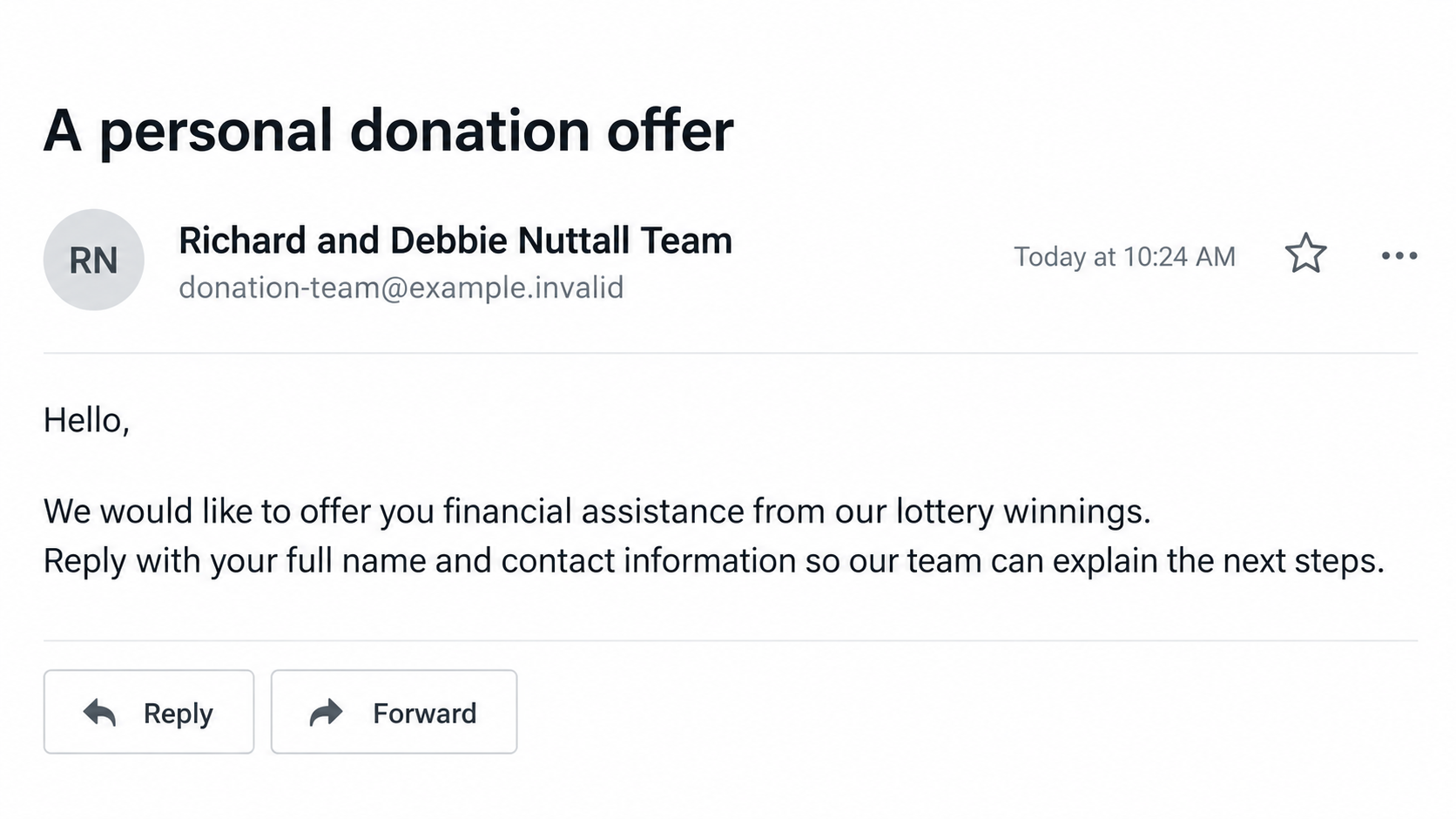
Overview
The winners are real; an account using their names needs separate proof
The Richard and Debbie Nuttall Team scam borrows the identity of genuine EuroMillions winners to make a donation offer seem credible.
These messages misuse the couple’s identity. Their real lottery win does not establish that they contacted you, appointed the sender, or benefited from the approach.
The email image is a fictional example with an inactive sender address. It is not an original message from the winners or a verified scammer.
Adding Team, Foundation, or a similar word to a display name does not establish an authorized organization. Those labels require their own verification.
A documented earlier incident shows how identity borrowing works
An April 2024 report described a woman who contacted a Facebook profile she believed represented the Nuttalls after hearing about it through another person.
She became suspicious when the conversation turned to identifying information. The report included a lottery operator statement that the impersonating account had been removed.
That incident establishes a real impersonation concern. It does not prove that every later profile belongs to the same operator or follows an identical script.
The report described requests for identifying information, not a verified fee payment by that woman. A later demand for money would be a separate warning sign.
The offer should not cost you money or control of your accounts
A surprising private gift is not automatically impossible. The danger is treating a recognizable name as permission to bypass normal privacy and payment safeguards.
- Do not send an advance payment to a supposed donation agent.
- Do not provide login details or security codes to receive a gift.
- Do not forward part of a payment to another person at the sender’s direction.
- Do not identify a profile as genuine merely because it copies news photographs.
If the conversation moves toward fees, sensitive documents, or financial instructions, stop. Verify through a route independent of the person making the offer.
Why a Real Lottery Story Makes Such Effective Bait
A basic search can confirm that Richard and Debbie Nuttall won a substantial EuroMillions prize in January 2024. That supplies a convincing foundation for the approach.
But the search answers a different question from the one you need answered. It confirms a public event, not who controls an email address or social profile.
An impostor can repeat a real winner’s biography without access to the winner’s money. Public photographs and familiar headlines make that identity easy to imitate.
The proposed gift then connects the public story to your private worries. The sender does not need to explain an investment or sell a product.
They only need you to believe that a generous person has chosen to help. Once that feels possible, an unusual request can start sounding like paperwork.
Financial stress can make the distinction harder to maintain. Wanting relief from debt is understandable; the dishonest act belongs to whoever exploits that hope.
How the Richard and Debbie Nuttall Team Scam Works
Step 1: A message or profile presents the winners as benefactors
The approach may arrive by email or social media. You might also hear about an account from someone who sincerely believes its offer is genuine.
A recommendation from a friend is not necessarily a lie by that friend. They may have encountered the same impersonation and passed it along in good faith.
The sender uses the Nuttall names and the lottery story to make financial assistance seem plausible. A supposed team can create an additional layer of formality.
Before replying, distinguish a public story about generosity from a specific application or offer. One does not authenticate the other.
Step 2: Conversation replaces the usual identity checks
The account invites you to explain your circumstances or provide contact information. A sympathetic response can make the exchange feel less like a financial transaction.
That personal attention matters. You may start trusting the sender because they listen, remember details, or express concern rather than immediately demanding a payment.
Kindness in a chat is not proof of identity. Neither are long conversations, a familiar profile picture, or messages signed with a winner’s first name.
Keep sensitive family details private while you assess the offer. You do not need to disclose medical records or financial hardship documents to an unverified stranger.
Step 3: Your details become the condition for moving forward
A request for identifying information can be presented as a necessary registration step. The sender may say a team member needs it before arranging help.
Ask what the information is for and who would receive it. More importantly, verify the organization independently before considering whether that request is proportionate.
A name and reply address are not equivalent to a passport scan or banking login. The sensitivity increases as the conversation asks for more.
Do not assume a form is safe because it looks official. A polished document can still deliver your information to someone unrelated to the real winners.
Any request for an authentication code is particularly concerning. Receiving money does not require you to give an unknown donor control over an existing account.
Step 4: A supposed administrative problem may introduce a fee
In an advance-fee variation, promised assistance is delayed until you pay an alleged processing, release, transfer, or verification charge.
A fee is not required for the impersonation to be harmful: requests for sensitive information already create risk. Other versions may add a demand for money.
The appeal rests on an unequal comparison: the requested fee seems small beside the large gift. That comparison fails if the promised gift does not exist.
A certificate or payment screenshot supplied by the sender does not resolve that problem. It is another assertion from the same unverified source.
Do not send a smaller test payment or buy a gift card to demonstrate cooperation. Either action gives the sender something real for an unverified promise.
Step 5: The promise can continue while the requirements change
Once you have invested time, shared your story, or paid, abandoning the conversation can feel like giving up help that is almost within reach.
That feeling can support another request: a different agent must check you, another document is needed, or an earlier fee supposedly went to the wrong place.
Do not judge the next demand by how much effort you have already spent. Assess whether there is independent proof of the sender’s identity and authority.
If there is not, stop providing information or money. A promised donation is not a reason to accept an expanding series of private conditions.
Checks That Actually Help, and Checks That Do Not
Verifying the news is only the first step
Finding the lottery story can confirm names and background. It cannot establish that a particular Gmail address, Facebook account, or chat participant belongs to the couple.
A fraud report about one account also cannot identify every future sender. Avoid publishing accusations against unrelated people who happen to share similar names.
Photographs and testimonials can be copied
A profile picture may be genuine photography of the winners while the account itself is fraudulent. The image’s authenticity and the account’s authenticity are different questions.
Likewise, comments claiming someone received money can be unverifiable. A large comment count is not the same as a bank-confirmed donation.
You do not need to prove that photographs were altered or generated. The practical issue is whether the message establishes who is actually making the offer.
A claimed team should have an independently checkable role
Do not accept an agent’s authority merely because another unverified participant introduces them. Several people repeating the story can still belong to the same deception.
If a message names a charity, contact that charity through its independently established website. Check the particular program and sender, not just whether the charity exists.
A genuine charity’s existence does not authorize someone to collect fees using its name. Do not send documents while waiting for an answer.
Be specific when making that check: name the program, account address, requested documents, and proposed payment method. A general question about donations may miss the impersonation.
Keep any confirmation separate from the suspicious conversation. Forwarded screenshots supposedly showing approval are less useful than a response obtained through the organization’s established contact route.
A gift and a lottery prize are not interchangeable
Someone offering a private donation is not necessarily claiming you bought a winning ticket. Not entering a draw therefore does not, alone, resolve the claim.
Focus on what follows: unverifiable identity, requests for sensitive access, an advance fee, or instructions to route money. Those details reveal the actual risk.
The FTC’s prize-scam guidance explains the danger of paying fees for promised winnings. A donation story can borrow similar payment pressure.
What to Do if You Have Fallen Victim to This Scam
-
Stop the conversation without sending a final payment.
Do not pay to cancel an application, retrieve a document, or complete the supposed gift. You do not need the sender’s permission to disengage.
Save the conversation first if you can do so safely. Then block the account rather than debating whether the promised help is still available.
If someone introduced you to the profile, warn them privately. Explain that the identity was not verified instead of accusing them of knowingly helping the scam.
-
Preserve the account identifiers and payment instructions.
Save profile links, usernames, full email addresses, message dates, attachments, and payment references. A display name alone may not identify the same account later.
Record any different agent, recipient, or company mentioned in the conversation. Keep these as claims made by the sender, not established organizational connections.
Avoid posting family documents or complete bank details when warning others. Provide sensitive evidence privately to your bank, platform, or investigating authority.
-
Contact the provider you used to pay.
Explain that someone impersonated lottery winners to obtain money. Identify the actual recipient and method, not just the names used in the messages.
Ask whether a payment can be stopped, recalled, or disputed and what supporting records are needed. Save the case number and follow-up instructions.
Do this even if the amount seems embarrassing or small. The provider needs accurate details, and prompt reporting is more useful than continuing to negotiate.
-
Respond to the information you disclosed.
For a shared password, change it through the genuine service and inspect account access. If you reused it, protect those other accounts too.
If you sent identity documents or sensitive financial information, tell the relevant institution. Ask which protective measures fit the document and your location.
In the US, IdentityTheft.gov can help you plan a response. Sharing information is an exposure, not proof that every form of identity theft occurred.
-
Report the impersonating profile and the fraud.
Use the platform’s report function for the actual account or message. Include the profile identifier and explain whose identity it claims to represent.
In England, Wales, or Northern Ireland, use Report Fraud. People in Scotland should use the appropriate Police Scotland reporting route.
US readers can report the approach at ReportFraud.ftc.gov. A report helps document the incident, but it does not guarantee repayment.
-
Keep later offers separate from your existing recovery process.
A new contact may promise the original gift, an apology payment, or recovery of your loss. Do not trust that claim because they know your story.
Use the references and contact routes you already established with your provider. Reject an unsolicited recovery service that asks for payment or account access.
If the incident affected your finances, speak to a trusted person or established support organization. You deserve practical help without another stranger selling hope.
Frequently Asked Questions
Are Richard and Debbie Nuttall real lottery winners?
Yes. Their genuine EuroMillions win is the background impostors borrow. It does not authenticate a message, private account, or supposed representative using their names.
Is the real couple responsible for this scam?
The warning concerns impersonators. A fake account’s claims are not evidence that the real winners created, authorized, or benefited from the approach.
Does Team in the sender name prove there is an official donation office?
No. A display name is easy to create. Verify the actual person or organization independently before sharing information or following financial instructions.
What if a friend says they received an offer too?
They may also have been targeted. A sincere recommendation is not proof that the account is genuine or that a promised payment exists.
Should I pay a small fee to unlock a large donation?
No. Do not pay an unverified representative for access to promised assistance. A larger promised amount does not reduce the risk of losing the fee.
What if I replied but did not send money?
Stop replying and review what information you shared. Secure any exposed account, preserve the messages, and report the impersonating profile.
The Bottom Line
Do not send fees, sensitive documents, or account access through a Richard and Debbie Nuttall Team scam message. A real lottery story cannot authenticate its sender.
If you already responded, stop further disclosure. Contact your payment provider about money sent, protect exposed accounts, and report the actual impersonating profile.

Join the discussion
0 commentsShare your experience or ask a question about this article.
Community experiences
Did this happen to you?
Your experience could help someone recognize the same scam. Submit a private report for our team to review.
I experienced this tooReports are reviewed before publication. Sharing publicly is always your choice.
Discussion
Start the conversation
Have a question or something useful to share? Add the first comment.