

A Minnesota traffic notice lands in your messages, warning that an unpaid violation could affect your license. You don’t remember receiving a ticket.
The deadline leaves little room to think. Before treating that message like a real court document, take a closer look at who is asking you to act.
Overview
The notice turns an unfamiliar fine into an immediate worry
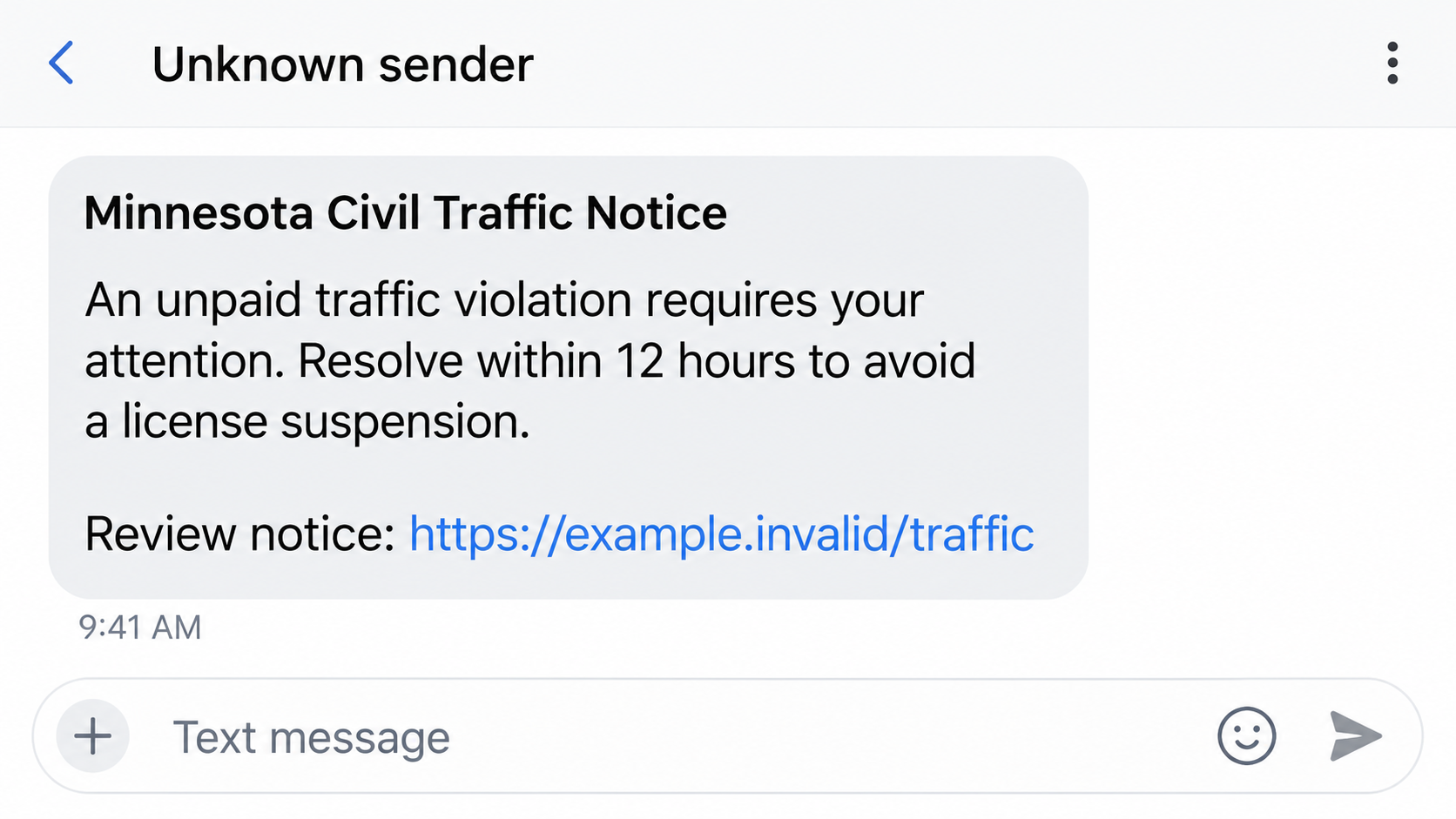
The Minnesota Civil Traffic Notice scam uses text messages or similar digital notices to claim that a driver has an unresolved traffic violation.
Some versions borrow a motor vehicle agency’s name. Others present themselves as court notices, using formal language to make a payment request seem compulsory.
The image shows an invented example, not an original citation. Its deadline and nonfunctional link illustrate the pressure tactic without directing readers to a live destination.
The suspicious combination is an unexpected demand, threatened consequences, and a route supplied by the same sender to supposedly settle everything.
Minnesota has already warned about fake DVS payment messages
Driver and Vehicle Services, or DVS, is a division of the Minnesota Department of Public Safety. It is a real agency, not a scam operation.
In a July 2025 warning, DVS described fake penalty and traffic-ticket messages using several variations of its name.
The bulletin says DVS does not ask for information or money by text. That is different from claiming every message from every Minnesota organization is fraudulent.
A sender writing Minnesota DVS has not authenticated itself. A familiar agency name is something an impostor can type into a message.
Check the obligation somewhere the sender does not control
Do not pay through the unexpected notice. Check the alleged citation through the Minnesota Judicial Branch or contact the relevant court independently.
- Keep the notice separate from any genuine ticket you already have.
- Do not use its link or QR code to decide whether it is authentic.
- Use DVS for questions within its responsibilities, rather than treating it as every court’s payment office.
- Contact your card issuer promptly if you entered card details on the linked page.
A fake notice is a reason to change how you verify a claim, not a reason to ignore an independently confirmed citation.
What Makes the Message Feel Like a Real Legal Notice?
A traffic violation is plausible enough to unsettle almost anyone who drives. You may wonder whether a camera, parking issue, or old address explains the surprise.
The wording can sound administrative rather than openly threatening. Terms such as civil notice or enforcement suggest that a routine process is already underway.
A list of consequences then makes an ordinary message feel like the final opportunity to intervene. The payment link becomes the apparent escape route.
Pause here: worrying that a ticket might exist does not tell you whether this sender is entitled to collect it. Those are separate questions.
Likewise, a case reference is only useful when the responsible court can verify it. A string of letters and digits is easy to invent.
Do not rely solely on whether the message knows your name or vehicle information. Accurate personal details do not establish a sender’s legal authority.
How the Minnesota Civil Traffic Notice Scam Works
Step 1: A text claims there is an unresolved violation
The notice arrives without the context you would normally expect from a ticket you received. It may name Minnesota, a vehicle agency, or a court.
Some versions resemble a brief alert. Others use a longer document-style message, potentially with official-looking formatting or a legal reference.
Those presentation choices create the same initial impression: something has already been recorded against you, and you are late in dealing with it.
Do not treat the sender’s explanation for missing paperwork as confirmation. If a real citation exists, it should be checked through the appropriate official channel.
Step 2: Threats shift your attention away from the sender
The message may warn about a license suspension, registration consequences, added charges, or a court-related penalty unless you act quickly.
Exact amounts, deadlines, and threatened actions can vary. There is no single wording that all fraudulent Minnesota notices must contain.
The pressure works by changing the question in your mind. Instead of asking who sent the notice, you start asking how quickly you can clear it.
That is why an invented deadline deserves scrutiny rather than obedience. A message cannot establish a real suspension simply by announcing one.
A particular legal consequence may be possible in a genuine case. Only the responsible authority can explain whether it applies to your actual situation.
Step 3: A link or QR code supplies the supposed solution
The sender directs you to a page presented as a way to review or resolve the violation. A QR code can serve the same purpose.
Scanning a code does not validate the destination. It only retrieves the address encoded inside, which may belong to someone unrelated to Minnesota authorities.
A page can display a state name or emblem without authorization. Those visual details should never replace checking how you reached the service.
HTTPS is also not a government credential. It can encrypt your connection to a deceptive page just as it encrypts a legitimate one.
The safer route starts with a fresh visit to the relevant official website, not with an address or search suggestion supplied by the notice.
Step 4: The page asks for information or payment
A fake payment page may request your name, address, card number, expiration date, and security code. Other versions may ask for additional identity information.
Entering those details creates a real exposure even if the page displays an error afterward. An unsuccessful-looking transaction does not prove your information stayed private.
Conversely, clicking a link does not prove that you paid or that malware was installed. Your response should reflect what you actually entered, approved, or downloaded.
If a verification code arrives, read what it authorizes. Do not supply it to the page simply because the sender calls it a routine confirmation.
Stop if the site requests banking credentials to settle an unexplained fine. Verify the obligation first, using a contact route independent of that page.
Step 5: The notice may be followed by more requests
Some versions may continue after an attempted payment, claiming it failed or another charge is due. That follow-up is not a reason to try again.
A receipt generated by the suspicious page is not proof a court received money. Confirm payment status with the real authority through its own records.
Do not make a second payment merely because the sender insists the first was incomplete. First ask your financial institution what actually happened.
Keep both the original notice and follow-up messages. Differences between the claimed agency, payment destination, and sender can help your provider understand the incident.
DVS Questions and Court Questions Are Not the Same Thing
Use the court’s own route to check a citation
The Minnesota Judicial Branch provides an official fine and citation information page. Start there rather than at an unsolicited payment link.
Use information from a genuine citation when available. If a record is missing or unclear, contact the appropriate court instead of assuming the text supplies the answer.
The court’s traffic guidance also explains options for handling a real ticket. Do not rush into paying something you intend to question.
A newly issued citation may not be visible immediately. The court’s payment information notes that processing can take up to seven days.
If you have a genuine paper ticket and cannot locate it online, contact the court. Do not use the unexpected message as an alternative collection service.
Use DVS for the status or service it actually handles
A licensing question and a court fine can be connected without being the same administrative task. Ask the relevant organization about its part of the issue.
This distinction matters when a message mixes court threats with a vehicle agency’s name. Combining official terms does not create an official collection process.
A correct-looking link still needs context
An address ending alone cannot settle the question. Government organizations sometimes direct users to separate authorized payment services, so check the route you followed.
Instead, follow the route from the official agency or court website you opened yourself. That establishes context a copied logo or isolated address cannot provide.
If You Have Both a Real Ticket and a Suspicious Text
The two can arrive around the same time without being connected. A real citation does not authenticate every later message mentioning traffic enforcement.
Compare the actual citation details with the court’s records. Do not assume a similar amount, matching county name, or convenient timing proves a shared origin.
If you already paid the real court, keep that receipt and ask the court about its recorded status. Do not pay again through an unexplained text.
If the real ticket remains unresolved, ask about its actual deadline and available options. A scam warning should not leave you uncertain about a genuine obligation.
This separates two tasks that the message tries to combine: protecting yourself from an impostor and dealing responsibly with an authentic citation.
What to Do if You Have Fallen Victim to This Scam
-
Stop using the notice and preserve a copy.
Capture the full message, sender, date, displayed link, and any payment confirmation. If possible, save the destination address without reopening the page.
Write down whether you only viewed it, entered details, approved a code, submitted a payment, or downloaded anything. Those differences determine the next steps.
After saving evidence, report the message through your messaging app and block the sender. Do not reply to request removal from a supposed court list.
-
Protect a card you entered, even if payment appeared to fail.
Contact the card issuer through a verified channel and explain that a fraudulent traffic-payment page received the details. Ask whether replacement or temporary controls are appropriate.
Review pending and completed transactions together with the issuer. Identify the suspicious transaction accurately instead of assuming its statement description will say Minnesota.
If you were charged, ask about the dispute process and evidence required. Follow the issuer’s instructions promptly; a refund is not automatic.
-
Secure any account credentials or approvals you disclosed.
If the page collected a password, change it on the genuine service. Check other accounts where you used the same password.
For banking access or a shared authorization code, contact the bank’s fraud team. Ask them to review sessions, recipients, and actions connected with that exposure.
Do not wait for a visible loss before reporting a disclosed login. An account can need protection even when its current balance looks unchanged.
-
Respond separately to identity information exposure.
If you supplied a driver’s license image, Social Security number, or similar identifying material, keep a record of precisely what was shared.
Use the recovery guidance at IdentityTheft.gov to select appropriate protections. Do not assume every field on a fake form creates the same risk.
Watch for follow-up messages that reuse those details. Someone repeating your information back to you has not thereby become a legitimate investigator.
-
Check your device only when the interaction warrants it.
If you installed software or an extension, stop using the affected device for sensitive accounts until you have assessed and removed the unwanted access.
A Malwarebytes scan can help look for malicious software after a risky download. It cannot undo a card payment or invalidate a stolen password.
AdGuard can add filtering against some malicious advertising and destinations. It does not authenticate a court notice or guarantee that every phishing link is blocked.
-
Report the scam and resolve any genuine citation independently.
Minnesota’s DVS warning directs people who fell victim to report through the FBI’s Internet Crime Complaint Center. Provide the saved message and transaction details.
Separately contact the court if you still have a question about a real ticket. Paying an impostor does not establish that an actual obligation was satisfied.
Ask your bank and the real authority for reference numbers. Keep their responses with your evidence rather than continuing discussions with the suspicious sender.
Frequently Asked Questions
Is a Minnesota Civil Traffic Notice text a real ticket?
The title alone proves nothing. Unexpected notices demanding payment through supplied links should be treated as suspicious and checked directly with the appropriate Minnesota authority.
Does DVS text people to request traffic-fine payments?
DVS says it does not request money or information by text. Its warning covers impostor messages claiming outstanding penalties or traffic tickets.
Does a judge’s name make the notice authentic?
No. A name, signature image, or case reference can be copied or invented. Verify the alleged case with the court through independently obtained contact information.
Should I scan the QR code to see the fine?
No. Use the official court website instead. A QR code is another way to deliver an address, not a seal of authenticity.
What if I only opened the link?
Close it and consider what else happened. Entered information, approved requests, downloads, and installed software require different responses; opening a page alone does not prove infection.
Can I ignore an actual citation after receiving this scam?
No. Verify a genuine citation separately and follow the real court’s instructions. The fraudulent message and any legitimate legal obligation are different issues.
The Bottom Line
Do not pay through a Minnesota Civil Traffic Notice scam message. Its threatened deadline is not proof of a real fine, court case, or license restriction.
Check with the appropriate authority directly. If you already entered financial information or paid, contact your provider now and preserve the notice for your report.

Join the discussion
0 commentsShare your experience or ask a question about this article.
Community experiences
Did this happen to you?
Your experience could help someone recognize the same scam. Submit a private report for our team to review.
I experienced this tooReports are reviewed before publication. Sharing publicly is always your choice.
Discussion
Start the conversation
Have a question or something useful to share? Add the first comment.