

Unsolicited text messages claiming you have a toll violation and a “Notice of Civil Infraction Hearing” are spreading across the US, often using well-known court names like Los Angeles County or Detroit’s 36th District Court. The message pressures recipients to either appear in court or pay a penalty by a deadline, then provides a QR code that leads to a fake payment portal.
These sites typically show a small amount due, such as $6.99, and prompt victims to enter credit card and personal details. The payment is just bait. The real goal is to steal card data and identity information.
Scam Overview
The core idea behind this scam is simple: use fear, authority, and urgency to push people into paying “just to make it go away.”
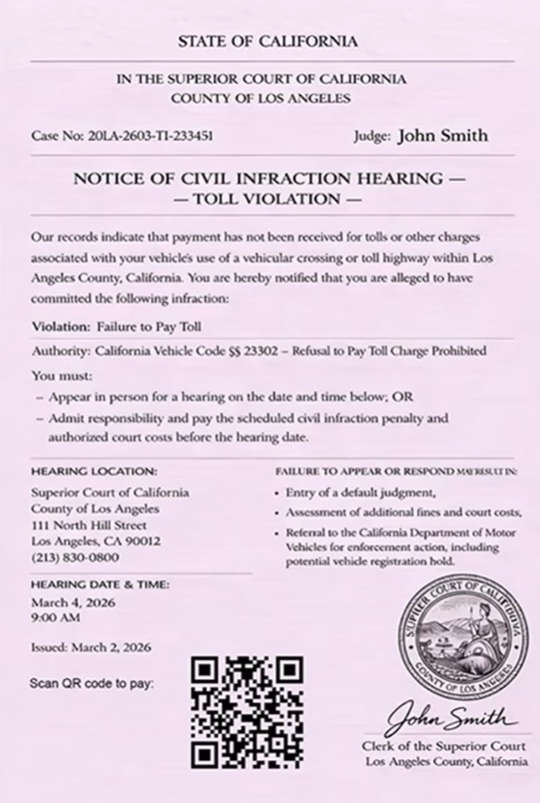
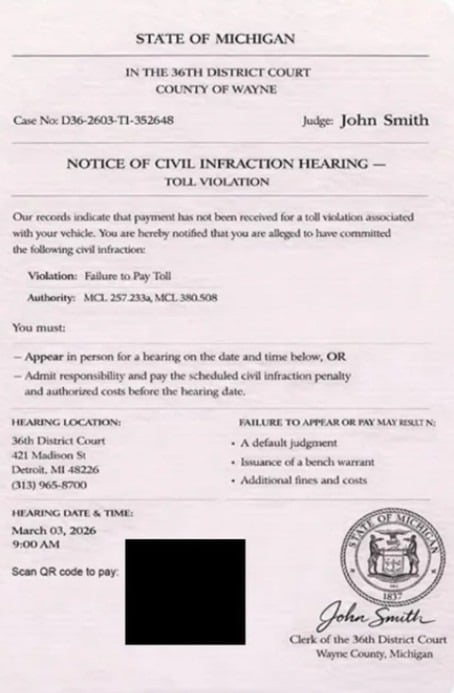
Scammers are sending text messages that claim the recipient committed a toll violation and must either appear in person for a court hearing or pay a penalty before a specific date. The message is often paired with an “official-looking” document image that resembles a court notice, with a state header like STATE OF CALIFORNIA or STATE OF MICHIGAN, a court name, a case number, and a signature line.
In the examples circulating, the fake notice is framed as a “NOTICE OF CIVIL INFRACTION HEARING” and includes language like:
- “Our records indicate that payment has not been received…”
- “Violation: Failure to Pay Toll”
- “You must appear in person… OR admit responsibility and pay…”
To make it feel real, the notice often references recognizable places and institutions, such as:
- Superior Court of California, County of Los Angeles
- 36th District Court, County of Wayne (Detroit, Michigan)
- Other city and county names across the United States, including large metro areas and smaller jurisdictions
The document commonly includes a QR code and a prompt like “Scan QR code to pay.” That QR code is the trap.
Why the QR code matters
A QR code feels neutral. People associate it with restaurants, parking meters, invoices, and quick payments. Scammers take advantage of that comfort.
Instead of asking you to click a suspicious link in a text, they present a QR code that feels more “official,” more “procedural,” and less like a scam. Many victims scan first and think later.
The QR code typically redirects to a scam website that imitates a government agency, a court, a toll operator, or a DMV-like payment portal. The page may look polished, branded, and structured like a real citation system.
The small-dollar bait: why you see $6.99 and similar amounts
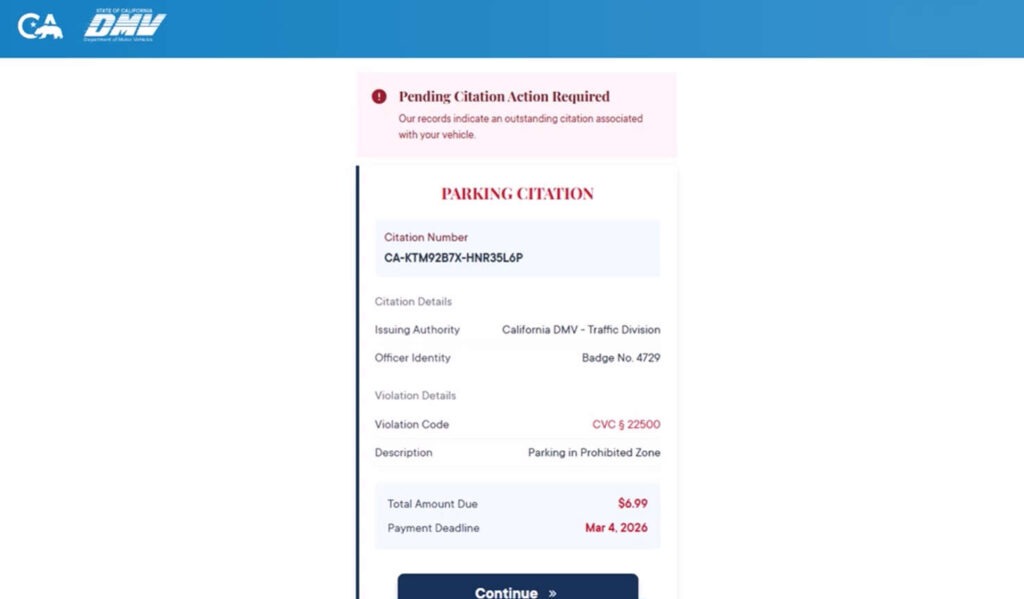
A major feature of this scam is the use of a small payment amount. In one common fake portal, the page shows:
- A citation-style layout
- A “Total Amount Due” of $6.99
- A short deadline (for example, “Payment Deadline Mar 4, 2026”)
- A prominent button like “Continue”
That low amount is strategic.
If the page demanded $250 or $500, many people would slow down and verify. But $6.99 feels like a nuisance fee. It feels easier to pay than to fight.
Scammers know that many victims will think:
“I do not remember this, but it is only $6.99. I will just pay and move on.”
The moment you enter your card number, expiration date, and CVV, the scam has accomplished its real goal.
What the fake payment page often looks like
These scam pages usually mimic the structure of a real citation or payment portal. Common elements include:
- A header implying an official agency or department (DMV, traffic division, toll division, court payment system)
- A “Citation Number” formatted with random letters and numbers
- A “Violation Code” or statute reference to look legitimate
- A “Total Amount Due” and “Payment Deadline”
- A big button like “Continue”
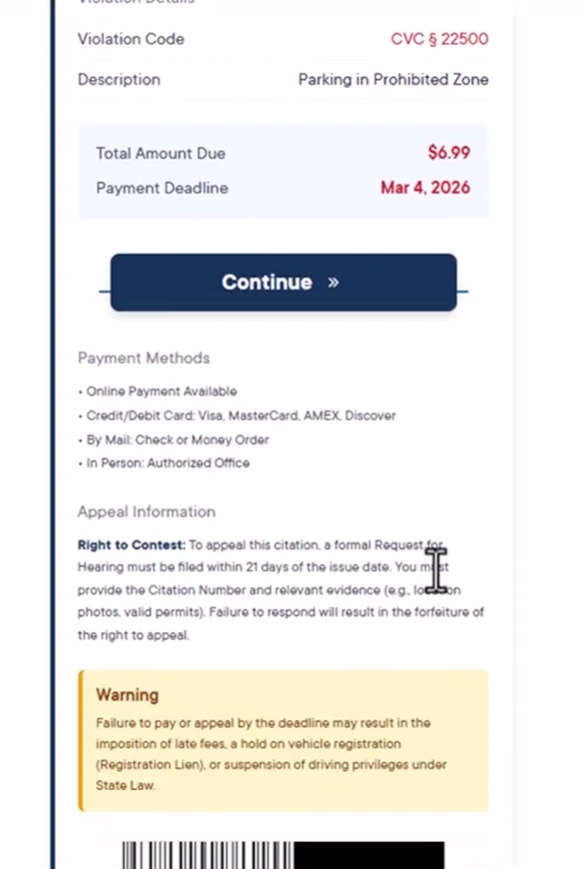
- A list of “Payment Methods” to seem authentic (credit cards, mail, in person)
Some pages even include an “Appeal Information” section, warnings about late fees, and language about holds on vehicle registration. That extra text is not there to help you. It is there to convince you.
Why scammers impersonate courts and DMVs
Courts and DMVs are perfect targets for impersonation because:
- People fear penalties, warrants, and license issues.
- People believe court documents must be handled quickly.
- People assume “official paperwork” is not something to ignore.
- The average person does not know how court notices are actually delivered.
A real court notice typically comes through formal channels, often by mail, and it is usually tied to verifiable case records. Scammers exploit the fact that most people will not stop to confirm what a real civil infraction hearing notice should look like.
Geographic spread: why you see multiple states and cities
This scam is not limited to one location.
Scammers reuse the same template and swap out the header, court name, city, and phone number. Today it might claim to be Los Angeles County. Tomorrow it might claim to be Detroit, Washington, or another jurisdiction.
That flexibility makes the scam scale fast. It also makes it harder for victims to compare notes, because the details change while the core trick stays the same.
The real harm: it is not about the toll
This scam is not trying to collect a toll payment.
It is trying to collect:
- Credit card number, expiration date, CVV, and billing ZIP code
- Full name, phone number, email address
- Home address and possibly date of birth
- Vehicle details like plate number or make and model
- Any other “verification” fields the fake portal asks for
Once scammers have card data, they may:
- Run small “test” charges to confirm the card works
- Attempt larger purchases later
- Sell the card details to other criminals
- Use the personal info for broader identity theft attempts
Even a small payment page can lead to big financial damage.
How The Scam Works
Below is the typical step-by-step flow, with the common variations that make it convincing.
Step 1: The scammer targets phone numbers at scale
Scammers send these texts in bulk. They do not need to know who actually drove on a toll road.
They can obtain phone numbers through:
- Data broker lists and marketing databases
- Leaked data from unrelated breaches
- Randomized number dialing (sending to entire number ranges)
- Old scam lists traded between criminals
That is why people receive these notices even if they do not drive, do not have a car, or have never been to the state mentioned.
Step 2: The “official” text message creates urgency
The text message usually has a hard deadline and a serious consequence.
Common pressure tactics include:
- “Final notice” or “action required”
- “You must respond by today”
- “Late fees will be added”
- “Failure to appear may result in judgment”
- “Vehicle registration hold” language
The goal is to interrupt your day and push you into quick action before you verify.
Step 3: The scam introduces authority with a court-style notice
Instead of a plain link, many versions include an image that looks like a court notice titled something like:
- “NOTICE OF CIVIL INFRACTION HEARING”
- “TOLL VIOLATION”
- “FAILURE TO PAY TOLL”
The document often includes:
- A court name (for example, “Superior Court of California, County of Los Angeles”)
- A case number formatted to look real
- A judge name (often generic, like “John Smith”)
- A hearing location address and a phone number
- A hearing date and time
This is theater. It is designed to trigger compliance.
Here is what it usually says:
“Notice of Civil Infraction Hearing” document text (California version)
STATE OF CALIFORNIA
IN THE SUPERIOR COURT OF CALIFORNIA
COUNTY OF LOS ANGELESCase No: 20LA-2603-T1-233451 Judge: John Smith
NOTICE OF CIVIL INFRACTION HEARING
TOLL VIOLATIONOur records indicate that payment has not been received for tolls or other charges associated with your vehicle’s use of a vehicular crossing or toll highway within Los Angeles County, California. You are hereby notified that you are alleged to have committed the following infraction:
Violation: Failure to Pay Toll
Authority: California Vehicle Code §§ 23302 – Refusal to Pay Toll Charge Prohibited
You must:
- Appear in person for a hearing on the date and time below, OR
- Admit responsibility and pay the scheduled civil infraction penalty and authorized court costs before the hearing date.
HEARING LOCATION:
Superior Court of California
County of Los Angeles
111 North Hill Street
Los Angeles, CA 90012
(213) 830-0800FAILURE TO APPEAR OR RESPOND MAY RESULT IN:
- Entry of a default judgment,
- Assessment of additional fines and court costs,
- Referral to the California Department of Motor Vehicles for enforcement action, including potential vehicle registration hold.
HEARING DATE & TIME:
March 4, 2026
9:00 AMIssued: March 2, 2026
Scan QR code to pay:
Clerk of the Superior Court
Los Angeles County, California
Step 4: The QR code bypasses your usual scam filters
Many people have learned not to click random links in texts.
A QR code feels different. It feels like a “document workflow” step, not a link.
But scanning a QR code is functionally the same as clicking a link. You are still being routed to a website the scammer controls.
Step 5: The landing page mimics a citation or DMV payment portal
After scanning, the victim is taken to a page that looks like a payment system.
A common structure includes:
- “Pending Citation Action Required”
- “Parking Citation” or “Toll Violation” headers
- Citation number and “Issuing Authority” fields
- A small amount due, such as $6.99
- A payment deadline displayed in red
- A big “Continue” button
Even when the scam claims a toll violation, the payment portal may shift terminology and call it a “citation” or “parking citation.” That mismatch is a frequent red flag, but many people miss it because the page looks official at a glance.
Here is what the scam sites say:
Pending Citation Action Required
Our records indicate an outstanding citation associated with your vehicle.PARKING CITATION
Citation Number
CA-KTM92B7X-HNR35L6PCitation Details
Issuing Authority: California DMV – Traffic DivisionOfficer Identity
Badge No. 4729Violation Details
Violation Code: CVC § 22500
Description: Parking in Prohibited ZoneTotal Amount Due: $6.99
Payment Deadline: Mar 4, 2026
Step 6: The victim is asked for personal information “to confirm identity”
Before collecting payment, the fake portal may ask for details like:
- Full name
- Address
- ZIP code
- Email address
- Phone number
- License plate number
This serves two purposes.
First, it makes the flow feel legitimate. Second, it gives scammers identity data they can reuse.
Step 7: The victim enters credit card details to pay the small fee
This is the moment the scam succeeds.
The fake site collects:
- Card number
- Expiration date
- CVV
- Billing address and ZIP code
Sometimes the site will show a fake “processing” animation, then confirm payment, or sometimes it will error out and ask you to try again.
If it errors and asks again, that can lead victims to submit multiple cards.
Step 8: The scammer monetizes the data immediately and later
Once scammers have your card details, they can:
- Attempt card-not-present transactions online
- Add your card to digital wallets if they have enough matching information
- Sell the card details in criminal marketplaces
- Bundle your personal info with the card data to increase resale value
Some victims see fraudulent charges within minutes. Others get hit days or weeks later, once the card has been sold or used in waves.
Step 9: The victim is left with confusion and a false sense of closure
Because the “amount due” is small, some victims do not notice the fraud right away.
They may assume they paid a legitimate fee and move on, until:
- A larger fraudulent charge appears
- Their bank flags suspicious activity
- They start receiving more scam attempts using their personal details
That is why this scam is dangerous even if you think “nothing happened.”
What the scam text message and notice often say
Scammers constantly change the wording, but the structure stays consistent: authority, urgency, consequences, payment path.
Here are realistic examples of how these scam texts can look. These are samples, not official messages.
Example scam text message
“NOTICE OF CIVIL INFRACTION HEARING: Toll Violation. Our records indicate unpaid toll charges. You must appear for a hearing or pay the penalty before the scheduled date. Scan the QR code to pay now.”
Common variations you may see
- “Unpaid toll violation. Final notice. Pay immediately to avoid additional fines.”
- “Court hearing scheduled. Failure to respond may result in judgment. Scan to pay.”
- “Outstanding toll charge. Pay before the deadline to prevent vehicle registration hold.”
- “DMV Notice: Pending citation action required. Pay the balance now.”
- “Toll enforcement notice: Payment not received. Settle today.”
If the message contains a QR code, a shortened link, or a domain you do not recognize, treat it as suspicious by default.
Red flags that expose the scam quickly
Scammers rely on you not taking a second look. If you slow down, the cracks show.
Red flag 1: Courts do not typically collect payments via QR codes in random texts
A legitimate court payment process is normally tied to a verifiable case record and a known payment portal. A QR code in an unsolicited text is a major warning sign.
Red flag 2: Generic names and placeholders
Many fake notices use generic names like “John Smith” for the judge or clerk.
Real notices usually include specific names tied to the jurisdiction, but even that is not enough to prove legitimacy. Scammers can copy real names too.
Red flag 3: “Too neat” urgency and consequences
Scam notices often cram multiple scary consequences into one message:
- default judgment
- additional fines
- registration holds
- suspension of driving privileges
Real systems have consequences, but they do not usually present them in a single fear-based block designed to make you panic-pay.
Red flag 4: The amount due is oddly low
A toll violation might be small, but scammers intentionally pick amounts like $6.99 because it bypasses skepticism.
A real toll notice is more likely tied to an account history, a specific toll operator, and a breakdown of dates and trips.
Red flag 5: The website is not the official payment destination you can verify independently
Even if the page looks like a DMV or court portal, the key question is:
Did you get to it by typing the official address yourself, or by scanning a code from an unsolicited message?
If you arrived via QR code from a random text, you are on the scammer’s path, not yours.
How to verify whether you actually owe a toll or citation
If you want certainty, use a process that removes the scammer from the loop.
1) Do not use the QR code, link, or phone number in the message
If you call the number on the scam notice, you may reach the scammers.
If you use the QR code, you will land on their site again.
2) Look up the official agency yourself
If the notice claims it is a toll violation, identify the real toll operator for your area or the area you supposedly drove in.
Then type the official website into your browser manually, or use a trusted bookmark you already have.
3) Check your toll account or payment history
Many legitimate toll operators have:
- online accounts
- mailed invoices
- customer service lines listed on their official website
If you have never had an account and you supposedly owe money, that is even more reason to verify through official channels.
4) If the notice claims a court hearing, verify with the court using independently found contact info
Search for the court’s official site and phone number on your own, then ask whether the case number exists.
Do not rely on the number printed on the image.
5) Watch for mismatch signals
If the “notice” says toll violation but the payment portal says “parking citation,” or if the jurisdiction does not match where you live or drive, treat it as highly suspicious.
Scammers mix templates. Real agencies usually do not.
What To Do If You Have Fallen Victim to This Scam
If you scanned the QR code, entered personal info, or typed in your credit card details, act quickly. You can limit the damage.
Here is a practical checklist.
- Contact your bank or card issuer immediately
Tell them you entered your card details on a fraudulent payment site. Ask them to block the card, issue a replacement, and review recent transactions. - Dispute any unauthorized charges
If you see charges you did not make, dispute them right away. Time matters. - Turn on transaction alerts
Enable instant alerts for purchases, online transactions, and card-not-present activity. This helps you catch attempts early. - Change passwords if you entered additional account details
If you provided an email address and password anywhere (even on a separate page), change that password immediately and change it anywhere else you reused it. - Watch for “follow-up scams”
After a successful theft, scammers often try again. You may get calls claiming to be your bank, the court, or a fraud department. Treat unexpected follow-ups as suspicious. - Check your credit and consider a credit freeze
If you entered personal data like address, date of birth, or driver’s license details, consider placing a credit freeze with the major credit bureaus. At minimum, monitor your credit reports. - Report the scam text
You can forward scam texts to 7726 (SPAM) in the United States on many carriers. This helps carriers identify and block similar campaigns. - Report identity theft indicators
If you suspect identity misuse, file a report through official identity theft reporting channels and keep documentation. Save screenshots of the message and the payment page. - Save evidence before it disappears
Scam pages often go offline quickly. Take screenshots of the text message, the QR code, the website, and any confirmation screen. - If you entered information on your phone, review device safety
This scam is mainly about data entry, not malware, but it is still smart to:
- update your phone’s operating system
- remove any unknown configuration profiles (if applicable)
- review recently installed apps
- run a reputable mobile security scan if you have one
- Notify your mobile carrier if texts keep coming
If you get repeated waves, your number may be on an active target list. Carrier support can sometimes help with filtering options. - Stay alert for mail or “official” letters that reference the scam
Some scam rings escalate to email or mailed notices using the personal details they collected. Treat any unexpected “collections” communication with extra skepticism.
How to protect yourself going forward
You do not need to memorize every scam. You just need a few rules that hold up under pressure.
Use a simple decision rule for toll-related texts
If you receive an unexpected toll or court payment demand by text:
- Do not scan.
- Do not click.
- Do not call the number in the message.
- Verify through official websites you find yourself.
That single habit breaks most of these scams immediately.
Train yourself to pause when the amount is “convenient”
Scammers love amounts that feel easy to pay.
If you see $6.99, $9.99, or another nuisance-level charge attached to an urgent threat, treat it as a manipulation tactic, not a friendly discount.
Remember the scam’s real product: your data
The scam is not selling you a toll payment.
It is buying your credit card details and your identity information, using fear as the currency.
The Bottom Line
The Notice of Civil Infraction Hearing Toll Violation scam is a high-volume, high-conversion tactic because it combines three powerful triggers: authority, urgency, and a small “just pay it” amount like $6.99.
The QR code is not a convenience feature. It is a delivery mechanism for a fake payment portal built to harvest credit card data and personal details.
If you receive one of these texts, treat it as malicious by default. Do not scan the code. Verify any real toll issues through official channels you access independently. And if you already entered your card details, contact your card issuer immediately and take steps to protect your identity.
FAQ
Is a “Notice of Civil Infraction Hearing” toll violation text message legitimate?
In most cases, no. Courts and toll agencies generally do not initiate enforcement through random text messages with a QR code that sends you to a payment page. Treat unsolicited “court notice” texts as suspicious until proven otherwise.
Why does the scam ask for a small amount like $6.99?
Because it lowers your defenses. A small charge feels like a nuisance fee, so people are more likely to pay quickly without verifying. The real objective is to capture your credit card details and personal information, not the $6.99.
What happens if I enter my credit card details on the scam site?
Your card data can be stolen and used for unauthorized charges. Scammers may also sell the details to other criminals. Even if you only see a small charge at first, larger charges can appear later.
What personal information are scammers trying to collect?
Commonly:
- Full name
- Address and ZIP code
- Phone number and email address
- Vehicle or plate information
- Sometimes date of birth or other “verification” details
That information can be used for identity theft, account takeovers, or future targeted scams.
Can scanning a QR code infect my phone with malware?
Scanning a QR code usually opens a website. That by itself is typically about redirecting you to a phishing page, not installing malware. The main risk is what you do next, especially entering card details or personal information. Still, if the page prompts you to install an app, accept a profile, or allow permissions, stop immediately.
The notice mentions Los Angeles, Detroit’s 36th District Court, Washington, or another city. Does that mean it is real?
No. Scammers reuse templates and swap city and court names to match different targets. Seeing a real court name on a fake notice is common and does not prove legitimacy.
How can I verify if I actually owe a toll or citation?
Do not use the QR code, link, or phone number in the message. Instead:
- Look up the official toll agency or court website yourself
- Use contact info from the official site
- Check your toll account or official payment portals you can confirm independently
I clicked or scanned but did not enter any information. Am I safe?
You are likely fine if you did not submit information. Close the site, do not interact further, and keep an eye on follow-up scam messages. If you entered any personal details, take precautions.
I entered my card details. What should I do right now?
Act immediately:
- Call your card issuer and report card details were entered on a phishing site
- Freeze the card and request a replacement number
- Review recent transactions and dispute anything unauthorized
- Turn on real-time purchase alerts
Should I cancel my card even if I do not see fraudulent charges yet?
Yes. In phishing cases, it is safer to replace the card proactively because the details may be used later or sold. Ask the issuer to block the current card number and issue a new one.
Can scammers put a hold on my vehicle registration or suspend my license?
Not through a scam site. Those threats are used to pressure you. Only legitimate agencies, following real legal and administrative processes, can do that.
How do I report these scam toll texts?
Options that help:
- Forward the text to 7726 (SPAM) if you are in the US and your carrier supports it
- Report it inside your messaging app as spam/phishing
- If you lost money or shared sensitive info, file a report with relevant consumer protection or identity theft channels and keep screenshots
Why do these scams keep coming back?
They are cheap to run, scalable, and successful. Scammers rotate domains and reuse the same templates across many US cities and states, which is why the messages look similar but the locations and dates change.
What are the biggest red flags to look for?
- Unsolicited “court notice” text message
- QR code or short link to pay
- Small amount due like $6.99
- Threats of immediate penalties or registration holds
- Payment page that feels generic or mismatched (toll notice but “parking citation” page)
- Unknown domain not clearly tied to an official agency site

Join the discussion
0 commentsShare your experience or ask a question about this article.
Discussion
Start the conversation
Have a question or something useful to share? Add the first comment.