

Vermix Pulse Pro is being promoted as a plug-in pest repeller that claims to drive away roaches, mice, rats, ants, spiders, mosquitoes, bed bugs, and other pests without sprays, traps, poisons, or exterminators.
But before ordering, buyers should look closely at the claims, the pricing, the multi-unit checkout structure, the return terms, and the fact that similar ultrasonic pest repellers are widely available from low-cost Chinese suppliers. This appears to follow the same dropshipping pattern seen with many viral gadget offers: exaggerated claims, inflated discounts, social media advertising, generic sourcing, multiple-site promotion, and refunds that may be difficult or not worth pursuing.
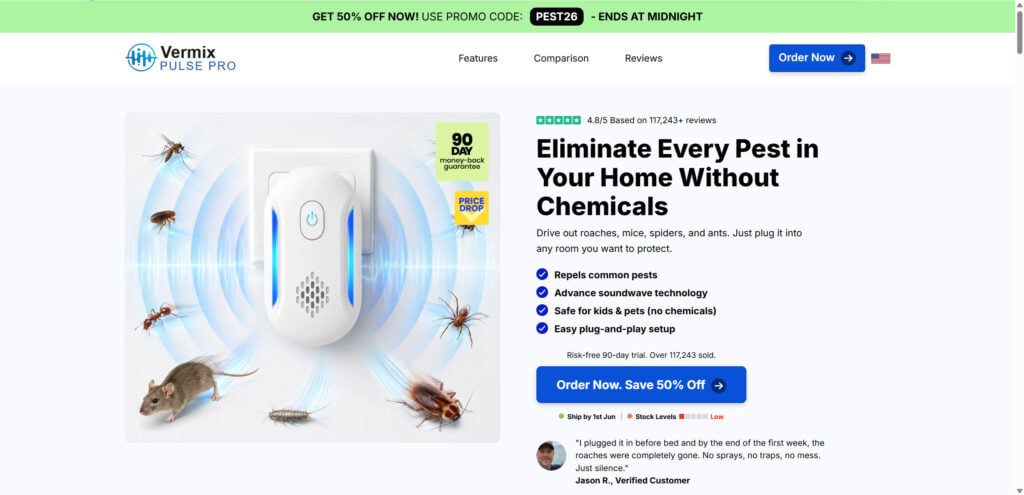
Vermix Pulse Pro Overview
Vermix Pulse Pro is marketed as a chemical-free electronic pest control device. The sales pages claim it uses ultrasonic pulses, electromagnetic waves, and “bionic frequency” patterns to make a home uncomfortable for pests.
The device is presented as a simple plug-and-play solution. You plug it into a wall outlet, leave it running, and the device supposedly sends signals through the home to disturb pests hiding inside walls, under floors, behind appliances, and inside cabinets.
The marketing claims include:
- Chemical-free pest control
- No sprays, traps, poison, or messy cleanup
- Silent operation for humans
- Safe around children and common pets
- Coverage up to 1,600 square feet
- Protection against mice, rats, roaches, ants, spiders, mosquitoes, bed bugs, fleas, moths, and silverfish
- Results within days or weeks
- A 30-day or 90-day money-back guarantee, depending on the sales page
- Heavy discounts such as 70% off
- Multi-unit pricing for 2, 3, 4, or 5 units
The problem is not that pest problems are fake. Pest infestations are real and stressful. The concern is the way Vermix Pulse Pro is being sold.
A plug-in device advertised as replacing pest control, traps, and sprays should be treated with caution. Ultrasonic pest repellers have a long history of questionable advertising, inconsistent performance, and exaggerated claims. Many consumers buy them because they want a clean, easy solution, but pests are rarely solved by one cheap plug-in device.
Why Vermix Pulse Pro Raises Red Flags
1. The claims sound too broad
Vermix Pulse Pro is promoted for a long list of pests: mice, rats, roaches, ants, spiders, mosquitoes, bed bugs, fleas, moths, and silverfish.
That is a red flag by itself.
Different pests behave differently. Rodents, roaches, ants, bed bugs, mosquitoes, and spiders do not all respond to the same control method. A device that claims to deter almost everything in the home should have strong, independent evidence behind it.
The sales pages make it sound like one plug-in device can reach hidden areas, disrupt pest behavior, and make the entire home less attractive. That may sound convenient, but it is not how serious pest control usually works.
Real pest management depends on identifying the pest, finding entry points, removing food and water sources, sealing gaps, using traps or bait when appropriate, and sometimes hiring a licensed professional.
2. Ultrasonic pest repellers have a weak evidence history
Ultrasonic pest repellers have been marketed for decades. The pitch is always similar: pests hear or sense the frequency, become uncomfortable, and leave.
The issue is that real-world results are inconsistent. Some pests may react temporarily, some may adapt, and some may not respond at all. Sound can also be blocked or weakened by furniture, walls, appliances, carpets, boxes, and room layout.
This is especially important for claims that the device reaches “inside walls” or hidden nesting areas. Those claims sound powerful, but they are difficult for a normal buyer to verify.
3. “Electromagnetic wall penetration” is a common marketing hook
Vermix Pulse Pro claims to use electromagnetic pulses through a home’s wiring to reach hidden pests.
This type of claim has appeared in older electronic pest control advertising before. It sounds more advanced than a basic ultrasonic device, but buyers should ask for real proof.
Questions buyers should ask:
- Has this exact product been independently tested?
- Which pests were tested?
- Was the test done in real homes or controlled lab conditions?
- How long did the effect last?
- Did pests leave permanently or simply move elsewhere?
- Were infestations eliminated or just reduced?
- Does the device work through walls, furniture, and multiple rooms?
- Is the 1,600 square foot coverage claim independently verified?
Without clear answers, this is marketing language, not proof.
4. The product appears to be sold on multiple sites
Vermix Pulse Pro appears across multiple web pages and promotional assets, including Onninest-branded pages, Vermix-branded pages, and marketplace-style listings.
This matters because legitimate brands usually have a clear official website, clear company identity, consistent refund terms, and consistent pricing. Dropshipping-style products often appear on multiple funnels with slightly different offers, claims, prices, and guarantee wording.
When the same product appears through different websites or landing pages, buyers should be careful. It may be a generic product being promoted through affiliate funnels rather than a unique invention from a trusted pest-control company.
5. Similar devices are very cheap from Chinese suppliers
Ultrasonic plug-in pest repellers are widely available from wholesale suppliers and marketplaces. Many are sold for only a few dollars per unit, especially in bulk.
This does not automatically mean Vermix Pulse Pro is fake. But it does suggest the product category is generic and easy to private-label.
The dropshipping pattern is simple:
- A seller sources a cheap ultrasonic pest repeller.
- The device is renamed with a premium-sounding brand.
- A landing page is built around exaggerated claims.
- Social media ads push the product as a breakthrough.
- The product is sold at a much higher price.
- Buyers may receive a generic device that looks similar to cheaper units elsewhere.
The risk is that customers pay premium prices for something that may be nearly identical to low-cost pest repellers sold on Alibaba, Amazon, Temu, AliExpress, or other marketplaces.
6. The discounts may be inflated
Some Vermix Pulse Pro pages show regular prices near $199.96 per unit, then advertise a discounted price such as $29.99 or $49.99.
That type of large discount is common in direct-response ecommerce. The “regular price” may be inflated to make the current offer look urgent and valuable.
Buyers should not judge the product by the crossed-out price. They should compare similar plug-in ultrasonic pest repellers from multiple sellers and check whether the hardware appears identical.
7. Multi-unit offers create a risk of over-ordering
Vermix Pulse Pro is promoted with volume pricing for multiple units. Some pages list options for 2, 3, 4, or 5 devices. Other pages encourage buyers to place one unit in each room or cover larger homes with several units.
That structure creates a risk. Buyers may intend to buy one unit but end up buying several because of preselected bundles, “best value” offers, checkout upsells, or confusing quantity options.
This is a common complaint pattern with dropshipping funnels. The buyer thinks they are buying one item, then later sees a higher charge or receives multiple units.
Before paying, buyers should screenshot the cart and checkout page showing:
- Exact quantity
- Final total
- Shipping cost
- Tax
- Any selected bundle
- Any post-purchase upsell
- Whether the order is one-time or recurring
8. Returns may be difficult or effectively impossible
Some sales pages promote a money-back guarantee, but the actual return experience may be harder than expected.
The promotional material connected to Vermix Pulse Pro states that return shipping costs are the responsibility of the buyer. That means if someone buys multiple units and the product does not work, they may need to pay shipping to return the order.
For cheap generic electronics, return shipping and tracking can make the refund feel pointless. Buyers may also face conditions such as contacting support first, getting approval, shipping within a return window, returning all packaging, or proving the product was defective.
This is why “money-back guarantee” should not be treated as proof that the purchase is risk-free.
How the Vermix Pulse Pro Sales Funnel Appears to Work
Step 1: The ad targets pest anxiety
Pest problems create immediate stress. People do not want roaches in the kitchen, mice in the attic, ants in the pantry, or spiders near children.
The ad usually presents a clean, simple solution: plug in the device and let it work silently.
This is emotionally effective because it avoids everything people hate about pest control:
- Smelly sprays
- Dead pests
- Poison bait
- Sticky traps
- Expensive exterminators
- Messy cleanup
- Safety concerns around kids and pets
The product is sold as an easy escape from all of that.
Step 2: The device is made to sound advanced
Instead of saying it is a basic ultrasonic pest repeller, the page describes a triple-signal system using ultrasonic, electromagnetic, and bionic frequencies.
That makes the product sound more advanced than the common plug-in pest repellers already sold everywhere.
But buyers should not confuse technical-sounding language with verified performance. A product can use impressive terms and still fail to solve an infestation.
Step 3: The page claims hidden-area coverage
The marketing says Vermix Pulse Pro can reach deep cracks, crevices, walls, floors, cabinets, and hidden nesting spaces.
This is one of the strongest claims and one of the hardest to verify.
If pests are nesting in walls, behind cabinets, under floors, or in crawl spaces, a homeowner usually needs inspection, sealing, sanitation, traps, bait, or professional treatment. A plug-in repeller may not reach or affect those areas in a reliable way.
Step 4: The price is framed as a limited-time deal
The pages use large discounts, “70% off,” “stock limited,” and urgent sale language.
This is designed to make people buy before comparing prices. If buyers slow down, they may find similar devices for much less.
Step 5: Buyers are pushed toward multiple units
Because the pages claim one device covers a large area but also recommend multiple units for rooms or bigger homes, buyers may feel they need several.
That increases the order value and also increases refund risk. If the product does not work, the buyer now has multiple devices to return.
Step 6: The device may arrive, but results may disappoint
Some buyers may receive a real plug-in device. That does not mean the claims are true.
The likely disappointment is not that nothing arrives. The more common issue is that the product arrives but does not remove the pest problem as advertised.
Possible outcomes include:
- Pests continue appearing
- Roaches or rodents adapt quickly
- Ants or bed bugs are not affected
- The device only works in the immediate room
- It does not penetrate walls as implied
- The buyer realizes similar devices are much cheaper elsewhere
- The return process becomes frustrating
Main Red Flags
- Promoted with broad claims against many unrelated pests.
- Uses “ultrasonic,” “electromagnetic,” and “bionic frequency” language.
- Claims to reach inside walls, floors, and hidden nesting spaces.
- Advertised as a chemical-free alternative to traps, sprays, and exterminators.
- Sold through multiple websites and promotional pages.
- Similar plug-in pest repellers are widely available from low-cost Chinese suppliers.
- Heavy discounts such as 70% off may be inflated.
- Multi-unit pricing increases the risk of ordering more than intended.
- Return shipping may be the buyer’s responsibility.
- Refunds may be difficult if the product does not perform as expected.
- Onninest reviews show mixed feedback around product expectations and order issues.
- Ultrasonic pest repellers have a long history of disputed effectiveness.
Is Vermix Pulse Pro a Scam?
Vermix Pulse Pro may ship a physical plug-in pest repeller, so this may not be a simple “pay and receive nothing” scam.
The bigger issue is whether the product is being oversold.
A fair conclusion is this: Vermix Pulse Pro appears to be a high-risk dropshipping-style pest repeller offer because it combines exaggerated pest-control claims, generic product signals, multiple sales pages, inflated discount marketing, multi-unit upsells, and return terms that may make refunds difficult.
Buyers should not expect a cheap plug-in device to eliminate an active infestation or replace professional pest control.
It may be used as a minor add-on in a broader pest management plan, but it should not be treated as a guaranteed solution for roaches, mice, bed bugs, ants, mosquitoes, or hidden infestations.
Why You Should Be Careful With Plug-In Pest Repeller Claims
Pest problems are rarely solved by one device. If you have roaches, rodents, bed bugs, or ants, the real solution usually starts with identifying the pest and understanding why it is there.
For example:
- Roaches need food, water, and hiding spaces.
- Mice enter through small gaps and need exclusion.
- Ants follow scent trails and may have colonies outside.
- Bed bugs require targeted inspection and treatment.
- Mosquitoes breed around standing water.
- Spiders often appear where other insects are present.
A plug-in device does not remove food sources, seal entry points, eliminate nests, remove eggs, kill bed bugs, block rodent holes, or sanitize infested areas.
That is why buyers should be skeptical of any ad implying that one plug-in unit can make all pests disappear.
What To Do Before Buying
1. Compare the product with generic alternatives
Search for:
- ultrasonic pest repeller plug in
- electromagnetic pest repeller
- bionic ultrasonic pest repeller
- plug-in mouse repellent
- ultrasonic roach repeller
- OEM ultrasonic pest repeller
If similar devices appear for a few dollars each, that is a sign you may be looking at a marked-up generic product.
2. Avoid multi-unit bundles
Do not buy 3, 4, or 5 units before testing one. If the device does not work, you will have more money tied up and a harder return process.
3. Screenshot the checkout page
Before paying, save screenshots showing:
- quantity
- price per unit
- total price
- shipping
- taxes
- selected bundle
- guarantee terms
- return policy
- whether any upsell was added
This helps if you need to dispute the charge.
4. Read the return policy carefully
Do not rely only on “money-back guarantee” language. Confirm:
- who pays return shipping
- where the return must be sent
- whether all units must be unused
- whether packaging is required
- how long the return window lasts
- whether a restocking fee applies
- whether refunds include shipping
5. Do not use this as your only pest-control method
If you have an active infestation, use proven steps:
- seal entry points
- remove food sources
- store food in sealed containers
- reduce moisture
- clean grease and crumbs
- use traps or bait correctly
- inspect hidden spaces
- call a licensed pest-control professional for serious infestations
What To Do If You Already Ordered
1. Check the order confirmation
Confirm how many units you were charged for. Look for:
- quantity
- bundle selection
- final price
- shipping cost
- merchant name
- any post-purchase upsells
- any subscription or recurring billing language
2. Cancel quickly if the order is wrong
If you ordered more than intended, contact support immediately. Use written communication so you have proof.
3. Save all evidence
Save screenshots of:
- the ad
- product page
- claims
- checkout page
- receipt
- refund policy
- tracking information
- support emails
4. Test the device carefully
Check whether the unit works, whether it makes noise, whether it heats up, whether it has proper labeling, and whether it looks like the product advertised.
Do not assume the device is effective just because a light turns on.
5. Do not wait too long
If pests are still active and the return window is short, do not wait until the deadline passes. Ask for return instructions early.
6. Dispute if necessary
Contact your bank, credit card issuer, or PayPal if:
- you were charged for more units than ordered
- the product never arrives
- the device is not as advertised
- the seller refuses a valid return
- the refund process is unreasonable
- an unwanted subscription or repeat charge appears
Use clear wording such as:
- “item not as described”
- “misleading advertising”
- “unauthorized quantity charged”
- “seller refuses refund”
- “product did not match advertised claims”
FAQ
What is Vermix Pulse Pro?
Vermix Pulse Pro is a plug-in electronic pest repeller marketed as a chemical-free way to deter pests using ultrasonic, electromagnetic, and bionic frequency signals.
Is Vermix Pulse Pro a scam?
It may ship a real device, but the offer has several red flags: exaggerated pest-control claims, generic product signals, multiple sales pages, heavy discounts, multi-unit upsells, and refund friction.
Does Vermix Pulse Pro really eliminate pests?
Be cautious. Ultrasonic pest repellers have mixed and often weak real-world evidence. They should not be relied on as the only solution for infestations.
Is Vermix Pulse Pro from China?
The exact sourcing may not be clear from every sales page, but similar plug-in ultrasonic pest repellers are widely available from Chinese suppliers at very low wholesale prices. This raises a generic dropshipping risk.
Why are multiple units promoted?
The seller recommends multiple units for larger homes, separate rooms, and better coverage. This can increase the total order value and may lead some buyers to purchase more than they intended.
Can buyers receive more units than ordered?
That is a risk with bundle-based ecommerce funnels. Buyers should check the final cart and payment screen carefully before submitting payment.
Are returns easy?
Not necessarily. Promotional pages may advertise a guarantee, but return shipping may be the buyer’s responsibility, and refund eligibility may depend on support approval and return conditions.
Is it safe around pets?
The sales pages claim the device is safe around common household pets, but households with sensitive animals such as rabbits, hamsters, guinea pigs, birds, reptiles, or specialty pets should be cautious and consult a veterinarian if unsure.
Should I use Vermix Pulse Pro for bed bugs?
Do not rely on a plug-in ultrasonic device for bed bugs. Bed bugs usually require targeted inspection and treatment.
Should I buy Vermix Pulse Pro?
Be cautious. Compare similar devices, avoid bundles, read the return terms, and do not treat it as a replacement for proven pest-control methods.
The Bottom Line
Vermix Pulse Pro is marketed as a simple plug-in pest repeller that can make pests leave your home without chemicals, traps, or exterminators. The offer sounds convenient, but it carries several warning signs.
The biggest concerns are exaggerated claims, questionable ultrasonic pest-repeller effectiveness, generic Chinese-supplier product signals, multiple sales pages, inflated discount marketing, multi-unit upsells, and return terms that may make refunds difficult.
If you have a serious pest problem, do not rely on a viral plug-in device as your main solution. Compare prices, avoid multi-unit bundles, document everything, and use proven pest-control methods.
10 SEO Titles
- Vermix Pulse Pro Review: Scam or Legit Pest Repeller?
- Vermix Pulse Pro Scam? Buyer Warning Before Ordering
- Is Vermix Pulse Pro Legit or a Dropshipping Pest Repeller?
- Vermix Pulse Pro Exposed: Generic Ultrasonic Device?
- Vermix Pulse Pro Review: Claims, Returns, and Red Flags
- Vermix Pulse Pro Pest Repeller Scam Warning
- Onninest Vermix Pulse Pro Review: What Buyers Should Know
- Vermix Pulse Pro Refund and Multi-Unit Order Risks
- Vermix Pulse Pro Ultrasonic Repeller: Does It Really Work?
- Vermix Pulse Pro: Read This Before You Buy

Join the discussion
0 commentsShare your experience or ask a question about this article.
Discussion
Start the conversation
Have a question or something useful to share? Add the first comment.