

Blazara is being promoted online as a powerful “next generation” windproof lighter that can create fire in rain, snow, wind, and harsh outdoor conditions. The ads frame it as a rugged survival tool for camping, hiking, grilling, emergencies, and everyday use.
But before ordering, buyers should look closely at the claims, the advertorial-style sales page, the generic product category, the multi-unit buying pressure, and the refund risks. This appears to follow the same dropshipping-style gadget pattern seen with similar lighters: exaggerated survival claims, inflated discounts, generic sourcing, confusing product descriptions, and returns that may be difficult or not worth pursuing.
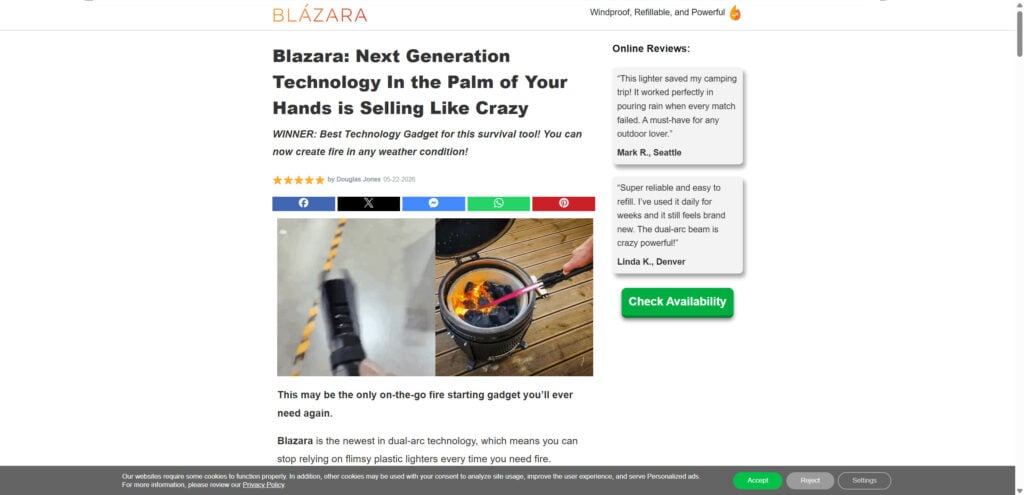
Blazara Lighter Overview
Blazara is marketed as a “dual-arc torch lighter” and a “best technology gadget” for people who need reliable fire in any weather condition. The sales page claims it is windproof, waterproof, refillable, lightweight, durable, and powerful enough to ignite flammable material in harsh outdoor environments.
The product is promoted with bold claims such as:
- Creates fire in any weather condition
- Works in rain, snow, wind, and cold
- Uses “dual-arc technology”
- Has a powerful adjustable flame
- Reaches up to 1300 degrees
- Creates a flame up to 10 cm
- Has a “military-grade exterior”
- Has a waterproof case
- Is “windproof in hurricanes and severe weather”
- Has supposedly sold over 1.5 million units
- Comes with a 70% discount
- Includes a 90-day money-back guarantee
That pitch sounds impressive. But it also raises multiple red flags.
A lighter can be useful. A refillable butane torch lighter can be wind-resistant and practical for grills, candles, campfires, and outdoor activities. But that does not mean Blazara is a unique survival breakthrough. Many similar butane torch lighters are sold across Amazon, Alibaba, AliExpress, Temu, and other marketplaces, often at much lower prices.
The concern is not whether a physical lighter may arrive. The concern is whether buyers are paying a high markup for a generic imported lighter promoted with exaggerated claims and affiliate-style advertising.
Why Blazara Raises Red Flags
1. The page is an advertorial, not an independent review
The Blazara page is written like a product review. It includes a named author, star rating, customer quotes, bold claims, and a strong recommendation to buy.
But the bottom of the page discloses that it is an advertisement, not an actual news article, blog, or consumer protection update. It also says the site has a monetary connection to the product and receives payment when qualified leads are referred.
That matters.
The page is designed to look like an independent recommendation, but it is part of a sales funnel. Buyers should not treat the article-style layout as unbiased testing or journalism.
2. The marketing uses exaggerated survival language
Blazara is not simply sold as a lighter. It is sold as a serious outdoor survival tool that can supposedly work in extreme rain, wind, snow, and cold.
The page even claims it is “windproof in hurricanes and severe weather.”
That is an aggressive claim for a small consumer lighter. Even if the flame is more wind-resistant than a normal disposable lighter, buyers should be skeptical of language that makes it sound nearly unstoppable in extreme conditions.
Survival-style copy is common in dropshipping gadget funnels because it makes a simple item feel essential.
3. The product description is confusing
The page calls Blazara a “dual-arc” lighter but also says it is butane refillable and has an adjustable jet flame.
That is confusing because a plasma arc lighter and a butane torch lighter are usually different product types.
A plasma arc lighter uses electricity to create an arc. A butane torch lighter uses fuel to create a flame. Some hybrid-style lighters may use an electric ignition system to ignite butane, but the sales page should explain this clearly.
Instead, the wording appears to blend “dual-arc,” “torch,” “butane,” and “adjustable flame” language in a way that may make the product sound more advanced than it really is.
4. Similar lighters are widely available
The basic design appears similar to many windproof butane torch lighters already sold online. These products often include:
- Refillable butane tank
- Visible gas window
- Safety lock
- Adjustable jet flame
- Wind-resistant flame
- Outdoor/camping branding
- Long flame shape
- Tactical-looking shell
That means Blazara may not be a unique invention. It may be a generic lighter promoted under a branded name.
This is a common dropshipping pattern:
- A low-cost product is sourced from a supplier.
- A premium-sounding brand name is created.
- A sales page presents it as a new breakthrough.
- Ads drive traffic to the page.
- Buyers pay more than the product may be worth.
- Returns become difficult or impractical.
5. The discount may be inflated
The page says Blazara retails for $79.98 or $99.99, then promotes a 70% discount where buyers can get it for $31.99.
This type of crossed-out pricing is common in direct-response ecommerce. The “retail price” may be inflated to make the discount look much larger than it really is.
Buyers should not judge value based on the claimed regular price. They should compare similar torch lighters by image, features, material, safety lock, flame type, and actual customer reviews.
6. The site pushes buyers to buy multiple lighters
The page encourages people to keep a second Blazara in the car, a third at home, and another in a bag.
This is not subtle. It is a multi-unit sales tactic.
Many dropshipping funnels push customers toward buying several units because the product cost is low and the seller wants to increase the order value. The risk is that buyers may order more than they need or be pushed into a larger package through checkout upsells.
For these offers, one of the biggest buyer complaints is receiving more units than expected or being charged more than expected.
7. Returns may be difficult in practice
The page promotes a 90-day money-back guarantee, but the same page also says the advertorial site is not responsible for product returns, product support, or shipping. It tells customers to contact the provider of the goods directly.
That creates a trust issue.
The page aggressively promotes the product, but distances itself from responsibility once the sale is made. If the product arrives late, arrives defective, does not match expectations, or proves to be a cheap generic lighter, the buyer may need to deal with a separate provider or support channel.
In dropshipping-style offers, returns are often difficult because:
- The seller may delay responses.
- Return shipping may be paid by the customer.
- The return address may be overseas.
- The item may need to be unused.
- Shipping and handling may not be refunded.
- Tracking may be required.
- The refund may cost more effort than the product is worth.
That is why “90-day guarantee” does not automatically mean the purchase is risk-free.
How the Blazara Sales Funnel Appears to Work
Step 1: The ad creates an emergency-use scenario
The pitch starts by making normal lighters seem unreliable. It talks about plastic lighters failing, running out of fuel, or not working in rain and wind.
This creates a problem the product can solve: you need a stronger, tougher, more reliable lighter.
Step 2: The product is framed as advanced technology
The sales page calls Blazara “next generation technology” and describes it as a dual-arc torch lighter.
This makes the product feel more technical than a standard refillable butane lighter.
The average buyer may not stop to ask whether “dual-arc” and “butane torch” are being used accurately. The terminology simply makes the product sound modern and powerful.
Step 3: The page uses trust signals
The advertorial includes a 5-star rating, a named author, customer testimonials, and statements like “selling like crazy” and “thousands of Americans have ordered theirs.”
These signals are designed to reduce buyer skepticism. But on a sales page, these elements are not the same as verified independent reviews.
Step 4: The page creates urgency
The product is promoted with a 70% discount, claims that it is selling fast, and “if it’s still available” language.
This pushes people to buy quickly instead of comparing similar lighters elsewhere.
Step 5: Buyers may be sent to a separate checkout
The page uses tracking links and refers buyers to the “official website” or provider page. This is common in affiliate marketing funnels.
The first page does the selling. The checkout or provider page collects payment. If problems happen later, responsibility may be unclear.
Step 6: The buyer may receive a generic lighter
Some buyers may receive a real torch lighter. That does not prove the claims were fair.
The likely issue is value and expectation. A buyer may think they are getting a premium survival gadget, but receive a basic butane lighter similar to lower-priced products sold elsewhere.
Step 7: Refunds may become frustrating
If the product is not what the buyer expected, the refund process may not be simple. The sales page itself says the advertorial site is not responsible for returns or support.
That means buyers may need to chase the actual seller, deal with return rules, and pay shipping costs.
For a low-cost lighter, many customers may simply give up.
Main Red Flags
- The website is an advertisement, not an independent review.
- The page says it has a monetary connection to the product.
- The page says it is not responsible for returns, support, or shipping.
- The product is promoted with exaggerated survival claims.
- “Windproof in hurricanes” is an unrealistic-sounding claim.
- The page mixes “dual-arc” and butane torch lighter language.
- Similar butane torch lighters are widely sold online.
- The crossed-out pricing and 70% discount may be inflated.
- The page encourages buyers to purchase multiple units.
- Buyers risk receiving more units than intended through bundles or upsells.
- Returns may be difficult or impractical.
- Similar products appear on Amazon and wholesale supplier platforms.
- This may be a generic imported lighter sold at a markup.
Is Blazara a Scam?
Blazara may ship a real lighter, so this may not be a simple “pay and receive nothing” scam in every case.
The bigger issue is whether the product is being oversold.
A fair conclusion is this: Blazara appears to be a high-risk dropshipping-style lighter offer because it combines advertorial marketing, exaggerated survival claims, confusing technical wording, generic product signals, multi-unit sales pressure, and refund risks.
The product may work as a basic refillable torch lighter. But buyers should not assume it is a unique, military-grade, hurricane-proof survival device.
If you want a windproof torch lighter, compare similar products from known retailers first. You may find similar items for less, with clearer return terms and better buyer protection.
Safety Concerns Buyers Should Consider
Lighters are fire-producing products. Even a small torch lighter can cause burns, ignite clothing, damage surfaces, or start a fire if used carelessly.
Before using any imported torch lighter, check for:
- Proper safety lock
- Clear instructions
- Butane refill warnings
- Flame adjustment instructions
- Manufacturer or importer labeling
- Child-resistant design
- Fuel leak warnings
- Compliance markings
- Packaging warnings
- Automatic shut-off or safe operation controls
Do not store a butane lighter in a hot car. Do not leave it near children. Do not overfill it. Do not point it at your face, hands, clothing, pets, or flammable materials.
If the lighter smells strongly of gas, leaks, will not shut off, sparks incorrectly, overheats, or feels unsafe, stop using it.
What To Do Before Buying
1. Compare similar lighters
Search for:
- refillable butane torch lighter
- windproof camping lighter
- lightsaber torch lighter
- waterproof torch lighter
- adjustable flame butane lighter
- Blazara lighter alternative
Compare the shape, safety lock, flame type, gas window, and price. If the same or similar product is much cheaper elsewhere, that is a strong warning sign.
2. Do not trust the discount alone
A 70% discount does not prove value. Crossed-out prices are often used to make cheap products look premium.
3. Avoid multi-unit packages
Do not buy several lighters before testing one. If the product is generic, defective, or disappointing, a bundle only increases the loss.
4. Screenshot the checkout
Before paying, save screenshots showing:
- selected quantity
- final price
- shipping cost
- discount
- refund terms
- guarantee wording
- any upsell
- any recurring or refill language
This helps if you need to dispute the charge later.
5. Use a payment method with buyer protection
Use a credit card or PayPal. Avoid debit cards or payment methods that make disputes harder.
What To Do If You Already Ordered
1. Check your confirmation email
Confirm:
- how many units were ordered
- total amount charged
- shipping and handling fees
- merchant name
- expected delivery date
- whether any upsells were added
2. Save all evidence
Save screenshots of:
- the ad
- product page
- claims
- checkout page
- order confirmation
- tracking information
- refund policy
- support emails
3. Inspect the lighter before use
Check whether it matches the ad. Look for:
- fuel leaks
- missing safety lock
- weak construction
- missing instructions
- unclear labeling
- defective ignition
- flame control problems
- overheating
Do not use it if it appears unsafe.
4. Keep the packaging
If a return is possible, the seller may require original packaging.
5. Contact support in writing
If the product is not as advertised or you received more units than expected, ask for a refund in writing. Request:
- cancellation if not shipped
- refund if misrepresented
- cancellation of any upsell or recurring charge
- return address
- prepaid return label
- written confirmation that no future charges will occur
6. Dispute if needed
Contact your bank, card issuer, or PayPal if:
- you were charged for more units than ordered
- the product never arrives
- the product is not as advertised
- the lighter is defective or unsafe
- the seller refuses a reasonable refund
- the return process is unreasonable
Use clear wording such as:
- “item not as described”
- “misleading advertising”
- “unauthorized quantity charged”
- “defective product”
- “merchant refuses refund”
FAQ
What is Blazara?
Blazara is promoted as a refillable windproof torch lighter for camping, survival, grilling, and outdoor use.
Is Blazara a scam?
It may ship a real lighter, but the offer has several dropshipping-style red flags: advertorial marketing, exaggerated claims, generic product signals, multi-unit pressure, and difficult return risks.
Is Blazara really waterproof and windproof?
The sales page makes strong claims about rain, wind, snow, and harsh conditions. Buyers should treat those claims cautiously unless the exact product has independent testing.
Is Blazara a plasma lighter or butane lighter?
The page uses “dual-arc” language but also says the lighter is butane refillable and has an adjustable jet flame. Buyers should verify the exact technology before ordering.
Is Blazara made in China?
The sales page does not clearly prove the product’s manufacturing origin. However, similar butane torch lighters are widely available from Chinese wholesale suppliers, which supports the generic dropshipping risk.
Can buyers receive more units than ordered?
That is a risk with these direct-response funnels, especially when the sales page encourages buying multiple lighters and checkout pages use bundle offers or upsells.
Are returns easy?
Not necessarily. The advertorial page says it is not responsible for returns, product support, or shipping, and tells buyers to contact the provider directly.
Is Blazara worth $31.99?
Maybe not. Similar torch lighters appear on major marketplaces and supplier sites. Buyers should compare prices before ordering.
Is a torch lighter safe?
Only if it is properly designed, labeled, and used carefully. Fire-producing products can cause burns, fires, and injury. Keep them away from children and flammable materials.
Should I buy Blazara?
Be cautious. Compare similar lighters first, avoid multi-unit bundles, screenshot checkout terms, and use a payment method with buyer protection.
The Bottom Line
Blazara is marketed as a rugged next-generation lighter that can create fire in almost any weather. The product may work as a basic refillable torch lighter, but the offer has several warning signs.
The biggest concerns are the advertorial-style sales page, exaggerated weatherproof and survival claims, confusing “dual-arc” versus butane torch wording, generic product signals, multi-unit sales pressure, and return risks.
Blazara may not be a complete fake, but it appears to be a high-risk dropshipping-style gadget offer. Buyers should compare alternatives, avoid rushed purchases, and be careful before ordering through social media ads or affiliate sales pages.

Join the discussion
0 commentsShare your experience or ask a question about this article.
Discussion
Start the conversation
Have a question or something useful to share? Add the first comment.