

CoolMate is being promoted as a compact 2-in-1 wall-mounted air conditioner and heater that claims to cool rooms in summer, warm them in winter, and reduce energy use with advanced “silicon” technology.
But before ordering, buyers should look carefully at the claims, the product design, the price, the return policy, and the fact that very similar wall-mounted heater/fan units appear on wholesale marketplaces for a fraction of the advertised retail price. This appears to follow the same dropshipping pattern seen with many viral home gadgets: exaggerated heating and cooling claims, generic Chinese product sourcing, inflated discounts, multi-unit upsells, and return terms that may make refunds difficult.
CoolMate Overview
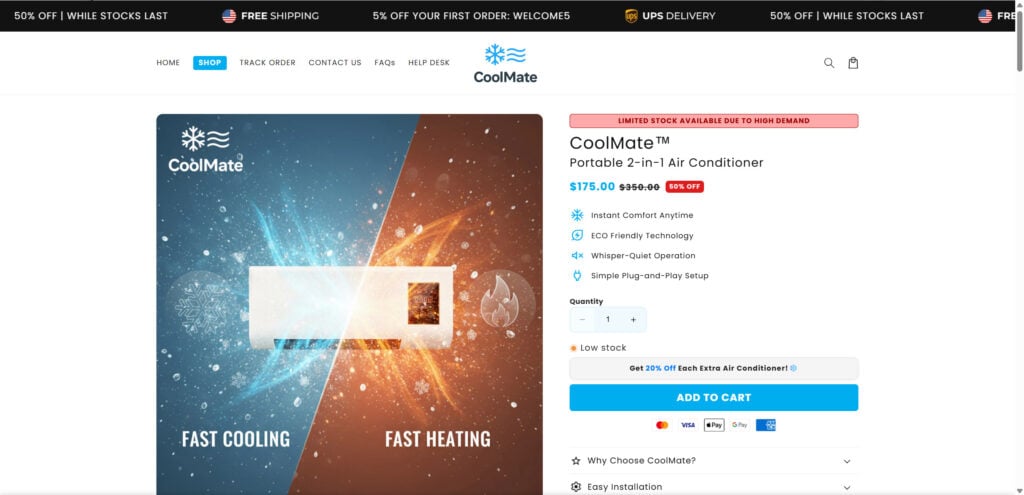
CoolMate is sold through CoolMateUSA.com as a “Portable 2-in-1 Air Conditioner & Heater.” The website describes it as a compact wall-mounted device that can deliver instant heating and cooling, adjust room temperature in seconds, and provide year-round comfort.
The marketing claims include:
- 2-in-1 cooling and heating
- Instant comfort in 3 seconds
- 1800W high-efficiency power
- Up to 98% electric conversion
- Save up to 50% on energy
- Wall-mounted, plug-and-play design
- Quiet operation
- Smart temperature control
- Suitable for bedrooms, offices, living rooms, bathrooms, dorms, and small spaces
- Free delivery
- Sale price of $175, down from a claimed $350
- Extra discounts when buying more than one unit
At first glance, the offer sounds convenient. A small device that cools in summer, heats in winter, saves energy, and costs far less than a real HVAC unit is attractive.
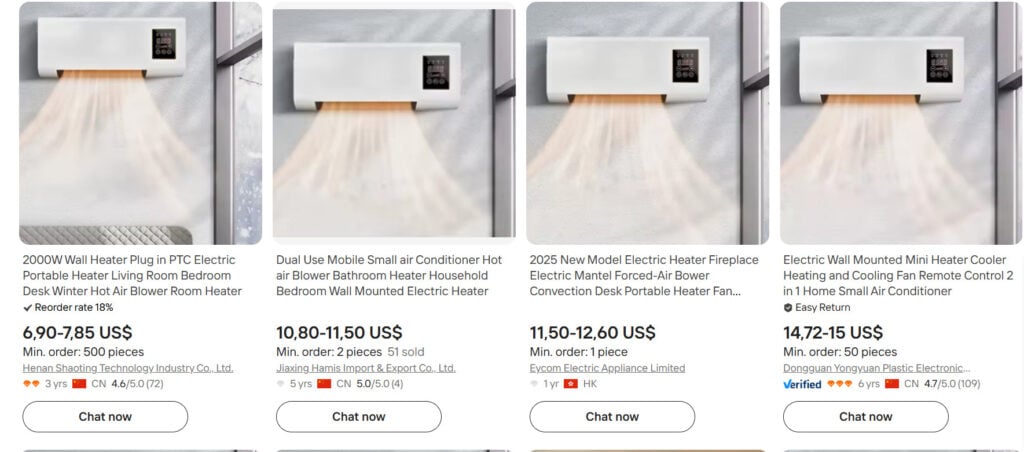
The problem is that the product shown looks very similar to generic wall-mounted PTC heater/fan units sold on Alibaba and other supplier marketplaces. The screenshot provided shows similar-looking units listed for roughly $6.90 to $15 per unit, depending on supplier, minimum order quantity, and configuration.
That does not automatically prove CoolMate is fake. But it does raise a serious value question. If the same type of hardware is available at wholesale prices under $20, then a $175 retail price with a claimed $350 regular price should be treated with caution.
Why CoolMate Raises Red Flags
1. The “air conditioner” claim is questionable
CoolMate is advertised as a 2-in-1 air conditioner and heater. But based on the product design, buyers should ask a basic question: is this a real air conditioner, or just a heater with a fan?
A real air conditioner normally needs a compressor, refrigerant system, condenser, evaporator, exhaust/heat rejection path, or heat-pump components. A small wall-mounted plastic unit with a fan and heating element cannot cool a room like a real AC unless it has a genuine refrigeration or heat-pump system.
The page uses language like “advanced silicon heating and cooling technology,” but buyers should look for real technical specifications, such as:
- Cooling BTU rating
- Refrigerant type
- Compressor details
- Heat pump function
- EER or SEER rating
- Airflow output
- Noise rating
- Certification marks
- Safety approvals
- Manufacturer identity
If those details are missing or vague, the “air conditioner” claim may simply mean it blows air, not that it actively lowers room temperature like an AC unit.
2. The “saves up to 50% energy” claim is suspicious
CoolMate claims high-efficiency performance and up to 98% electric conversion. That may sound impressive, but electric resistance heaters are already close to 100% efficient at turning electricity into heat.
That means a small electric heater cannot magically produce much more heat from the same electricity than another ordinary electric resistance heater. It can heat a small area efficiently if used instead of heating an entire home, but it does not create free energy.
The “save up to 50%” angle is commonly used in viral heater ads. The usual trick is not that the device is uniquely efficient. The savings, if any, come from heating only one small room instead of using central heating everywhere.
That is not the same as the device being revolutionary.
3. The product looks like a generic Alibaba-style heater
The screenshot you provided shows very similar wall-mounted heater/cooler-style products listed on Alibaba for low wholesale prices.
The product images match the same general design:
- White wall-mounted body
- Black digital control panel on the right
- Air outlet on the bottom
- Warm airflow graphic
- Similar product positioning as a mini heater or hot/cold blower
- Chinese suppliers offering low per-unit costs
This is a classic dropshipping sign. A generic product is sourced cheaply, renamed with a premium-sounding brand, placed on a polished Shopify-style website, then advertised with large discounts and exaggerated claims.
The final buyer may receive a real product, but not necessarily a premium appliance worth the advertised price.
4. The claimed discount may be inflated
CoolMate is shown at $175, reduced from a claimed $350 regular price.
That type of crossed-out pricing is common in dropshipping stores. It makes the product feel like a limited-time bargain, even when similar items can be found elsewhere for far less.
The important question is not what the website says the product “normally” costs. The important question is whether the same or similar unit is available from other sellers for much less.
When a product that looks like a $10–$20 wholesale heater is sold for $175, buyers should slow down.
5. Multi-unit discounts increase the risk of over-ordering
The site promotes extra discounts for each additional air conditioner. This is a common upsell tactic.
Instead of buying one unit, customers may be pushed to buy two, three, or more for bedrooms, offices, bathrooms, or family members.
That increases the seller’s order value and increases the buyer’s risk. If the product does not cool as expected, is cheaply made, arrives damaged, or has safety concerns, the customer is now stuck trying to return multiple units.
With dropshipping-style products, buyers may also accidentally order more units than intended through cart offers, checkout upsells, or “add another and save” prompts.
6. Returns may be difficult
CoolMate’s return policy allows returns only for unused and undamaged items within 14 days of receipt. Return requests must be submitted by email, returns need approval, and customers are responsible for return shipping. Original handling and shipping costs are non-refundable, even if the customer paid for shipping.
That is not a generous return policy for a product buyers need to test.
A customer usually cannot know whether a heater/cooler works well until they open it, plug it in, and try it in a real room. But if the product must be unused and undamaged, refund eligibility may be limited.
The policy also says defective, damaged, or incorrectly shipped items must be reported within 7 days and require clear photos or videos.
That creates practical risk. If the product disappoints after use, or if the buyer misses the short reporting window, getting money back may be difficult.
7. Cheap heating gadgets can pose safety risks
Any device that plugs into the wall and uses 1800W of power should be treated carefully. That is a high power draw for a small appliance.
The issue is not just whether CoolMate warms a room. The issue is whether the device is properly designed, certified, labeled, and tested.
Cheap online heaters have repeatedly raised safety concerns in consumer testing. Some mini heaters sold online have failed safety tests, with reported risks including fire, electric shock, burns, overheating, poor build quality, and unsafe internal components.
This does not prove CoolMate itself is unsafe. But it does mean buyers should be careful with any generic-looking heater sold through aggressive ads, especially if the seller does not clearly show recognized safety certifications and manufacturer details.
How the CoolMate Sales Funnel Appears to Work
Step 1: The ad sells year-round comfort
The marketing starts with a simple promise: stop switching between heaters and air conditioners. Buy one small unit that handles both summer and winter.
This is effective because many people want a cheap solution for bedrooms, offices, dorms, garages, or small apartments.
The product is framed as convenient, portable, efficient, and easy to install.
Step 2: The page uses technical-sounding language
CoolMate claims “advanced silicon heating and cooling technology” and “ECO 1800W performance.”
This makes the product sound more advanced than a basic fan heater. But without clear technical data, those phrases are mostly marketing language.
Buyers should not confuse “silicon technology” with real compressor-based cooling or heat-pump performance.
Step 3: The product is positioned as an energy saver
The page claims up to 98% electric conversion and energy savings.
This is a common heating-gadget tactic. The seller makes the product sound more efficient than ordinary heating, even though electric resistance heating already converts nearly all electricity into heat at the point of use.
A small heater may reduce bills only if it allows you to heat one small room instead of the whole home. It is not automatically cheaper if you run it for long periods or use multiple units.
Step 4: The buyer sees a large discount
The product is presented as 50% off, with a regular price of $350 and a sale price of $175.
This creates urgency and makes the buyer feel they are getting a premium appliance for less.
But if similar units are available from Chinese suppliers for under $20, the discount becomes much less convincing.
Step 5: The store encourages extra units
The cart and site messaging encourage buying more than one unit. That is common in dropshipping funnels because the seller wants to increase the average order value.
The buyer may think: one for the bedroom, one for the office, one for the bathroom.
But if the product is generic or underperforms, buying multiple units makes the refund problem larger.
Step 6: Returns become the buyer’s problem
If the product does not cool the room, feels cheap, makes noise, heats poorly, or fails after use, the buyer may discover the return policy is restrictive.
Returns require approval. The item must be unused and undamaged. The customer pays return shipping. Shipping and handling are not refunded.
That makes the advertised offer much less risk-free than it may appear.
Main Red Flags
- Marketed as a 2-in-1 air conditioner and heater, but the design appears closer to a fan/heater unit.
- No clear evidence of real compressor-based air conditioning.
- Claims cooling and heating in seconds.
- Claims 1800W high-efficiency performance.
- Claims up to 98% electric conversion and up to 50% energy savings.
- Similar-looking units appear on Alibaba for roughly $6.90 to $15 wholesale.
- Sold at $175 with a claimed $350 regular price.
- Extra-unit discounts encourage multi-unit orders.
- Return policy allows only 14 days and unused/undamaged items.
- Customers are responsible for return shipping.
- Original handling and shipping costs are non-refundable.
- Defect claims must be reported within 7 days with photos or videos.
- Cheap mini heaters sold online have documented safety concerns in consumer testing.
- The product may be a generic Chinese dropshipping item sold at a high markup.
Is CoolMate a Scam?
CoolMate may ship a physical product, so this may not be a simple “pay and receive nothing” scam.
The bigger issue is whether the product is being oversold.
A fair conclusion is this: CoolMate appears to be a high-risk dropshipping-style heater/fan offer because it combines exaggerated heating and cooling claims, questionable “air conditioner” positioning, inflated pricing, generic product signals, multi-unit upsells, and restrictive return terms.
The product may work as a small electric heater or fan. But buyers should not assume it will cool a room like a real air conditioner, save 50% on energy, or perform like a premium HVAC appliance.
Why the Cooling Claim Matters
Calling a product an “air conditioner” creates a strong expectation.
A real air conditioner removes heat from a room and transfers it elsewhere. That requires a refrigeration cycle, heat pump system, or some other meaningful heat-removal process.
A fan can make skin feel cooler by moving air, but it does not lower room temperature. A heater/fan combo may blow warm air in winter and unheated air in summer, but that is not the same as air conditioning.
This is why buyers should demand clear technical data before buying any small “portable AC” or “2-in-1 heater and cooler” promoted through social media ads.
If a product does not list BTU output, refrigerant specs, compressor information, exhaust requirements, or real cooling capacity, treat “air conditioner” as a marketing claim until proven otherwise.
What To Do Before Buying
1. Compare the product image with wholesale listings
Search for similar terms:
- wall mounted PTC heater
- mini wall heater with remote
- hot and cold air blower wall mounted
- 2000W wall heater plug in
- portable wall mounted electric heater
- mini air conditioner heater wall mounted
If the same-looking product appears for a fraction of the price, that is a major warning sign.
2. Ask for real cooling specifications
Before buying, ask the seller:
- What is the BTU cooling capacity?
- Does it use a compressor?
- Does it use refrigerant?
- Is it a real air conditioner or just a fan?
- What is the airflow rating?
- What safety certifications does it have?
- Who manufactures it?
- Where is it made?
- What is the return address?
If the seller cannot answer clearly, do not buy.
3. Do not buy multiple units first
Avoid bundle deals and extra-unit discounts until you test one unit. If it does not perform as expected, returning several units may be expensive or impossible.
4. Read the return policy carefully
Do not rely on “easy returns” language. Check:
- return window
- unused condition requirement
- who pays return shipping
- whether shipping and handling are refunded
- whether approval is required
- defect reporting deadline
- return address location
5. Use a payment method with buyer protection
Use a credit card or PayPal. Avoid debit cards if you are unsure about the seller.
What To Do If You Already Ordered
1. Check your order confirmation
Confirm:
- how many units were ordered
- total amount charged
- shipping cost
- merchant name
- delivery estimate
- whether any upsell was added
2. Save all evidence
Save screenshots of:
- the product page
- heating/cooling claims
- energy-saving claims
- checkout page
- order confirmation
- return policy
- tracking page
- support emails
3. Inspect the unit before extended use
Check for:
- damaged packaging
- missing instructions
- lack of safety labels
- strange smell
- overheating
- loose plug
- rattling parts
- weak airflow
- no real cooling effect
- incorrect voltage
- missing remote or accessories
Do not use the product if it appears unsafe.
4. Report defects immediately
CoolMate’s policy requires defective or damaged items to be reported within 7 days. If there is a problem, email support quickly with photos or videos.
5. Do not assume you can return it after testing
The return policy requires unused and undamaged condition. If you are unsure whether you want to keep it, avoid damaging packaging and document everything.
6. Dispute if necessary
Contact your bank, credit card company, or PayPal if:
- you were charged for more units than ordered
- the product never arrives
- the product is not as advertised
- the seller refuses a valid refund
- the device is unsafe or defective
- the return process is unreasonable
Use clear wording such as:
- “item not as described”
- “misleading cooling claims”
- “unauthorized quantity charged”
- “defective product”
- “merchant refuses refund”
FAQ
What is CoolMate?
CoolMate is marketed as a portable 2-in-1 air conditioner and heater that can warm or cool a room using a compact wall-mounted design.
Is CoolMate a real air conditioner?
Be cautious. The product appears more like a wall-mounted heater/fan unit. Unless the seller provides clear BTU, compressor, refrigerant, or heat-pump specifications, buyers should not assume it cools like a real air conditioner.
Is CoolMate a scam?
CoolMate may ship a real product, but the offer has multiple dropshipping-style red flags: exaggerated claims, generic product signals, inflated pricing, multi-unit upsells, and restrictive return terms.
Is CoolMate from China?
The CoolMate website may not clearly disclose manufacturing origin, but the screenshot provided shows very similar wall-mounted heater/fan units listed by Chinese suppliers at low wholesale prices.
Why is the $175 price concerning?
Similar-looking units in the provided Alibaba screenshot are listed for roughly $6.90 to $15 wholesale. That suggests CoolMate may be a low-cost generic product sold at a high markup.
Can CoolMate save 50% on energy?
Be skeptical. Electric resistance heaters already convert nearly all electricity into heat. Savings may only happen if you use a small heater in one room instead of heating a larger space.
Are returns easy?
Not necessarily. CoolMate’s policy says returns must be unused and undamaged, requested within 14 days, approved by the company, and shipped back at the customer’s expense.
Can buyers receive multiple units by mistake?
That is a risk with stores that promote extra-unit discounts, bundles, or checkout upsells. Always check the cart and final total before paying.
Is CoolMate safe?
Do not assume. Any 1800W heater should have clear safety certifications and instructions. Cheap online heaters have had documented fire and electric shock risks in consumer testing, so inspect the unit carefully.
Should I buy CoolMate?
Be cautious. Compare similar products first, ask for real cooling specs and safety certifications, avoid multi-unit bundles, and use a payment method with buyer protection.
The Bottom Line
CoolMate is marketed as a compact 2-in-1 air conditioner and heater that promises fast comfort, energy savings, and year-round use. The offer sounds convenient, but it carries several warning signs.
The biggest concerns are the questionable “air conditioner” claim, the energy-saving language, the generic Alibaba-style product appearance, the large retail markup, the extra-unit sales push, and the restrictive return policy.
CoolMate may work as a small heater or fan, but buyers should not expect it to perform like a real air conditioner or a premium HVAC system. Compare alternatives, avoid rushed purchases, and be careful with any high-wattage heater sold through social media-style ads.

Join the discussion
2 commentsShare your experience or ask a question about this article.
Discussion
received my unit today had instruction for a220volt unit. Nothing for a120 volt unit there for I am returning for full refund. the unit I received was 120 volt with no instruction
In reply to lecroy billy s.
A 120 volt unit shipped with instructions for a 220 volt one tells you where it came from and how little checking happens in between – the same box is sent everywhere and whichever leaflet is nearest gets dropped in. It also matters for safety: do not improvise with an appliance whose actual rating you cannot confirm, and if the plate on the unit and the paperwork disagree, treat the paperwork as worthless.
On the refund, be careful how you go about it. Do not post it back at your own expense to whatever address is on the parcel – ask for a written return authorisation and a prepaid label with tracking, and if they will not provide one, ring your card issuer and dispute the charge as not as described. Missing and incorrect documentation is a solid basis for that, and you generally have up to 120 days. Do not accept a partial refund to keep the unit, since agreeing to one makes a chargeback harder.
Missing or wrong safety documentation on a mains appliance is also worth reporting to the CPSC at saferproducts.gov.