

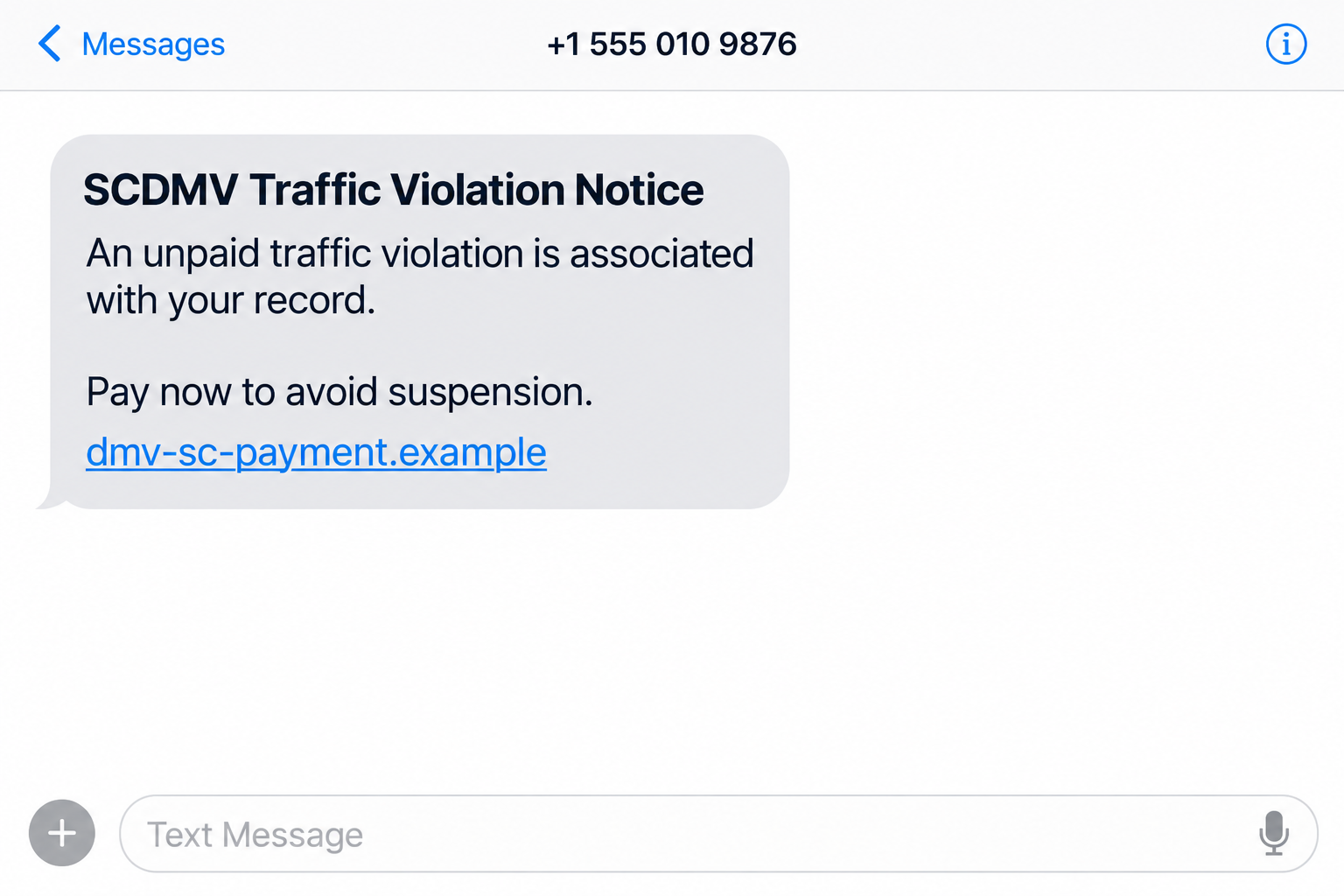
An SCDMV traffic-violation text says your driving privileges are at risk. There is a payment link, a deadline, and just enough official language to interrupt your day.
If losing your license would disrupt work or family life, that message can be hard to set aside. Start by checking the collection claim behind the threat.
Overview
The text ties an alleged debt to your license
The SCDMV traffic violation text scam impersonates South Carolina’s Department of Motor Vehicles. It claims a traffic ticket or toll requires urgent payment to prevent suspension.
The agency has warned that it does not use texts to collect unpaid traffic tickets or toll violations. These collection threats are not an approved payment service.
The real SCDMV can handle genuine driving-record matters. The scam abuses that recognizable role to make a stranger’s payment instructions seem authoritative.
The correct website changed in 2026
SCDMV’s current public website is dmv.sc.gov. The agency announced its move to that address for January 5, 2026.
Its older SCDMVOnline.com address was scheduled to redirect during 2026. Old guidance naming that former address does not authorize a new collection text.
The lead image is a fictional illustration of the tactic, not an actual agency text or a working payment destination.
The link is not the place to settle uncertainty
A recipient may genuinely wonder about a ticket. The safe response is to reach the appropriate office independently, not enter a card to find out more.
- Do not pay through an unexpected SCDMV collection message.
- Check licensing questions on the current official agency website.
- Verify a real citation with the court or office responsible for it.
- Report exposed payment details to your issuer even if the page showed an error.
Actual notices and account services should be evaluated on their own facts. This warning concerns the impersonation demand, not every online South Carolina government transaction.
Why the Suspension Threat Is So Effective
The message does not need to convince you that a ticket is serious in the abstract. It only needs to make you picture tomorrow without a valid license.
That picture can turn a questionable link into something that feels practical. Paying may seem quicker than working out whether a mistake has occurred.
The sender also benefits from unfamiliarity with government responsibilities. Many drivers do not routinely distinguish the DMV, a court, and a toll billing office.
The text puts them into one story: an unpaid charge, a driving record, and a button that supposedly prevents consequences.
The story may fit together, but the payment still needs checking. Find out who actually issued the obligation and where that office keeps its records.
If the message arrives while you are renewing a registration or dealing with a real ticket, coincidence can make it feel timely. Keep those activities separate.
How the SCDMV Traffic Violation Text Scam Works
Step 1: An unfamiliar sender claims an unpaid violation exists
The message uses SCDMV’s name and says something on your record remains unpaid. It may refer to a traffic violation or a toll.
You are being asked to accept the debt before you have verified the sender. A reference number printed in a text does not solve that problem.
Even a familiar-looking sender label can be misleading. Judge the request through independent agency information rather than assuming a display name establishes identity.
A message sent to your telephone does not prove that the agency selected you. Nor does it establish that the sender obtained confidential driving records.
Step 2: A deadline makes license trouble seem imminent
The threat links immediate payment with continued driving privileges. Waiting appears risky, while following the link is presented as the easy way to stay compliant.
SCDMV’s warnings specifically describe these urgent payment and suspension claims. The pressure is part of the deception, not a reason to lower your checks.
Do not let the countdown decide which office you contact. The organization responsible for a genuine matter can explain its actual status through an independently located route.
If the text tells you not to call or insists that only its link can help, that instruction makes independent verification more important.
Step 3: A lookalike link imitates a familiar agency address
The agency says scam messages can include links imitating its address and webpage. A believable label may therefore be part of the trap rather than reassurance.
Read the actual destination, not just a button saying “SCDMV.” A link can display familiar words while sending the browser somewhere unrelated.
Do not decide authenticity from the first few characters. The difference between an official host and a longer lookalike address can be easy to miss.
The simplest check does not require opening it: leave the message and type the current agency address yourself. Use the services linked there.
A padlock on an unfamiliar destination means the connection is encrypted. It does not identify the recipient of your card information as a government agency.
Step 4: The supposed payment process requests valuable details
A page may use the debt story to ask for a card, billing address, or personal information. Each detail can be valuable beyond the displayed payment.
Do not supply a second card because the first appears to fail. An error message does not prove that the information you entered was never received.
Similarly, a payment receipt generated by the page cannot establish that a South Carolina agency credited your account. Confirm through the actual issuer of the obligation.
If the page asks you to install software, share your screen, or provide a banking code, stop. None of those requests authenticates the collection claim.
Step 5: Anxiety can keep you responding after the first interaction
A later message may insist you still owe money or must correct information. Once you have started, completing the process can feel easier than admitting uncertainty.
Pause before another payment. Check your own bank records and reach the real office through its website, instead of using the sender’s support contact.
The documented warnings do not prove that every version uses the same page or follow-up sequence. Protect what you actually exposed rather than chasing a template.
Most importantly, do not interpret another threat as confirmation of the first. Several messages from the same unknown source remain one unverified source.
Checking SCDMV Information Without Using the Text
Use the current government address
The change to dmv.sc.gov is relevant because older articles and saved instructions may still refer to SCDMVOnline.com. The agency announced the transition publicly.
A page claiming the move requires a card-verification payment deserves no special trust. Navigate to the current site independently and follow its own instructions.
Do not assume that every service provider linked by a government agency must share its domain. Confirm the route from the official site before supplying information.
Keep a ticket inquiry separate from a driving-record inquiry
If you have a genuine citation, use the issuing court’s or authority’s independently verified instructions. Ask about the specific citation number, balance, and options.
If your concern is an actual license-status question, use SCDMV’s official services or published contact route. A stranger’s collection link should handle neither inquiry.
Do not pay an alleged ticket simply to protect yourself from a hypothetical suspension. Establish that the obligation belongs to you and that the recipient is authorized.
Do not build a rule from one warning sign
Out-of-state numbers, spelling errors, and odd formatting can raise doubts. A carefully written message from a local-looking number still needs the same independent check.
Likewise, knowing your name does not establish official access. Personal details can circulate through many channels, and the text alone does not reveal their origin.
Focus on the collection demand and verification route. You do not need to identify the criminal, hosting company, or technology used before refusing an unsafe payment.
What to Do if You Have Fallen Victim to This Scam
-
Save a clear account of the interaction. Capture the text and any visible payment information you already have, then stop communicating with the sender.
Record which details you entered and whether you approved a payment or authentication request. Avoid including complete passwords in a written incident summary.
Keep original receipts for your provider. When warning friends, remove private data and avoid forwarding the functioning link.
-
Ask your bank or issuer to protect exposed payment details. Use its official app or a number from a genuine statement.
Explain the SCDMV impersonation and whether the page accepted, rejected, or repeatedly requested your card. Request guidance on replacement and transaction monitoring.
Report any unfamiliar charge and ask about the applicable dispute process. If you approved a transfer, describe that accurately and inquire about possible recovery.
-
Secure accounts and documents that were involved. Change any submitted password on the real account and stop reusing it on other services.
Check account access and recovery options for unauthorized changes. If you disclosed a verification code, notify the provider whose message supplied it.
If identity information was exposed, consult IdentityTheft.gov for tailored recovery steps. A name alone and a complete identity document are different exposures.
-
Find out whether a real driving issue exists. Open the official SCDMV website for licensing questions, or locate the actual authority handling a known citation.
Ask about the verified record rather than whether a screenshot “looks real.” Keep any genuine deadline in view while the financial fraud is investigated.
If no legitimate obligation is confirmed, do not return to the sender for a second opinion. Their own explanation cannot independently validate their demand.
-
Check software and browser changes if relevant. Close the destination and review any application, extension, or notification permission you added during the interaction.
Malwarebytes can help examine a device after suspicious software installation. A scan is not necessary merely because a text reached your inbox.
Additional web filtering, such as AdGuard, may block some deceptive ads or destinations. It cannot verify a court debt or reimburse a transfer.
Do not hire a stranger offering to clean your phone and restore your license remotely. Use support you independently selected.
-
Report the fraud, then remove the lure. SCDMV recommends reporting spam texts to your carrier by forwarding them to 7726.
You can also describe the incident through the FTC’s fraud reporting service. Include the claimed agency, visible destination, sender, and payment details where appropriate.
After keeping needed records, block the sender and delete the text. Treat an unsolicited refund offer as a new contact to verify, not automatic help.
If the Text Arrives During a Real Renewal
Someone renewing a registration may expect government messages and overlook the switch in subject. Read whether the text actually concerns the service you requested.
A renewal you started through the official website does not authorize a separate traffic-fine demand. Use your existing session or independently opened account to check progress.
If you recently changed address, verify the change through the normal agency process. Do not send a replacement address or identity document through the suspicious link.
For a household with several drivers, agree on who handles verified notices. That reduces the chance of two people paying the same unfamiliar demand out of concern.
Save genuine renewal receipts separately from suspicious messages. When asking for help, clearly identify which transaction you started and which request arrived without warning.
If you use a shared email address for vehicle paperwork, tell other users about the suspicious approach. Ask them not to submit another card while you investigate.
Bank alerts can help you spot an unexpected charge, but they do not authenticate the original website. Keep monitoring tied to financial protection, not reassurance about the text.
If the message involves a work vehicle, pass the saved notice to the responsible administrator. Keep company payment details out of an unverified text conversation.
Frequently Asked Questions
Does SCDMV send texts collecting overdue tickets or toll violations?
The agency says it does not use text messages for that collection. Do not follow an unexpected payment demand threatening suspension.
What is SCDMV’s current official website?
The current address is dmv.sc.gov. SCDMV announced its January 2026 move, with the former SCDMVOnline.com address scheduled to redirect during 2026.
Is a familiar-looking SCDMV webpage enough to trust a payment?
No. Scam links can imitate the agency’s address and design. Reach the genuine website independently instead of trusting a page supplied by the message.
Can this scam actually suspend my license?
A stranger’s text does not establish your license status. Check a genuine status concern directly with SCDMV and handle any verified matter through official instructions.
What should I do if I paid but received no receipt?
Contact your financial provider with the transaction information you have. Lack of a receipt does not prove the payment failed or the card information remained private.
Should I respond to ask which ticket the text concerns?
No. Asking the sender keeps verification within the same untrusted conversation. Locate the appropriate office yourself and ask about the actual record.
The Bottom Line
Do not pay an SCDMV traffic-violation text to avoid a threatened suspension. The agency has rejected this collection method; check real matters through official channels.
If the message already obtained money or card details, contact your issuer promptly. Then address any genuine ticket separately with the office that actually handles it.

Join the discussion
0 commentsShare your experience or ask a question about this article.
Discussion
Start the conversation
Have a question or something useful to share? Add the first comment.