

A news-style article says JPS is opening an investment opportunity for Jamaicans. A video makes the announcement feel bigger, and a registration link seems to offer a way in.
For anyone hoping to put savings to work, a familiar company name is a powerful introduction. What matters is who is waiting behind that registration link.
Overview
The pitch borrows Jamaica Public Service’s identity
The fake JPS investment program scam presents an investment opportunity as though it comes from Jamaica Public Service, the real electricity company.
JPS has warned about a fraudulent news article and video making that claim. The company says the purported program is false and it is not requesting investment money.
This is an impersonation warning, not an accusation that JPS is operating the offer. Keeping that distinction clear matters when deciding whom to contact.
A supposed announcement leads toward registration and money
The dangerous step is treating the article’s link, contact form, or person answering inquiries as an authorized investment channel.
The company’s own warning advises against following associated links, completing forms, disclosing personal or financial information, or sending money.
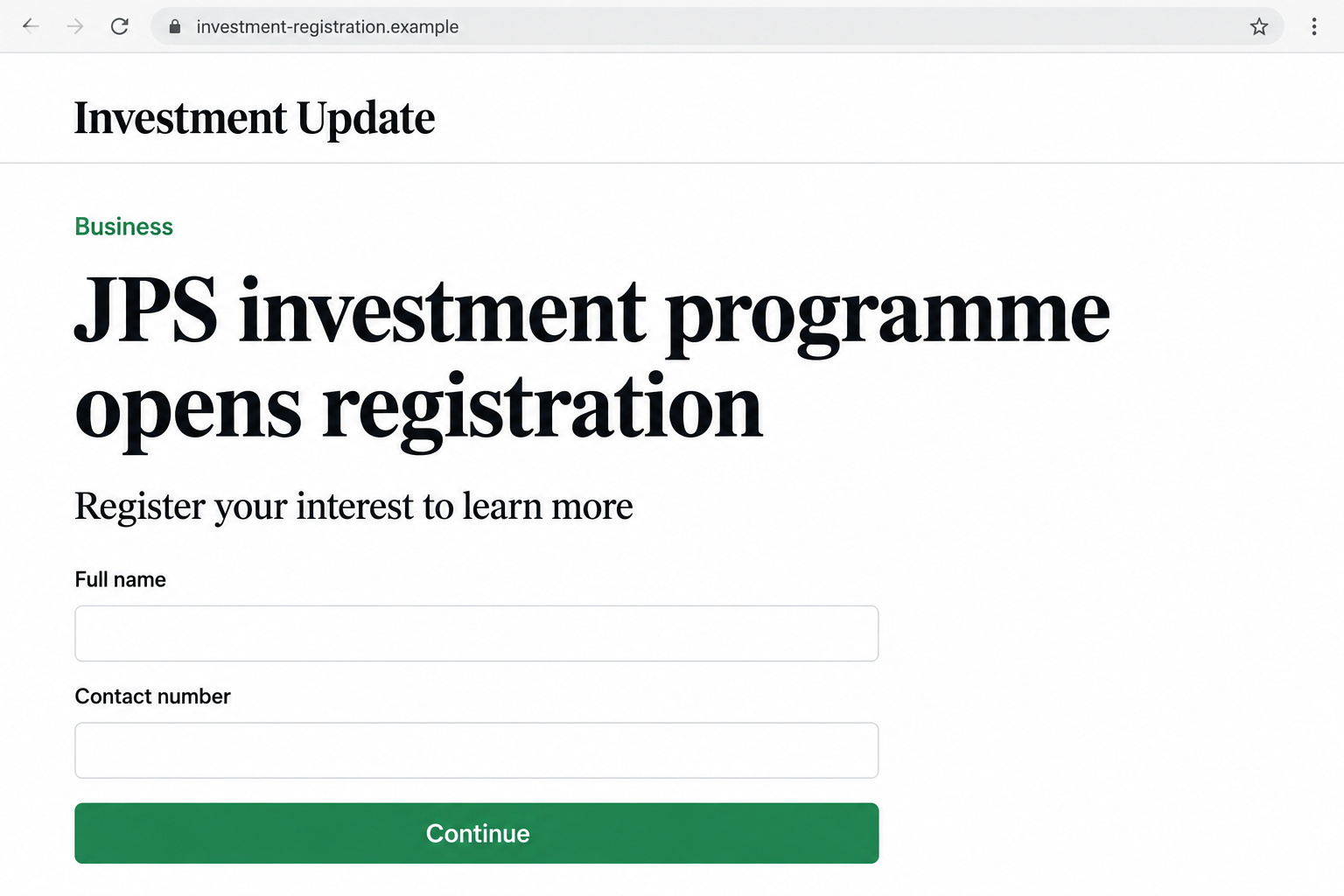
The image above illustrates a registration lure. It is not an original JPS announcement, a captured investment website, or evidence of a particular payment arrangement.
The offer needs independent confirmation, not a more convincing sales pitch
A polished presentation cannot overcome the company’s denial. Do not fund this supposed program because a page, video, or caller insists places are available.
- Leave the promotional page before checking the claim.
- Find JPS announcements through its independently accessed official website.
- Do not submit identity documents to unlock investment information.
- Contact your financial provider promptly if you already sent funds.
The warning does not identify every operator, destination, or transaction method. A different website address does not make the same unauthorized JPS claim trustworthy.
Why the JPS Name Makes the Story Persuasive
An unfamiliar investment business has to explain itself. A name people recognize from an essential household service can feel as though that explanation has already happened.
You may know JPS as a customer, recognize its branding, or have relatives who deal with it. None of that establishes a separate investment invitation.
The sales pitch benefits when you transfer trust from the utility to the person controlling the registration page. Those are not automatically the same organization.
News-style formatting adds another layer. A headline and video may appear to report an announcement rather than sell something, making the promotion feel independently checked.
But a page can describe itself as news while steering every interested reader toward the same form. Editorial appearance is not a substitute for authentic publication.
The concern is not simply whether the promised return sounds too generous. Even a restrained proposal is unsafe when the named company says it did not launch it.
How the Fake JPS Investment Program Scam Works
Step 1: A supposed business announcement catches your attention
The documented lure is a fake article and video claiming JPS has introduced an investment program. That gives the offer a story before it asks for money.
A reader may encounter a shared link or a forwarded clip rather than the original page. A trusted friend sharing it does not authenticate the underlying announcement.
Someone can pass along a pitch because they genuinely hope it will help others. Their good intentions do not establish where the pitch originated.
Before sharing it further, look for the actual announcement on JPS’s own channels. Do not rely on a screenshot of a headline without its publication context.
Step 2: Familiar branding is used to supply credibility
The investment claim attaches itself to a recognizable company. That can make a stranger’s instructions feel like an extension of an established relationship.
A logo, business vocabulary, or apparently professional video is easy to mistake for authorization. The company must independently confirm the program, not merely resemble its presentation.
Do not assume a speaker authorized the use of their likeness or words. The confirmed warning does not require identifying a particular editing method or video technology.
Whether footage is altered, miscaptioned, or simply used in a misleading setting, the practical question remains who is actually inviting and receiving the investment.
Step 3: Interest becomes a request for contact details
A registration form can feel harmless compared with a payment. You may think you are only asking for information and can decide later.
Yet submitting a name, telephone number, or email address gives the person behind the offer a direct route to you.
A subsequent caller may already know the program you viewed. That knowledge can sound like proof of an organized company when it merely follows your form submission.
Do not send identification, banking records, or account screenshots to prove you qualify. Verification documents are valuable information, not a reasonable entry fee for an unconfirmed offer.
The exact fields may differ between versions. The illustrated form demonstrates this risk without claiming that every circulated page uses those same fields.
Step 4: The supposed opportunity becomes a funding decision
The company warning describes a pitch that asks people to invest money. At that point, the false association is being used to justify a financial transfer.
Before any genuine investment, you should know the legal recipient, the product, the risks, the documents governing it, and the applicable regulatory position.
A payment account, receipt, or professionally written agreement does not by itself supply those missing answers. Do not confuse a working transfer method with an authorized investment.
If the recipient differs from the company named in the advertisement, stop and ask why through independent channels. Do not accept an unsolicited salesperson’s explanation as confirmation.
The warning does not prove one universal deposit amount, payment rail, or promised yield. Avoid using a mismatch with another version as reassurance.
Step 5: Further requests can deepen the loss
After money has gone, a person may feel pressure to keep cooperating so the first transfer is not wasted. That is a dangerous place to make another decision.
If someone asks for a release payment, tax, verification transfer, or upgrade to recover funds, treat that as a fresh demand requiring independent scrutiny.
These are possible follow-up risks, not confirmed steps in every JPS impersonation. Do not send an additional payment merely because a dashboard displays a balance.
A number on a website is not proof that funds are invested, withdrawable, or held by JPS. Your provider’s actual transaction record is more useful during recovery.
How to Separate the Utility from the Impersonator
Check the announcement outside the promotional journey
Open JPS’s official website independently and look for company news. Its warning also identifies @myjpsonline as an official social-media handle.
Do not navigate through a link labeled “official confirmation” inside the investment page. That lets the promoter choose both the claim and the supposed verification.
A repost containing the real company’s name is still a repost. Check whether the account, website, and announcement actually belong to the company.
Keep bill payment and investment money separate
A genuine electricity account or bill-payment portal does not validate an unrelated investment form. The purpose of a transaction matters as much as a familiar brand.
Do not add investment money to a utility payment or send customer-account details to a salesperson who claims that ownership must be confirmed.
If you have a separate billing question, handle it through the usual official customer-service route. Do not let the investment contact take over that conversation.
Ask about the actual investment, not just the logo
For any different, genuine financial proposal, independently check the provider and product with the relevant Jamaican financial regulator before committing money.
Find the regulator yourself, rather than accepting a certificate image or registration link supplied by a promoter. Company registration alone is not investment authorization.
That general check does not rescue this particular pitch: JPS has already rejected the supposed program. There is no reason to complete its onboarding to investigate further.
What to Do if You Have Fallen Victim to This Scam
-
Stop new transfers and preserve your records. Keep the article address, messages, account names, receipts, and any instructions about where money was sent.
Write down amounts and currencies exactly as shown in your own records. Do not convert them from memory or confuse a quoted amount with a completed transfer.
You can save existing communications without logging back into a suspicious platform. Avoid uploading further documents to keep the account supposedly active.
-
Contact the institution that handled the payment. Tell your bank, card issuer, or transfer provider that an investment offer impersonated JPS.
Ask promptly whether a transfer can be stopped, recalled, traced, or disputed. Supply the beneficiary details and transaction references you actually used.
Do not describe a transfer you approved as an unrecognized card purchase. Accurate facts help the provider choose the correct process, although recovery is not guaranteed.
-
Protect accounts linked to information you disclosed. If you shared a password, change it through the genuine service and replace matching passwords elsewhere.
If you gave away an authentication code, tell the affected provider. Review recent access, linked devices, recovery contacts, and unfamiliar financial activity.
For uploaded identity documents, ask the issuing authority about misuse reporting and appropriate protective steps. The response should match the document and your jurisdiction.
-
Notify the real company and local authorities. Find contact information independently on the official JPS website and explain how its identity was used.
Report a financial loss to the police and provide your transaction evidence. Ask your financial institution which fraud-reporting channels apply to the payment.
Do not send complete banking credentials or unnecessary identity documents to a social-media account offering to take a report on JPS’s behalf.
-
Check your device if the pitch led to software. Remove unfamiliar browser permissions and inspect downloads if you followed a registration or investment link.
If you installed an application or remote-access tool, end that access and consider a trusted security check, including Malwarebytes where appropriate.
AdGuard may help filter some deceptive advertising. Filtering cannot authenticate an investment or return money already sent.
No software installation is established for every version of this pitch. A suspicious article alone is not evidence that your device has been compromised.
-
Warn affected contacts without spreading the lure. If you forwarded the opportunity, tell recipients the company has denied it and advise them not to register.
Share the official warning instead of the promotional link. Remove other people’s names and financial details from anything you post publicly.
Reject strangers promising guaranteed recovery for an upfront fee. Real case updates should come through the institutions and authorities you independently contacted.
If You Have Only Registered Your Interest
You can stop without paying. You do not owe a promoter money merely because you completed a form or listened to a presentation.
Be ready for calls that refer to your application. A caller knowing your name or the program title is not independent proof of employment by JPS.
Do not read banking codes aloud, share your screen, or move a conversation to a different app to complete supposed eligibility checks.
Keep a short record of contacts and block persistent approaches. If threats or harassment begin, include those messages when speaking to the appropriate authorities.
If you used only a contact email and telephone number, focus on suspicious follow-up messages. Replacing every account or device is not automatically necessary.
Keep essential household money outside the conversation. Do not borrow from relatives or send an electricity-bill payment to a promoter while trying to rescue an earlier transfer.
If you discussed the opportunity with a family member, tell them you have stopped. They should not respond to someone claiming you authorized another payment.
Frequently Asked Questions
Is JPS offering the investment program in the circulating article?
JPS says the purported program is false and it is not requesting money for it. Do not invest through the article, video, or associated registration channel.
Does this warning mean Jamaica Public Service is a scam?
No. The real utility is warning that its identity is being misused. The accusation concerns the unauthorized investment promotion, not ordinary JPS services.
Can a professional video prove the offer is approved?
No. Presentation quality does not establish authorization. Check the underlying announcement with the company independently rather than relying on a clip, logo, or testimonial.
What if a friend has already registered?
Registration does not validate the program. Encourage your friend to stop before sending money, protect shared information, and read the company’s own warning.
Should I pay a fee to withdraw a displayed investment balance?
Do not send more money to the impersonator. Save the demand and contact your payment provider about the transfers that actually occurred.
Can a security scan recover my investment?
No. A scan can help investigate unwanted software after relevant exposure. Financial recovery requires dealing with the payment provider and authorities, without any guaranteed outcome.
The Bottom Line
Do not put money into the fake JPS investment program. The company whose name makes the offer persuasive has explicitly denied launching it.
If you already paid, stop further transfers and contact your financial provider with the real transaction records. Share the official warning, not the registration link.

Join the discussion
0 commentsShare your experience or ask a question about this article.
Discussion
Start the conversation
Have a question or something useful to share? Add the first comment.