

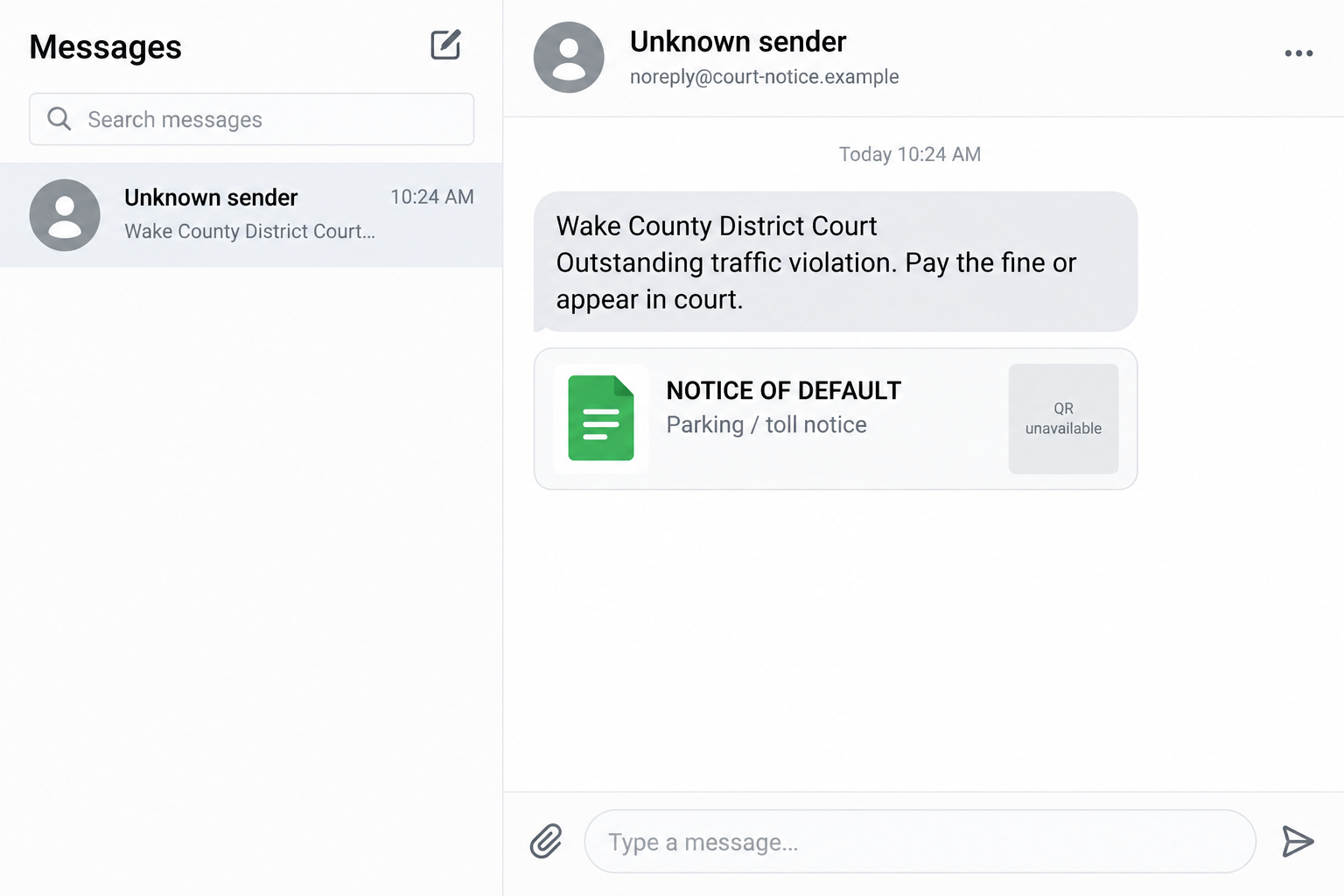
A message mentions Wake County District Court and an overdue traffic violation. Then an attached notice asks you to choose between paying and appearing in court.
Before rearranging your day or reaching for a card, take a closer look at how that notice reached you and where it wants you to go.
Overview
A parking or toll problem becomes a court threat
The Wake County District Court scam uses an alleged unpaid traffic matter to make an unexpected message feel like something you cannot safely ignore.
A payment demand arrives wrapped in courtroom language. The alternative sounds worse: appear before a judge or face penalties for failing to respond.
The North Carolina Judicial Branch has specifically warned Wake residents about this impersonation. Its warning concerns fraudulent parking and toll notices, not a new court payment service.
Personal details make the demand harder to dismiss
The judicial warning explains that scammers may already have your name and address. They may also borrow real officials’ names and recognizable local places.
Those details can make the document feel personal without making its payment instructions genuine. A familiar address is something to check, not a reason to trust.
The lead image is an illustration of this approach. It isn’t an original court notice, and its example link and unavailable QR box cannot process payments.
The message must not control the verification
You can check whether a case exists without following the sender’s instructions. Leave their message out of the conversation when you contact the court.
- Do not use the notice’s payment link or QR code.
- Locate Wake court services independently through the North Carolina Judicial Branch.
- Ask the clerk about any genuinely outstanding matter.
- If you supplied a card, contact its issuer rather than waiting for another message.
The real court is being impersonated. This warning does not mean that every Wake court document, traffic citation, or independently accessed online payment is fraudulent.
Why a Court Date Changes the Way People React
An overdue toll can seem like an administrative mistake. A court appearance sounds like a problem that could affect work, family arrangements, and your driving privileges.
That shift gives the sender leverage. Paying may start to feel like the simplest way to avoid an unfamiliar legal process, even when the alleged violation is vague.
The notice also creates a false choice. You are pushed toward its payment route or its supposed hearing, while the sensible third option, independent verification, disappears.
It can be especially unsettling if you recently drove around Raleigh, borrowed a vehicle, moved home, or discovered an old piece of mail.
None of those circumstances confirms the message. They simply give you a reason to check your actual records using a route the sender did not provide.
Likewise, a real unpaid charge does not authenticate a separate text about it. Treat the underlying obligation and the person demanding payment as two different questions.
How the Wake County District Court Scam Works
Step 1: An unexpected message introduces an outstanding violation
The approach starts with a text claiming there is an unresolved traffic, parking, or toll issue. The court’s name supplies authority before you have seen any evidence.
You may not remember the incident. That uncertainty is useful to the sender, because people often cannot immediately account for every road, parking area, or delayed bill.
A genuine connection to Wake County is not required for you to receive the message. Receiving it does not show that the court selected your number.
At this stage, do not reply to establish whether the sender knows more. A conversation with the sender still leaves them in charge of the explanation.
Step 2: A document supplies the appearance of a legal record
The message may contain an image that resembles formal paperwork. A heading, case reference, or official-looking layout makes the claim seem more substantial than an ordinary text.
What matters is whether the named court can independently confirm the record. Matching information between the message and its attachment only proves that those materials agree.
Scammers can also use a real official’s name. Finding that person on a government website does not establish that they signed or authorized the document.
Do not post an unredacted copy publicly to ask strangers for reassurance. Your own name, address, or unrelated case information deserves protection, even in a fraudulent message.
Step 3: Payment is presented as the escape from court
The notice says you must pay or appear, with penalties attached to inaction. That framing encourages you to resolve the anxiety before investigating the alleged debt.
A short deadline can make calling a clerk feel inconvenient. Yet the inconvenience is precisely why stepping outside the message is worthwhile.
The sender has not proved an obligation simply by listing unpleasant consequences. A threatening paragraph cannot substitute for a case that the appropriate office can identify.
Do not travel to an address or meeting suggested only by the message. Confirm a claimed appearance with court staff before changing plans or taking money anywhere.
Step 4: A link or QR code moves you into the sender’s channel
A QR code is a way to open information, often a web address. It is not a court seal, a signature check, or permission to trust the destination.
The North Carolina warning specifically advises recipients not to follow the links or scan the codes in these messages.
If a destination requests payment or personal details, its appearance is not enough. A copied heading can sit above a form that belongs to an impersonator.
A secure connection does not settle that ownership question. Encryption can protect your connection to the wrong website just as it protects a connection to the right one.
You do not need to visit the destination to investigate the notice. Save what is already visible, then leave the message and use official court information.
Step 5: The information you share determines the next risk
Sending a card exposes different information from merely reading a text. Sharing a password, identity document, or verification code requires a different response again.
A payment confirmation generated by an unfamiliar website does not show that Wake County received money or closed a matter.
If another message demands a correction or additional payment, stop. Do not let a supposed failed transaction become a reason to submit more cards.
The public warning does not establish one specific website, malware payload, or loss for every recipient. Respond to what you actually did, without assuming the worst.
How to Check a Wake County Court Claim Safely
Start with the county court page, not the attachment
Use the Judicial Branch’s Wake County page to find local court services, the contact directory, and payment information.
Find the clerk through that directory. The official warning directs people to their local clerk of superior court to verify whether an outstanding issue exists.
Do not assume that the words “District Court” require you to trust a different number printed in the suspicious notice.
Give the clerk a clear question
Explain that you received an unexpected message claiming a parking or toll violation requires payment or a court appearance. Ask how to verify it safely.
Have the stated case reference and your relevant vehicle information available. Provide information only after you have independently reached the correct office.
If there is a genuine matter, ask which court handles it, what deadlines apply, and which official process covers your available options.
A scam warning is not legal advice about an actual citation. Do not miss a verified hearing because a separate message was fraudulent.
Understand what an online search can and cannot tell you
The county page links to official services for finding cases and court dates. Follow those links rather than a search advertisement offering to resolve the notice.
No search result is not a universal certificate that nothing exists. Spelling differences, the wrong county, or a different record type can complicate a lookup.
If uncertainty remains, ask the clerk instead of submitting information to the sender for a supposedly more detailed search.
If the office is closed, keep the notice and use the published opening hours to plan your inquiry. Do not substitute the sender’s after-hours contact.
For an existing case with a lawyer, send the saved message through your usual communication channel. Avoid introducing a new address supplied by the notice.
What to Do if You Have Fallen Victim to This Scam
-
End the exchange and keep the notice. Save a screenshot of the sender, message, attachment, visible address, and any receipt before blocking the contact.
You do not need to reopen its website or scan its code to preserve evidence. Keep a private note of what you clicked and submitted.
If someone is still calling, end the call. Avoid debating whether they are a real clerk or explaining which bank you plan to contact.
-
Tell your card issuer about exposed details. Use the banking app or the number printed on your card, not a refund number supplied by the sender.
Explain that you entered information on a suspected court-impersonation page. Ask about blocking the card, replacing it, and reporting any transaction.
Describe authorized and unauthorized payments accurately. The issuer decides the available dispute process; a scam report does not guarantee reimbursement.
-
Secure any account credentials you entered. Change an exposed password on the real service from a trusted device. Replace reused passwords on other accounts too.
Review account sessions and recovery settings, and enable stronger authentication where available. Tell the provider if you shared a login or payment approval code.
If you supplied identity information, use IdentityTheft.gov for a recovery plan appropriate to the information involved.
-
Check a claimed case with Wake court staff. Resolve the factual question through the official county court page and independently located clerk.
Ask whether any real appearance or deadline needs attention. Keep the answer separate from a bank fraud report, since the two offices handle different problems.
If the clerk identifies a genuine case, obtain its actual instructions. Do not send further money through the original message to try to satisfy it.
-
Address downloads or browser changes only if they occurred. Close the page, review unexpected downloads, and remove notification permissions you granted to an unfamiliar site.
If you installed something or your device behaves suspiciously, a reputable scanner such as Malwarebytes can help check for unwanted software.
AdGuard can provide additional filtering against some deceptive ads and sites. Neither tool replaces a bank call or cancels a payment.
Simply receiving or viewing this text is not proof that your device contains malware. Avoid unnecessary resets or paid “court security” services.
-
Report the impersonation and reject recovery offers. Forward unwanted texts to 7726 where your carrier supports it, and use its spam-reporting option.
Report the demand through ReportFraud.ftc.gov. Include the message and destination details you already saved, without posting financial secrets publicly.
A caller offering to reverse the payment for an advance fee may be another scammer. Work with your own financial provider, not an unsolicited recovery agent.
Helping Someone Who Is Frightened by the Notice
If a relative sends you the message, begin with the practical problem: they are worried about being required to appear in court.
Offer to locate the correct court page together. That gives them a concrete next step without asking them to take your reassurance on faith.
Avoid saying that only careless people fall for these notices. Real names and local details are deliberately used to make the demand difficult to dismiss.
If money is involved, help them make a list of transactions and contact their provider promptly. Save the original message rather than circulating it widely.
When warning a neighborhood group, describe the tactic and point people toward official verification. Remove personal information and do not repost an active payment code.
Frequently Asked Questions
Is the Wake County District Court parking or toll text genuine?
The Judicial Branch has identified these payment-or-appearance messages as scams. Verify any actual court concern independently rather than using the message’s link or QR code.
Why does the notice include my name and address?
Scammers may have personal details before contacting you. Those details do not authenticate the sender, prove a court case exists, or establish a court data breach.
Should I appear at the location listed in the message?
Check the supposed appearance with the clerk using official contact information first. Do not rely on the sender’s location, date, or instructions for bringing payment.
Does reading the attachment infect my phone?
Reading the notice alone does not establish an infection. Follow-up action depends on whether you opened a destination, supplied information, downloaded software, or changed device settings.
Can I ignore a real ticket because I also received this scam?
No. A fraudulent message and a legitimate obligation can coexist. Check the real record and follow its verified deadlines without paying through the impersonator.
What if the payment page gave me a receipt?
Keep it for your financial provider, but do not treat it as court confirmation. Ask the clerk about the alleged case and tell your issuer what happened.
The Bottom Line
Do not pay or scan the Wake County District Court scam notice. Its parking or toll demand should be checked through the real clerk, not its attachment.
If you already shared financial details, contact your provider now. Then verify any genuine court obligation separately so the false notice does not create another problem.

Join the discussion
0 commentsShare your experience or ask a question about this article.
Discussion
Start the conversation
Have a question or something useful to share? Add the first comment.