

A Davidson County court notice appears in your messages, complete with a traffic-related warning. Suddenly you’re wondering whether you missed something important.
Before trusting the deadline or the payment instructions, take a moment to untangle which office the message is actually claiming to represent.
Overview
The court name is real; the unsolicited payment approach is the problem
The Davidson County court text scam uses a supposed traffic-hearing notice to make an unexpected message feel like an obligation you cannot postpone.
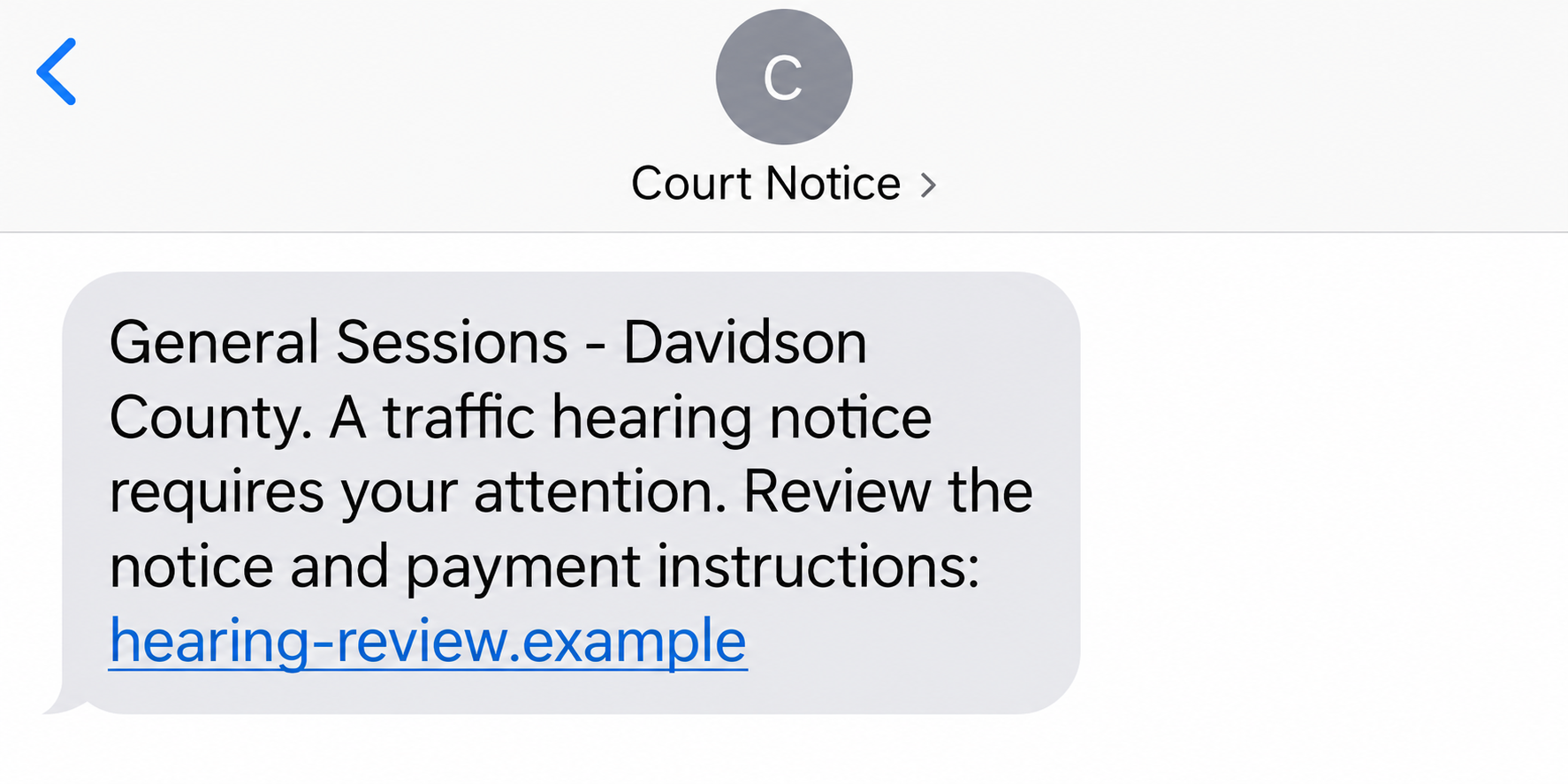
The Nashville Public Defender’s scam warning specifically identifies messages resembling General Sessions traffic-hearing notices. This is impersonation, not evidence that the court sent the demand.
Our lead image illustrates the approach with invented wording. It does not reproduce an authentic court document, recipient’s message, or payment destination.
A court-style notice makes the link harder to question
The alarming part may arrive as text, an attached notice, or a page reached from the message. The presentation encourages you to concentrate on consequences.
A demand can appear to offer a choice: deal with a hearing or settle the problem now. That framing makes the payment route seem reassuring.
But a court name, a hearing date, and a formal layout can all be supplied by the same unverified sender.
Checking the right office breaks the pressure
Keep these distinctions in mind before providing anything:
- Metro traffic and parking questions have their own official contact route.
- A General Sessions civil inquiry is different from a criminal-case inquiry.
- An incoming number is not authenticated just because it resembles a court number.
- A payment request cannot verify itself by referring you to its own link.
You can take a possible legal matter seriously without accepting an unknown sender’s instructions. The next step is independent verification, not an argument over text.
Which Davidson County Office Should You Actually Contact?
Traffic, civil, and criminal questions are not interchangeable
The General Sessions Court’s official questions page points Metro traffic and parking inquiries to the Traffic Violations Bureau at 615-862-5222.
It separately lists 615-862-5195 for General Sessions civil questions and 615-862-5601 for the criminal clerk’s office.
Use the directory to choose the relevant office. Don’t assume the first genuine-looking court number in a message handles the type of case being alleged.
This distinction can save a frightened reader from being bounced between unrelated desks. Describe the allegation plainly and ask where the correct record is held.
Contact details can change. When you need help, open the official page yourself and check its current listing before placing the call.
A warning about fraud does not dismiss a real case
If you already have an attorney or genuine court paperwork, use those established contacts. Don’t abandon a scheduled appearance because a separate message looks suspicious.
Likewise, don’t pay an unfamiliar link merely because your name appears in a real case. A true background detail does not authenticate a new demand.
Ask the appropriate clerk whether the specific matter exists and what official instructions apply. Legal advice about your circumstances should come from your lawyer.
Before calling, have the notice and any genuine paperwork nearby. Note the type of case mentioned so you can explain the question without repeating the sender’s threats.
If you cannot reach the office immediately, preserve the inquiry for its normal contact route. Don’t accept an unknown caller’s offer to handle everything after hours.
For a relative’s case, avoid uploading their documents to a stranger’s website. First establish who is requesting them and why you should be the person responding.
How the Davidson County Court Text Scam Works
Step 1: The message introduces a hearing you weren’t expecting
A court-related heading interrupts an ordinary day with the suggestion that your attention is already overdue.
Traffic matters are useful to an impersonator because they sound plausible without requiring much explanation. You might immediately start searching your memory for a recent drive.
The message can exploit that uncertainty even when it doesn’t identify a trustworthy case. Your effort to explain the allegation supplies some of its credibility.
Pause before filling in the missing details for the sender. A genuine inquiry should be checked against records outside the message.
Don’t interpret receipt as proof that the court obtained your number for a real hearing. The sender’s access to a contact address establishes very little.
Step 2: Formal language makes an immediate response feel necessary
The notice may describe consequences for failing to act. An appearance deadline or payment instruction can make it feel risky to wait until you find help.
You don’t want to miss a legal obligation, yet something about the message feels wrong. The deadline makes it harder to listen to that hesitation.
The safest response is neither instant payment nor total dismissal. Separate the alleged case from the sender’s proposed way of resolving it.
Keep the details for an official inquiry, but stop following the conversation. You don’t owe an unknown sender a defense of your driving history.
A court-style signature is not a reason to make an exception. Names and titles can be copied without the named person’s participation.
Step 3: A link or QR code becomes the convenient next step
The message directs you toward a place where the alleged matter can supposedly be reviewed or settled. Convenience makes the change of destination easy to miss.
A QR code performs the same basic job as an address: it can point your device somewhere else. Its printed appearance does not authenticate the destination.
If you previewed a QR address without opening it, don’t assume the scan alone transferred money or infected the device.
If you opened the destination, focus on what happened next. A page view, a document upload, and a completed payment expose different things.
You don’t need to follow a suspicious destination to prove that the initial message deserves checking. Start from the official court directory instead.
Step 4: The supposed resolution asks for information or money
An unverified site may request payment details or information framed as necessary to locate the case. This is where a frightening story becomes a concrete risk.
A field labeled verification still sends information to whoever operates that form. Its label doesn’t establish an official reason to collect the data.
Never supply a banking passcode just because a supposed clerk says it confirms payment. Read any genuine bank notification and contact the bank directly.
Payment instructions involving gift cards, cryptocurrency, or a stranger’s payment-app account should stop the exchange, not trigger a search for a nearby shop.
The local warning identifies broader court impersonations as well. That doesn’t mean every traffic-text recipient is taken through the same payment process.
Step 5: Follow-up contact tries to preserve the sender’s authority
If you hesitate, another message or call may claim to explain the notice. Treat it as another unverified approach rather than independent confirmation.
The Public Defender’s warning notes that criminals can spoof official telephone numbers. A familiar caller ID cannot replace a call you initiate yourself.
End the incoming conversation before dialing a verified contact. Don’t let the caller transfer you to a supposed clerk or remain present during a bank call.
If you already paid, a new demand doesn’t become valid because the first payment happened. Stop and preserve the details for your financial provider.
There is no verified universal follow-up script here. The useful rule is to require a fresh, independent route before trusting another request.
Warning Signs That Matter More Than a Misspelled Word
One message tries to handle several different jobs
Be cautious when the sender switches between traffic collection, criminal enforcement, license administration, and technical support without explaining the actual case.
A collection link cannot establish its authority merely by naming several public offices. More official-sounding labels do not make a request better authenticated.
Ask one narrow question through a verified contact: which office handles this alleged obligation? You should not need to follow a payment link to learn that.
The sender discourages a second opinion
Pressure to stay on the phone, keep the matter secret, or bypass your usual contact is a reason to stop following instructions.
You can write down what was said without agreeing to it. If the matter is real, a verified office can explain the appropriate next step.
For an older relative, offer to help locate the right office instead of taking over their banking credentials. Keep both verification and account control straightforward.
Paying is treated as proof that the allegation was correct
An impersonator may frame payment as the only way to avoid a worse outcome. That framing leaves no room to establish whether the alleged debt exists.
A legitimate issue deserves a legitimate record. Don’t substitute the sender’s confidence, a payment receipt, or your own understandable anxiety for that record.
What to Do if You Have Fallen Victim to This Scam
-
Break contact without trying to win the argument. Stop replying and end any related call. You can check the alleged case through another route.
Save the message and any attachment already on your device. Note the sender, destination address, payment instruction, and sequence of events while you remember them.
Don’t open an unfamiliar attachment again simply to collect more evidence. The information you already have may be enough to begin a report.
-
Call the payment provider if you sent money or exposed a card. Explain that a supposed Davidson County court notice led to the transaction.
Provide the amount, recipient, time, and method. Ask what can be stopped, recalled, restricted, replaced, or disputed under that provider’s procedures.
Be accurate about whether you authorized the payment. A truthful description helps the provider assess options; an impersonator’s promise of reimbursement does not.
-
Check the legal claim separately. For Metro traffic or parking, consult the bureau identified by the official court directory.
For another case type, use the appropriate civil or criminal contact. Tell the office which kind of notice you received, not merely that it mentioned court.
If a real matter exists, obtain its genuine instructions. A scam payment should not be assumed to resolve a real citation or appearance requirement.
-
Secure disclosed passwords and codes. Use the real account’s website or app to replace any password entered on an unfamiliar page.
Review account sessions and recovery details if those credentials were exposed. Tell your bank immediately if you passed along one of its authorization codes.
Don’t install software or share your screen with someone offering to help finish the court payment. That expands access without verifying the original demand.
-
Handle identity exposure according to the documents involved. List whether you supplied a license image, birth date, address, or Social Security number.
Use IdentityTheft.gov when sensitive identifiers were disclosed or misuse appears. It provides a starting point for an identity-recovery plan.
For an exposed document, ask its issuing agency about appropriate safeguards. Do not assume that every disclosure requires the same replacement process.
-
Review the device if the link led to unwanted changes. Remove unfamiliar notification permissions and inspect any downloads associated with the interaction.
If you installed a program or notice suspicious behavior, consider a reputable scanner such as Malwarebytes on a compatible system.
AdGuard offers additional filtering for some deceptive websites and advertising. These tools do not cancel transfers or validate a hearing.
No scan is automatically required just because a message arrived. Respond to actual software or browser exposure, not the sender’s claim that your device needs repair.
-
Report useful details and watch for recovery demands. Submit the impersonation through the FTC reporting service and use your carrier’s spam-reporting option.
Where supported, forward the text to 7726. After preserving necessary evidence, block the sender instead of continuing a conversation to gather more information.
Keep bank references with the original record. If another caller requests an advance fee to recover the payment, verify that contact with your provider yourself.
Frequently Asked Questions
Is a Davidson County General Sessions hearing text genuine?
The local Public Defender warns about fake messages resembling those notices. Don’t trust an unsolicited payment approach; confirm any alleged matter with the correct official office.
Which number handles Metro traffic and parking questions?
The court’s questions page lists the Traffic Violations Bureau at 615-862-5222. Check that page for the current contact before calling.
Is the General Sessions civil clerk the same as traffic support?
No. The official directory lists different routes for civil, criminal, and Metro traffic questions. Choose according to the actual allegation rather than the message’s broad heading.
Does a real court number on caller ID prove anything?
Not by itself. Official numbers can be spoofed. End the incoming call and place your own call using independently verified contact information.
Can scanning the notice’s QR code immediately empty my account?
A QR code can point to a website. The important exposure is what you opened, authorized, submitted, or installed afterward, not the code’s appearance alone.
Should I ignore an actual court appearance because of this scam?
No. Verify existing paperwork with the clerk or your lawyer. Rejecting a suspicious message and meeting a genuine legal obligation are separate decisions.
The Bottom Line
Don’t pay the Davidson County court text or follow its QR instructions. The hearing format is being used to impersonate an official process.
Confirm any genuine matter through the correct court contact. If money or account information has already been shared, put your payment provider in the conversation immediately.

Join the discussion
0 commentsShare your experience or ask a question about this article.
Community experiences
Did this happen to you?
Your experience could help someone recognize the same scam. Submit a private report for our team to review.
I experienced this tooReports are reviewed before publication. Sharing publicly is always your choice.
Discussion
Start the conversation
Have a question or something useful to share? Add the first comment.