

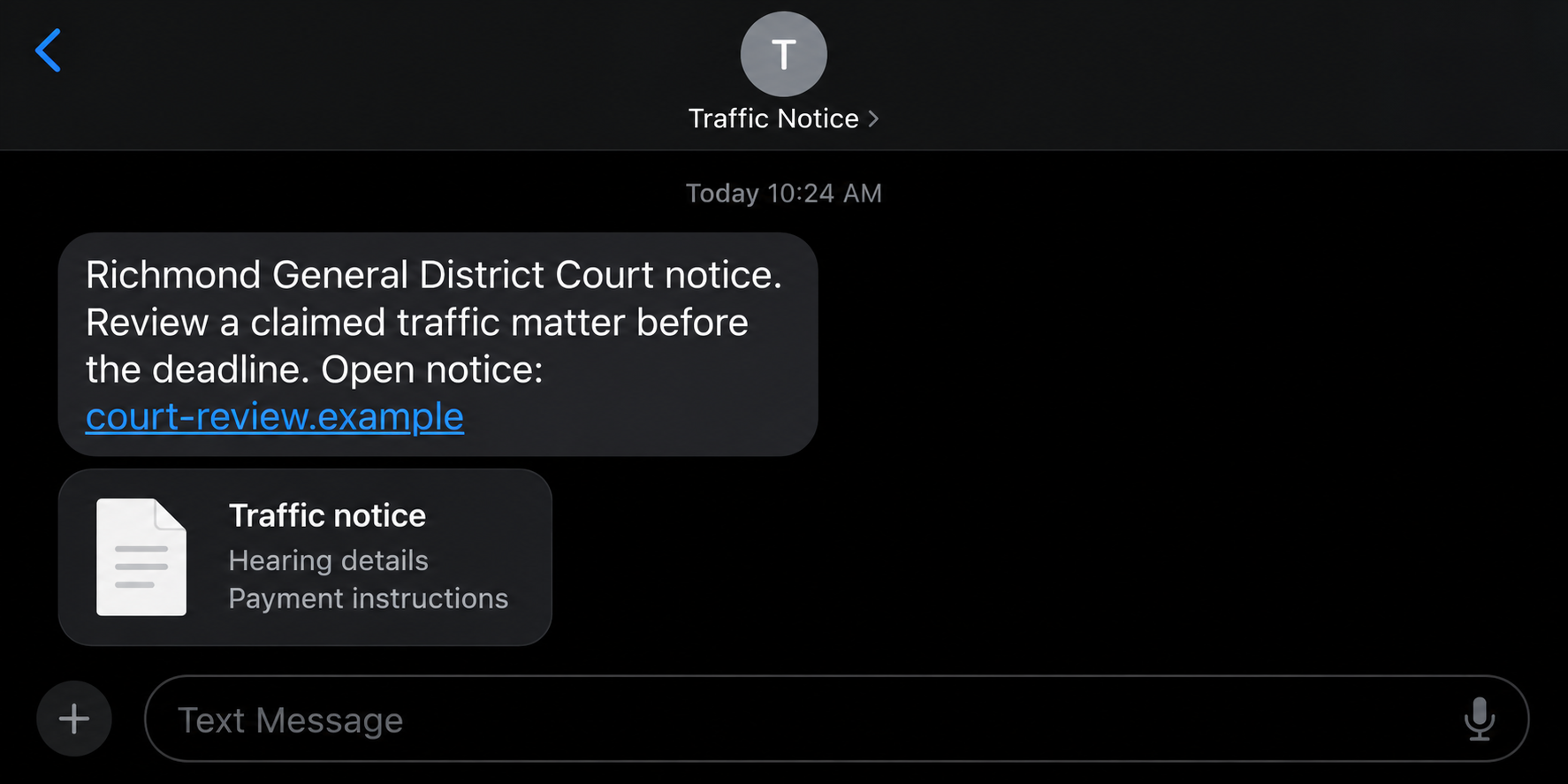
A Richmond court notice lands on your screen with a traffic warning and a deadline. The formal heading makes it difficult to dismiss.
Before opening its payment instructions, there is one detail worth slowing down for: which Richmond court is supposedly asking you to act?
Overview
A fake traffic notice borrows Richmond’s court authority
The Richmond General District Court scam impersonates a real court to make a traffic-related demand look urgent and official.
The city’s Circuit Court Clerk announcements page warns about fraudulent messages alleging a fine or General District Court hearing. It advises against scanning their QR codes.
That warning comes from a genuine city office. It does not make an incoming message genuine or turn the Circuit Court clerk into General District Court support.
A hearing threat can make the payment shortcut feel safer
The demand encourages you to resolve uncertainty through a link or code supplied by the same sender. That is precisely the route to avoid.
The illustration above uses fictional wording and an example address. It shows the presentation, not a real recipient’s notice or an authenticated court interface.
A copied document can contain recognizable terms without establishing a case. The important information must be checked outside the message.
The correct locality and court provide a better starting point
Before paying, separate these questions:
- Does the allegation concern Richmond City rather than Richmond County or another locality?
- Is it a General District Court matter rather than a Circuit Court matter?
- Can the relevant official record or clerk confirm the alleged case?
- Did you reach that service independently instead of following the notice?
These checks do not require arguing with the sender. They give you a way to address a possible real obligation without handing control to an impersonator.
Richmond City, Richmond County, and Circuit Court Are Not the Same
A familiar place name is not enough
The Virginia court directory identifies Richmond City General District Court as part of the 13th Judicial District.
Richmond County is a different locality. A search result containing Richmond can therefore be genuine yet still be the wrong office for your question.
Use the complete court name and the locality in your own records. Don’t let a vaguely familiar heading decide which office receives your documents.
Someone who recently traveled through Virginia may not immediately know the distinction. That uncertainty is a reason to check, not a reason to follow the message.
The warning office and the case office can differ
A city office can warn residents about impersonation of another court. You still need the appropriate clerk when asking whether a particular case exists.
For Richmond City, the General District directory lists separate criminal/traffic and civil contacts. Use the current listing for the matter you’re checking.
Don’t copy a Circuit Court payment address into a General District inquiry merely because both pages belong to legitimate public institutions.
You need the office that can check this particular case. A genuine government page isn’t enough if it handles a different court or locality.
How the Richmond General District Court Scam Works
Step 1: A traffic allegation arrives as a formal notice
The first impression is administrative: a court name, a traffic-related heading, perhaps a document preview. It feels unlike the obvious promotions you normally delete.
That appearance may prompt you to search your memory for a parking issue, an overlooked letter, or a recent journey.
A message doesn’t need to prove any of those events to make you worry. Uncertainty can do much of the work before you reach its instructions.
Keep the allegation separate from your guesses. The sender has not become credible simply because you can imagine a reason the notice might concern you.
Likewise, a reference number is useful only when an independent official record can connect it to a genuine matter.
Step 2: A deadline makes a quick payment seem sensible
The notice connects inaction with an unpleasant legal or financial outcome. A hearing can sound more intimidating than the amount supposedly needed to avoid it.
You may feel that paying is the cautious choice, even while something about the message seems wrong. That reverses the real decision.
Sending money to an unverified recipient does not protect you from an unverified allegation. First establish whether there is a matter to resolve.
Do not rely on the sender to explain how long you can spend checking. Their deadline is another part of the claim.
If you possess genuine paperwork, follow its verified contact route. A new text should not silently replace existing instructions from your lawyer or the court.
Step 3: The QR code hides the next destination behind a familiar action
Scanning a code feels ordinary because people use QR links for menus and everyday services. A court-like document can borrow that habit.
The code is not an approval mark. It can simply contain an address selected by the person who created the document.
Don’t scan it to check whether the document looks more convincing on a larger screen. The official court directory provides a safer starting point.
If you already previewed its address, leave it unopened. If you opened a page, note what you actually did there before deciding which protective steps apply.
A scan alone does not establish an infection, an authorized payment, or a new court obligation.
Step 4: The destination asks you to resolve the alleged problem
A fraudulent destination can present itself as a place to check a balance or make a payment. Its appearance should not override its unverified origin.
Forms create a particularly important boundary. Entering card details or identifiers gives information to the operator even when you believe you’re only looking up a case.
Don’t use real information to test whether a suspicious form works. A test submission can expose the same details as an intended transaction.
If a bank sends an authorization message, examine what the bank says is being approved. A court-themed page cannot redefine that code’s purpose.
The precise fields and payment process can differ. Treat a possible risk as conditional rather than assuming every Richmond recipient experiences the same sequence.
Step 5: The apparent outcome leaves the real case unresolved
A confirmation screen from the wrong destination cannot establish that the genuine court has received anything.
Even an actual charge proves only that money moved through a payment system. It does not verify the allegation that persuaded you to authorize it.
Check the official record independently. If you paid an impersonator, involve the provider quickly and tell the real clerk separately about any case question.
Don’t send a second payment to unlock a receipt or reverse an error. Preserve the first transaction details and seek help through your own trusted channels.
Someone offering recovery may repeat information from the original exchange. That familiarity still isn’t proof that the new contact represents your bank or a public office.
How to Check a Richmond Traffic Matter Safely
Begin with Virginia’s court directory
Open the Virginia Court System independently and select the relevant General District Court. Match the locality before looking for case information.
The official General District Court information page distinguishes its case-information services. Some searches provide information, while the locality-based system also supports online payments.
Follow the official page’s link rather than a sponsored result or an address supplied by the suspicious notice.
Finding a search interface doesn’t mean you should immediately pay. First confirm that the record concerns you and that the listed instructions apply to your circumstances.
Use the clerk for uncertainty, not the message’s help contact
The Richmond City directory lists John Marshall criminal/traffic support at 804-646-6431 and Marsh Manchester at 804-646-6677. Check the current directory before calling.
Explain the kind of allegation and ask which office can confirm it. Don’t assume every case or question belongs to the same building.
If a search returns no clear match, it is not helpful to accept the text’s explanation instead. Ask the correct clerk about the uncertainty.
When an existing attorney handles the matter, use that relationship. A general warning article cannot decide whether a particular appearance or payment is legally required.
Don’t turn verification into a new data disclosure
Prepare the information needed for a legitimate lookup, but give it only through the verified service or appropriate official contact.
Don’t upload an entire license image to a random website that promises to search every court. More personal data does not make an unofficial service more reliable.
If you’re helping someone else, let them retain control of banking credentials. You can find the right contact without needing their passwords.
What to Do if You Have Fallen Victim to This Scam
-
Stop using the notice’s contact route. Close the unverified destination and end any related conversation. Don’t follow another link offered as a correction.
Preserve the original text, its document preview, any visible destination, and transaction records you already possess. Note the order in which the requests appeared.
Keep private evidence intact for official reporting, but redact identifying information before discussing the notice on a public forum.
-
Get the payment provider involved promptly. If you entered a card or sent money, use the genuine banking app or a number from your card.
Describe the court impersonation and the actual transfer method. Ask about card protection, payment recall, investigation, or dispute procedures that fit your transaction.
Don’t wait for a statement to arrive if the details were exposed. An empty transaction list does not establish that a submitted card number is safe.
-
Verify any genuine Richmond case through the right clerk. Use Richmond City General District contacts only if that is the court involved.
Keep the fraud report and the case inquiry separate. Neither an FTC report nor a bank dispute cancels an actual court obligation.
Ask your lawyer about existing paperwork or a disputed appearance requirement. Don’t treat the impersonator’s instructions as legal advice.
-
Replace exposed account credentials. If you supplied a password, change it at the real service and at other accounts using the same credential.
Check for unfamiliar sessions, altered recovery details, and activity related to any code you disclosed. Tell the bank what its original code notification described.
A public case number is different from a banking login. Record the specific information shared so your response matches the actual exposure.
-
Address sensitive identity-document exposure. If you submitted a license image or Social Security number, consult IdentityTheft.gov for a recovery plan.
Ask the issuing agency about precautions for an exposed document. Consider credit-file protection if sensitive identifiers or signs of identity misuse make it relevant.
Do not assume that receiving the text proves identity theft has occurred. The next action should follow what was disclosed or observed.
-
Review downloads and browser permissions when applicable. If the site prompted an installation or notification access, examine those changes through your device’s normal settings.
For installed unwanted software or suspicious behavior, Malwarebytes can help inspect a supported system. Obtain it independently, not from a supposed court repair link.
AdGuard can supplement browser protection by filtering some deceptive content. It cannot authenticate legal notices or remove information already submitted to a form.
Simply viewing a message does not establish malware. Avoid paying someone who claims a special court-related security scan is mandatory.
-
Report the impersonation and watch for another demand. Use ReportFraud.ftc.gov, your messaging app’s reporting tool, and 7726 where supported by the carrier.
After saving necessary evidence, block the sender. Review genuine account alerts rather than responding to new texts about refunds, investigations, or an additional fine.
Tell a trusted household member if you need help following up. It is easier to manage a clear timeline than several parallel conversations with unknown callers.
Frequently Asked Questions
Is the Richmond General District Court text scam confirmed?
Richmond’s official announcements warn about fake traffic notices claiming General District Court hearings or fines. The warning concerns impersonation, not wrongdoing by the real court.
Should I use the Circuit Court clerk to pay this notice?
Don’t pay an unverified notice. Circuit and General District Courts are distinct; establish the correct court and genuine record before following any payment instructions.
Are Richmond City and Richmond County the same court locality?
No. Match the full locality to your genuine record. A legitimate website for the wrong Richmond won’t establish whether your alleged case exists.
Does a QR code make the document official?
No. It can direct you to any address its creator selected. Use the court’s independently reached website instead of the notice’s code.
What if the official case search doesn’t show the allegation?
Ask the appropriate clerk to clarify. A confusing search is not a reason to substitute the sender’s payment page for an official answer.
Can I recover a payment made through the fake notice?
Ask your payment provider promptly about available options. Outcomes vary with the payment method and circumstances; nobody can guarantee recovery for an advance fee.
The Bottom Line
Leave the Richmond notice’s link and QR code alone. Verify any traffic matter through the correct General District Court and its official records.
If you supplied card details or paid, contact your provider directly. Don’t let another message about enforcement or recovery pull you back into the same exchange.

Join the discussion
0 commentsShare your experience or ask a question about this article.
Community experiences
Did this happen to you?
Your experience could help someone recognize the same scam. Submit a private report for our team to review.
I experienced this tooReports are reviewed before publication. Sharing publicly is always your choice.
Discussion
Start the conversation
Have a question or something useful to share? Add the first comment.