

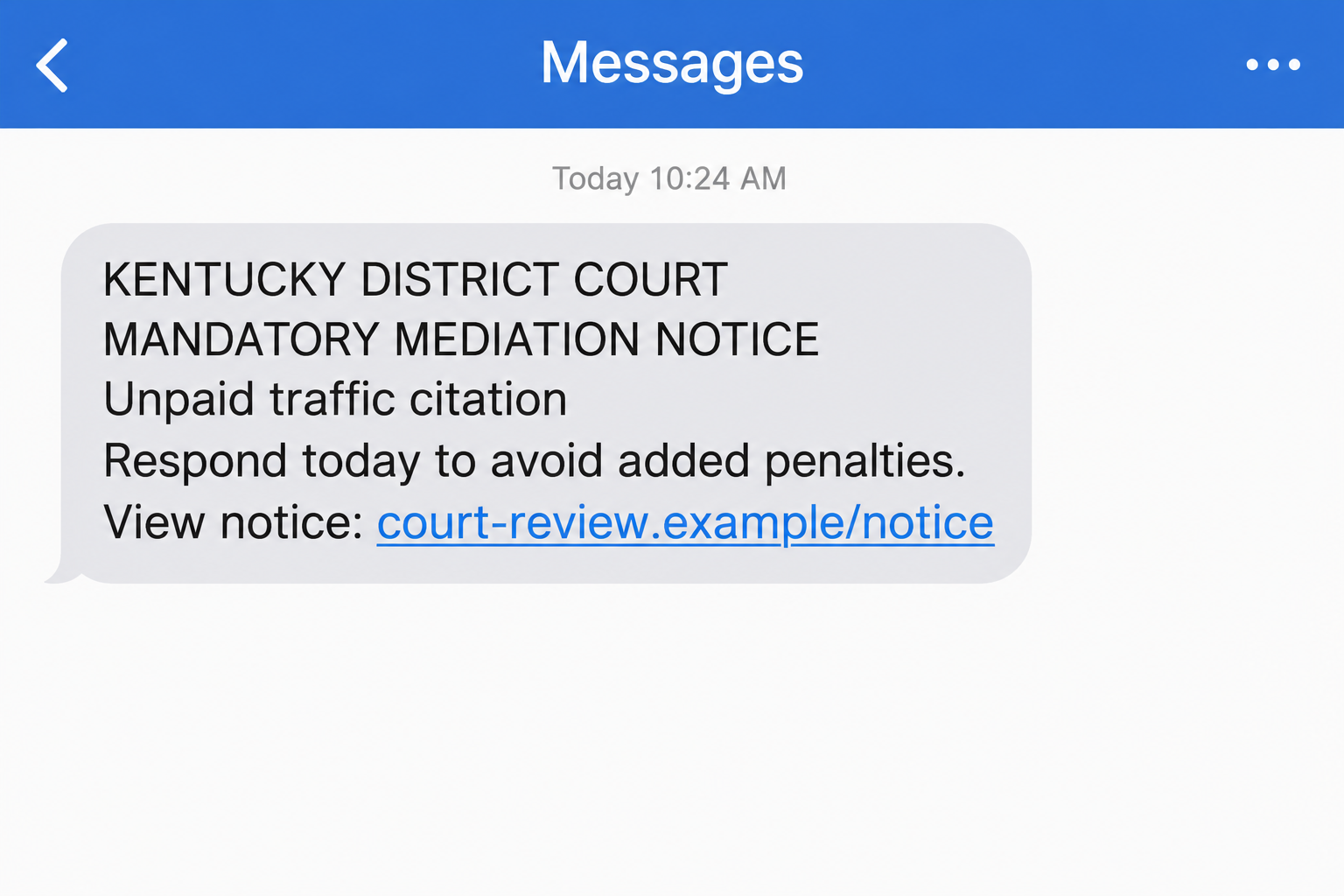
A text says a Kentucky court has scheduled you for mandatory mediation. There is an unpaid traffic citation, a looming deadline, and a notice you never expected.
You may not remember a ticket. But with your license and a court appearance apparently at stake, simply closing the message feels difficult.
Overview
A traffic allegation is dressed as a court instruction
The Kentucky District Court text scam claims an unpaid citation has led to scheduled mediation. It uses the possibility of legal trouble to push an immediate response.
The Kentucky Court of Justice’s statewide scam warning specifically identifies this impersonation. The alleged proceeding is the bait, not an independently confirmed appointment.
A message can look more substantial than an ordinary payment reminder because it appears to instruct you to attend or resolve an official matter.
The threatened consequences make checking feel risky
The official warning describes threats involving warrants, license suspension, default judgment, and additional fees. Those claims are intended to make the sender’s instructions feel unavoidable.
They do not establish that a case exists. Nor does a court heading, legal phrase, or copied reference number verify the document’s origin.
The lead image illustrates the lure using fictional wording and a nonfunctional web address. It is not a genuine notice issued to a particular recipient.
The useful response is verification outside the message
You do not have to choose between trusting a stranger and disregarding a possible real obligation. Check the allegation with the appropriate court office.
- Keep the text’s link and QR code out of your checks.
- Find the county’s court contact through the official Kentucky court website.
- Ask whether the claimed case and scheduled event are genuine.
- Address any verified obligation using instructions obtained from that office.
A fraudulent notification cannot create a lawful appointment merely by announcing one. A separate genuine case, however, still deserves attention through its proper channel.
Why the Word Mediation Makes This Notice Persuasive
It sounds like a chance to avoid something worse
Mediation can sound less frightening than arrest or a courtroom hearing. That makes a notice offering it feel like an opportunity rather than a threat.
The pressure comes from what supposedly happens if you fail to cooperate. A person may follow the link hoping to prevent escalation, not intending to pay anyone.
That first decision still gives the sender control over the next page. A button labeled “view notice” deserves the same caution as one labeled “pay.”
Do not assume an administrative-sounding task carries less risk. The message may ask you to confirm identity or provide payment details before showing the supposed appointment.
Real court processes provide convincing vocabulary
Kentucky has genuine courts, traffic cases, and mediation procedures. Their existence supplies language that a fraudulent notice can borrow without obtaining any authority.
The issue is not whether mediation ever exists. It is whether this particular proceeding and communication can be confirmed independently.
Finding mediation on a genuine court website does not confirm your appointment. Ask the proper office about the case, not whether the word itself sounds official.
Keep your question concrete: which county, which case, which scheduled event, and which office can confirm those details without relying on the text?
How the Kentucky District Court Text Scam Works
Step 1: The message introduces a citation you supposedly failed to resolve
The sender starts with an unpaid traffic allegation. It may imply that an earlier notice was missed, making the lack of recognition feel like your mistake.
Busy drivers can imagine overlooking a letter or forgetting a ticket. The message benefits from that uncertainty before offering any independently verifiable record.
Do not supply a recent journey, vehicle detail, or address to help the sender explain the allegation. Record its existing claims first.
If several people use a vehicle, ask about actual paperwork separately. A shared car can explain confusion, but it cannot authenticate this particular sender.
Step 2: A court heading turns the allegation into an apparent order
The message invokes District Court and scheduled mediation. A notice-shaped image, reference field, or official-looking signature can make an ordinary text resemble a formal document.
That presentation encourages you to focus on compliance rather than origin. You start considering attendance or payment before asking who created the notice.
A copied official name is not permission from that person. Do not assume a named judge or clerk authored a document simply because it bears their name.
Likewise, searching an employee directory cannot authenticate a message. The relevant office must be able to confirm the actual case and instruction.
Step 3: Penalties narrow the time you feel able to spend checking
The claimed consequences turn hesitation into an apparent legal risk. A license threat can feel particularly urgent when driving is necessary for work or caregiving.
The sender may present several consequences together. Their combined effect is emotional pressure, not proof that they are available in the alleged circumstances.
You do not need to interpret every legal term while staring at the notice. Establish an independent court contact before considering what any claimed deadline means.
If a caller joins the exchange, end the conversation before searching. A person who remains connected can keep directing your checks back toward their own operation.
Step 4: The notice supplies the route for supposedly resolving the issue
A link or QR code offers access to the alleged notice, appointment, or payment process. The sender has now supplied both the problem and its solution.
A QR code is simply another way to open a destination. It does not validate the court, protect the information entered, or make the underlying claim official.
A copied court heading can appear on the resulting page too. Matching colors between a text image and website show consistency, not institutional control.
Do not log in or enter a card to discover whether a case exists. A verification step that collects sensitive information is still a disclosure.
Step 5: A response can expose more than the displayed fee
The requested action may involve money, identity details, or further contact with an impostor. The risk depends on what you actually provide.
A small displayed amount can make a card submission feel harmless. But the value of the information entered is separate from the fee shown.
Another prompt may claim an error or demand an additional step. Stop rather than trying a second card or sending documents to complete the supposed process.
The official warning does not establish one identical technical payload for every text. Receipt of the message alone is not evidence of an infected device.
What a Seal, Signature, or Warrant Can Actually Tell You
Kentucky’s June 2024 forged-warrant alert explains that fraudulent documents can carry copied seals, case numbers, charges, and signatures.
That earlier warning provides useful context, not evidence that every current mediation text includes a warrant. Keep the document you received separate from other reported variants.
A signature-like mark tells you what appears on the page. It does not establish that a judge reviewed, signed, or authorized it.
The same applies to a courthouse address. A scammer can copy the address of a real building while sending you to an unrelated payment destination.
If the message includes a warrant threat, do not negotiate with the sender about buying time. Ask the court office how to verify the claimed legal action.
Kentucky’s alert states that a valid arrest warrant would not be served by phone, text, or email. That does not mean genuine court matters can be ignored.
How to Check the Alleged Appointment Without Opening Its Link
Find the correct county office
Use the official Kentucky Circuit Court Clerk information to locate the relevant county’s contact details.
The title can be confusing when the message says District Court. Circuit Court Clerks also maintain District Court records, so the office name is not a mismatch.
If the notice gives no county, explain that when contacting an independently located court office. Do not let the omission push you back toward its callback number.
Use a number from the official court site, not a sponsored search result or the contact block printed inside the questionable notice.
Ask questions that establish a record, not just a balance
Say you received an unsolicited mediation notice and want to verify it. Ask what information the office needs through its established procedure.
Find out whether the case reference exists and whether the scheduled event applies to you. A matching surname alone should not settle that question.
If there is a genuine case, confirm its date and available response methods. Ask where legitimate payment instructions are published, if payment is actually required.
Record the office, time, and answer. You may need those details when explaining to your financial provider why a separate payment demand was fraudulent.
Keep unresolved legal questions separate from the scam report
A clerk can explain records and procedures, but cannot necessarily advise you on legal strategy. Seek qualified help if the underlying matter requires legal advice.
If you already have an attorney handling the case, use your established contact details to share the notice. Do not switch to an address supplied by its sender.
Never travel to a private payment location because a texter says a warrant can be cleared there. Verify any requested attendance directly with the appropriate office.
What to Do if You Have Fallen Victim to This Scam
-
Save the notice and end the conversation. Keep a screenshot, sender details, visible destination, and any transaction record already available.
Do not scan the code again for evidence. Write down what you did while it is fresh, including whether any information was submitted.
If someone is still calling, stop answering while you verify matters independently. You do not owe the suspected sender another explanation or a final payment.
-
Tell your financial provider about the court impersonation. Explain whether you entered card details, provided bank information, or completed a particular payment.
Ask the provider which protective steps fit that exposure. Card replacement, transaction disputes, transfer recalls, and account monitoring address different problems.
Be accurate about what you authorized and why. Fraudulent persuasion can be relevant even when you personally clicked the payment button.
Act promptly, but do not assume a reversal is certain. Save your provider’s reference number and follow its instructions about further documentation.
-
Protect credentials or identity information that reached the page. A disclosed password should be replaced through the genuine service, with reused passwords changed elsewhere.
Check recovery contacts and recent sessions if an account login was involved. Avoid any follow-up message offering a quick correction through another unfamiliar link.
For exposed sensitive identity information, begin with IdentityTheft.gov. Choose recovery measures based on the data involved, rather than assuming every recipient faces identical harm.
-
Confirm the alleged court matter directly. Tell the proper clerk what the message claimed and ask whether any real appointment or case needs attention.
Keep genuine case paperwork and scam evidence in separate folders. Paying an impostor cannot be treated as proof that a real citation was satisfied.
If you missed an independently verified deadline, obtain appropriate guidance promptly. This scam warning is not a substitute for responding to actual court instructions.
-
Report through the official route, not the text’s help desk. Kentucky’s court scam page links the Attorney General’s reporting process.
You can also notify local law enforcement about attempted court impersonation or losses. Supply the records you preserved without publishing private identifiers.
A report to the court administration is not automatically a police report, financial dispute, or Attorney General complaint. Keep track of which organization received which information.
-
Watch for a supposed refund or case-clearing service. A second caller may use details from the incident to sound like someone assigned to help.
Do not pay a recovery fee or disclose another banking code. Contact your original financial provider or reporting agency through the route you already established.
If you only viewed the text, preserve and report it, then remove it. More invasive recovery steps should match an actual disclosure or installation.
When the Notice Arrives Outside Court Office Hours
An evening or weekend message can make a threatening deadline harder to evaluate. The sender’s link may appear to be the only available way to respond.
Do not interpret office closure as permission to trust that route. Save the notice and locate the official office’s published hours and contact options.
If money or financial details were already sent, your provider may have a fraud contact available before the court reopens. Handle that exposure promptly.
For the alleged case, leave a record through an independently verified official channel where appropriate. Preserve your attempt and any response.
Ask a trusted person to help you organize the facts if the threat is overwhelming. They can read a screenshot without clicking the link or sharing credentials.
A separate genuine court deadline may require timely legal advice. Do not rely on the scammer to explain extensions, attendance requirements, or your options.
Frequently Asked Questions
Is the mandatory mediation text really from Kentucky District Court?
Kentucky’s courts explicitly warn about this unpaid-citation mediation scam. Do not follow the message; independently verify any alleged proceeding with the proper clerk.
Does the warning mean Kentucky never uses mediation?
No. Genuine mediation exists. The deceptive part is an unverified message presenting a fabricated or misrepresented proceeding as an instruction you must obey.
Why contact a Circuit Court Clerk about District Court?
Kentucky’s Circuit Court Clerks maintain trial-court records, including District Court records. Locate the relevant county office through the official court website.
Can a genuine-looking signature establish that the notice is valid?
No. Names and signature images can be copied. The office handling the alleged case must confirm its existence and instructions independently.
Should I pay a small fee while waiting to verify the notice?
Do not pay through the questionable message. A small charge can expose financial details, and an impostor’s receipt cannot settle a genuine case.
What if the website rejected my card?
Contact the issuer about the information entered anyway. An error screen does not establish that your details were deleted or that no charge will follow.
The Bottom Line
The Kentucky District Court text scam turns an alleged traffic citation into a frightening mediation demand. Do not respond through its link, code, or callback route.
Verify the claimed case with the appropriate county clerk. If you already disclosed payment information or sent money, contact your financial provider and preserve the notice.

Join the discussion
0 commentsShare your experience or ask a question about this article.
Discussion
Start the conversation
Have a question or something useful to share? Add the first comment.