

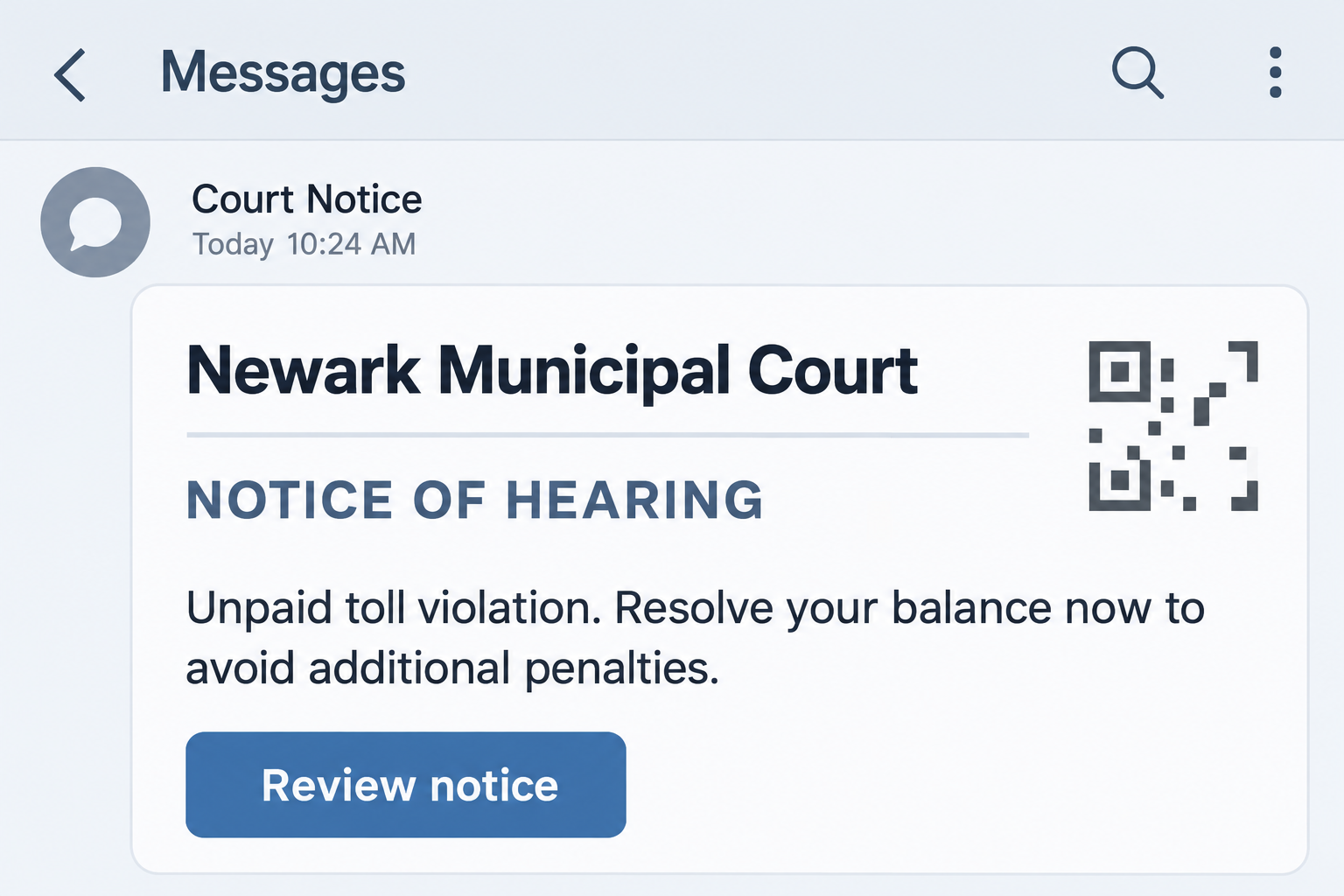
A Newark Municipal Court notice appears in your messages, complete with a hearing warning. You’re wondering which trip or parking stop could have caused it.
The document offers a quick way to deal with the problem. Before taking that shortcut, check where the instructions are leading you.
Overview
A real court name is attached to a false collection notice
The Newark Municipal Court text scam uses an alleged toll or traffic issue to push recipients toward a payment link or QR code.
An official East Newark borough alert relays the New Jersey Judiciary’s warning about fraudulent toll messages claiming to come from Newark Municipal Court.
The notice may threaten default judgment, added costs, or notification to the New Jersey Motor Vehicle Commission. Those threats are pressure, not independent confirmation of a case.
Newark and East Newark are separate municipalities. East Newark published the warning; Newark Municipal Court is the institution impersonated in the messages it describes.
The payment shortcut is the part to avoid
The official alert specifically advises against scanning the QR code, following the message’s links, or providing personal and financial information in response.
The illustration above recreates that kind of interface with a nonfunctional code. It does not reproduce an original court notice or a recipient’s message.
A suspicious notice can contain:
- The name Newark Municipal Court or another court-style heading.
- A claim that an unpaid violation now requires urgent attention.
- A deadline tied to additional penalties or administrative consequences.
- A QR code, button, or web address for resolving the alleged balance.
- Instructions that keep verification inside the message’s own payment route.
You don’t need to decide whether every visual detail is wrong. The safe first step is leaving that route and checking independently.
There is an official route for genuine ticket questions
New Jersey Courts provides municipal-court information and a route to NJMCDirect. The borough’s warning directs legitimate traffic-ticket payments through that official starting point.
Whether a particular case can be paid online depends on its actual requirements. A scam message cannot settle that question for you.
If the result is unclear, contact the responsible court using its official listing. Don’t interpret an unfamiliar portal or missing search result as permission to ignore paperwork.
How the Newark Municipal Court Text Scam Works
Step 1: A message introduces a violation you weren’t expecting
The first contact is an interruption rather than a ticket you knowingly received. It asks you to accept a legal or financial problem before verifying its origin.
That can work even when the allegation is vague. If you have driven in New Jersey, you may wonder whether you overlooked a notice.
A recipient outside Newark can feel the same uncertainty. The message itself doesn’t establish where you traveled, what happened, or whether any record concerns you.
Don’t supply missing details to make the story fit. Start by checking whether the claim exists outside the message at all.
Step 2: A document-like layout makes the demand feel procedural
A court name, hearing label, reference number, or formal-looking attachment can make a text feel like paperwork rather than advertising or spam.
However, a document image is still content supplied by its sender. Printing an institutional name doesn’t connect that sender to the institution.
Nor is a plausible reference number an independent lookup result. It should be checked through the real court’s own process, not entered into an unknown checkout.
Avoid building your decision around typography or spelling alone. A careful imitation can be grammatically correct and still direct you to the wrong payment recipient.
Step 3: Penalties discourage a slower, independent check
The official borough warning describes threats involving default judgment, fines, costs, and notification to the Motor Vehicle Commission.
These claims make a website visit seem easier than a possible court problem. You may be tempted to pay first and work out the details later.
But paying first is precisely the decision an unverified sender wants. An urgent message doesn’t prove that its deadline or alleged balance applies to you.
If an authentic deadline concerns you, ask the actual court about it. Don’t let the sender decide that independent contact is too slow.
Step 4: A QR code or button moves you away from the message
The shortcut can hide the destination until you interact. A QR code is simply another way to direct a device toward content or an address.
It isn’t a security certificate or a government seal. Its presence on something resembling a notice doesn’t authenticate the page it opens.
The borough’s official phishing alert tells recipients not to use the codes or links in these fraudulent messages.
Don’t scan the code just to see what happens. You can check a genuine ticket without visiting the address supplied by an unverified sender.
Step 5: A supposed resolution can expose payment or identity details
A fraudulent payment route may ask for information that feels normal during a real transaction: a name, address, card details, or account credentials.
On an impostor page, entering those details puts them in the wrong place. The apparent fee isn’t the only concern.
Even if the page reports an error, don’t assume the information you entered was discarded. Tell the relevant provider what you supplied.
Not every sample has the same fields or outcome. The important distinction is between an independently reached official service and the message’s unverified destination.
Step 6: The next contact can reuse the original allegation
Someone may follow up about a failed payment, unresolved balance, or supposed investigation. Those additional claims need their own independent verification.
A person who repeats the notice’s details hasn’t necessarily checked a court record. The information may simply come from the earlier exchange.
Don’t continue to another card, another link, or a different payment method because the first attempt supposedly failed. Stop and protect what you already exposed.
Move the conversation somewhere the sender doesn’t control: the actual court, your financial provider, or an official reporting channel.
How to Check a Real Newark Ticket Without Using the Text
Begin with New Jersey Courts, not an advertisement
Type the judiciary’s known address yourself or use an official directory you already trust. Avoid choosing a payment service simply because it appears prominently in search.
Start from njcourts.gov and find municipal courts, then NJMCDirect, following the route described in the official borough guidance.
This keeps the starting point separate from the suspicious sender. It also helps distinguish an official service from an unrelated payment intermediary.
Check the address at each stage. A familiar word appearing somewhere inside a long address isn’t sufficient to identify the organization controlling it.
Use the actual ticket information you possess
If you received genuine paperwork separately, use its details through the official service. Don’t treat a reference invented by a text sender as authoritative.
Read the real portal’s instructions before entering information. Don’t upload identity documents or financial records to a page simply to test whether it is genuine.
If you can’t locate the matter, ask the court for guidance. An online search can be incomplete or require information you don’t currently have.
Conversely, finding a real ticket doesn’t validate the text’s link. A genuine obligation should still be handled through the proper channel.
Keep toll accounts and court matters in their correct places
A message may blur toll charges, traffic tickets, and court proceedings into one urgent demand. Don’t assume those labels mean a single office handles everything.
For a genuine toll concern, use the responsible toll operator’s established account or billing route. For a municipal case, use the responsible court.
Ask which institution actually issued the obligation and how to verify it. You shouldn’t have to follow an unsolicited QR code to answer that question.
What the Message Does Not Prove
Receiving this notice doesn’t establish that your license is suspended, your vehicle is flagged, or a judgment has been entered against you.
It also doesn’t establish how the sender obtained your number. Avoid assuming that the court’s systems were breached simply because the message names a court.
A link opening successfully isn’t proof of legitimacy either. A polished page can load normally while belonging to an unrelated operator.
Likewise, viewing a message doesn’t automatically mean the device is infected. Your next steps should depend on what information, money, downloads, or access were involved.
What to Do if You Have Fallen Victim to This Scam
-
Leave the message’s payment route.
Close any page it opened and don’t submit more information. Avoid replying, scanning again, or using the sender’s number to ask whether it was genuine.
If you only received the text, save any evidence you need, report it as junk, and block the sender through your messaging app.
You don’t need to replace cards merely because the notice arrived. Additional protective action depends on what you actually entered or shared.
-
Tell the card issuer about every card you entered.
Use the number on your card or the bank’s real app. Explain that a fake court-payment page collected your details.
Include an apparently rejected card as well as one that was charged. An error message doesn’t confirm that the card information stayed private.
Ask about blocking or replacing the affected card and reviewing transactions. Report unfamiliar charges promptly and retain the bank’s case reference.
-
Report any completed transfer through its actual provider.
Keep the payment confirmation, recipient, amount, and time. Contact the bank or payment service through a separately verified support route.
Explain the impersonation accurately and ask what cancellation, dispute, or recall options remain. No article or recovery agent can guarantee the outcome.
The FTC’s instructions for people who paid scammers distinguish the response according to how the money was sent.
-
Recover exposed logins before they are reused.
If you typed a password, change it directly on the real service. Replace the same password anywhere else you used it.
Review account recovery details and unfamiliar access. Enable appropriate multifactor protection, and don’t read a new verification code to someone calling about the incident.
If you supplied only card details, account-password theft isn’t automatically established. Describe the actual fields you completed when asking your provider for help.
-
Keep a private record of the notice and destination.
Save the sender details, document image, visible address, receipts, and approximate times. Don’t revisit an unknown page just to complete your notes.
Separate what the message claimed from what you observed. For example, record that it threatened a license consequence, not that your license was actually affected.
Redact identity and payment information before sharing a warning publicly. Give complete evidence only to verified institutions that need it.
-
Address identity exposure when sensitive identifiers were entered.
If the form requested Social Security information or you discover identity misuse, consult IdentityTheft.gov for an individualized recovery plan.
Ask relevant providers about protecting affected accounts. Credit freezes may be appropriate for some identity exposures, but they don’t reverse a card charge.
Write down which information was disclosed. That helps you choose proportionate protection instead of reacting as if every account and document were compromised.
-
Check downloads or permissions only if that exposure occurred.
If you installed an app, opened a suspicious download, or allowed remote access, review that change separately from the payment problem.
Malwarebytes can assist with relevant malware checks. AdGuard may help reduce malicious-ad exposure, but it doesn’t establish that a court page is authentic.
Neither tool cancels a ticket, restores a stolen payment, or secures a password already disclosed. Keep the court, account, and device tasks separate.
-
Report the text and verify any genuine obligation.
Use your app’s spam-report option or forward the message to 7726 where supported. The FTC explains those reporting options.
You can also report the impersonation at ReportFraud.ftc.gov. Contact the real court independently if you still need clarity about a ticket.
Don’t pay someone who offers to remove the notice or guarantee a refund. A new fee would create another transaction, not verify the original claim.
Frequently Asked Questions
Is the Newark Municipal Court toll text legitimate?
The official borough alert identifies fraudulent toll messages using that court’s name. Don’t follow the received payment route; verify a genuine issue through official channels.
Does the warning come from Newark or East Newark?
East Newark published the cited alert about messages impersonating Newark Municipal Court. They are different municipalities, and the publisher’s name should not be confused with the impersonated court.
Can a QR code confirm that a notice is official?
No. A code directs your device somewhere; it doesn’t establish the sender’s authority. The official warning specifically advises against scanning codes in these messages.
Where should I start checking an actual traffic ticket?
Use New Jersey Courts’ municipal page and its NJMCDirect route. Contact the responsible court if eligibility, missing information, or the result leaves you uncertain.
What if my card was rejected on the page?
Tell that issuer its card information was exposed anyway. A rejected transaction doesn’t prove the page discarded what you typed, and another card could also be compromised.
Does receiving the text mean I missed a hearing?
No. The message isn’t independent evidence of your court status. Check any genuine concern through the real court rather than accepting the sender’s accusation.
The Bottom Line
Don’t pay through a Newark Municipal Court text scam or its QR code. The official warning identifies fraudulent messages that borrow the court’s authority to pressure recipients.
Use the judiciary’s own route to check a real ticket. If you entered payment or account information, protect it through the relevant provider and report the message.

Join the discussion
0 commentsShare your experience or ask a question about this article.
Discussion
Start the conversation
Have a question or something useful to share? Add the first comment.