

You get a Kansas traffic notice on your phone, although you don’t remember being stopped. It says your driving privileges could be affected unless you resolve it.
The message has a payment link and just enough official language to sound important. Knowing which Kansas office handles the issue changes how you should respond.
Overview
The DMV label hides an unverified allegation
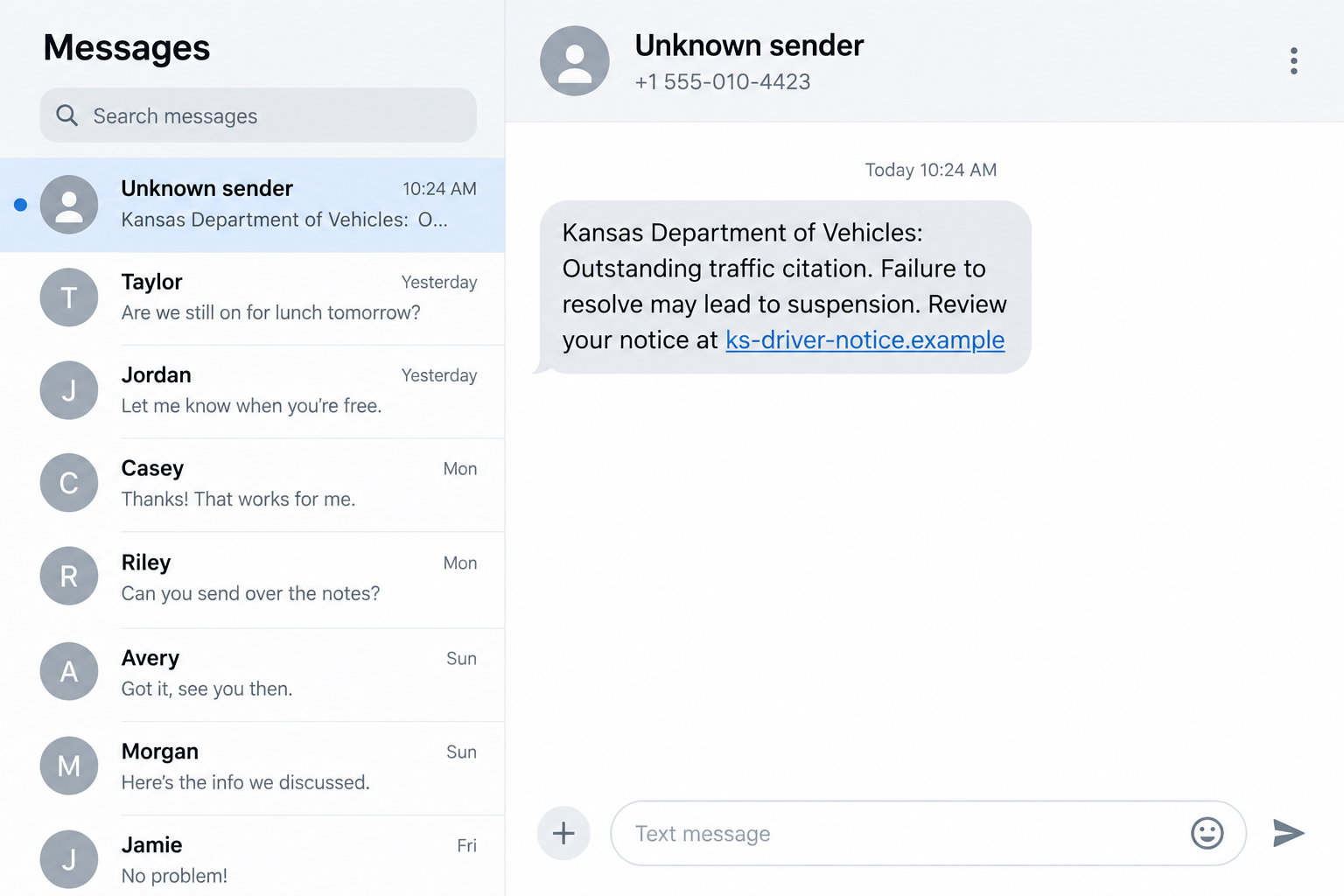
The Kansas DMV text scam presents a supposed unpaid citation or violation as an urgent matter affecting your license.
Messages may use DMV, DOV, or another official-sounding label. Those letters are not a connection to a real driver record or court case.
In Kansas, the Department of Revenue’s Division of Vehicles provides driver services. Its Driver Solutions office is the relevant starting point for suspension-related inquiries.
Official warnings support a clear payment warning
The Sedgwick County District Attorney warned about DOV impersonation texts claiming unpaid traffic citations and threatening license suspension.
The deception combines a credible consequence with a destination chosen by the sender. Payment and personal information are the material risks.
- A citation allegation needs a matching record, not just a threatening message.
- A license-status inquiry belongs with the appropriate driver-services office.
- A real toll balance needs verification with the actual toll operator.
- One text combining these issues doesn’t authenticate any of them.
What the pictured notice means
The example above was generated to illustrate the message format. It contains a fictional address, not an active collection site or an authentic Kansas notice.
Don’t use the unsolicited link to settle the claim. Check independently, using the official service that actually handles the record described.
This distinction also protects against a common mistake: Kansas does have genuine toll travel. The existence of a toll road doesn’t make an unexpected text legitimate.
Three Different Problems the Message Can Blur Together
A traffic citation is tied to a particular case
A notice about a violation should lead to an identifiable incident and responsible jurisdiction. Statewide terminology cannot replace that information.
If you have actual ticket paperwork, examine the issuing authority and court details. Contact that office through information obtained independently of the suspicious text.
Ask whether the record concerns you, what it alleges, and what response options apply. Don’t make a payment simply to test whether the claim disappears.
Some cases involve choices or deadlines beyond paying an amount. Get case-specific information from the responsible office rather than allowing a stranger to select your response.
Driver Solutions handles a different question
The Kansas Department of Revenue’s Driver Solutions contact page covers suspension and revocation inquiries and provides official routes for assistance.
It also links to online services, including a driver-license status check. Start there when your concern is whether your driving privileges are actually affected.
A claim in an SMS isn’t a substitute for that check. Nor does paying a suspicious website establish that a real restriction has been removed.
If you discover an actual issue, ask what requirements apply to your record. Don’t assume an unrelated scam payment satisfied any of them.
Tolls are real, but they are not the same as citations
Kansas has toll travel, including the state’s 69Express lanes. Advice claiming there are no Kansas tolls gives readers the wrong test.
A toll is not automatically a traffic citation, and a toll account is not the same thing as your driver-license account.
If the text alleges a toll, identify the road, date, vehicle, and actual operator. Review your existing account or independently locate the official billing route.
A recent trip may make the timing believable. It doesn’t prove the sender saw that trip or that the linked site is entitled to collect anything.
Rental vehicles and shared vehicles can complicate billing questions. Use the relevant rental agreement or account records without accepting the unknown sender as the answer.
How the Kansas DMV Text Scam Works
Step 1: The text turns a generic threat into a local concern
The sender borrows Kansas agency language and announces an outstanding traffic matter. An unexpected message becomes harder to dismiss when it names your state.
You may wonder whether paperwork went to an old address, a camera recorded something, or another driver used the vehicle.
Those questions explain why the text catches attention. They are not evidence that its allegation is accurate.
Keep the message long enough to document it, then make your own inquiry. The sender doesn’t need to participate in that process.
Do not reply with identifying details to help them locate the case. That reverses the burden of verification and supplies information they may not have.
Step 2: Suspension language makes the sender’s deadline feel unavoidable
A threat to your license can affect more than a trip. It can bring work, childcare, medical appointments, and daily independence into the decision.
The message uses that concern to make immediate payment seem like the lowest-risk option. But the payment route itself is what needs checking.
A cited rule or formal notice heading can be copied into a text. You don’t need to interpret unfamiliar legal language on the sender’s schedule.
Record any reference or date, but verify it with the real office. Don’t treat a countdown as proof that a government system has already acted.
Equally, don’t dismiss genuine paperwork because you received a scam. An actual known case needs its own response through its legitimate channel.
Step 3: A linked page appears to offer a straightforward solution
The destination may resemble a driver-services or traffic-payment page. It can display a state name, balance, deadline, and reassuring payment controls.
Those elements can be reproduced without access to government records. Their appearance doesn’t establish that the site knows anything about your license.
A government-related word inside a long address is also insufficient. You need to know which organization controls the destination, not merely recognize part of its spelling.
Rather than manually untangling a suspicious address, leave the page. Reach the relevant service from a trusted official starting point.
No payment is needed to verify a site’s authenticity. A small test transaction gives the recipient something real without answering who they are.
Step 4: The supposed settlement can collect more than a fee
Depending on the version, the form may seek billing details, card information, identifying data, or credentials. Don’t assume every recipient sees identical fields.
The cost shown on screen can distract from those disclosures. A low apparent balance can still expose a payment method with a much larger usable limit.
A failed-payment message isn’t assurance that your details stayed private. Treat entered information as potentially exposed and describe it accurately to the provider.
Never give a second card to help the site troubleshoot the first. Likewise, don’t supply bank codes to someone offering to fix the transaction.
Read notifications from your actual bank separately. A prompt authorizing a payment is not made harmless by a stranger calling it cancellation.
Step 5: The unfinished problem becomes a reason to approach you again
A follow-up may claim the balance remains due, the payment needs confirmation, or a refund is waiting. Each version creates another reason to respond.
Someone mentioning details from the earlier form can sound credible. But those details may be precisely what the original interaction exposed.
Check a genuine bank record or official case record instead of asking the same contact whether everything worked.
If money moved, contact the service that processed it. If a real license issue exists, speak with Driver Solutions separately.
A promise to fix your driving record shouldn’t keep you waiting to protect your card. The bank and Driver Solutions have different jobs here.
A Safer Way to Resolve the Uncertainty
Choose the office before providing information
First identify the category: court citation, driving status, vehicle registration, or road toll. Don’t assume the text has assigned the issue correctly.
The official Kansas Revenue directory distinguishes driver-services contacts from titles and registration. Use that distinction instead of accepting one generic DMV payment desk.
Where a court is involved, locate the court through its official directory or genuine paperwork. Ask which records are needed for a specific inquiry.
You may need to identify yourself to a real service. The safeguard is independently reaching that service before sending information, not refusing every legitimate identity check.
Compare records rather than how official the text sounds
Useful comparisons include the incident date, the vehicle involved, a genuine ticket number, and a receipt from an earlier payment.
Generic phrases about compliance or final notice cannot substitute for those details. A seal or formal signature doesn’t supply the missing connection either.
Save the real office’s response and any reference it provides. That makes later follow-up easier without reopening the fraudulent notice.
If you cannot locate a record immediately, ask the office what to do next. Don’t invent a waiting period or assume every database updates instantly.
Don’t decide based only on the sender number
An unfamiliar or overseas number can be a warning sign, but it doesn’t identify the operator’s location or establish who controls the whole scheme.
A local-looking number isn’t authentication either. The payment demand and independent record check are more dependable than assumptions about a prefix.
Report the number and website as they appeared, without contacting them for clarification. Preserve observations rather than conclusions you cannot substantiate.
What to Do if You Have Fallen Victim to This Scam
-
Put the notice aside and document your actions. Save the original text, apparent destination, and receipts or bank entries already available.
List the information you provided and any files downloaded. Don’t reopen the payment form just to make the incident record more complete.
Keep sensitive details out of public discussions. A screenshot intended as a warning shouldn’t reveal information another impersonator can reuse.
-
Speak with your financial provider about payment exposure. Contact the card issuer through an established banking channel if you entered card details or paid.
Ask which protective measures and dispute routes fit the transaction. Tell the provider whether you approved it after deception or never approved it at all.
Other payment methods require their own provider’s assistance. The FTC’s scam recovery advice explains the relevant contacts without promising reimbursement.
-
Replace secrets that were disclosed. Change a submitted password through the genuine account and end sessions you don’t recognize where the service allows it.
If a code was shared, identify which service and action it concerned. Report that promptly instead of assuming the code only related to a traffic fine.
Check account contact details as well. A password change alone may not address an unfamiliar recovery address or another access permission.
-
Assess identity-data exposure separately. A driver’s license image or sensitive identifier creates different concerns from an exposed email address.
Consult IdentityTheft.gov for tailored recovery steps if identity information was disclosed or misused. Ask the appropriate issuing agency about document-specific concerns.
Keep reporting references and watch genuine financial notices. Don’t send identity documents to an unsolicited recovery agent claiming to verify your complaint.
-
Check changes to the device when they occurred. Remove unfamiliar notification permissions, extensions, or software connected with the encounter.
A scan with Malwarebytes can help after suspicious software exposure. AdGuard may reduce malicious advertising, but it can’t retract information sent to a form.
Don’t assume merely reading the text infected anything. Prioritize the accounts and payment methods that were actually exposed.
-
Resolve any real Kansas record independently. Use Driver Solutions for a license inquiry, the responsible court for a citation, or the genuine operator for toll billing.
Explain the actual record you want checked, not just the frightening language in the scam. Retain instructions from the verified office.
Paying an impersonator doesn’t settle a real obligation. Conversely, an unsolicited demand doesn’t establish that you owe one.
-
Report the deception and decline further payment demands. Submit the relevant facts through the FTC’s reporting service and your financial provider’s fraud process.
A caller claiming to recover your payment must be verified just as carefully as the original sender. Don’t accept a new fee as a necessary recovery step.
Share the lesson with anyone managing the same vehicle records, but pass along a redacted copy rather than a live payment link.
Frequently Asked Questions
Is Kansas DMV the official agency name?
People use DMV informally, but Kansas driver services are provided through the Department of Revenue’s Division of Vehicles. Familiar initials don’t authenticate a text.
Does Kansas have real toll roads or lanes?
Yes. Genuine Kansas toll travel exists, including 69Express. Verify a bill with the actual operator; don’t use the false rule that every toll allegation is impossible.
Who can check a claimed license suspension?
Start with Kansas Revenue’s official Driver Solutions page and its current service links. An unknown text sender cannot establish your driving status.
What if I drove in Kansas recently?
The timing makes the message plausible, not verified. Compare the claimed incident with independent trip, rental, toll-account, or court records.
Is my information safe if the form said payment failed?
Not necessarily. Submitted details may still have been captured. Describe the information entered to your issuer or affected account provider and ask about protection.
Should I ignore every government message after receiving one scam?
No. Reject this unverified payment route while checking genuine paperwork and official records separately. A real case still deserves an appropriate response.
The Bottom Line
Don’t pay through the Kansas DMV text scam’s link. Verify the specific claim with the office or operator responsible, not with the person making the threat.
If you already disclosed payment details, involve the provider promptly. Address a genuine Kansas citation or license issue through official channels as a separate matter.

Join the discussion
0 commentsShare your experience or ask a question about this article.
Discussion
Start the conversation
Have a question or something useful to share? Add the first comment.