

An Idaho DMV text announces that penalties are about to begin. An outstanding fine, it says, needs attention before your driving privileges become the next problem.
The official-looking wording can make a forgotten ticket seem possible. There is a better starting point than trying the payment route supplied with that warning.
Overview
The transportation department identifies the demand as impersonation
The Idaho DMV text scam claims a traffic fine or registration problem must be resolved online. Its authority comes from a borrowed agency name, not an authenticated record.
The Idaho Transportation Department’s warning describes these messages as fraudulent and unconnected with its DMV services.
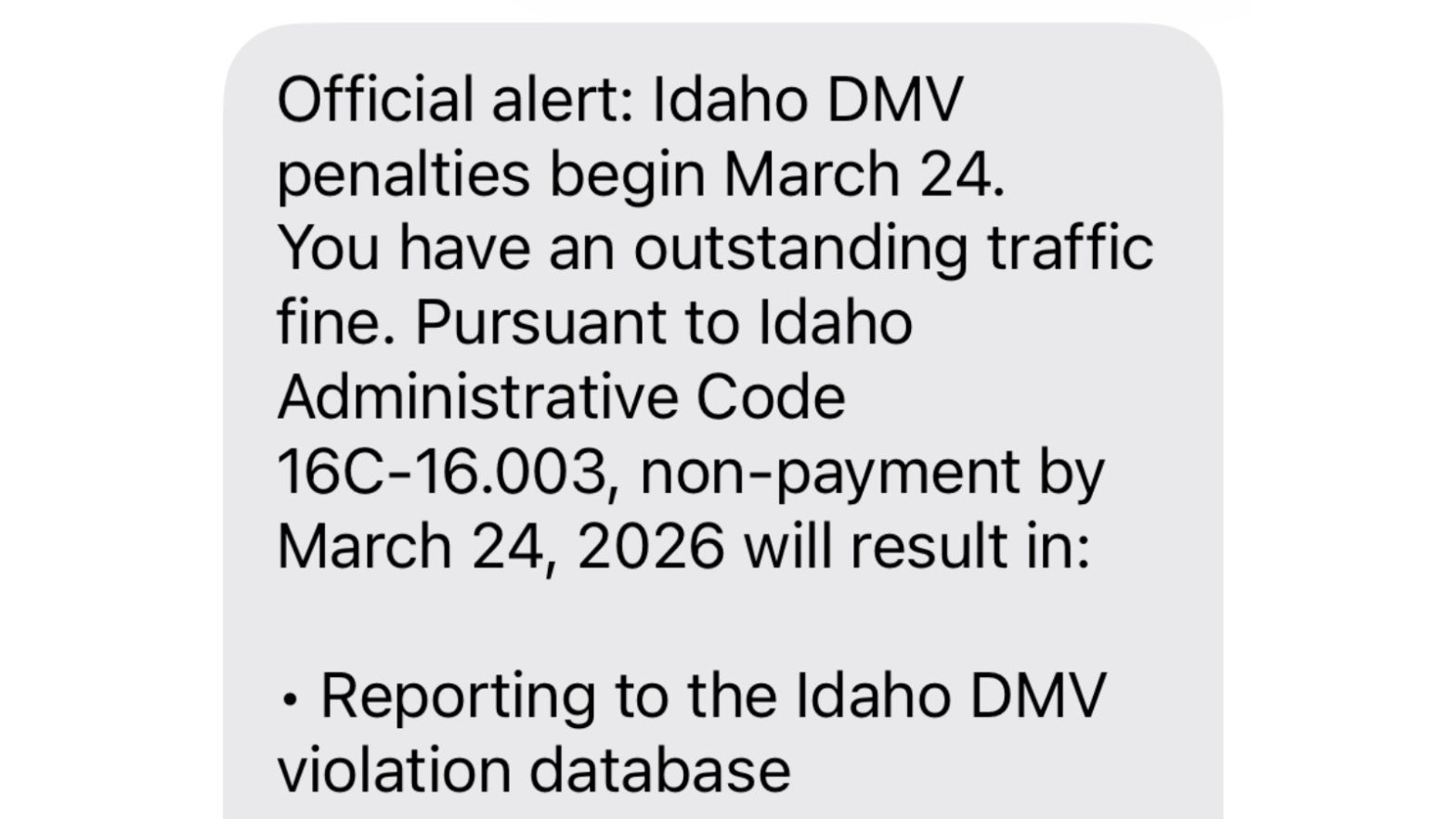
The image shows the upper portion of the example ITD published with its March warning. That historical deadline is not a current instruction to readers.
A genuine DMV exists, but this message does not come from it
Idaho’s Division of Motor Vehicles is part of ITD. It provides real online services and works with county offices handling driver or vehicle transactions.
That makes the agency a useful identity to borrow. Drivers may recognize the subject while remaining unsure which office would handle a particular problem.
Do not treat that uncertainty as a reason to trust the text. Find the service you need through the genuine department.
Your response should match the allegation and your exposure
Before disclosing anything, separate what the text alleges from what you have actually done. Those are two different sets of questions.
- A license-status concern belongs with the official DMV service.
- A particular court citation should be verified with its court.
- An alleged toll needs the correct road operator and account.
- Information entered into a suspicious form needs its own protective response.
The scam’s requested payment should not proceed. If a genuine obligation exists elsewhere, deal with it through the responsible office rather than the sender’s proposed shortcut.
Why the Idaho DMV Name Makes the Message Plausible
You may already have unfinished vehicle paperwork
A renewal, move, or recently purchased vehicle gives you a ready explanation for an unfamiliar notice. The sender can benefit from that explanation without knowing your circumstances.
You may read the threat and immediately start remembering forms, stickers, or old mail. That is understandable, but it is not confirmation of a debt.
Look for a document or account you already trust. Keep that independent material separate from the story the incoming message is telling.
The real services are spread across different functions
The official Idaho DMV starting page explains licensing, vehicle, county-office, and online-account resources. Not every office provides every type of service.
A broad statewide demand can gloss over those distinctions. It suggests that one link handles the ticket, registration, and driving-status questions together.
Ask which record actually needs attention. A registration transaction is not automatically a court payment, and a court receipt is not a complete licensing-status report.
Receiving a text is not the entire test
ITD’s separate toll-scam warning says it sends texts when customers have opted into electronic notifications. That is not permission for unsolicited collection threats.
A service you requested should have a context you recognize. If a message unexpectedly asks for payment or sensitive information, verify the request outside that thread.
Do not conclude that a successful past transaction authenticates every later message bearing the same name. Familiarity is useful only when connected to the correct interaction.
How the Idaho DMV Text Scam Works
Step 1: A final notice turns an unknown fine into your problem
The message announces that a balance remains unpaid. It may imply that earlier notices have passed, leaving little time to question the alleged violation.
You might worry that mail went to an old address. The possibility of missing correspondence can make the sender’s confidence feel more reliable than your own memory.
However, the message still needs a real underlying record. You do not have to supply a missing incident or location on its behalf.
Step 2: A date and code make the threat look procedural
The agency-published example includes a specific March deadline and an administrative-code reference. Those details make the payment story appear scheduled and formal.
They remain claims in a fraudulent message. A code printed beside a threat is not a court finding or proof that ITD authorized the demand.
Nor should an old deadline create a bigger emergency when the message is recirculated. Check your actual records instead of asking the sender what penalty now applies.
You do not need to become an expert in Idaho regulations before refusing an unverified payment. The first useful question is who really sent it.
Step 3: The threat directs attention toward an online fix
A link can promise to show the fine, confirm your registration, or prevent licensing trouble. That makes the next screen feel like customer service.
ITD’s warning covers both outstanding-fine and overdue-registration pretexts. A different subject line does not make the same unsolicited route safe.
Start a separate visit to the DMV’s official website if you are concerned. Do not ask the texter to supply another link when the first fails.
If the message provides a QR code, the checking principle stays the same. Its visual format does not identify who receives the information behind it.
Step 4: The supposed check asks for details you should not surrender
The destination may request identifying information or a payment method. A form can collect those entries without ever finding a real Idaho record.
Be cautious when a site needs financial details before explaining which violation is involved. You should not have to pay an unknown operator to learn the allegation.
A small displayed fee does not make your card number less sensitive. The proposed payment and the information disclosed are separate exposures.
If a bank sends a code, read what its message actually authorizes. Do not let the collection page interpret that instruction for you.
Step 5: A screen result is confused with a change to state records
A confirmation can make the problem feel solved. But a receipt from an unverified destination does not show that ITD or a court updated anything.
If the transaction appears unsuccessful, do not cycle through other payment methods. An error does not guarantee that previously entered details were discarded.
Leave and check with the provider responsible for the exposed funds. Obtain any actual driving-status answer from the official service separately.
The public alert does not identify every possible destination or one universal malicious program. Respond to what happened, rather than assuming every recipient experienced the same compromise.
Three Idaho Checks That Should Not Be Combined
Check your driving status through the published DMV route
The department’s driver-record and suspension guide provides a driving-status resource and explains other record services.
A status check and an order for a certified driver record serve different purposes. Do not assume that every legitimate record fee is an overdue traffic penalty.
Conversely, an impostor cannot justify its demand by pointing out that genuine state services sometimes cost money. The service, recipient, and reason still need to match.
Follow the links published by ITD, including any authorized service provider it identifies. Do not guess legitimacy solely from whether every subsequent address ends the same way.
For registration, use the correct vehicle service or county office
Review reliable renewal paperwork or the account reached through ITD’s website. Check the vehicle involved and the service you actually need.
Idaho’s DMV page explains that county offices can provide driver licensing, motor-vehicle services, or both. Locate the appropriate office before making an appointment or sharing documents.
If you recently moved, ask how to update the real record. Do not send your new address to the text sender to see whether its balance changes.
For a shared or company vehicle, let the responsible account holder make the check. You can help find the office without exchanging passwords.
ITD also links to Ada County’s virtual lobby for limited motor-vehicle services. A real remote option is different from an unexpected caller offering to clear a fine.
Follow the published route and check which service is available. Do not assume a virtual vehicle appointment can answer a separate licensing or court question.
For a court ticket, identify the actual case
Use authentic citation paperwork to determine the court. Find its published contact information independently and ask how to verify the particular matter.
A state licensing page is not a substitute for the court’s answer about a case. Likewise, a suspicious text cannot tell you whether a genuine hearing remains scheduled.
If the records show a real deadline, obtain appropriate assistance. The scam warning should not become a reason to ignore an actual notice.
What About an Idaho Toll Demand?
ITD’s toll warning explains that Idaho has no toll roads and that the department does not issue toll fines. An ITD-branded toll collection demand conflicts with that warning.
That does not mean an Idaho resident can never receive a legitimate bill for travel elsewhere. An out-of-state journey needs its own operator and account check.
Do not make the sender’s combined story fit by linking a trip in another state to your Idaho license. Establish each part through its actual owner.
If a rental company handles road charges, use its genuine contact process. A separate administration charge should not be paid through a stranger’s DMV link.
What to Do if You Have Fallen Victim to This Scam
-
Record what happened and stop interacting. Retain the original message, its displayed address, and payment records already available on your device.
Make a brief note of the information entered, payment attempted, and any software or permissions involved. Do not return to collect more screenshots.
-
Contact the financial provider connected to your disclosure. Explain the Idaho DMV impersonation and describe the actual transaction or attempted payment.
Ask which protective and recovery options apply. Keep its reference number and distinguish your account’s recorded activity from what the suspicious page claimed happened.
A sender promising an automatic reversal should not delay that conversation. Treat a request for another card or recovery fee as a new unverified demand.
-
Secure accounts if you entered login information. Change the affected password at the authentic service, review active sessions, and inspect recovery contact details.
Protect other accounts that reused the same password. Explain any shared code to the relevant provider so it can assess the specific action involved.
-
Protect identity information according to its sensitivity. Keep copied identification and personal details out of public posts while seeking help.
For serious identity exposure or misuse, use IdentityTheft.gov to plan suitable steps. A lack of immediate charges does not answer every identity concern.
If a work vehicle or business account was involved, inform the responsible administrator. Give them the facts without forwarding an active malicious destination.
-
Verify the real DMV or court issue separately. Reach the appropriate Idaho service using the official resources described above.
Ask what record exists and what confirmed requirements apply. A bank dispute and a state-record inquiry solve different parts of the situation.
If the page caused an installation or permission change, seek trusted technical help too. A text by itself does not justify assuming the device needs repair.
-
Report the message and reject follow-up pressure. Use your carrier’s spam-reporting tool or 7726 where supported, then report relevant details at ReportFraud.ftc.gov.
For a financial loss or substantial identity misuse, consider a report through local law enforcement or IC3. Retain the original evidence privately.
Afterward, block the sender. A different caller who knows about the alleged ticket is still someone whose identity you need to verify independently.
Helping Someone Who Is Afraid to Ignore the Notice
They may be worried about tomorrow’s drive rather than the text itself. Offer a concrete way to check the real status instead of dismissing that concern.
Locate the genuine DMV starting page together or help identify the court on reliable paperwork. That gives them an alternative to the sender’s deadline.
If they already entered a card, prioritize contacting the issuer. You can organize the message details while they keep control of their own financial account.
Frequently Asked Questions
Is the Idaho DMV fine or registration text legitimate?
ITD identifies these unsolicited collection messages as fraudulent. Check your actual record through its official services rather than the text’s destination.
Why does the image contain a March deadline?
It is the upper example published with ITD’s historical warning. Its date illustrates the pressure tactic and does not set a present deadline for readers.
Does ITD ever send texts to customers?
Its toll warning recognizes opted-in electronic notifications. That is different from a stranger’s fine demand or threat about your driving privileges.
Is a paid driver-record service automatically suspicious?
No. Genuine record services can have fees. Reach the intended service through ITD’s published resources and distinguish it from an alleged unpaid violation.
Can a toll bill be real if I live in Idaho?
A journey elsewhere can create a legitimate charge. Verify it with the proper operator; it does not validate an Idaho DMV-branded collection text.
Does a fake payment receipt restore driving privileges?
No. Check the official record and requirements directly. Preserve the receipt for your payment provider rather than treating it as state confirmation.
The Bottom Line
Do not pay the Idaho DMV text scam. ITD rejects these fine and registration messages, and their deadlines cannot replace an authentic record check.
Use the official DMV or responsible court for the underlying question. After payment or sensitive disclosure, protect the affected account through its real provider immediately.

Join the discussion
0 commentsShare your experience or ask a question about this article.
Discussion
Start the conversation
Have a question or something useful to share? Add the first comment.