

A friend sends a link to a business story that seems to answer the question every cautious investor asks: has someone trustworthy checked this platform?
The headline looks reassuring, and the page reads like ordinary financial news. Before opening an account, follow the story beyond its polished first screen.
Overview
A news story used as a sales funnel
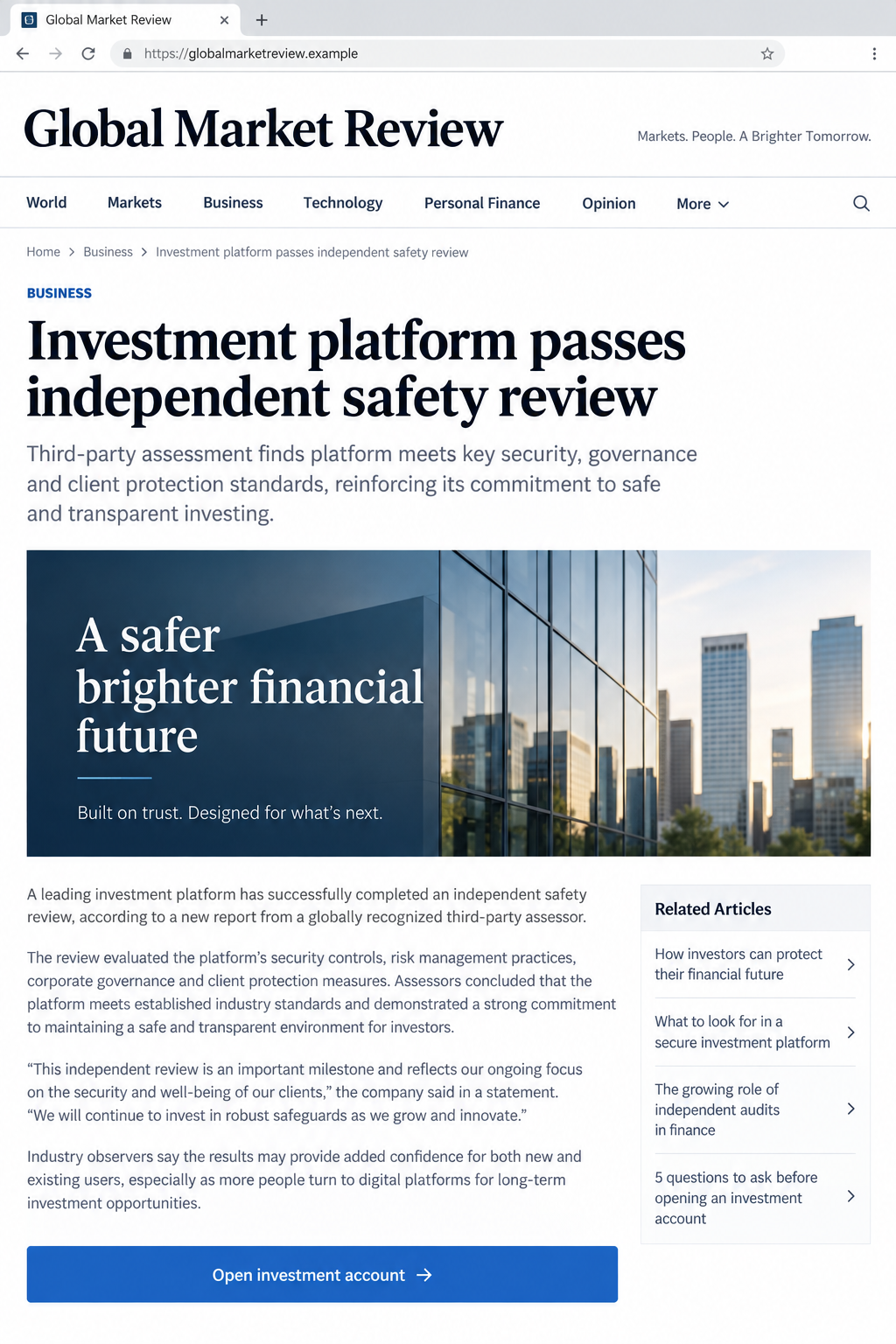
The fake Reuters investment safety review scam uses a counterfeit news page to give an investment platform undeserved credibility. The real news organization is not involved.
Australia’s Scamwatch reported a fake Reuters webpage that claimed a fraudulent platform had passed safety checks and held an “official partnership” with Reuters.
The page directed readers toward account registration. That is the point where a supposed article stops functioning as reporting and starts acting as recruitment.
A polished masthead can be invented quickly. A claimed independent review matters only if the reviewer, findings, and publication can be verified elsewhere.
The broader path into the article
A visitor may arrive through a social post, a friendly group chat, or a recommendation from someone they know. The link feels warmer than a random advertisement.
Scamwatch also describes unrelated-interest WhatsApp groups, such as fishing or sport chats, that later introduce a fake investment expert and platform.
Those entry points need not appear in every case. The fake news page can stand alone, or it can reinforce weeks of conversation inside a group.
The common factor is borrowed trust. A friend, a news brand, and a tidy account dashboard each supply a different reason to stop asking questions.
What to verify before sending money
Do not treat a page’s design, a celebrity reference, or a displayed “safety review” as independent proof. Verify the entity and its authorization outside the page.
- Search the actual news outlet’s own website for the claimed story.
- Read the full address, not just the masthead.
- Check the investment business against its regulator.
- Refuse any fee demanded to release a withdrawal.
Even a real news report is not a license for a trading platform. A publication can cover a company without recommending or guaranteeing it.
How the Fake Investment News Scam Works
Step 1: Meet the reader where they already spend time
Investment scams do not always open with a promise of instant wealth. Some begin inside a social group devoted to an entirely different shared interest.
Scamwatch describes chats built around hobbies such as fishing or sport. That atmosphere makes a later money conversation feel like advice from acquaintances.
Another path is a recommendation from a friend. The friend may honestly believe the platform is profitable because their own account displays rising figures.
Some promoters receive a referral commission, while others are victims themselves. Do not accuse the person who sent the link without understanding their situation.
The scammer only needs the link to arrive with enough social proof that you read the page. The apparent endorsement does the rest.
Step 2: Dress an advertisement as independent reporting
The counterfeit page resembles a mainstream business article, complete with headline, masthead, layout, and language about safety checks.
Scamwatch’s example falsely used Reuters branding and claimed an official partnership. The real Reuters site did not certify the investment platform.
The word “review” is useful to the criminal because readers understand it as an outside assessment. Without evidence, it is only a claim on a web page.
A fake story may mention a celebrity indirectly rather than showing a blatant endorsement. A reader follows the celebrity angle and then meets the platform pitch.
That is why checking a quote or photograph alone is insufficient. The article’s location, author, links, and claimed approval all need independent confirmation.
Step 3: Make the next click feel like ordinary research
The article may contain a button to learn more, read the review, or open an account. It leads away from the news-looking page to a registration form.
The transition is subtle. A reader who came seeking verification is asked to begin investing before any regulator or company details have been established.
The fake masthead supplies the impression of scrutiny, but the sign-up flow is controlled by the seller. The two pages may belong to the same operation.
Before entering a name or phone number, go to the real news organization’s site independently and search for the article there.
If it cannot be found, do not let the fake page explain the absence with a story about deleted links or exclusive access.
Step 4: Use a tidy dashboard to make deposits feel successful
After registration, the platform may show a balance and a sequence of gains. A screen can display numbers without proving the assets exist.
Scamwatch says some fraudsters allow a small withdrawal to encourage a larger deposit. That test payment is a persuasion tactic, not independent proof of solvency.
A trading dashboard can display profits and demand a withdrawal fee without holding a real investment. Verify the operator before paying anything further.
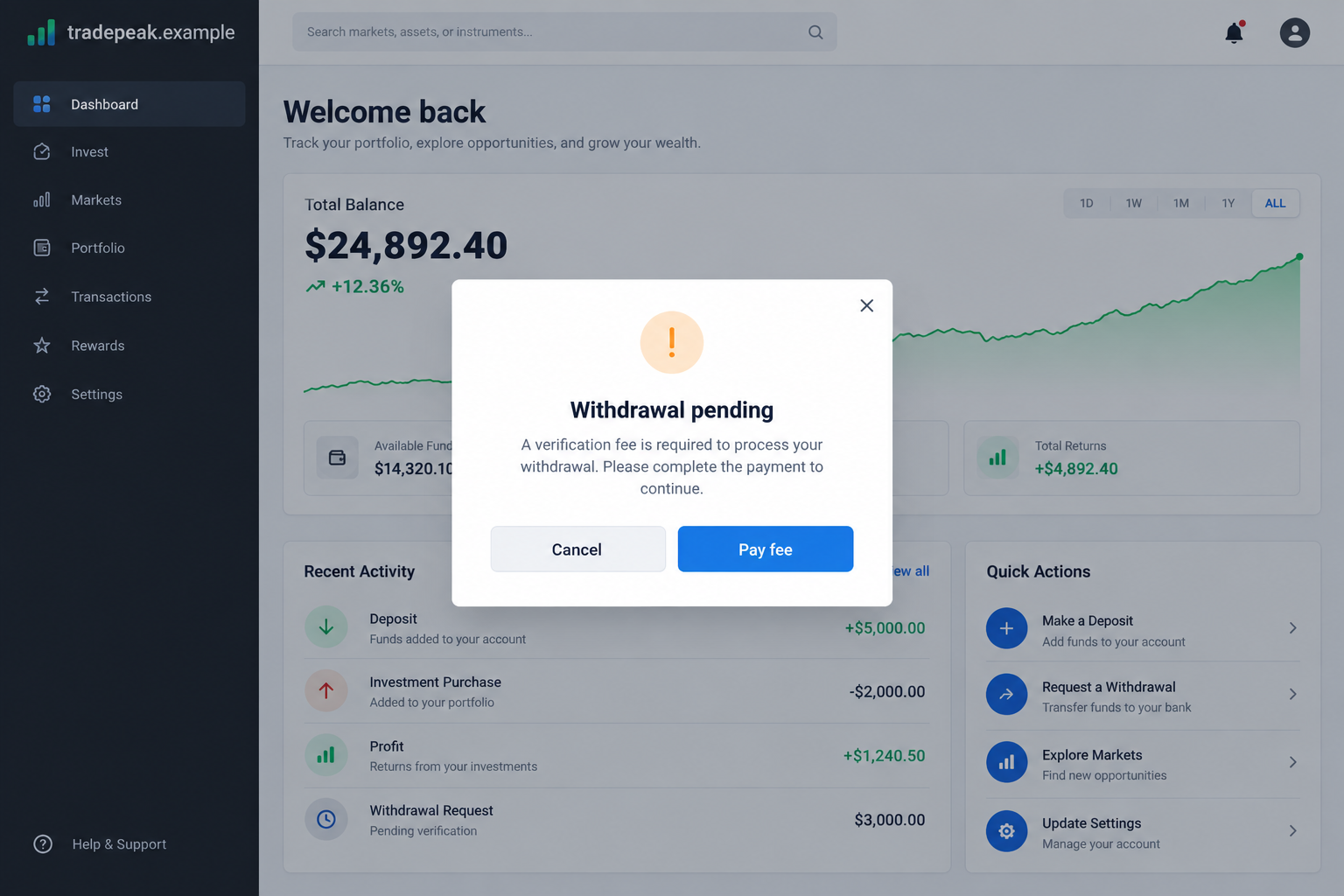
Imagine depositing $500 and seeing $640 on the account page a week later. Unless you can withdraw it freely, that number may be only a display value.
A legitimate investment can lose money, and a legitimate broker can impose disclosed fees. The red flag is an unexpected new payment required to release your own funds.
Keep copies of the terms and transaction instructions. The details may change once you ask to withdraw.
Step 5: Turn a withdrawal request into another payment
When the investor asks for money back, the platform may demand a tax, account verification charge, anti-money-laundering deposit, or other invented condition.
Scamwatch says victims may be asked for additional fees or taxes and still never receive the money. The fee is part of the loss, not a release mechanism.
The person in the group may urge patience and say they paid the same charge successfully. That reassurance can come from an accomplice or another deceived investor.
Do not send more funds to “unlock” a balance. Contact your bank or exchange instead and preserve records while recovery options are still available.
A disappearing support agent, changed rules, and repeated extensions are not normal investment risk. They are signs the displayed balance may be fictional.
Step 6: Recycle the story under another name
When a fake platform attracts complaints, the same promotional path can be reused with a different brand. The news-looking endorsement remains the central trick.
This is why an article focused only on one platform name can miss the lasting lesson. The address and entity change faster than the deception.
The counterfeit safety claim tries to replace due diligence with the appearance of due diligence. The reader must perform that check independently.
A later “recovery firm” may claim it found the lost balance and ask for a fee. Treat that contact as another unverified approach.
Real asset tracing is complex. Anyone promising guaranteed recovery from a message or social profile deserves particular skepticism.
Why the Fake News Page Feels More Trustworthy Than an Ad
It borrows an institution’s reputation
A news masthead implies editorial standards, reporters, and legal accountability. A copied logo can convey those associations even when the page is controlled by criminals.
Readers may remember seeing the brand before and stop at recognition. The actual domain may contain extra words, a different ending, or a misleading subdomain.
A search engine result or social preview can hide the full address. Open the publication’s home page yourself and locate the story through its own navigation.
Do not assume a matching headline is enough. Counterfeit pages can copy real headlines while inserting an unrelated investment call to action.
It gives the reader the answer they wanted
Someone considering an unfamiliar trading platform wants reassurance. A page announcing a passed safety review appears to solve that problem instantly.
Yet a genuine audit should identify who conducted it, what was tested, when it happened, and where the full report can be read.
“Official partnership” is also a vague phrase. A news outlet does not ordinarily guarantee the safety or returns of a platform it covers.
If the claim is real, both organizations should be able to verify it through their own official channels. If only the sales page says it, stop.
It moves from storytelling to transaction quietly
A normal article may link to background material. A fake investment article often turns the reader toward immediate registration and a deposit.
Look for urgency language near the sign-up button, such as limited places or access closing soon. A safety review should not require haste.
The page may feature a short form that asks for a phone number. That gives a salesperson a way to continue the pitch directly.
Do not mistake a sophisticated page for an independent publication. The economic purpose of the link is what reveals the funnel.
Independent Checks Before You Open an Investment Account
Search the outlet’s official domain for the exact article title. If the supposed review exists only on a lookalike address, it has not been verified.
Find the legal name of the investment operator, not only the trading brand. A trading name can be changed overnight; licensing belongs to an identifiable entity.
For Australian services, Scamwatch points to the Australian financial services license register. Elsewhere, use the regulator that oversees investment providers in your jurisdiction.
Compare the registered company, license number, address, and contact details. Fraudsters can copy a real license number while using a different site or phone.
Call the licensed firm through contact details on the regulator’s record. Ask whether the exact website and account invitation belong to it.
Check whether the platform explains custody, withdrawals, fees, and risk in plain language. Guaranteed or unusually consistent returns are a warning sign.
Be wary of a referral from a person whose only evidence is a screenshot of profits. An image can show what a platform wants users to believe.
Do not let a small successful withdrawal settle the question. Scamwatch says that payment can be used to win trust before much larger deposits.
Finally, decide whether you would use the platform without the fake news story. If the story is the sole reason to trust it, the foundation is weak.
What to Do If You Invested Through a Fake News Link
- Stop sending money. Do not pay a tax, clearance fee, or verification deposit to release a displayed balance. More payments can deepen the loss.
- Contact your bank or exchange quickly. Explain the suspected investment fraud and ask about recalls, disputes, account safeguards, or tracing options relevant to the payment method.
- Save the evidence. Keep the fake article URL, chat invitations, contact names, transaction records, wallet addresses, screenshots, and withdrawal demands.
- Secure accounts used during registration. Change reused passwords, enable MFA, and check email for forwarding rules or unfamiliar sessions.
- Warn friends carefully. Tell anyone you referred that the news endorsement was false. Avoid blaming a contact who may also have been deceived.
- Report to the appropriate authority. In Australia, use Scamwatch and your financial regulator. In the United States, report to the FTC and IC3.
- Reject recovery approaches. Do not share wallet recovery phrases, identity documents, or more money with strangers offering to retrieve lost funds.
If a suspicious file was downloaded, run a reputable Malwarebytes scan before using that device for banking. AdGuard may block harmful ads but cannot reverse transfers.
If you only read the page and did not submit details, close it and report the impersonation to the real news outlet. There may be no account exposure.
Payments by bank transfer, card, and crypto have different recovery options. Give your provider precise dates and identifiers rather than assuming all transactions are irreversible.
Be cautious about public posts asking for help. Fraudsters search those posts for people they can target again under the guise of asset recovery.
Frequently Asked Questions
Did Reuters endorse the investment platform?
No. Scamwatch described a counterfeit Reuters page that falsely claimed safety checks and an official partnership. The real outlet was impersonated.
Is a news article enough to prove a platform is regulated?
No. Verify the legal operator and its authorization with the relevant regulator, using contact details you found outside the article.
What if a friend sent me the link?
Your friend may have been deceived as well. Check the page independently and warn them if its domain or claims do not withstand verification.
Does a small successful withdrawal prove the platform is real?
Not necessarily. Scamwatch says scammers sometimes permit small withdrawals to encourage larger deposits before blocking later requests.
Should I pay a tax to release my profits?
No unexpected platform demand should be accepted without independent verification. Stop and speak to your bank or exchange before sending more funds.
Can a fake news page steal money without my registering?
Reading alone does not transfer funds. The risk rises when you submit personal data, install software, or deposit money through the linked platform.
The Bottom Line
A counterfeit news article can turn an unknown investment pitch into something that feels independently checked. The page’s authority is the illusion.
Verify the story on the real outlet and the operator with a regulator. If a withdrawal triggers new fees, stop paying and seek help immediately.

Join the discussion
0 commentsShare your experience or ask a question about this article.
Discussion
Start the conversation
Have a question or something useful to share? Add the first comment.