

Revoraco presents a pair of sculpted slides as a surprise find: striking shape, bargain price, and enthusiastic buyers apparently rushing to order.
It takes only a minute to reach the checkout. It takes longer to understand the names, shipping times, and guarantees scattered across the store.
Overview
The offer on the slides page
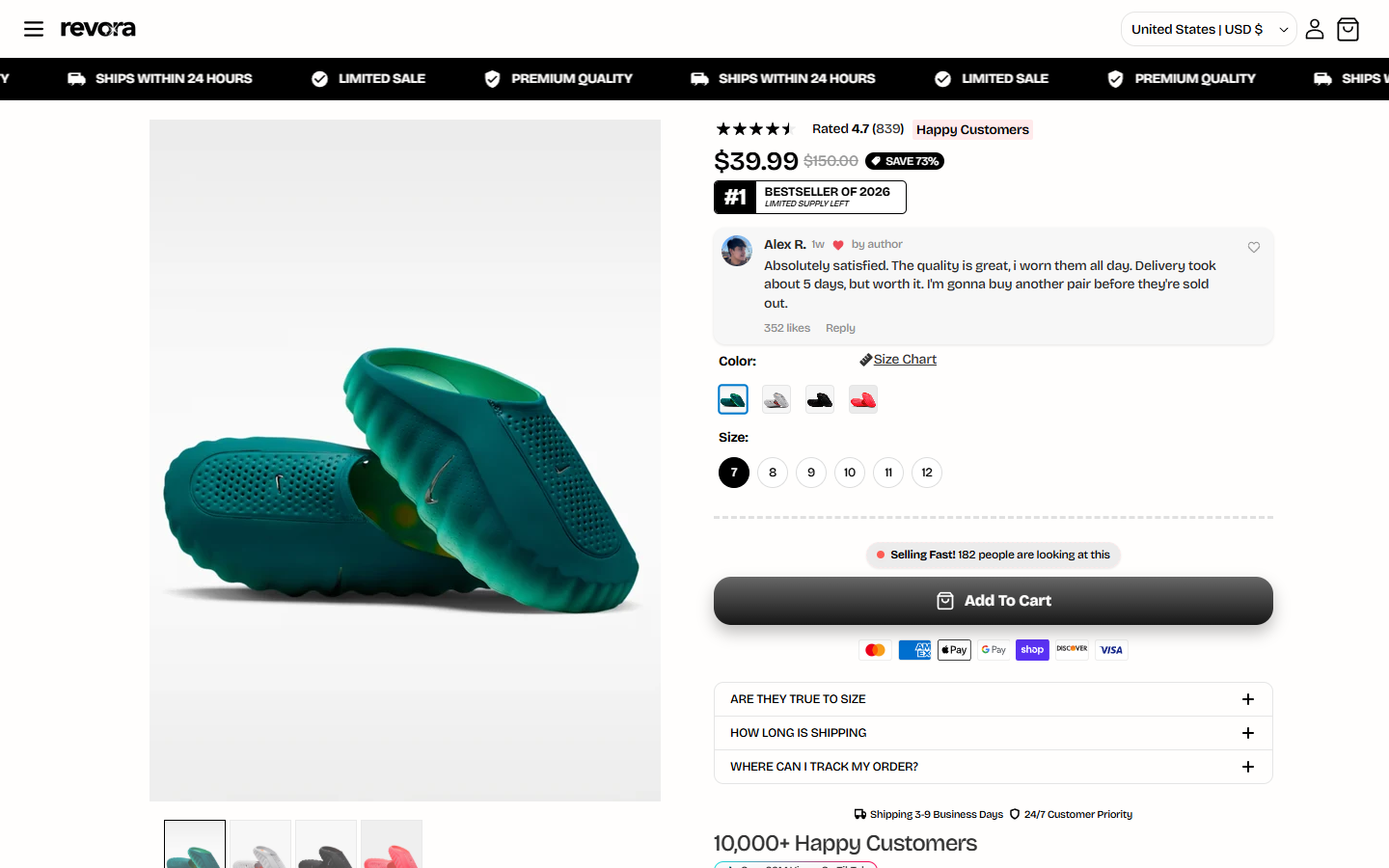
Revoraco sells molded slides in several colors and sizes. At our October 1 review, the product page displayed $39.99 against a $150 reference price.
It also showed 839 ratings, a best-seller badge, a moving count of current viewers, and a claim of more than 10,000 happy customers.
Those numbers are part of the seller’s presentation. We did not receive independent order records or a sample pair to verify them.
The discrepancies we could check
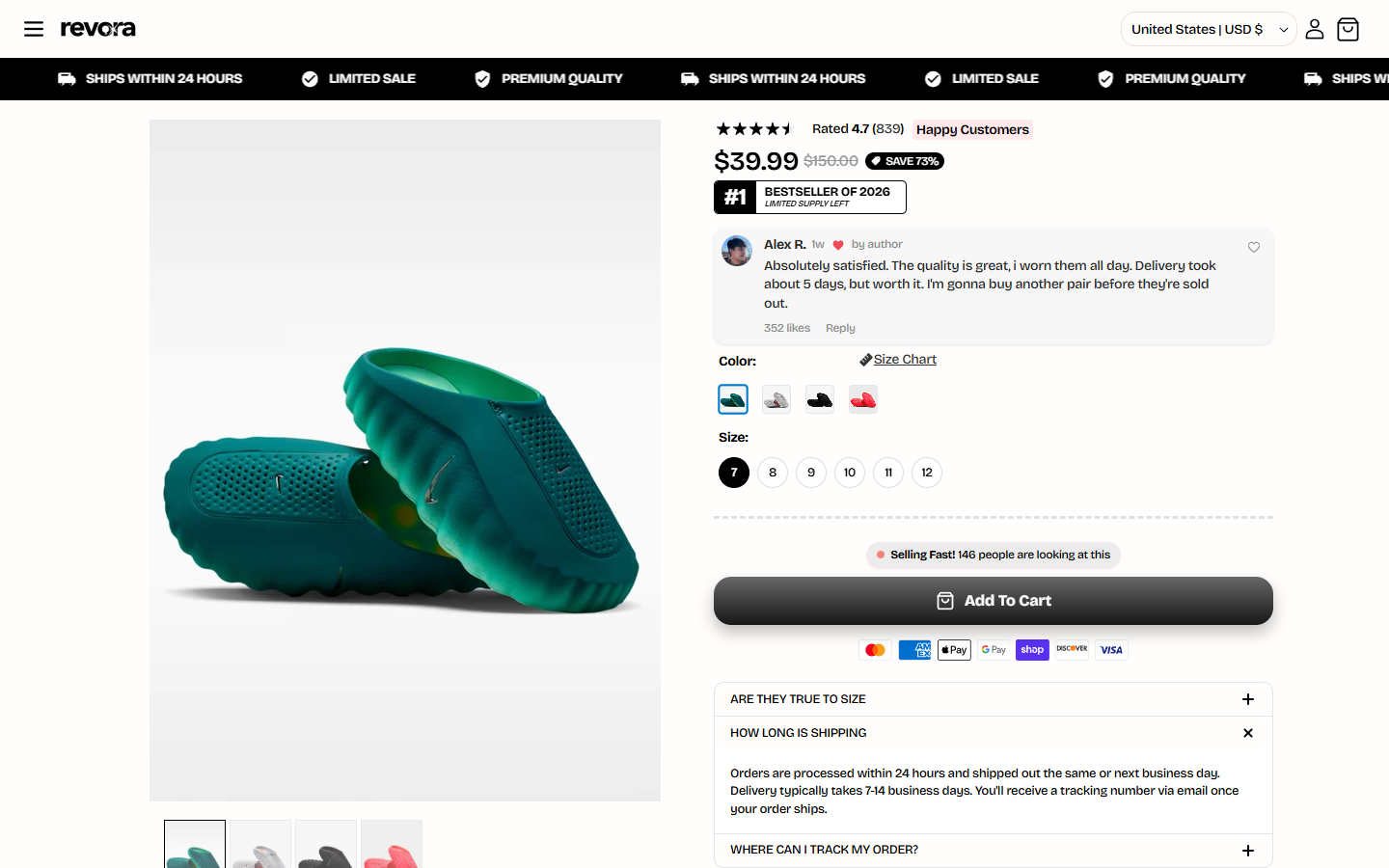
The product accordion says delivery generally takes 7–14 business days. A nearby badge says 3–9, while the FAQ adds 2–5 processing days.
The About page repeatedly calls the business Coma, then Revora. The domain and page footer use revoraco, making the identity hard to follow.
The terms page also names coma and leaves a policy link placeholder. That is especially unhelpful when a buyer wants the actual refund rules.
The evidence-based takeaway
These are observable marketing and transparency problems. They do not establish that every pair is counterfeit, undelivered, or the subject of a subscription.
- The advertised slide price was $39.99 during our check.
- Several social-proof figures appear without independently verifiable sales records.
- Three delivery descriptions give different expectations.
- The store uses revoraco, Revora, and Coma in customer-facing pages.
- An optional $4.99 shipping-insurance item appears in the cart interface.
A shopper should settle the total charge, real delivery window, seller identity, and return procedure before paying for the headline discount.
Why the Price and Reviews Feel Persuasive
The crossed-out price creates a value anchor
A $39.99 item can look ordinary. Place $150 beside it, and the same item suddenly looks like an unusually smart bargain.
The product page calculates a 73% saving. That arithmetic does not tell us whether these slides regularly sold for the higher number.
To judge value, compare material, sizing, sole design, warranty, and delivered cost with similar slides from established retailers.
Consider whether the distinctive shape is a patented design, a licensed product, or a common molded style. The website does not establish exclusive manufacture.
We did not identify the factory from the page. A photograph of footwear cannot prove it came from China or any other country.
The practical test is the product itself: fit, grip, finish, smell, comfort after wear, and whether the item matches the listing.
Several popularity claims reinforce each other
The site displays ratings, a high customer total, a TikTok view claim, and a number of people supposedly looking at the page now.
A moving viewer count is an urgency cue, not proof of inventory. We observed it change between page loads, but cannot audit its calculation.
Likewise, a site-hosted review card may describe a real buyer, a selected buyer, or marketing copy. We cannot determine authenticity from its layout.
The homepage claims a different aggregate, more than 2,500 verified buyers. Different figures might measure different things, but the site does not explain them.
Ask whether the reviews are collected by an independent platform and whether negative ratings can be displayed. A row of stars alone answers neither question.
Most importantly, do not let other people’s alleged satisfaction replace a check of your own size, delivery address, and return rights.
The product page speaks in two delivery voices
Click the shipping question under the size selector and it says delivery usually takes 7–14 business days after quick processing.
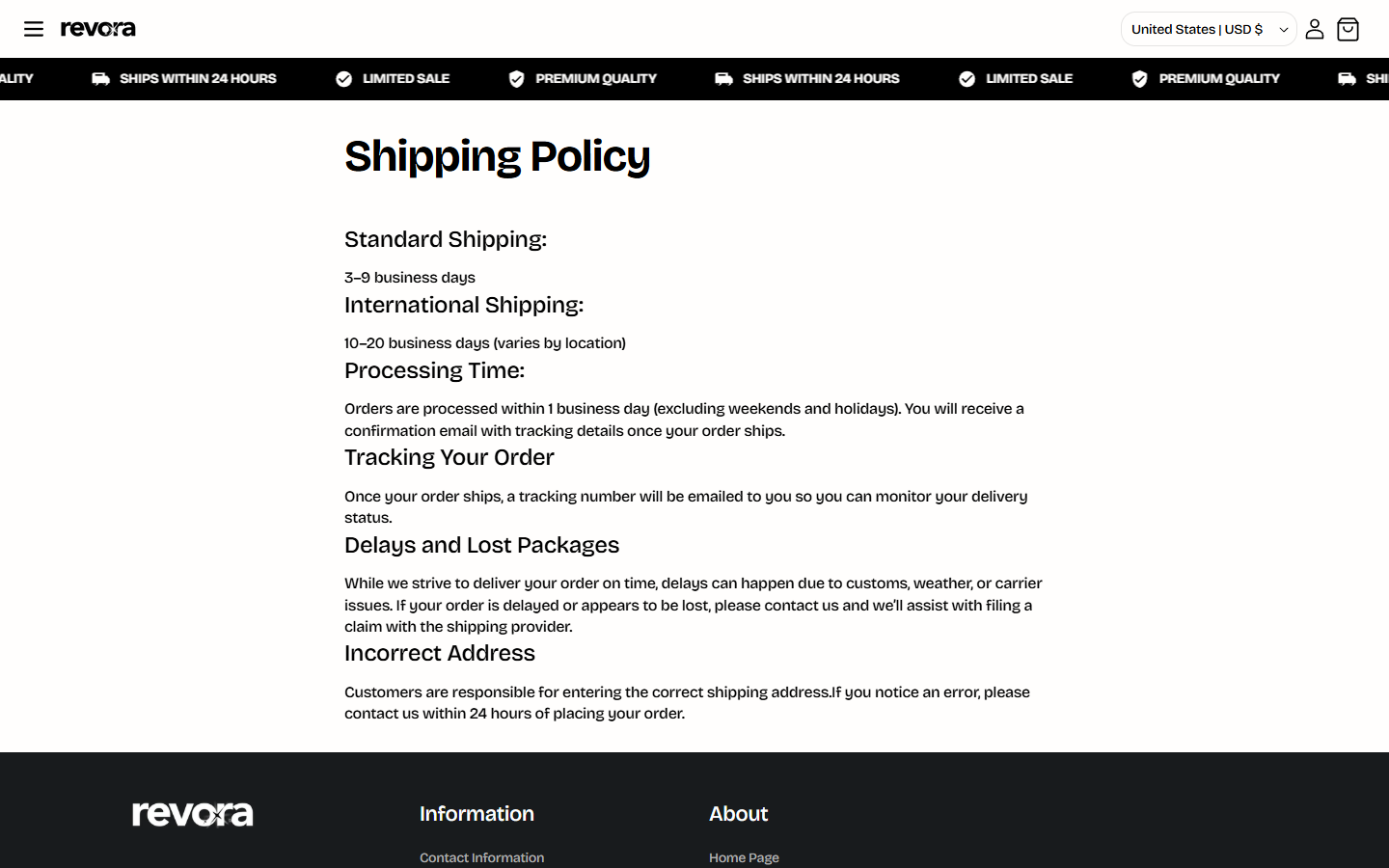
The badge beneath the same panel says 3–9 business days. Its separate shipping policy also uses the shorter range for standard shipping.
Then the FAQ says United States orders take 7–14 business days plus another 2–5 for processing.
Those are materially different expectations if you need the slides for a trip or a gift. Clarify which estimate applies to your address.
How the Revoraco Sales Funnel Works
Step 1: A visual-first product reaches the shopper
The slides’ ridged shape and bright color do much of the work. A short video or product image can make them look more distinctive than text would.
We did not verify any particular advertisement as deceptive. The store’s live page continues the visual pitch with a large photo and prominent color choices.
Before clicking buy, note whether the displayed photo corresponds to your selected color. Lighting and edited backgrounds can change how a material appears.
Check the size chart rather than assuming a familiar size number will fit a different molded design.
Step 2: The discount and best-seller labels compress deliberation
The offer presents a steep discount and phrases such as limited supply. Together, they encourage choosing a size before investigating the seller.
These phrases are marketing claims, not a clock on your consumer rights. There is no reason to rush past the policy links.
If you are unsure, leave the page and compare specifications elsewhere. A deal that only works when you skip basic checks is not much of a deal.
Step 3: Testimonials make quality seem settled
A review card near the buy button describes a buyer wearing the slides all day. Lower down, more stories discuss comfort and appearance.
None of that substitutes for independent testing. People have different foot shapes, and a soft first impression can change after longer use.
A sensible review would discuss arch support, friction, sole wear, slipping when wet, and the accuracy of the size chart.
The page does not give a controlled comparison. Treat praise as a prompt for questions, not proof the slides are worth a reference price.
Step 4: The cart may add another charge
The cart interface advertises shipping insurance for $4.99. The description says it protects against loss, damage, or theft.
We did not pay for an order, so we cannot say whether the option is always preselected or whether any buyer was unknowingly charged.
At the payment screen, look for the final line items and remove extras you did not choose. Screenshot the total before authorizing it.
Ask what the insurance covers that ordinary seller obligations do not. The answer may depend on where you live and the exact transaction terms.
Step 5: The promised delivery window becomes uncertain
The product answer, small badge, policy page, and FAQ do not describe one consistent timetable. Shipping and processing also appear to be counted differently.
Save the estimate shown at your checkout. If it changes later, that specific representation may matter more than a general site banner.
The shipping policy mentions possible customs delays, but does not identify the dispatch country for this particular pair.
A tracking number can help establish when a carrier actually received the parcel. An email saying shipped is not always the same event.
Step 6: A return request runs into unclear ownership
Revoraco displays a 30-day money-back assurance. Its FAQ says the customer may contact support for a replacement or appropriate resolution.
The FAQ also directs shoppers to a Refund Policy page, but that page was not among the prominent footer links we examined.
Meanwhile the About and terms pages use Coma, and some copy says Revora. A buyer should know which entity is actually responsible.
Ask support to provide its full return policy, authorized address, and merchant name in writing before relying on the badge.
Company, Address, and Fulfillment Checks
Three names appear where one seller should be clear
The domain says revoraco. The storefront repeatedly displays Revora. The About page says Coma, while also referring to Revora.
The terms page opens by naming coma as the operator and includes a bracketed policy-link placeholder.
Brand reuse and unfinished templates are possible explanations. Neither lets us identify the precise legal merchant from the text shown.
Ask for the full legal business name on the invoice. Check whether the card statement matches that answer.
This is not just a branding puzzle. When a return is contested, the contracting seller’s name determines which business should explain the charge.
A site can legitimately operate several labels. It should still connect those labels clearly enough that customers know who took their payment.
A contact form is not a physical return destination
The contact page calls the business family-owned and offers a message form. We did not see a full mailing address or registered entity there.
A form may be a legitimate support channel. It simply does not tell a buyer where a return goes or who would answer a formal dispute.
Use it to request a case number and an email copy of your message. If the form does not provide one, save a screenshot before submission.
Look for a mailing address on the order confirmation rather than assuming the contact form doubles as a return route.
Promises about response need an actual test
The page uses reassuring language about listening to customers. We did not send a test order inquiry or measure response time.
Before buying, ask whether your chosen size is returnable after trying it indoors and who pays postage if it does not fit.
Specific answers reveal more than a generic promise that support cares. Do not assume a 30-day badge covers worn footwear.
Origin and quality remain unverified
Nothing in our review established a manufacturer, production country, or independent material test for the slides.
Footwear can be made overseas and sold honestly. The risk here is paying a premium justified by unsupported exclusivity or quality claims.
Ask for material composition, care instructions, model identification, and country of origin. Compare them with the item and label delivered.
If the seller cannot provide those basics, the real value proposition becomes much harder to evaluate.
The site also lists other clothing in its catalog. A broad catalog is not suspicious by itself, but it makes product-specific sourcing information more important.
A Better Way to Evaluate the Slides
Start with fit, not a countdown
Print or measure your foot length and compare it with the store’s exact chart. If between sizes, ask about the width and toe-room dimensions.
Comfort claims are personal. A pair can feel soft for ten minutes and still cause rubbing after an afternoon.
Before ordering, decide how you would test them without violating any return condition. Request that condition from support first.
Compare the full delivered price
Write down the $39.99 product price, possible insurance, shipping, and taxes. Then compare the total with similar slides from a store with clear returns.
A cheaper headline can lose its advantage if the return address is far away or the buyer must pay high postage.
Conversely, these slides may be perfectly serviceable for someone who likes the design. The point is to choose with the hidden practical costs visible.
What to Do If You Ordered Revoraco Slides
- Save the order screen. Record the chosen color, size, add-ons, price, shipping estimate, and receipt before promotional copy changes.
- Check the payment amount. Compare the card charge with the authorized total. Ask the merchant about any extra $4.99 protection charge you did not select.
- Watch tracking dates. Keep the confirmation, dispatch email, first carrier scan, and delivery record. These help clarify a dispute over the shipping estimate.
- Inspect before extended wear. Photograph the label, sole, size marking, and any damage. Try the slides only as necessary to check fit until the return rule is clear.
- Request a precise resolution. Tell support whether the item is wrong, damaged, late, or simply unsuitable. Ask for the full policy and approved return address.
- Escalate unresolved billing or non-delivery. If direct support fails, ask your card issuer about dispute deadlines and supply the receipt, tracking, images, and messages.
Do not send the slides to an address guessed from a domain lookup. Use only a confirmed return destination tied to your order.
If you leave a public review, describe your own experience precisely. Avoid repeating unverified claims about other customers or the seller’s intentions.
Frequently Asked Questions
Is Revoraco a confirmed scam?
No. We documented conflicting shipping information and confused seller naming, but did not establish criminal fraud or inspect a delivered pair.
Are the slides really worth $150?
The site shows that as a reference price. We could not verify a meaningful history of sales at that figure, so compare similar products.
How long does Revoraco shipping take?
Different site sections say 3–9 or 7–14 business days, with the FAQ adding processing time. Ask which estimate governs your order.
Is shipping insurance mandatory?
The cart displays it as a $4.99 offer. Review the actual selected line items before payment; we did not complete a checkout.
Who runs revoraco.com?
Customer-facing pages use revoraco, Revora, and Coma. Ask for the legal merchant’s name, address, and invoice details before ordering.
Can I return slides that do not fit?
The site advertises 30-day satisfaction, but the visible FAQ does not spell out all footwear conditions. Obtain the full rule in writing.
The Bottom Line
Revoraco’s slides might appeal on shape and price. The same pages that promote them leave basic questions about delivery, seller identity, and returns unresolved.
Check the final charge and ask for written terms before letting a steep discount and moving popularity counter make the decision.

Join the discussion
0 commentsShare your experience or ask a question about this article.
Discussion
Start the conversation
Have a question or something useful to share? Add the first comment.