


Your internet bill just went up again, and a grandfather’s story promises a way out: one small device, no SIM, no contract and, he swears, no monthly bill ever.
The InfiniteFi ad page tells that story beautifully, but the product photo, the fine print and the order page waiting behind it each tell a slightly different one.
Overview
The pitch: internet with no provider
The page announces itself as an Advertorial in a thin black bar, then settles into the voice of a personal essay by a man named Gary Thompson.
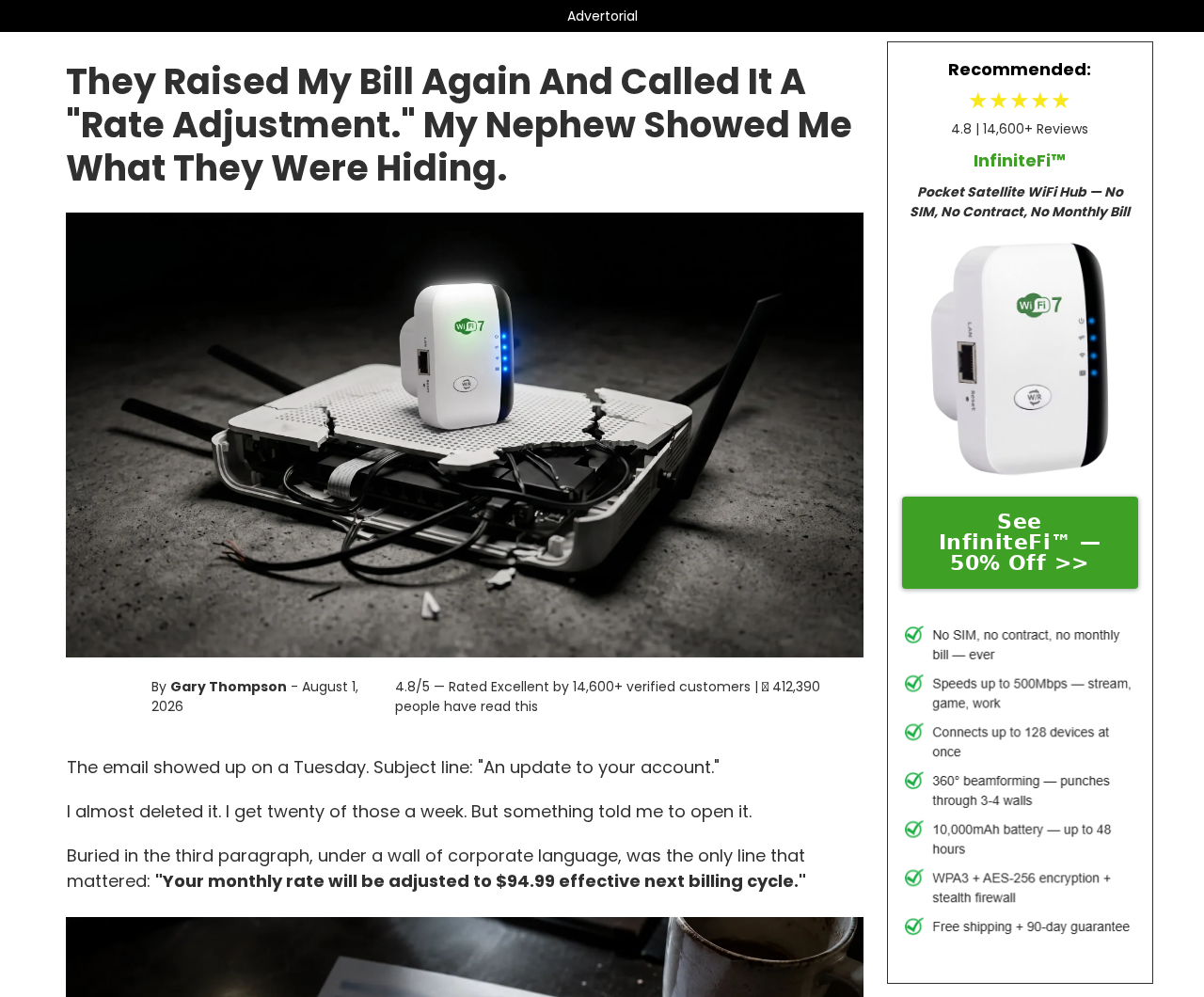
Thompson says a rate hike pushed his internet bill to $94.99, until his nephew, a telecom insider in the story, showed him a white gadget called InfiniteFi.
According to the nephew, he hasn’t paid an internet or hotspot bill in over a year, and the sidebar boils the whole promise down to a checklist:
- A pocket satellite WiFi hub that needs no SIM and no contract, with no monthly bill, ever.
- Speeds of up to 500 Mbps, shared by as many as 128 devices at once.
- A 10,000 mAh battery that is said to last up to 48 hours.
- A one-time price of $49, advertised at 50% off with free shipping.
- A 90-day money-back guarantee, backed by a 4.8-star rating from 14,600+ reviews.
What the page never explains
What the page never says is where the internet actually comes from: there’s no carrier, no satellite network, no manufacturer and no model number anywhere on it.
The closest thing to an explanation is a toll booth metaphor, in which the signal floats free in the air and providers simply charge you for walking through.
The device in the photo has a Wi-Fi 7 badge, an Ethernet port and a W/R button, so it looks like a plug-in range extender, not a satellite hub.
The copy also promises a small screen on the front, yet the photo shows only four indicator lights.
Alibaba, the wholesale marketplace, lists many plug-in repeaters with the same shape, LAN port and button layout, usually priced between $2 and $4 each.
Their suppliers are mostly in Shenzhen and other Chinese cities, they advertise 300 Mbps on 2.4 GHz, and none of the listing titles mentions Wi-Fi 7.
Whether InfiniteFi ships one of those units is impossible to say, because the page names no manufacturer and no model.
Where the money questions start
The funnel runs on try.inovirahome.com, a subdomain of a store whose footer names Inovira LLC, and the order page sits on that same subdomain.
That order page arrives with two add-ons already ticked: a $14.99 warranty, and a Rewards Club that is free for 28 days and then costs $31.73 a month.
So the advertorial’s promise of no monthly bill, ever, doesn’t survive contact with the checkout it leads to, where both boxes are checked before the buyer touches anything.
We didn’t place an order, so we can’t say what a card statement would eventually show.
The refund promises don’t line up either: 90 days in the advertorial, 180 on the order page, and only 30 days for unused, full-price items in the store’s policy.
That adds up to a firm recommendation: don’t buy InfiniteFi expecting internet with no provider and no bill, and if you already ordered, jump to the response section below.
Why a Pocket Box Cannot Replace Your Internet Provider
A device can share a connection but can’t conjure one, because every internet signal reaching your home or pocket travels over a network someone built and pays to run.
The FCC’s broadband guide spells out what satellite service really takes: a dish or base station, a satellite modem and a clear line of sight to the provider’s satellite.
InfiniteFi’s page describes a box that fits in a pocket and connects you “directly,” yet it mentions no dish and never names a satellite provider.
The other familiar way to carry internet around is a phone hotspot, which the FCC’s home network tips describe as sharing your cellular service with a laptop.
The same page advises checking your data plan for caps, which is a polite reminder that a hotspot still depends on a provider.
Satellite or cellular, neither route works without a provider, and that provider’s invoice is exactly the bill InfiniteFi says you can delete.
A range extender, which the pictured unit resembles, does something far more modest: it repeats a Wi-Fi network that already exists, so a weak signal reaches a bit farther.
Other sites using the name, including infinitefi.net and getinfinitefi.com, sell plug-in Wi-Fi range extenders and describe them as exactly that.
We can’t tell whether they share an operator with this advertorial, since a shared name alone proves nothing about who runs what.
These labels can’t be trusted anyway: one $2.90 wholesale listing says 802.11ax in its attribute table but only 300 Mbps on 2.4 GHz in its speed fields.
The advertorial’s proof is a speed test Marcus ran in front of the author, but a speed test only measures a connection; it can’t show who pays for it.
Wi-Fi 7 deserves a note too, since the badge sits on the unit: it’s a short-range standard for how your phone and laptop talk to a router or extender.
It says nothing about who supplies the internet behind that router, which is the one thing this page never explains.
The page insists that telecoms keep all this quiet, but if a $49 box really replaced a $95 plan, the news wouldn’t depend on a single advertorial to spread.
How the InfiniteFi Sales Funnel Works
Step 1: A bill-shock story opens the page
The first screen sells a feeling before it sells a device, with a headline that says a provider raised a bill, called it a rate adjustment and hid something.
A reader counter claims 412,390 people have read the piece and a rating bar boasts 4.8 stars from 14,600+ customers, though neither number comes with a source.
By the time the device finally appears, you’ve spent several paragraphs nodding along with the narrator about your own provider, which is exactly where the page wants you.
Step 2: A telecom insider supplies the authority
Marcus, the nephew, is introduced as a decade-long telecom insider, which makes him the page’s expert witness, even though nothing about him can be checked.
His argument is the toll booth: the road is built and free, someone put a booth on it, and everyone assumed they had to pay.
It’s a vivid picture that hides the real cost, because cell towers and satellites belong to companies that pay to build and run them.
The page adds that the device is completely legal but that no telecom would ever advertise it, a convenient way of explaining why you’ve never heard of it.
Step 3: Big specs arrive with no model name
The product section stacks up impressive figures: 500 Mbps, 128 devices, 360-degree beamforming, a 10,000 mAh battery, WPA3, AES-256 and a stealth firewall.
Each figure is the seller’s statement, and none links to a datasheet, a lab result or a regulatory filing, because the device has no model number to look up.
A model number matters because it’s how you find a manual, file a warranty claim or look up the device’s FCC filing if the unit ever misbehaves.
The sidebar photo and the hero photo show a white unit with the same Wi-Fi 7 badge, and the hero shot perches it on a smashed router.
The message is obvious: this box replaces your router. A plug-in extender, though, depends on your router to work at all, so it can’t do that.
Step 4: Testimonials appear that nobody can check
Four testimonials follow, each signed with a first name, a last initial and a city: Denise in Tampa, Curtis in Denver, Marie in Columbus and Anthony in Sacramento.
None carries a date or any way to be contacted. Denise, for example, says she cancelled Xfinity the week her unit arrived and now saves $88 a month.
The order page then repeats three of these testimonials word for word under different names: Denise becomes Jennifer, Marie becomes Bri and Curtis becomes Matt.
Each of the new names comes with a Verified Buyer badge, which is a lot of verification for words that first appeared under someone else’s name.
A note near the end of the advertorial says this price isn’t available on Amazon or in stores, which conveniently keeps independent reviews out of easy reach.
Step 5: Urgency and bundle pricing push a fast decision
Every few scrolls a banner returns with the same message: 50% off, free shipping, a batch that is moving fast and demand that has supposedly spiked.
The narrator’s brother orders two on the spot, and the order page confirms the logic: the per-unit price falls from $44.99 for one to $26.99 for five.
The math is made to feel generous, with $49 set against roughly $1,140 a year and a device that supposedly pays for itself in about two weeks.
That comparison only works, of course, if the device really replaces your provider, which is the one thing the page never demonstrates.
Step 6: The order page arrives with two boxes ticked
The green button in the sidebar leads to an order page on the same subdomain, which opens with the 3x bundle already selected.
That bundle is three units at $35.99 each, shown as 70% off $270, while a single unit costs $44.99 and the advertorial’s $49 price appears nowhere on the page.
Below the bundles sit two boxes, and both are already ticked when the page loads: the first adds an extended warranty for $14.99.
The second is labeled Yes! I want FREE Expedited Shipping + Rewards Club!
Its fine print says the club is free for 28 days and then costs $31.73 a month, which you can cancel anytime.
That contradicts the advertorial’s promise of no monthly bill, ever, and the box stays ticked unless the buyer notices it and unticks it.
In the order summary, the club shows up as Fast Track Savings Discounts Club, with delivery every 28 days, at $0.00 today.
The summary also lists Expedited Shipping at $9.95, even though the box promises free expedited shipping, and with the 3x bundle the total reads $117.94.
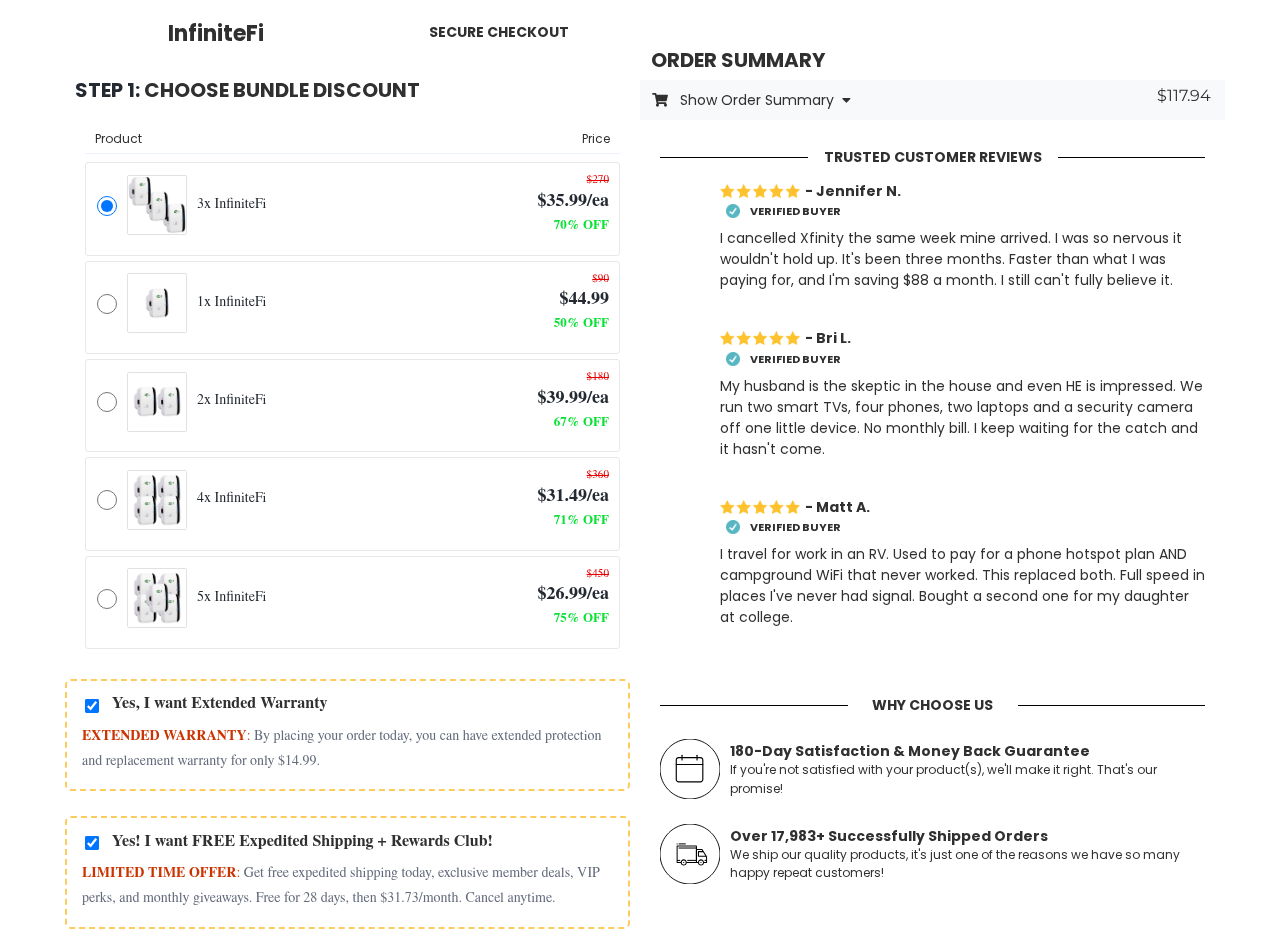
The page also promises a 180-day money-back guarantee, twice, which we’ll compare with the other refund promises further down.
Step 7: A second warranty offer follows the order
One more page of the flow can be opened without ordering anything, and its browser title reads IN – InfiniteFi V2 [NZ].
A progress bar at the top lists Checkout, Bonuses and Order Receipt with Bonuses highlighted, which suggests this add-on is offered once you’ve already checked out.
The order page already offered an extended warranty for $14.99, and this page offers a lifetime warranty for $9.95, labeled 70% off, for the same product.
Declining means clicking a sentence that says you accept regular replacement costs, which turns saying no into a small confession.

Two warranty prices one page apart are the kind of detail a rushed buyer never compares, but the refund line on this page matters more, as we’ll see below.
Step 8: A monthly club waits on the same domain
Inovira’s membership page introduces the Zenifynest Membership Club for $49.99 per month, promising wholesale prices, free shipping and priority support.
Step one on that page says to select VIP Add to Cart on any product, and to use the guest option if you want to pay full price.
Its FAQ then says that after a 12-day intro period you’ll be charged $29.99 a month until you cancel, and that the amount may be less but never more.
So the same page shows $49.99 at the top and $29.99 in the FAQ, and nothing explains which price applies to a buyer.
We examined the same club behind another offer in our VoltSaver X review.
Meanwhile, the store’s terms of service run to 24 sections and never mention a membership club, monthly billing or a subscription.
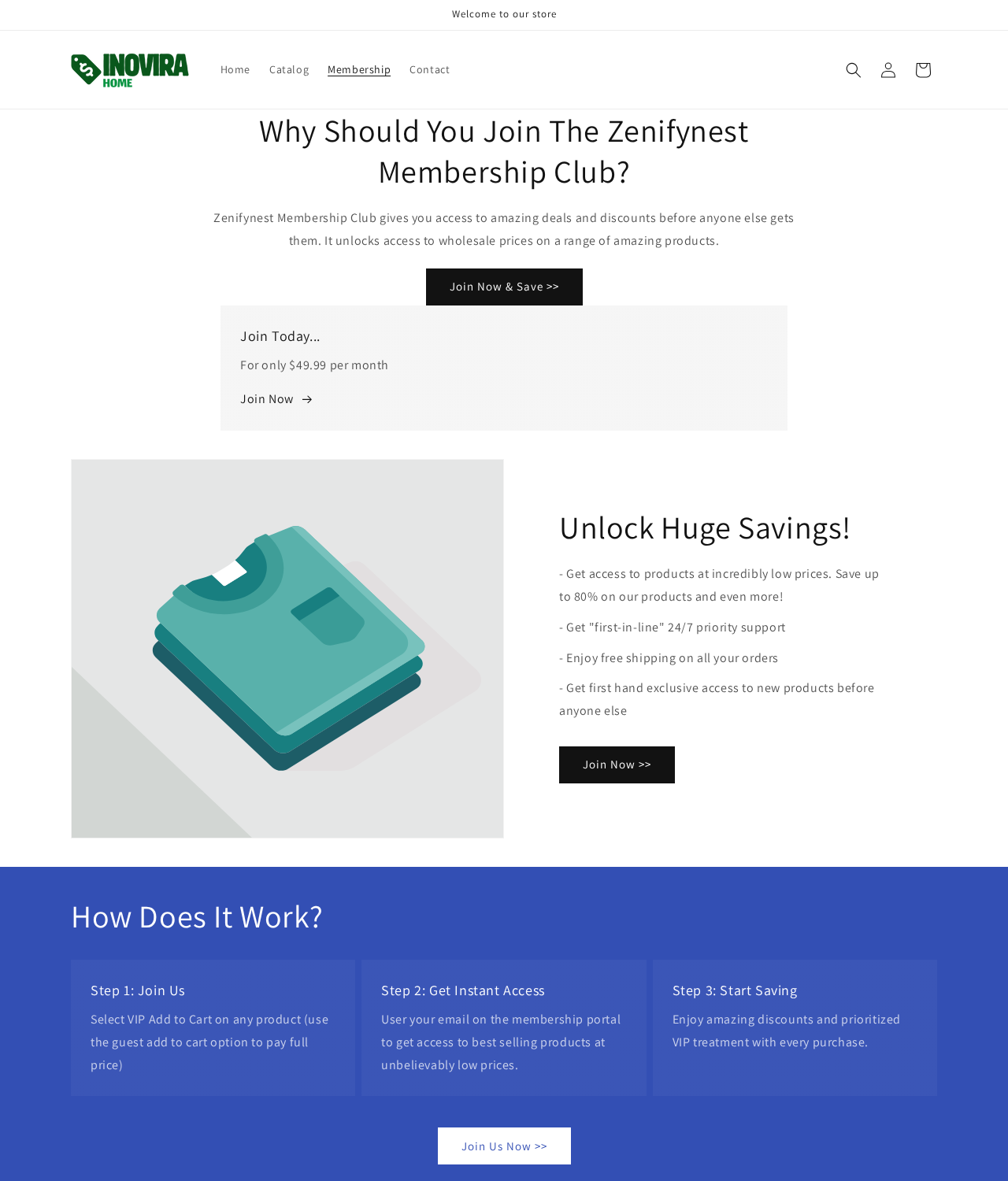
Whether this club and the order page’s Rewards Club are one program isn’t stated anywhere, and their terms differ: 12 days then $29.99 here, 28 days then $31.73 there.
If you’ve ordered, look through your confirmation email for any club, membership or VIP line.
Who Sells InfiniteFi, and Who Would Bill You?
The brand is not the legal company
Several names circle this offer. InfiniteFi is the product brand on the advertorial, while the store’s footer names Inovira LLC as the company behind the domain.
The club itself goes by three names: Zenifynest on the membership page, Rewards Club in the order-page box and Fast Track Savings Discounts Club in the order summary.
The membership page also lists its cancellation email at nuviohome.com rather than inovirahome.com, a different domain from the rest of the store.
Section 3 of the store’s terms adds another name, saying your order isn’t accepted until Natural Health confirms it, a company that appears nowhere else we looked.
That reads like leftover text from another seller’s terms, and it leaves a buyer unsure which business actually takes the order.
The obvious brand domain, infinitefi.com, now redirects to a GoDaddy for-sale page, while the store domain, inovirahome.com, was registered on March 26, 2026.
A registration date only dates the domain, but it does mean the store has had this web address for about seven months.
The address may be a mailbox or a depot
Every return goes to 260 Creek Stone Dr, Athens, Georgia 30601, the same address printed in the store’s footer.
We couldn’t tell whether that is an office, a home or a mail drop, and a web search found no business listing for Inovira LLC there.
The refund policy says returns need prior approval and that the store will send a label if it accepts your return, so the practical rule is simple.
Never mail a package to that address before you hold written approval and a prepaid label in your hands.
Support and cancellation must be reachable
The refund policy lists support@inovirahome.com for returns, while the membership page lists support@nuviohome.com and a phone number, +1 (681) 230-5117, for cancellations.
It also offers a cancellation form, which on the page we captured turns out to be a plain contact form with name, email, phone and comment boxes.
The page says cancellations are honored when requested at least three business days before the next billing date, so a late request may mean one more charge.
We didn’t call or email either contact and only read what the store publishes.
The supply chain must be traceable
Nothing we read names who makes InfiniteFi, who imports it or which model you receive, and without a model number you can’t check a manual or a warranty.
Wi-Fi hardware sold in the United States generally carries an FCC ID on its label, so look for it the day the box arrives.
Then compare the label and model with the photo on the page, since a unit with an Ethernet port is a different product from a pocket satellite hub.
Where the box ships from isn’t stated beyond the returns address, and the shipping policy promises delivery in 7 to 14 days.
Three Refund Promises That Cannot All Be True
The refund promise is the clearest test of any offer, and InfiniteFi’s pages make three of them that don’t line up.
The advertorial promises a 90-day money-back guarantee and advises running the device beside your current internet before cancelling anything.
The order page promises 180 days twice, and the warranty page repeats the 180-day figure in both columns while also noting there is no warranty after 30 days.
Inovira’s refund policy allows returns for 30 days after delivery, requires the item to be unused and in its original packaging, and refuses sale items.
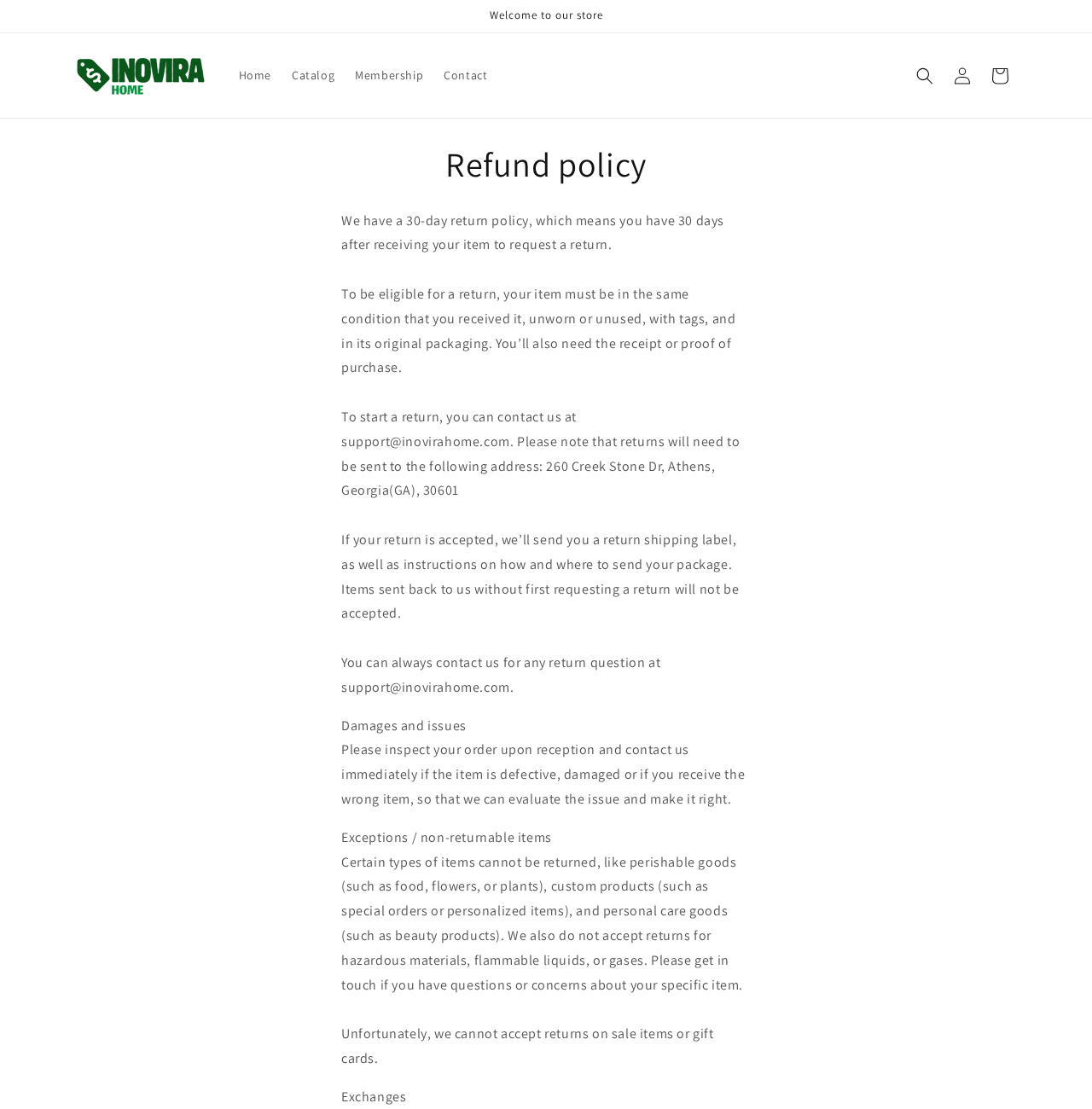
Put those together and a problem appears: read literally, a product advertised at 50% off is a sale item, and sale items can’t be returned.
A device you tested for weeks, as the advertorial recommends, is also no longer unused, so the advice and the policy pull in opposite directions.
Delivery speed gets the same treatment: the narrator’s unit arrived two days after he ordered, while the shipping policy says 7 to 14 days plus 48 hours of processing.
The policy also gives you only 12 hours after payment to cancel before dispatch, and after that you’re in the returns process.
The pages never say which promise governs an InfiniteFi order, so treat 30 days from delivery as your safe deadline and screenshot every promise you saw.
What to Do If You Ordered InfiniteFi
-
Keep your current internet for now. Don’t cancel your provider because of this page, and treat the device as an accessory rather than a replacement.
-
Read your confirmation email and card statement closely. Look for every charge and every company name, including Inovira, Zenifynest, Rewards Club and Fast Track Savings Discounts Club.
Check for either warranty too, and write down the exact merchant name on the statement, because that’s what your card issuer will search for.
-
Cancel the club in writing today. The order page says it is free for 28 days, so cancel before the free period ends to avoid the first $31.73 charge.
Reply to your order email, write to both support addresses and send the cancellation form, then keep a screenshot of every message you send.
-
Ask for a refund before the 30-day clock runs out. Quote the 180-day guarantee on the order page and the 90-day promise on the advertorial.
Request written approval and a prepaid return label, and don’t ship anything to Athens without both.
-
Call your card issuer. Explain that you were promised no monthly bill and ask how to dispute any recurring or unexpected charge.
Federal billing-error rules generally give you 60 days from the statement date, so don’t wait.
Federal law, 15 U.S.C. § 8403, requires online sellers of recurring charges to disclose all material terms before taking billing details and obtain express consent before charging, so cite it.
-
Document the device when it arrives. Photograph the box, the label and the unit, and note the model number and the FCC ID.
Keep your own router running while you test, and compare a speed test with the device unplugged and plugged in.
Then search the model number on Alibaba, and if an identical unit lists for about $3, put that in your refund request.
-
Report it. File a report at ReportFraud.ftc.gov and with your state attorney general, because reports on repeat offers are how regulators spot patterns.
Ignore anyone who contacts you offering to recover your money for a fee, because those offers are a well-known follow-up scam.
Frequently Asked Questions
Is InfiniteFi a real satellite internet device?
We found no evidence that it is: the page names no satellite provider, and the photo shows a unit that looks like a plug-in Wi-Fi extender.
Can a device give internet with no SIM, contract or monthly bill?
Only by sharing a connection that someone else pays for: a device can extend or share internet, but the service itself always comes from a provider.
Does InfiniteFi come with a monthly fee?
The advertorial says no, but the order page pre-ticks a Rewards Club that is free for 28 days and then $31.73 a month.
We didn’t place an order ourselves, so check the summary on your own screen before paying.
Which refund window applies?
The pages give 90, 180 and 30 days, so use 30 days from delivery as your deadline and ask for written confirmation of anything longer.
What does the Wi-Fi 7 badge mean?
It names a Wi-Fi standard for local wireless links between your devices and a router, and it doesn’t tell you where the internet connection comes from.
Is the Gary Thompson story real?
The page is labeled an advertorial, which means paid advertising, and we couldn’t verify Gary Thompson, his nephew or any of the customers quoted.
The Bottom Line
Do not buy InfiniteFi expecting internet with no provider: the page never explains where the signal comes from, and the pictured unit resembles repeaters wholesalers list for about $3.
The money side is no clearer, because the order page pre-ticks a club that bills $31.73 a month after 28 days while three different refund windows contradict each other.
If you already ordered, cancel the club in writing before day 28, ask for a refund within 30 days, and dispute any charge you didn’t clearly agree to.

Join the discussion
0 commentsShare your experience or ask a question about this article.
Discussion
Start the conversation
Have a question or something useful to share? Add the first comment.