


In the promotion, a man in a dark shirt introduced as Jason Cooper says a simple Wi-Fi trick can start paying you immediately, and the secret costs $67.
We could not reach the Smart AI System page, so the screens here come from a sister funnel we investigated earlier.
Overview
What the campaign promises
The promotion says you can connect your Wi-Fi, pay $67, and start earning immediately and endlessly.
It circulates as Smart AI System, Wi-Fi Profit System and a simple Wi-Fi trick, and it carries a 60-day money-back guarantee on the $67.
We could not open the sales page or find a website, so the details here come from public reports of the campaign and are not verified against the page.
Who the spokesperson is said to be
The man presented as Jason Cooper is said to be a paid spokesperson from an earlier scheme called Mobile Profits.
The new video is reportedly an AI-generated version built from his face, body and setting, which would mean he never recorded this particular pitch.
We could not confirm either claim without the page or a video file of the offer, and Jason Cooper may not be the actor’s real name.
Our investigation of the Mobile Profits site predates this campaign, and Trustpilot reviews there name a presenter other than Jason Cooper.
What we could and could not verify
Here is where each part of the story stands after our checks:
- Reported in public coverage: a $67 price, a 60-day guarantee, a spokesperson named Jason Cooper and an earlier Mobile Profits connection.
- Not found by us: a sales page, a domain, a named seller or any checkout we could read.
- Verified on official pages: how the JVZoo marketplace handles refunds, and what the FTC and Google say about fake endorsements.
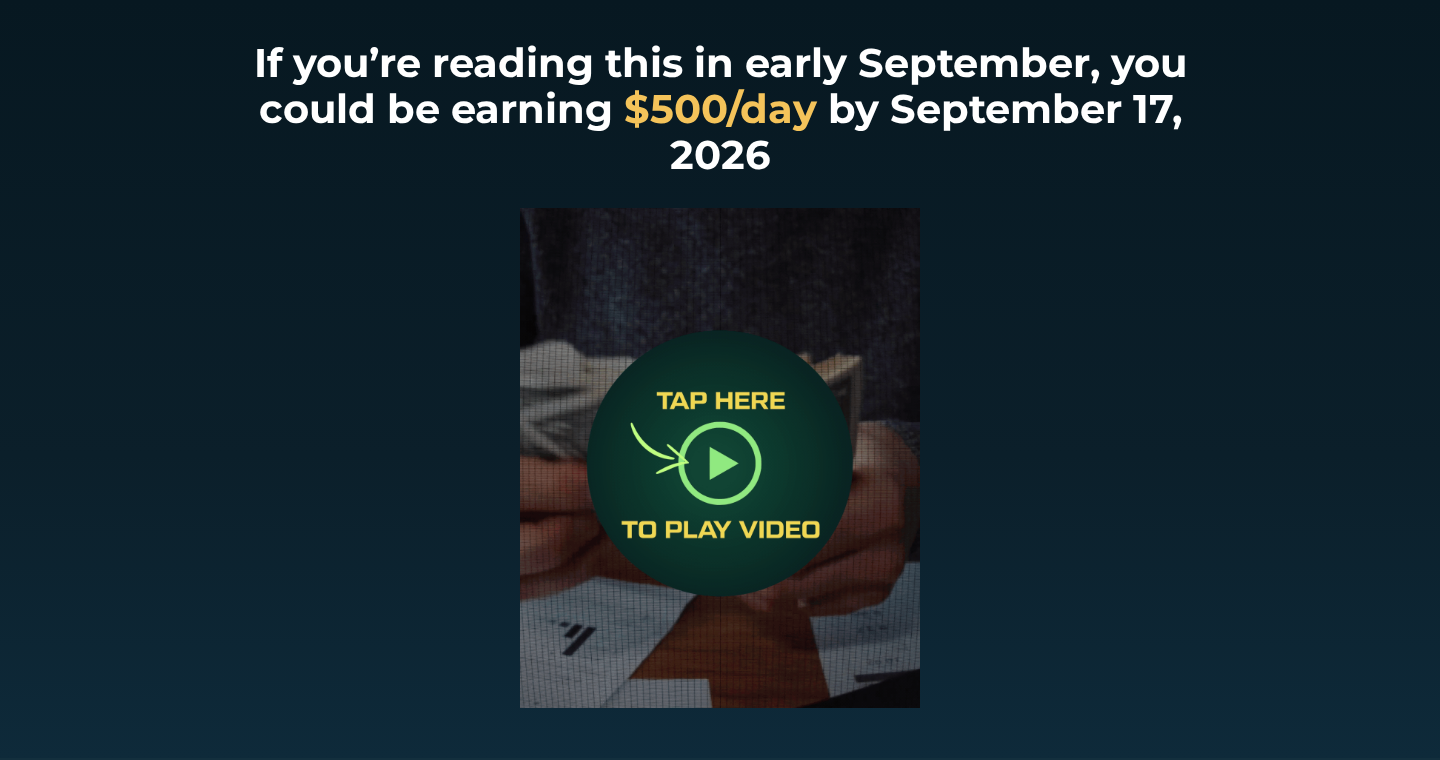
- Observed on a sister funnel: the $500 a day headline, the order-not-complete screen and the $147 upgrade shown in the images.
Our advice is not to pay, because a Wi-Fi connection cannot earn what the pitch promises, and the response section below covers anyone who already did.
What a Wi-Fi Connection Can and Cannot Earn
An internet connection is a pipe, not a business, and money only flows when a customer on the other end pays for something real.
One documented way to earn from a connection does exist: bandwidth-sharing apps such as Honeygain forward other companies’ traffic through your home network and pay you for it.
The terms of that app list the price: your provider may throttle or end your service, your IP address may land on blocklists, and you may meet more CAPTCHAs.
They also set a $20 minimum before you can cash out, and they describe business customers who use the traffic for tasks like ad verification and market research.
Nothing in the Smart AI System pitch, as reported, resembles that arrangement, because it names no customer, no service and no source for the money.
Federal regulations show what a seller of an income opportunity owes the buyer: the FTC’s Business Opportunity Rule demands a written basis for any earnings claim.
It also requires the claim to state the period measured and the number and percentage of buyers who actually reached that level.
Whether this offer falls under that rule is for regulators, but the yardstick is useful when a pitch states earnings without naming a source or any results data.
How the Wi-Fi Profit Trick Pitch Works
Step 1: A simple trick promises income from what you already own
The promise is that connecting your Wi-Fi starts the earnings immediately and keeps them coming, without saying where the money originates.
Because the raw material is something you already pay for, the trick feels free to try, and the $67 looks like the only cost.
That framing is familiar from earlier Wi-Fi funnels, such as the 3-step Wi-Fi trick, which described buyers paying $47 to $67 for outdated PDFs and generic training.
Step 2: A familiar face carries the trust
The promotion leans on a spokesperson, a man in a dark shirt who reportedly tells viewers the trick will change their lives.
If the footage was recycled and altered, as reported, the viewer is trusting a testimonial from a man who may never have seen this product.
The FTC’s rule on consumer reviews and testimonials, in force since October 21, 2024, bars fake testimonials.
It also says a celebrity’s avatar used without permission can violate the rule when buyers would believe the celebrity endorsed the product.
Google has also treated ads that falsely imply endorsement by a public figure as grounds for suspending the advertiser without warning, since March 2024.
Neither rule proves anything about this campaign, but both show that borrowed faces are already treated as a form of deception.
Step 3: $67 is the opening price
The price is $67, paid up front, with a 60-day money-back guarantee that is meant to make the payment feel safe.
A guarantee only protects you if someone answers the refund request, and on the JVZoo marketplace named in the reports each vendor sets and enforces its own refund policy.
A $67 price also works as an anchor: beside promises of immediate and endless income, it looks like a trivial bet, and trivial bets rarely get a second look.
Step 4: The order is not complete yet
The real cost can run well past $67, and a sister funnel we investigated shows how a first payment can lead to a second page.
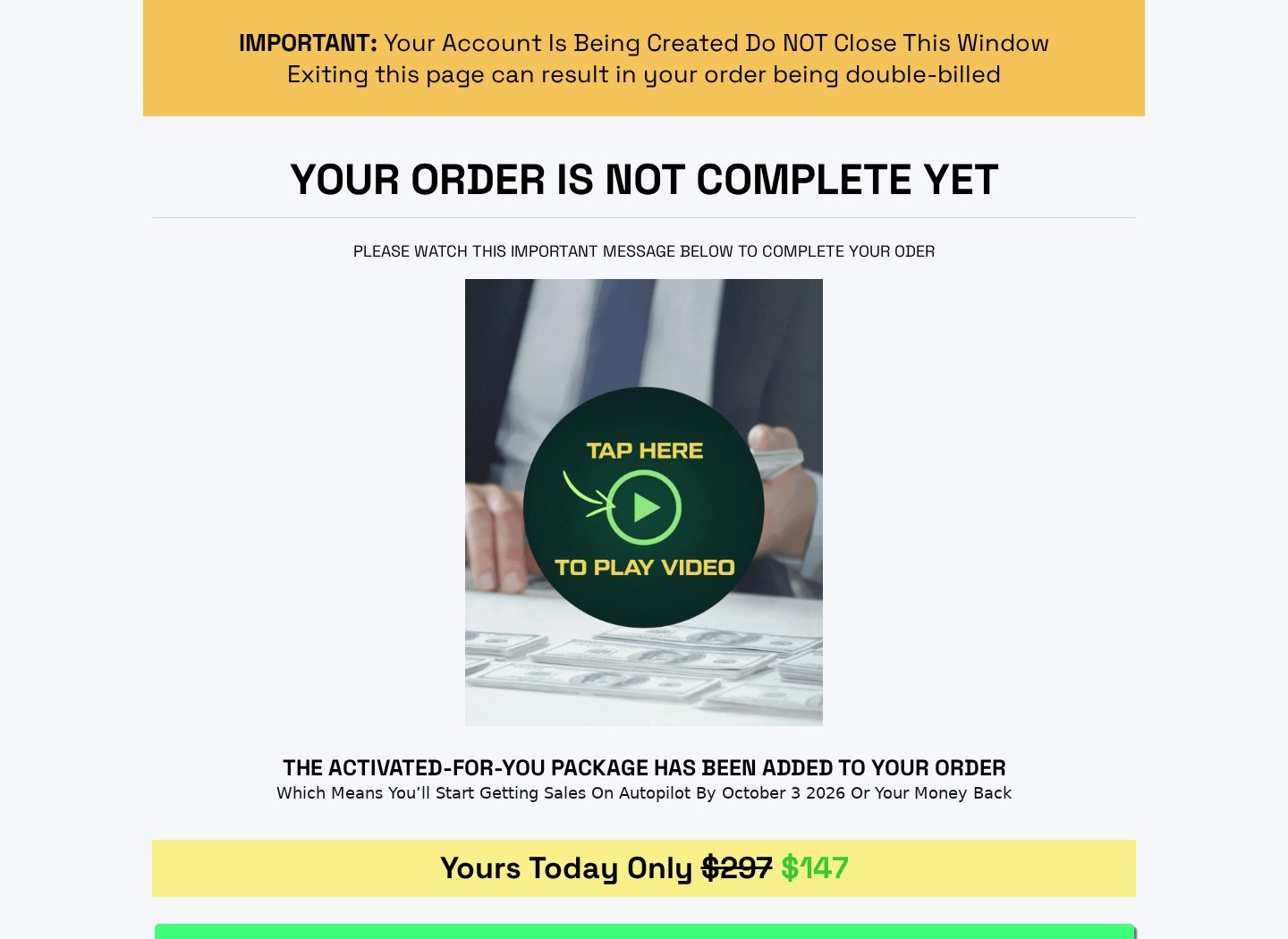
On that screen the headline says the order is not complete, and a banner warns the buyer not to close the window.
A package is then offered at $147, marked down from $297, and the banner says exiting the page can result in the order being double-billed.
The double-billing warning is the clever part, because it keeps a worried buyer on the page where the next offer is waiting.
We do not know whether Smart AI System uses the same screens, but reports mention charges buyers did not expect, so check every line of your statement.
Step 5: The pressure can move to chat and investing
The most serious risk is what may happen after the purchase: a push toward group chats and supposed investments.
In the pattern described, buyers are told their $100 has grown to $20,000 but cannot be withdrawn yet, and that $300 or $500 more will unlock it.
This is a pattern to expect from schemes of this kind, not a documented case, and we found no buyer account of it for this offer.
The FTC’s February 2026 alert on side hustles lists similar ingredients: fast cash for minimal work, pressure to act now and demands for money upfront.
Any invitation to send more money before you can withdraw earnings should end the conversation, however convincing the dashboard or the chat members look.
Who Sells Smart AI System, and Who Would Bill You?
The seller is not named in any source we could read
The offer has reportedly run through the JVZoo marketplace under names such as Aiguo Lin, which is the only seller detail in any report we found.
We could not verify it, and a name at checkout can be a vendor account, a front or a real person, so it identifies no one yet.
Our search covered dozens of queries, public scan records from the past 30 days and a check of obvious domain names, and none produced a Smart AI System site.
That absence proves nothing by itself, since offers we investigated earlier, such as AI Money Taps, changed names and domains while keeping the same promise.
A marketplace is not a guarantee
JVZoo’s terms say the purchase contract is solely between the customer and the vendor, and that each vendor sets its own refund policy.
The marketplace also says it does not guarantee refunds, and that the merchant of record can be a payment facilitator, JVZoo or the vendor, depending on the transaction.
Using a recognized marketplace therefore proves nothing about the offer: it tells you where the payment is processed, not whether the product works or the vendor pays refunds.
Charges and refunds must be traceable
JVZoo’s order lookup page says a charge can appear on a statement as JVZoo Marketplace, JVZoo or Jvz.
The same page lets buyers find an order with a one-time email link or an order number, and submit a refund request for purchases still inside the return period.
Its refunds page tells buyers to contact the selling company’s support, whose details are on the receipt, and states no deadline of its own.
The refund window is therefore whatever the vendor wrote, which is why the receipt and the original promise matter more than any later reassurance.
The product must be identifiable
We found no description of what a buyer receives beyond the name Smart AI System, and the reports do not say whether it is software, a course or a membership.
That matters because a refund claim or a card dispute works best when you can name the product, the seller and the promise that was broken.
Screenshot the sales page, the price, the guarantee text and the order confirmation before they change, because offers like this often change or disappear.
Five Questions to Ask Before Paying for Any Income Offer
The Smart AI System pitch, as reported, leaves the simplest tests unanswered, and the same tests work on the next offer with a different name.
-
Who pays me, and for what? A real income has a customer, a service and a price, and a pitch that skips all three is selling the dream instead.
-
What does a typical buyer earn? Look for the period measured and the share of buyers who reached the claimed level, which the FTC’s rule asks sellers to state.
-
Who is the legal seller? Find a company name, an address and a support contact on the checkout and the policy pages before entering a card number.
-
What is the full price? Ask what the upgrades cost and whether the advertised result is available without them, because the first payment is rarely the last.
-
Can I check the face? A named expert with a license or a track record can be verified, while a presenter with only a first name and a background cannot.
What to Do If You Paid for Smart AI System
-
Save the evidence. Keep the order email, receipt and statement line, and screenshot the page or ad if you can still open it, including the web address.
-
Ask for the refund in writing. Use the seller’s support contact on the receipt or the JVZoo order lookup, and keep copies of every message and reply.
-
Check the statement for other charges. Look for JVZoo Marketplace, JVZoo or Jvz, and for anything you did not agree to.
If a charge looks wrong, ask your card issuer about a dispute, since a dispute letter must reach the issuer within 60 days of the first bill with the error.
-
Refuse every request for more money. Nobody legitimate asks you to pay to unlock earnings or withdrawals, and pressure to act now is one of the FTC’s warning signs.
-
Report it. File at ReportFraud.ftc.gov and with the FBI’s IC3, listing the website, dates, amounts and anything known about the seller.
Report the ad as well, using the report option in the menu of the ad on the platform where you saw it.
-
Ignore recovery offers. Anyone who contacts you promising to get your money back for a fee is the next scam, so keep dealing only with your bank and the seller.
Frequently Asked Questions
Is Smart AI System a scam?
We could not open its page, so we cannot say what a buyer receives, only what the promotion claims and what it leaves out.
A $67 payment for a trick that earns money immediately, with no stated source of income, matches the warning signs the FTC lists, so we advise against paying.
Is Jason Cooper a real endorser?
That is unverified: the footage is reportedly from a paid role in Mobile Profits and was altered by AI, but we have not seen it.
Trustpilot reviews of the Mobile Profits site name another presenter, so the link between that site and this name remains unproven.
Can I get my $67 back?
Possibly, but the vendor decides: JVZoo says each vendor sets its refund policy, so start with the seller’s support contact on your receipt, then the order lookup page.
If that stalls, ask your card issuer about a dispute within 60 days of the first bill that shows the charge.
Can connecting my Wi-Fi to an app really earn money?
Only through arrangements like bandwidth-sharing apps, which sell your traffic to businesses, carry documented risks and pay out only from a $20 minimum.
Does using JVZoo mean the offer is legitimate?
No, because the marketplace says the contract is between buyer and vendor and that it does not guarantee refunds, so the platform’s name says nothing about the product.
Why can’t I find the Smart AI System website?
We could not find it either, after dozens of searches, a look at public scan records and a check of obvious domain names.
Similar offers change names and domains, as AI Money Taps did.
A screenshot with the web address from someone who saw the ad would let us verify the rest.
The Bottom Line
Do not pay $67 for the Smart AI System trick: the reported pitch names no source of income, and the spokesperson may be a recycled, AI-altered face.
We could not verify the page, so treat the campaign details as reports and the screens here as an example of a sister funnel’s upsells.
If you already paid, request a refund in writing, watch your statement for unexpected charges, refuse any request for more money and report it to the FTC and IC3.

Join the discussion
0 commentsShare your experience or ask a question about this article.
Discussion
Start the conversation
Have a question or something useful to share? Add the first comment.