


The trader you follow keeps posting gains, and now there is a way to invest alongside him. His shared account seems like the natural next step.
Before sending money, look beyond the updates in the group. The Kenneth Thom case shows how reassuring posts can conceal a very different account history.
Overview
Followers became clients of a shared trading account
Kenneth Thom, known online as K$ and K Money, built a following through Facebook, Instagram and Twitch, selling trading lessons and daily text alerts.
Beginning in late 2023, he invited Facebook group members into shared accounts he would manage for half the trading profits. Dozens of clients contributed nearly $800,000.
The DOJ’s sentencing announcement describes what followed: personal spending, major trading losses and performance updates that falsely suggested dramatic gains.
Thom received two years in prison for investment adviser fraud in August 2026. His case involved deliberate deception, rather than simply an unsuccessful trading strategy.
Less than half the money reached trading accounts
Of the nearly $800,000 raised, Thom invested approximately $350,000. Most of the remainder was diverted to personal uses, including travel, dining and luxury goods.
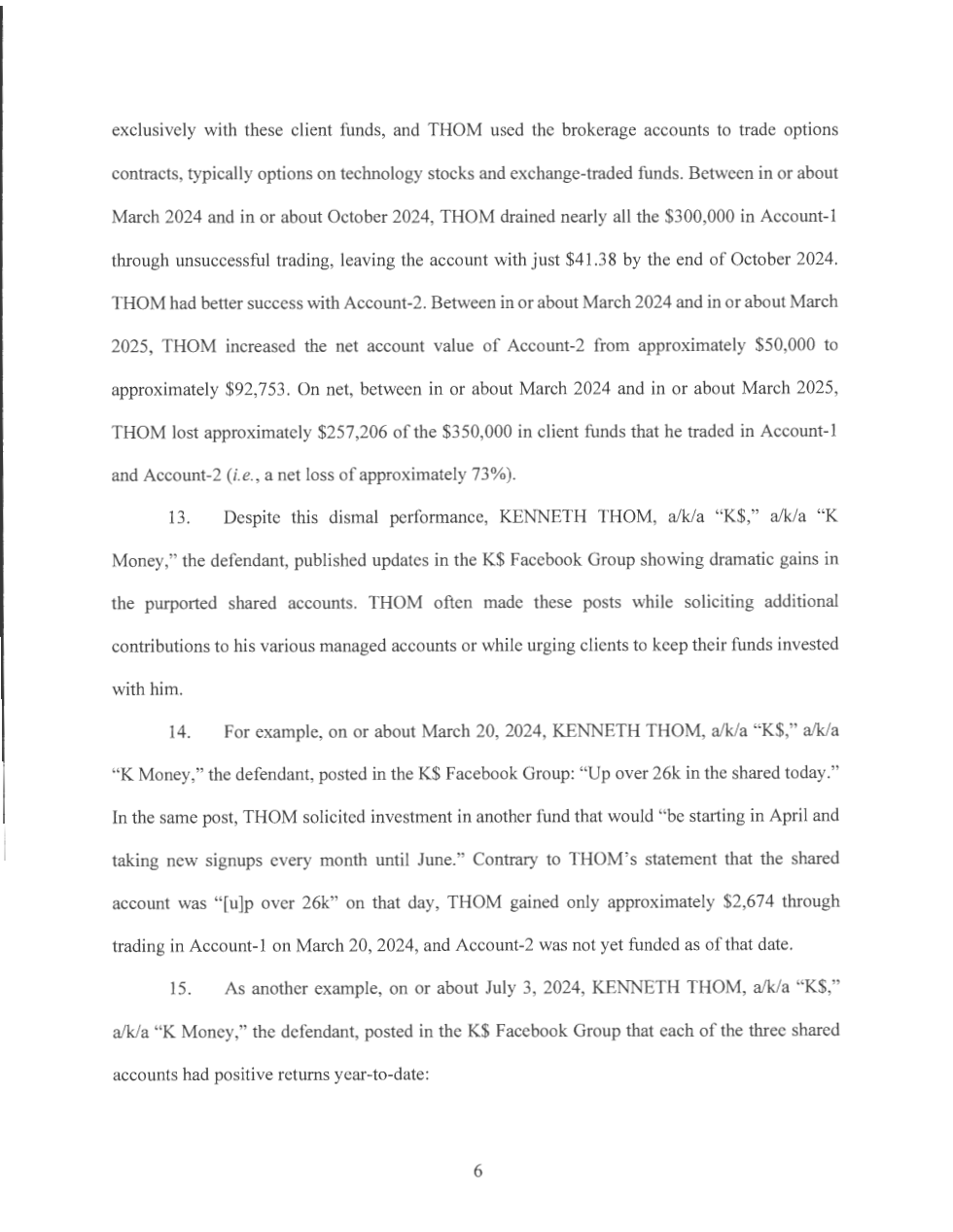
The money he actually invested also performed badly. Prosecutors said he lost approximately 73% between March 2024 and March 2025 while publishing misleadingly positive updates.
Forfeiture and restitution were each ordered at $724,756.09. Those are separate legal obligations, not two amounts to add together as a new measure of investor losses.
The post and the independent records told different stories
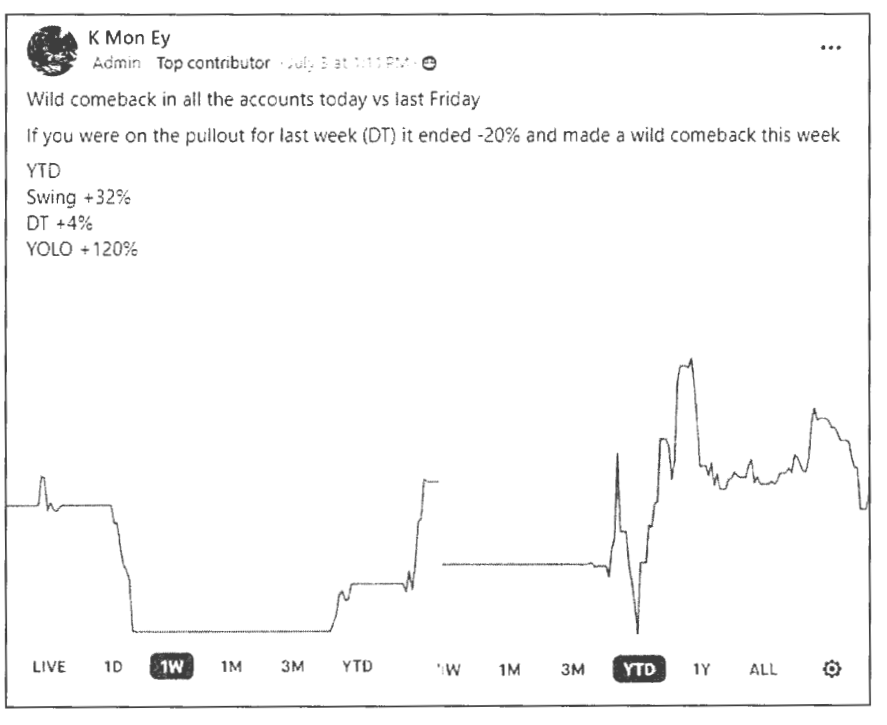
The lead reproduces an actual Facebook post included in the original federal indictment. It is documentary evidence from that earlier case stage, not a current Facebook capture.
The original charges were followed by Thom’s guilty plea and prison sentence. The document’s account of his posts helps explain the deception confirmed by the later outcome.
- A social following established familiarity without establishing custody of anyone’s investments.
- Payments to the trader were different from deposits into independently verifiable client accounts.
- Claimed gains in a group did not match the underlying trading records.
- A promised profit split did not ensure that contributions would be invested as described.
Why Trading Lessons Made the Investment Invitation Feel Familiar
A person can spend months watching someone discuss trades before ever considering sending them money. The lessons create familiarity with the speaker’s vocabulary, confidence and public identity.
That familiarity can make a new arrangement seem smaller than it is. Buying educational content and entrusting someone with investment funds are materially different decisions.
Buying information differs from giving someone control of your capital. The latter depends on the recipient’s authority and independent records establishing your interest.
Thom’s invitation crossed that boundary when followers joined shared accounts he would manage. A history of watching him online did not answer those financial questions.
Nor did the proposed profit split answer them. An agreement to take half the gains says little about whether money is invested, how losses are reported or withdrawals handled.
In this case, investors were deprived of accurate information at both stages. Much of the money never reached trading accounts, and the performance of invested funds was misrepresented.
The warning is therefore more specific than avoiding risky trades. Check the person, the arrangement and the actual custody of funds before accepting a familiar creator’s invitation.
How the K Money Shared Account Scam Works
Step 1: An online trading identity attracts followers
After a 2011 FINRA suspension, Thom promoted himself as a successful Wall Street trader. His courses and trade suggestions circulated through several social platforms.
The criminal account ties that public identity to his later solicitation of client money. It does not accuse Facebook, Instagram or Twitch of managing the investment scheme.
A professional-sounding biography should be checked independently. Someone’s past work in finance does not establish their current registration, permissions or ability to handle your funds.
Step 2: Followers are invited to contribute capital
Thom offered shared accounts managed in exchange for half the profits. The original indictment describes Facebook solicitations and different proposed trading arrangements.
The invitation moved the relationship from following trade ideas to transferring funds. Clients needed to understand the actual legal arrangement, not just its advertised split.
Ask whose account receives the payment and how your interest will be recorded. If the answer depends entirely on the promoter’s own messages, important questions remain unresolved.
Step 3: Contributions are diverted before trading
Prosecutors said only approximately $350,000 of the nearly $800,000 raised was invested. Personal spending consumed much of the remaining money.
That diversion is distinct from a market loss. Money spent on the manager’s lifestyle cannot be explained away as an unfavorable move in the securities being traded.
Keep the original payment destination when documenting a loss. A later screenshot of an account cannot establish what happened to every contribution that preceded it.
Step 4: Positive posts conceal actual losses
Thom published updates suggesting substantial gains despite serious losses in the money he traded. Those reports gave clients a misleading picture of their position.
An investor deciding whether to stay or add funds needs accurate performance information. False updates can distort both decisions even when some genuine trading took place.
Do not assume that a chart proves all the money is present. It must be connected to the actual accounts, period, contributions and withdrawals it claims to represent.
Step 5: Withdrawal problems and a renamed group follow
The indictment describes withdrawal obstacles and explanations for not responding. In January 2025, the Facebook group was renamed AYBABTU and Thom stopped answering clients.
The sentencing announcement also records that name change. For someone reconstructing the history, an old group name and a new one can belong in the same evidence file.
Preserve the connection rather than assuming that a renamed group represents a different operator. Keep messages and identifiers already available without trying to regain entry through strangers.
What the Facebook Post Left Out
The July 2024 post reproduced in the indictment claimed positive year-to-date results across three arrangements: Swing, DT and YOLO. The figures suggested gains in every category.
The accompanying court account described an overall loss of approximately 31% on the money traded by the end of the preceding trading day.
Those records help explain why an impressive post should not substitute for account statements. A graph can be genuine-looking while its accompanying claims misrepresent the client’s position.
Another example in the indictment concerned a March 2024 claim of being up more than $26,000. The described actual gain that day was approximately $2,674.
The document also states that a second account had not yet been funded then. Different account names could therefore create an impression that the underlying records did not support.
Check the Adviser and the Account Separately
The SEC’s Investor.gov guidance explains what FINRA BrokerCheck can show about an individual broker’s qualifications, employment, registration and disciplinary history.
Open BrokerCheck independently and search using the person’s legal name or registration number. Use identity and employment details to distinguish people with similar names.
Read the registration and disclosure information rather than stopping at a matching search result. If the identity or authority is unclear, ask the relevant regulator before transferring money.
A person’s registration history does not verify an advertised return or authenticate a particular bank destination. Those require separate checks of the actual arrangement.
Ask which institution holds the assets and whether it can provide records directly to you. Contact that institution through independently established details rather than the promoter’s supplied substitute.
Do not provide a password to help someone prove an investment exists. You should not have to surrender control of an unrelated account to verify the recipient of your money.
The historical suspension in this case comes from the criminal sources. A current search is for checking present information, not assuming a past status describes every later date.
What to Do if You Have Fallen Victim to This Scam
-
Stop sending contributions or additional charges connected to the shared-account offer. Save the investment invitation, profit-sharing promises and any account or payment instructions you received.
Preserve posts you can already access, including dates and group names. Do not delete the only copy because a new group or administrator promises better information.
-
Make a record of the money you actually transferred, any money returned and the dates. Keep displayed profits separate from those real transactions.
A claimed gain is evidence of what you were told, not another deposit to add to your loss. Give investigators the original figures without inventing missing entries.
-
Contact the sending bank or payment provider through its verified contact route. Explain the investment fraud and ask whether any pending transfer can be stopped or recalled.
Supply the transaction reference, recipient name, amount and date. Describe accurately whether you approved the payment after deception or discovered a separate unauthorized transaction.
-
If a genuine institution holds assets in your own name, contact it independently and request your actual account status. Keep its statements and written response together.
Ask what action it can take concerning the authority granted to another person. Do not liquidate positions or change another owner’s access without understanding the consequences.
-
Report the online solicitation through FBI IC3. Choose File A Complaint, read and accept the displayed terms, then complete the contact, transaction and loss information.
Include the aliases, group names and payment recipients shown in your records. Retain your submission details and any reference supplied for follow-up.
-
If your records relate to this prosecution, contact the Southern District of New York’s Victim and Witness Services at 1-866-874-8900.
Identify Kenneth Thom and ask which case or restitution process applies. A court order does not establish that a particular refund has already been distributed.
-
Refuse unsolicited offers to recover the investment in exchange for another payment. Check any supposed official role with the actual agency through independently obtained details.
A stranger who knows the group name may still be targeting victims again. Do not share identity documents or financial access merely to obtain a promised refund.
A Real Trade Does Not Explain Missing Contributions
Some of Thom’s client money was genuinely traded. That detail matters because a scheme need not be entirely imaginary to involve fraud.
An operator may point to real trades to avoid questions about money that never reached the accounts. Those trades cannot account for funds diverted elsewhere.
The same distinction applies to losses. Market performance should be evaluated using accurate records, while misuse of contributions requires its own explanation.
For clients, keep these questions separate: how much was received, how much was invested, what happened to the invested amount, and what was returned?
That approach prevents a broad claim about poor markets from swallowing the more basic question of where the original money went.
Frequently Asked Questions
Is the K Money case confirmed fraud?
Yes, Kenneth Thom pleaded guilty to investment adviser fraud and received a two-year prison sentence. The case established deception beyond ordinary disappointing trading results.
The sources describe misappropriated contributions and false performance updates. A bad investment alone would not establish those additional facts.
Was every contribution actually invested?
Prosecutors said Thom raised nearly $800,000 but invested approximately $350,000. Much of the remaining money was diverted for personal uses.
Those figures are different from the trading loss on the invested portion. Keep both parts of the conduct in view when understanding the scheme.
Is the Facebook image an AI reconstruction?
The lead is extracted from the actual federal indictment, which reproduced the performance post. The second image is another original page from the same document.
They are historical case materials, not current live Facebook screenshots. The later guilty plea and sentence establish the criminal outcome separately from the original charging document.
Does a 50% profit split make the manager trustworthy?
A profit-sharing arrangement does not independently establish the manager’s identity, authority, custody of funds or reporting accuracy. Those questions still need concrete answers.
In Thom’s case, the promised split did not prevent diversion and false performance claims. Do not treat payment terms as proof that assets exist.
What did the AYBABTU name change mean?
The sources record that Thom renamed the Facebook group AYBABTU in January 2025 and stopped responding to clients. Preserve both names if documenting that history.
The name change itself is not what proves the fraud. It belongs within the wider record of solicitation, money movement and misleading updates.
Does the restitution order guarantee repayment?
The court ordered $724,756.09 in restitution, but that order does not prove every victim has received funds. A distribution depends on the actual recovery process.
Follow verified case communications and keep your payment records. Do not pay someone who says another charge will unlock your portion.
The Bottom Line
Do not send money into Thom’s documented shared-account scheme or rely on social posts as proof of investment performance. The case established diversion and misleading reports.
If you already paid, preserve contributions and updates separately, contact the sending institution promptly, and report the online fraud through official channels.
For any future manager, verify both the person and the custody of your assets. A familiar online voice cannot replace independently obtainable account records.

Join the discussion
0 commentsShare your experience or ask a question about this article.
Community experiences
Did this happen to you?
Your experience could help someone recognize the same scam. Submit a private report for our team to review.
I experienced this tooReports are reviewed before publication. Sharing publicly is always your choice.
Discussion
Start the conversation
Have a question or something useful to share? Add the first comment.