


The mentor seems to have built the life you want, and his classes promise to explain how. An invitation to invest together can feel like getting closer to that success.
Before trusting the invitation, separate the public image from the business receiving your money. The Wealth Flow case shows how carefully those two things can be confused.
Overview
A successful-looking mentor sold a false real estate story
Joseph James Nantomah promoted himself as The Black Mentor, using an online persona, classes and Wealth Flow conferences to attract people seeking financial success.
The Justice Department’s sentencing announcement describes how that following became a source of real estate investors whose money was stolen.
Nantomah claimed a successful real estate enterprise and promised significant returns. In reality, prosecutors said he lacked the legitimate business and knowledge behind those claims.
The Wealth Flow scam therefore involved more than a course that failed to impress. The criminal case established false investment claims and diversion of investor funds.
At least 39 victims lost more than $2.7 million
The court account puts the stolen amount at $2,762,798.37 between May 2020 and December 2024. Victims were located across the United States and abroad.
Nantomah primarily targeted Nigerian immigrants and people from his church. Shared background and personal trust helped make the promised opportunity feel accessible and credible.
He received 48 months in prison in September 2026 and was ordered to pay $2,762,798.37 in restitution, followed by three years of supervised release.
Those are confirmed criminal findings, rather than accusations based only on social media complaints or a dissatisfied buyer’s account of a class.
The image of success was being financed by victims
Prosecutors described spending on luxury travel, cars, jewelry and a yacht. Nantomah also used victim funds to cultivate the persona that attracted more trust.
- Classes and conferences introduced the apparent expertise before investment requests followed.
- Claims of real estate success supplied the reason to trust him with capital.
- Shared community ties made the operator feel more familiar than an unknown salesperson.
- Investor funds supported personal spending and promotion instead of the promised real estate business.
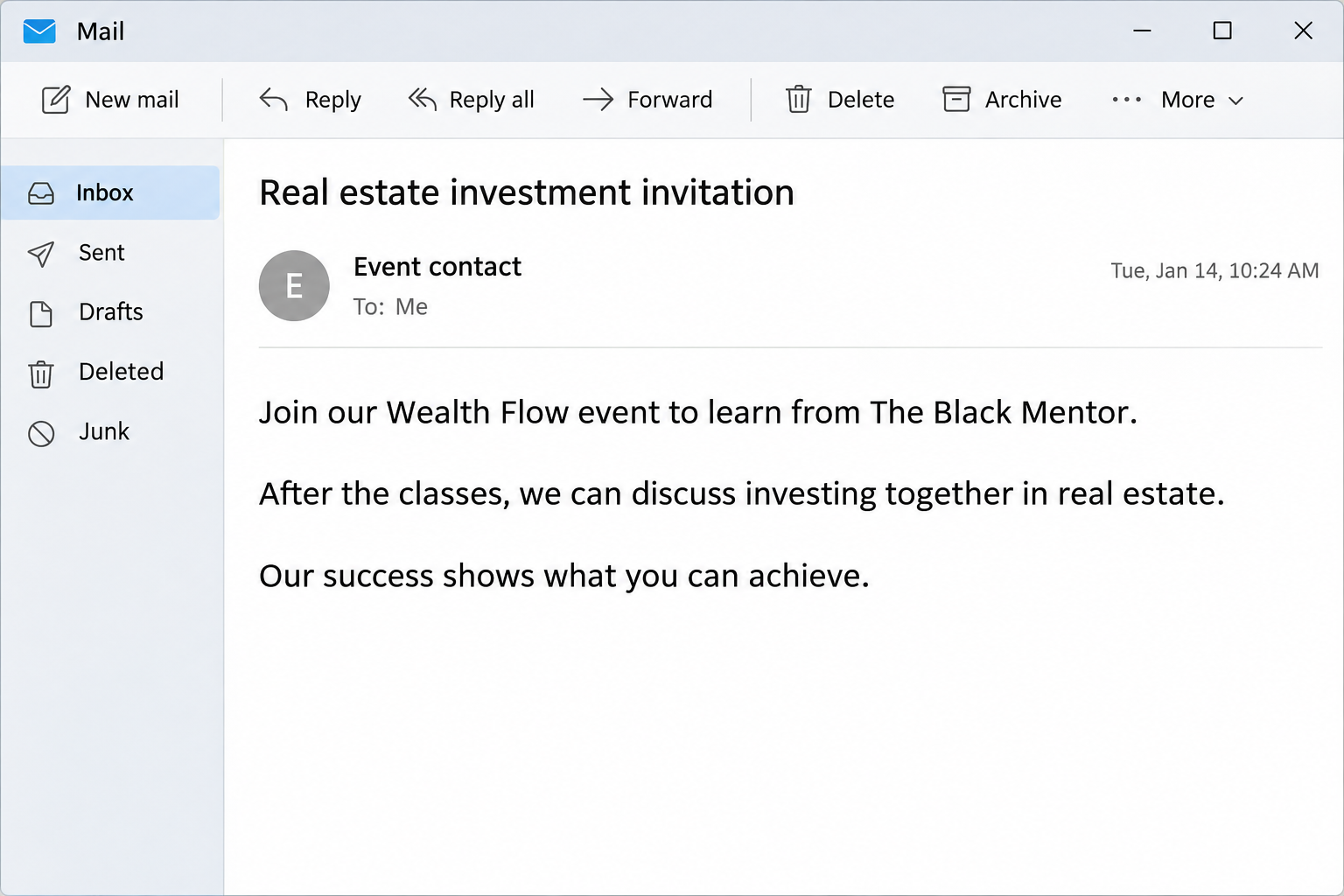
The email image reconstructs an investment invitation using fictional wording. It illustrates the class-to-investment approach without claiming to reproduce an original Nantomah message.
Why a Mentor Can Feel Safer Than an Unknown Promoter
A mentor offers more than a financial claim. They can appear to understand the problems you face and present their own success as a route you could follow.
For someone building a life in a new country, that can be particularly persuasive. A shared history may make the person seem easier to assess and more accountable.
Nantomah used those connections while presenting himself as someone who had already mastered the opportunity. The official account specifically describes working-class immigrants being harmed.
That detail helps explain the trust involved. The victims were not simply gambling spare money on a stranger; many risked savings their families depended on.
A course or conference can deepen that relationship. Attendees see other people listening, paying attention and treating the speaker as someone worth learning from.
But attendance does not independently establish a profitable business. A room full of interested people may reflect the strength of the presentation rather than completed investments.
Before the relationship turns into a transfer, check what you would actually acquire and who can verify it. Familiarity can help a conversation, but it cannot document assets.
How the Wealth Flow Scam Works
Step 1: A public identity promises a route to success
Nantomah cultivated a false online persona claiming that he had built a substantial real estate enterprise. The Black Mentor identity gave that story a recognizable name.
The apparent achievement came before the investment request. People were being introduced to someone they could admire and learn from, rather than immediately being asked for capital.
That order matters because the first impression can influence later financial decisions. A polished biography can become an unexamined assumption about the operator’s actual business.
Step 2: Classes and conferences create a closer relationship
Through conferences and paid classes, Nantomah purported to share knowledge about building success in the United States. The sessions placed him in a position of apparent expertise.
Students could then feel that they understood the person offering the investment. Participation made the later proposal seem like an extension of an existing relationship.
Keep educational purchases separate from financial decisions. Paying for a lesson does not establish that the teacher has authority, assets or a genuine investment business.
Step 3: Students are invited to invest in real estate
Nantomah used the classes to persuade students to place money into his supposed real estate business. He promised significant returns from the opportunity.
The court account describes a purchase, repair and resale story. Investors believed their money would support real estate activity that could generate those returns.
Before accepting a comparable offer, require a clear explanation of the actual transaction and your interest in it. A general success story cannot identify what your payment buys.
Step 4: Money supports the lifestyle and the promotion
Instead of conducting the promised legitimate business, Nantomah spent most of the victims’ funds on his lifestyle. The public image was therefore connected to the stolen money.
Prosecutors described private jets, luxury vehicles, expensive jewelry and a yacht. Those were documented uses of funds, rather than conclusions drawn simply from glamorous online photographs.
The same money also supported activities that strengthened his apparent credibility. That created a damaging loop: investor contributions helped finance the image used to attract trust.
Step 5: Shared trust leaves families exposed to the loss
The scheme continued over several years and affected at least 39 victims. Working-class families described serious harm from losing money they had saved.
Trust in a person or community can make questioning an investment feel socially difficult. It can also make people reluctant to discuss a loss after recognizing the deception.
If you are in that position, focus on protecting the remaining money and preserving records. You do not need to resolve the personal relationship before contacting your bank.
Joseph Nantomah, Wealth Flow and the Business Being Sold
The operator’s identity was central to the offer
The criminal announcement identifies Joseph James Nantomah as the person behind The Black Mentor persona and Wealth Flow conferences. His claimed achievements helped sell the investment story.
Keep his identity attached to this documented case. A similar event name, shared nationality or unrelated person offering financial education does not establish involvement in his conduct.
The real estate claim needed an actual business underneath
The central promise was that investor money would be used in a successful real estate operation. Prosecutors said the legitimate business and expertise being advertised did not exist.
For a prospective investor, ask what specific transaction the funds support, who owns the relevant assets and how your legal interest will be recorded.
Honorary titles were part of the cultivated image
DOJ described spending victim funds on honorary doctorate degrees for Nantomah and his wife. That expense formed part of maintaining the impressive public persona.
An honorary title cannot document a property’s ownership or explain an investment’s cash flow. Evaluate those claims using records relevant to the transaction itself.
Celebrity attendance did not verify the investment
The sentencing account says Nantomah paid celebrities to attend his conferences. Their presence helped support the appearance of a successful and well-connected mentor.
That fact does not establish that attendees knew about the fraud or managed investor money. Responsibility should follow the documented conduct, rather than proximity to an event.
Questions That Separate the Presentation From the Investment
Start with the asset and the agreement. Ask what property or venture your money funds, what you would own, and which entity is responsible for returning funds.
Then ask where the money will be held. A payment receipt can establish that you sent funds without establishing that the promised property or investment was acquired.
Require the proposed terms in writing, including expenses, risks, decision-making authority and withdrawal conditions. Do not let a confident conversation replace the agreement you would actually enter.
For property-specific claims, have an independent qualified local professional review the supporting records and your proposed interest. A photograph or address alone does not answer the ownership question.
Check any claimed financial registration through the appropriate regulator. Ask which registration applies to the person and activity, rather than accepting a decorative certificate as a universal license.
When someone presents themselves as a broker, Investor.gov explains how BrokerCheck can help verify registration history and disclosures.
Use the person’s legal name or registration number in FINRA BrokerCheck, then compare the identity, employment and disclosure details with the person seeking your money.
A matching record still does not guarantee a particular investment. If the role or identity does not fit, stop and contact the relevant regulator through its official route.
What to Do if You Have Fallen Victim to This Scam
-
Stop further contributions to the documented investment offer. Preserve the invitation, course or conference information, investment agreement, payment instructions and promised purpose of the funds.
Keep material you already possess without confronting other attendees or trying to collect their private records. Each person can preserve and report their own experience.
-
Prepare a payment timeline showing each contribution, recipient, date and reference. Record money returned separately from amounts that were merely promised.
If a payment covered a class rather than an investment, label it accurately. Do not assume every educational customer was also an investor in the criminal scheme.
-
Contact the bank or service used to send the investment through its verified contact details. Explain the fraudulent solicitation and ask whether any transfer can be stopped or recalled.
Give the exact recipient and transaction records. Ask for the case number, required evidence and deadlines rather than waiting for the promoter’s next explanation.
-
Report the online solicitation at FBI IC3. Select File A Complaint, review and accept the terms, then enter the contact, payment and loss information.
Include the relevant aliases and event names from your own records. Save the information submitted and any reference provided for later contact with investigators.
-
If your loss relates to this prosecution, contact the Eastern District of Wisconsin’s Victim Witness Unit at 1-800-680-8949. Identify Joseph Nantomah and your investment.
Ask what victim-assistance or restitution process applies and which documents are needed. The restitution order does not itself prove that your money has already been recovered.
-
Have an independent adviser review any agreement affecting property, retirement funds or an existing loan. Keep its deadlines visible while the fraud report is being handled.
A criminal investigation and a separate financial obligation may move on different schedules. Do not stop an existing repayment solely on an unfamiliar caller’s advice.
-
Tell someone you trust if shame or community pressure is keeping you from seeking help. Practical assistance can make it easier to assemble records and contact the bank.
Reject demands for new fees to recover the first payment. Verify anyone claiming to represent investigators through an independently obtained agency contact.
Helping Another Attendee Without Spreading the Risk
If a friend introduced you to an event, they may also have believed the presentation. Preserve what each person actually knew instead of assuming every referral was knowingly deceptive.
Share verified case information privately and give people room to check their own records. Publicly posting transfer receipts or identity documents can expose them to further targeting.
Avoid promising that everyone will recover the same amount through one process. Individual payments, agreements and the funds available for restitution can differ.
If someone is still considering a transfer, offer to review the specific property and recipient with them. A concrete check is often more useful than arguing about a speaker’s popularity.
Frequently Asked Questions
Is the Wealth Flow case confirmed fraud?
Yes, Nantomah received a four-year prison sentence and a restitution order after the criminal case established his investment scheme. At least 39 victims lost more than $2.7 million.
The findings concern false business claims and stolen investment funds, rather than simply a disagreement about the value of a motivational class.
Who was The Black Mentor?
The DOJ announcement identifies Joseph James Nantomah as the person using that moniker. He cultivated an online image of success and used classes to attract real estate investors.
That public identity was part of the documented solicitation. It should not be confused with verified ownership of the assets people believed they were funding.
Did the investment money really buy real estate?
Prosecutors said Nantomah lacked the legitimate business and real estate knowledge he claimed and spent most victim funds on personal uses and cultivating his persona.
The case illustrates why the actual transaction matters. Before paying any similar offer, establish what asset or interest your contribution is supposed to acquire.
Were the celebrities at his conferences involved in the fraud?
The official account says Nantomah paid celebrities to attend. It does not establish that those people knew about the scheme or handled investor funds.
Attendance can make an event feel credible without verifying its financial claims. Keep the accusation attached to the operator and conduct established by the criminal case.
Does a trusted church or community connection make an offer safer?
Shared background can help people feel comfortable, but it does not establish the investment’s assets, terms or control of funds. Those details still require independent checks.
Nantomah targeted people who trusted him through cultural and church connections. The victims’ trust explains the mechanism without making their community responsible for his actions.
Does the restitution order mean victims have been repaid?
The court ordered $2,762,798.37 in restitution, but an order is different from proof of collection and distribution. Follow verified case communications about any actual process.
Do not pay an intermediary to release a supposed share. Contact the real investigating office if an unexpected caller claims to have recovered your money.
The Bottom Line
Do not invest through Nantomah’s documented Wealth Flow scheme or rely on the cultivated Black Mentor persona as proof of a real estate business.
If you already paid, preserve the investment and payment records, contact the sending institution promptly, and report the online solicitation through official channels.
For any comparable offer, verify the actual asset, operator and agreement before trusting the presentation. A successful-looking mentor still needs a business that can withstand independent scrutiny.

Join the discussion
0 commentsShare your experience or ask a question about this article.
Community experiences
Did this happen to you?
Your experience could help someone recognize the same scam. Submit a private report for our team to review.
I experienced this tooReports are reviewed before publication. Sharing publicly is always your choice.
Discussion
Start the conversation
Have a question or something useful to share? Add the first comment.